
Scouting Christos Tzolis
After his debut, a deep dive on Arsenal's new left-winger: his physical profile, dribbling, movement, passing, crossing, shooting, temperament, and how his game will translate
“Before you play two notes, learn how to play one note. And don’t play one note unless you’ve got a reason to play it.”
— Mark Hollis
Wikipedia tells me that trilobites are “among the most successful of all early animals, existing in oceans for almost 270 million years, with over 22,000 species having been described.” In 1972, a young scientist, Niles Eldredge, was studying their fossils while his colleague, Stephen Jay Gould, studied land snails.
At the time, the prevailing evolutionary theory broadly implied that species A becomes species B, and if we could only get our hands on every fossil ever created, we’d see that gradual trajectory. But Eldredge and Gould knew that their trilobites and snails didn’t change for enormous stretches of time, before changing fast.
Famed biologist Ernst Mayr had already figured that new species don’t always arise from big, comfortable populations in the middle, but from smaller groups on the fringes, where circumstances are unique, and change can happen more rapidly. The strange byproduct is that the actual moment of a big change is the very thing least likely to be preserved and studied. So we are left with a tidy before-and-after, and when we fill in the middle, we naturally assume it to be a story of smooth, gradual … evolution.
Eldredge and Gould offered a balance to all this “gradualism,” implying that change can look more like a staircase than an arrow, and reinforcing how much there is to learn from the periods where nothing seemingly happens. They called it punctuated equilibrium, and even had a motto: “stasis is data.”
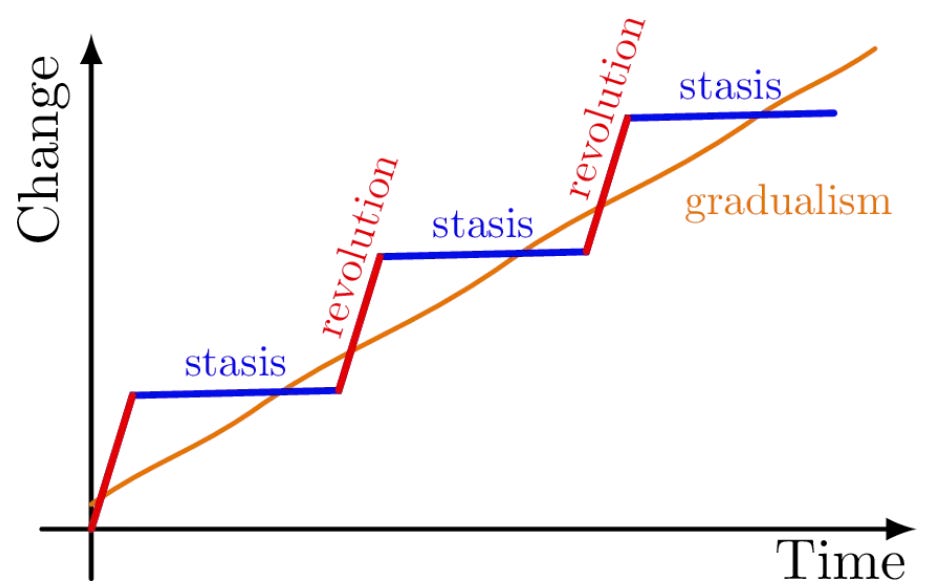
For Christos Tzolis, the trajectory was upwards until it wasn’t.
He made waves at the Lennart Johansson Cup as a 13-year-old, scoring 11 goals in five games. At one point, his team was invited to Barcelona and beat them 2-1, with a few scouts in the crowd taking notice of Tzolis, though nothing came to fruition. By the time he reached PAOK’s U17s, it was 29 more goals in 25 games.
He was then handed his first start for the senior side at eighteen, and in 2020/21 logged 16 goals and 10 assists across competitions, including 3 in the Europa, and was named the club’s player of the season; I just watched highlights of a Champions League qualifier he played against Besiktas in which he had two goals and an assist in 30 minutes, playing alongside Chuba Akpom. Norwich City came a-calling, where he is still the club’s joint-record signing. He started his tenure with style, with two goals and two assists on debut for the Canaries, before a first league start at, ahem, the Emirates.
What followed was the flat part of the story, his time in the small ponds. He was in the “peripheral isolate,” to borrow a phrase from Mayr. He only got a handful of Premier League minutes with Norwich City, then a loan to FC Twente. He logged all of 11 senior-level league starts across two seasons, accumulating ~1,000 minutes and two goals. “What can I say about it? Just look at my playing minutes,” Tzolis recounted to Goal.com. “I have to laugh about it now.” If he was changing, it wasn’t in the data.
But stasis was data, and in a flash, he reemerged for Fortuna Düsseldorf in the German second tier, an evolved species, fully formed, brimming with swagger and joint-leading the league in goals. Supporters set up a crowdfunding page with the hopes of helping trigger his buy option, but it was no use, as he was off to Bruges.
In the following two seasons, he’d start nearly every game, winning the league, earning the player of the year, and making his Champions League debut. He collected a total of 126 goal contributions in the three years following his time in the wilderness. The likes of Crystal Palace came calling with ambitious bids, but he awaited a call from the English champions, a phrase which still feels lovely to type. He is now an Arsenal player.
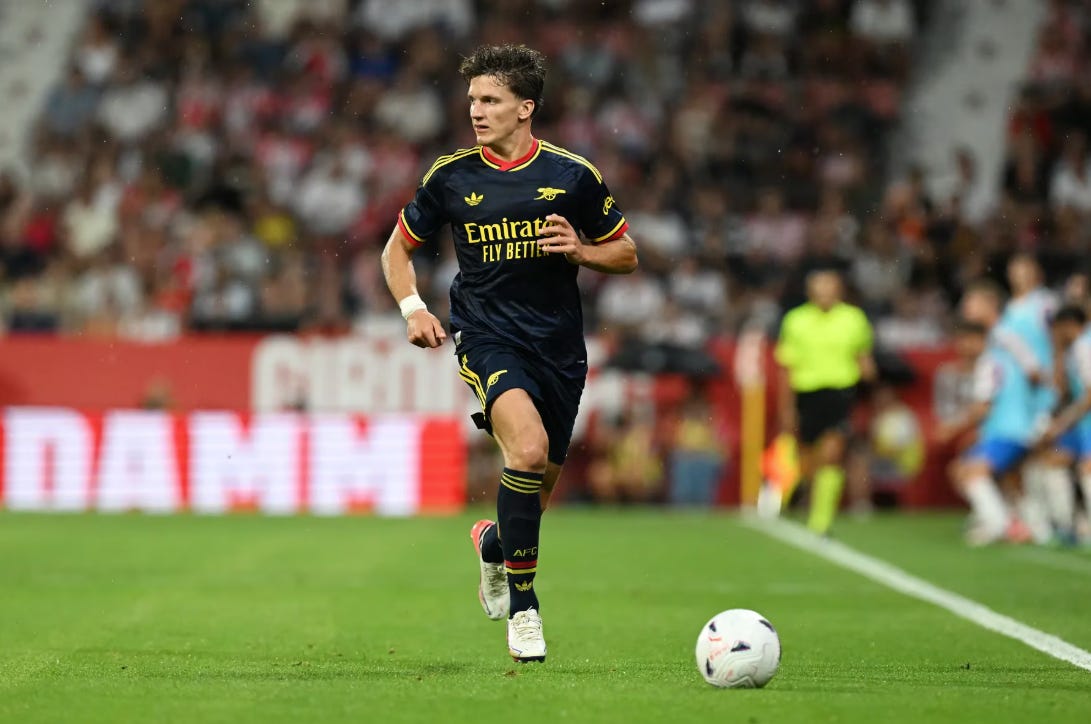
Tzolis made a grand entrance in a beautiful kit on Saturday, starting at left-wing in the friendly against Girona, and providing ample reason for optimism amongst the fanbase. In doing so, he showcased some of the skills he’s been employing every week in Belgium.
He started with some associative work in the normal patterns. He’d carry at the block and probe for openings, then pass-and-move while testing blindspots.
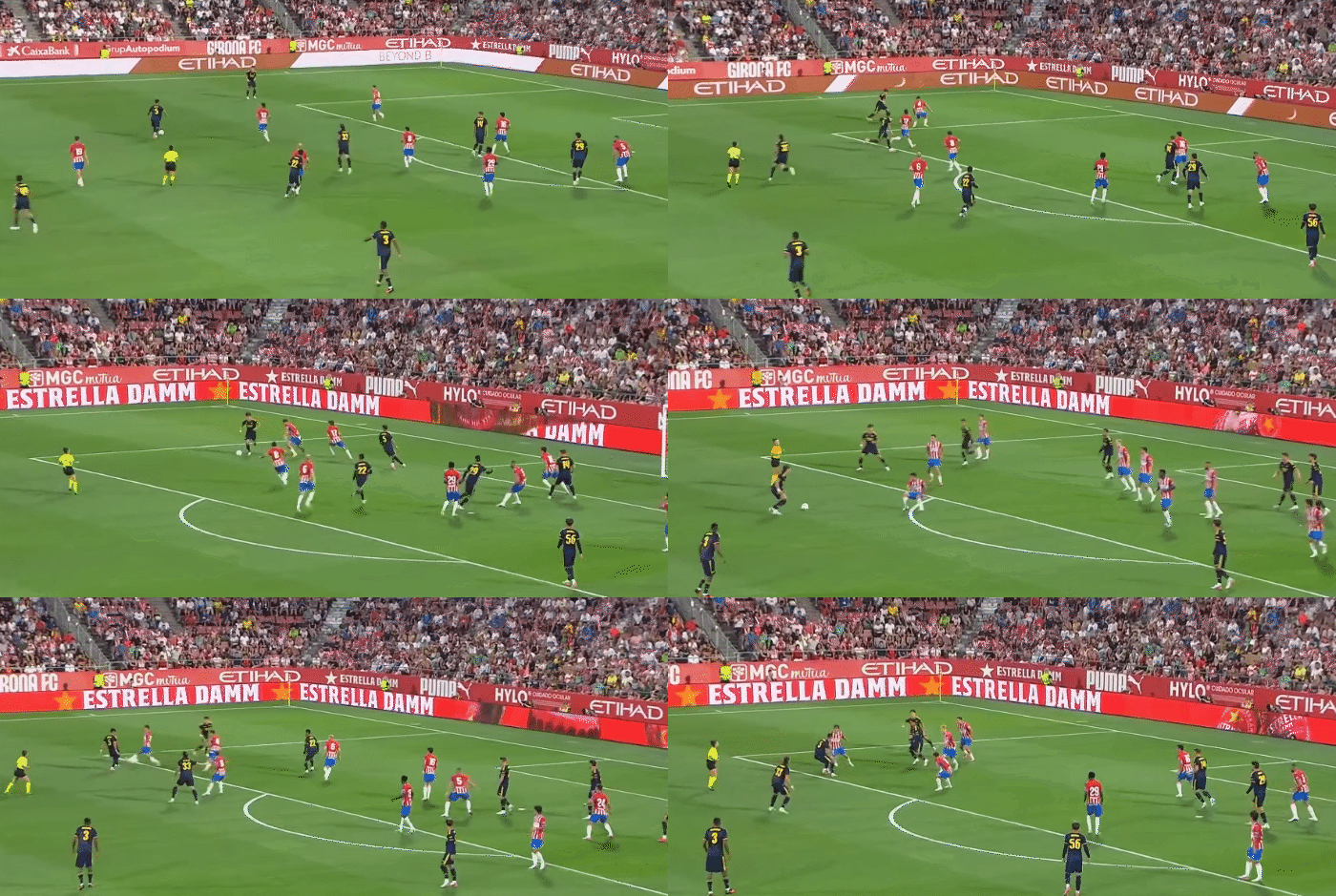
Crucially, though, that move just kept going. It was teeming with pace and passes, in no small part thanks to him. He continued going until Calafiori found him, lost in the half-space for a cutback and a chance.
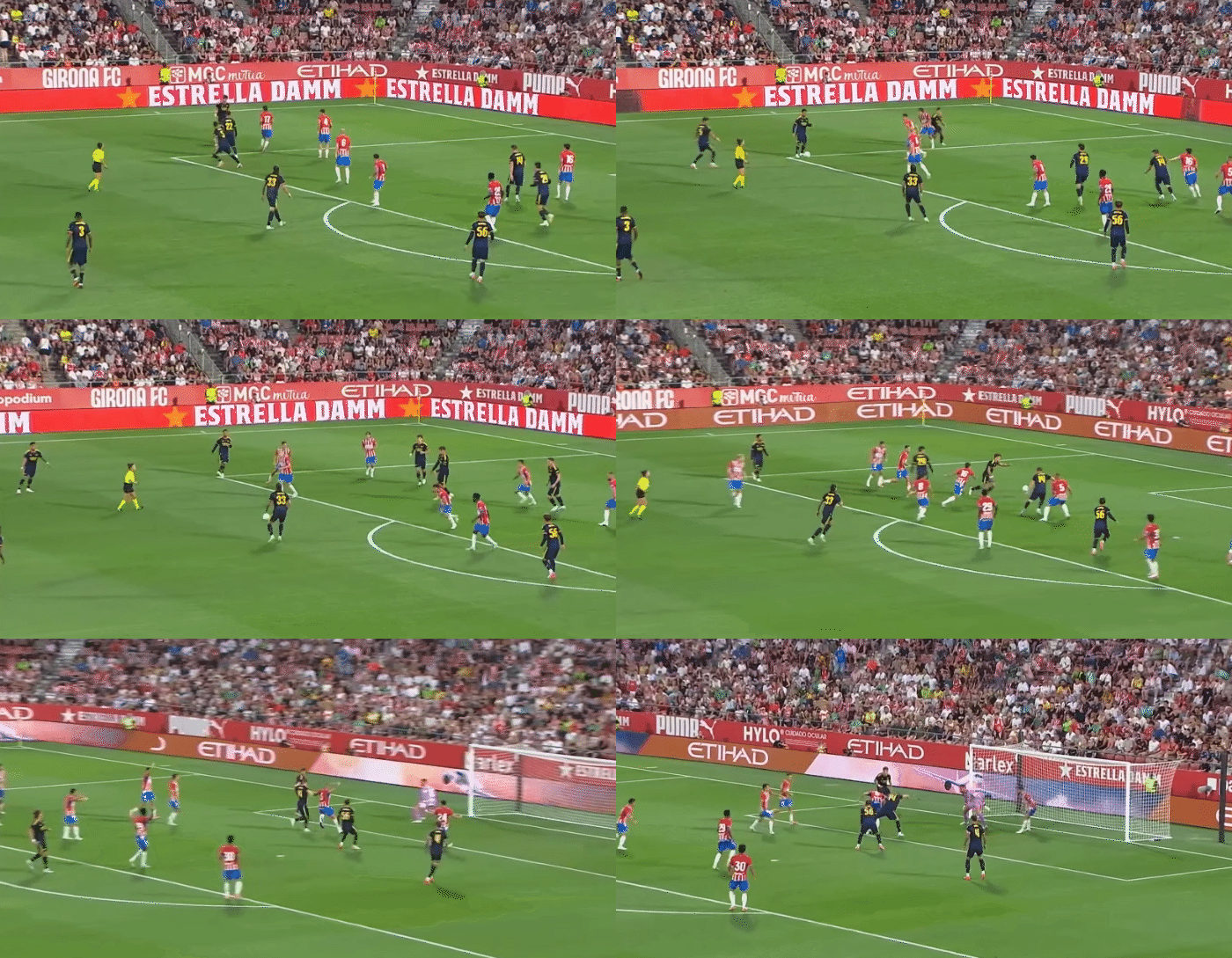
A few minutes later, Calafiori was the free man as the Girona shape was broken, and Tzolis didn’t wait for them to regroup. He drove right at them, cut in, and hammered home one of those leaning, powerful shots.
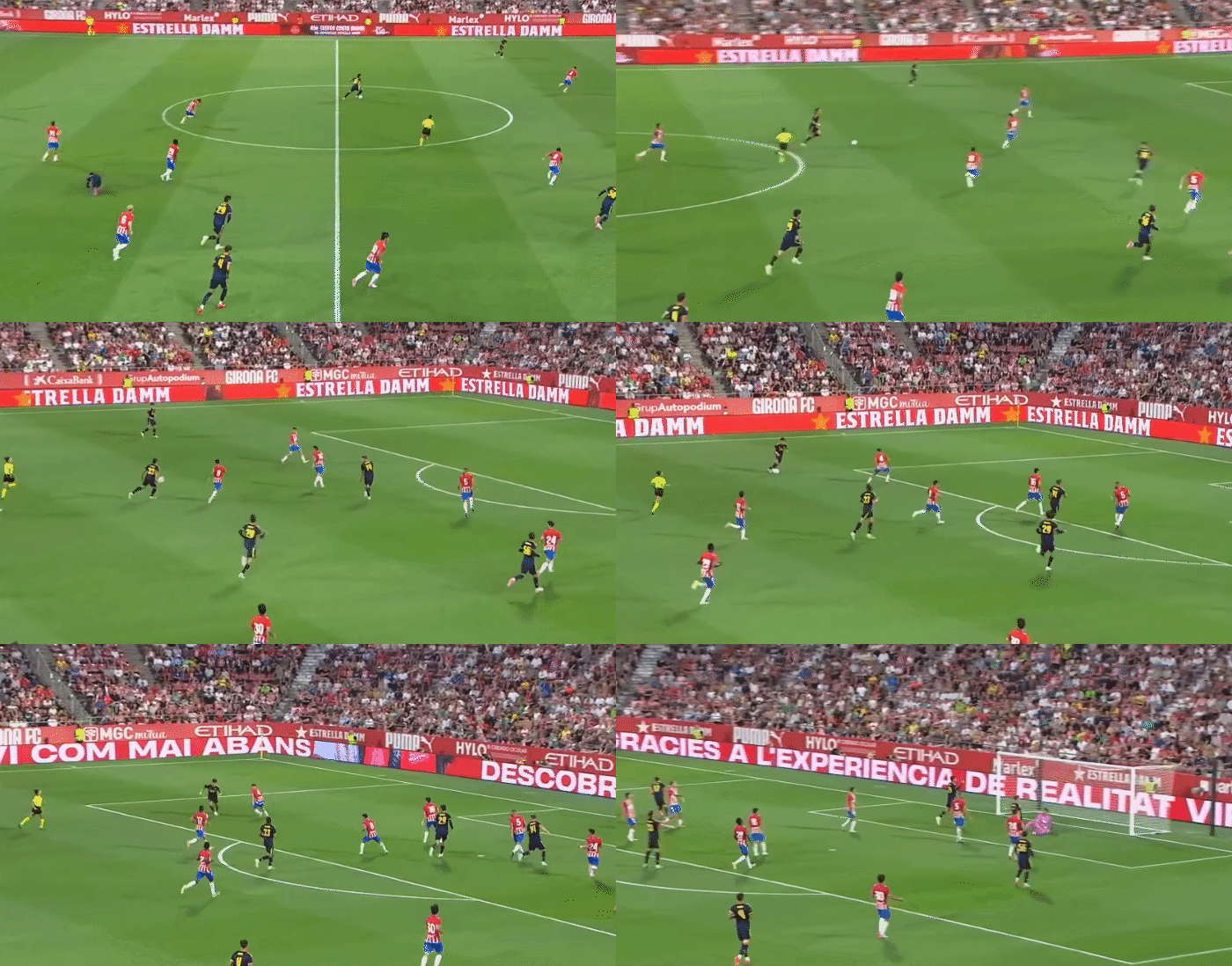
“I think you’re going to love the player,” said Arteta after the match. “He’s a very direct player. He’s got the goal between the eyes. I think really good at linking up. He’s a boy that comes with so much hunger as well and wants to prove it. It’s a dream for him and we are here to help him.”
His profile is rife with interesting little details. It’s also rife with questions about what will translate and what won’t.
🔥 Player overview
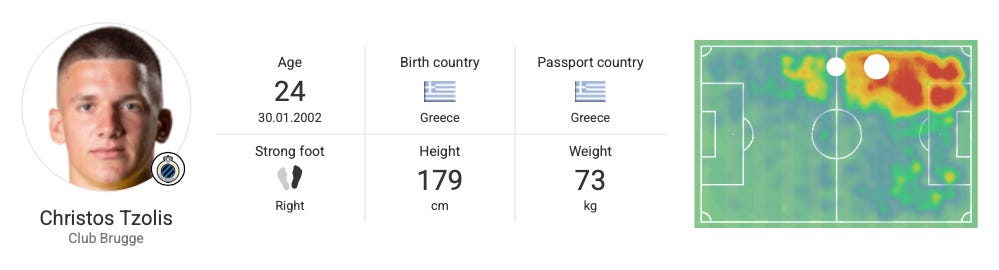
👉 Physical qualities
Tzolis is a 24-year-old, fairly compact forward with many good physical qualities, but aside from conveying a real feeling of both immediacy and repeatability, he doesn’t display many flashy athletic traits. Various outlets have him around 5’10” and 73kg, which feels right. His frame and two-footedness are what call Trossard to mind for many, though I think their play-styles differ, as we’ll get into, and by his own admission, Tzolis likes to model his game after David Villa.
One of the benefits of his experience is the wide variety of players we can benchmark him against, whether in Greece, the Championship, the Eredivisie, the 2. Bundesliga, Belgium, against a fair amount of national teams, in the Champions League, and even in the Premier League back with Norwich City. There is definitely some projection involved, but less than there could be.
It’s difficult to find many novel things to say about his physical profile, as almost every characteristic falls in the category of “quite good but not necessarily elite.” He is fast but not the fastest, balanced but not immovable, nice and coordinated. He tends to look the most visibly athletic when either carrying the ball or bursting around little pockets during associative play. While doing so, he can make little adjustments quickly, and is a controlled stopper. We’ve talked in the past about how deceleration is the sneaky athletic quality that matters as much as anything. Take care:
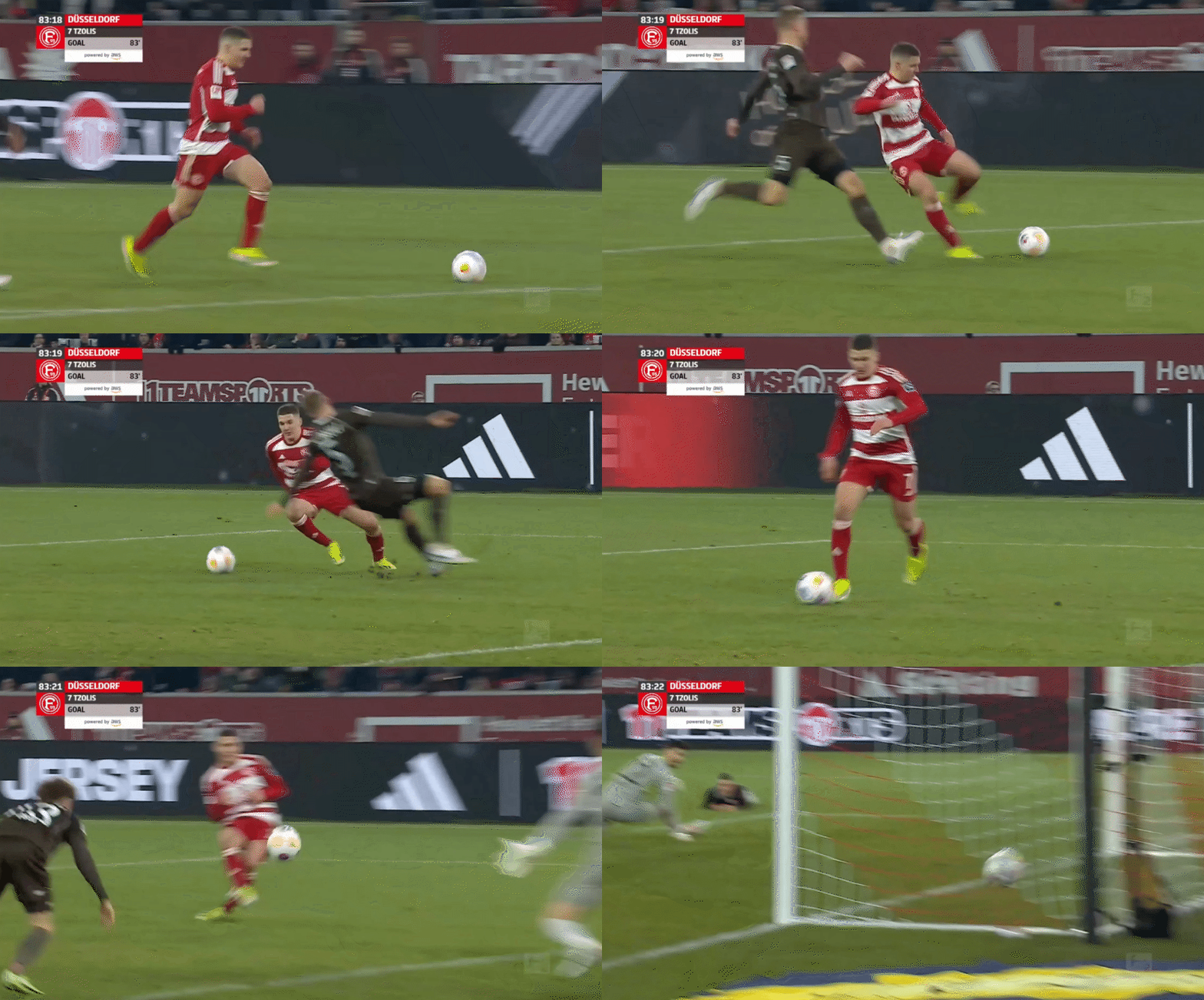
He is dexterous with both feet, and, as we’ll cover later, can really hit it.
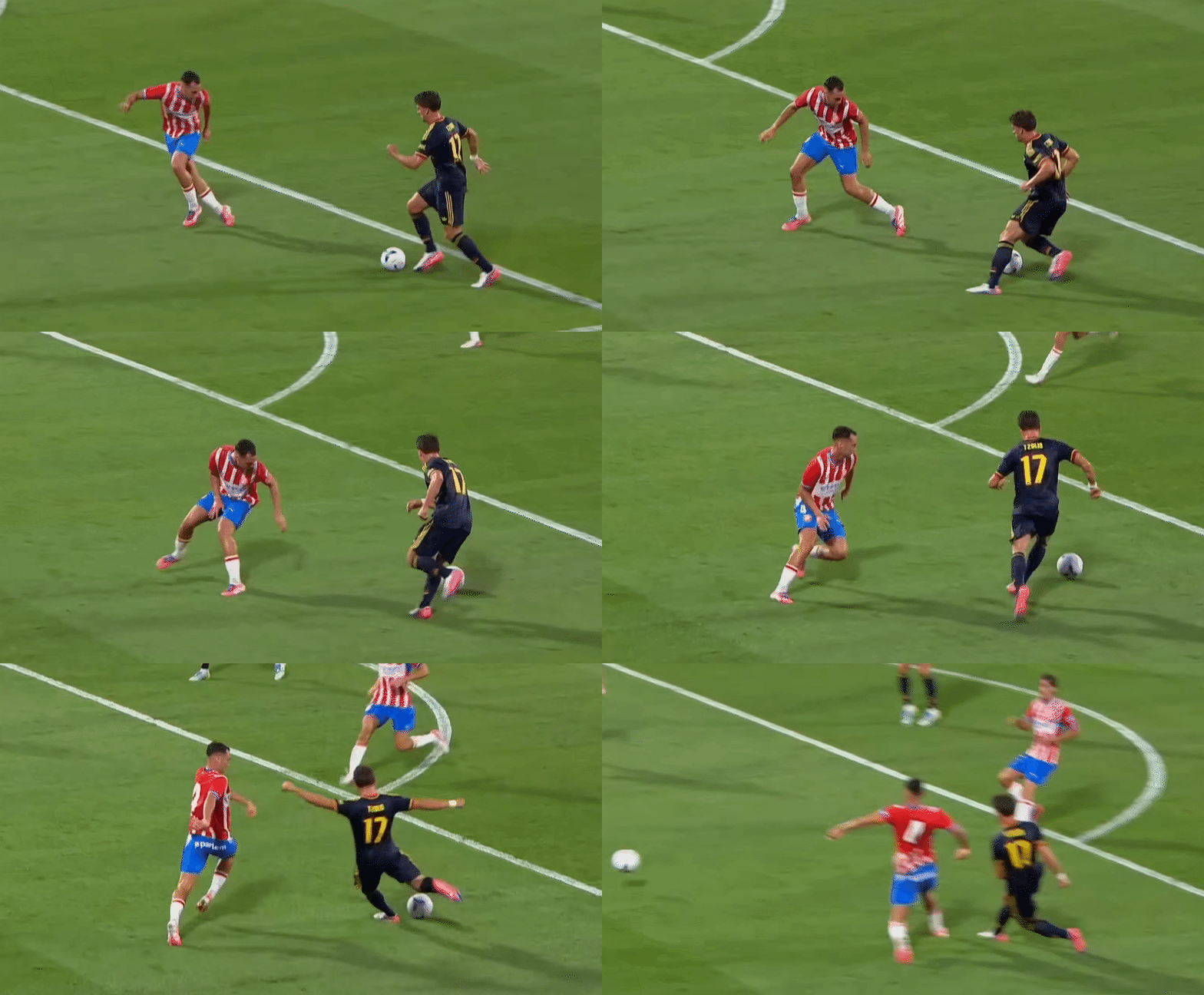
If you want one play to demonstrate some of his best qualities, you can see it here.
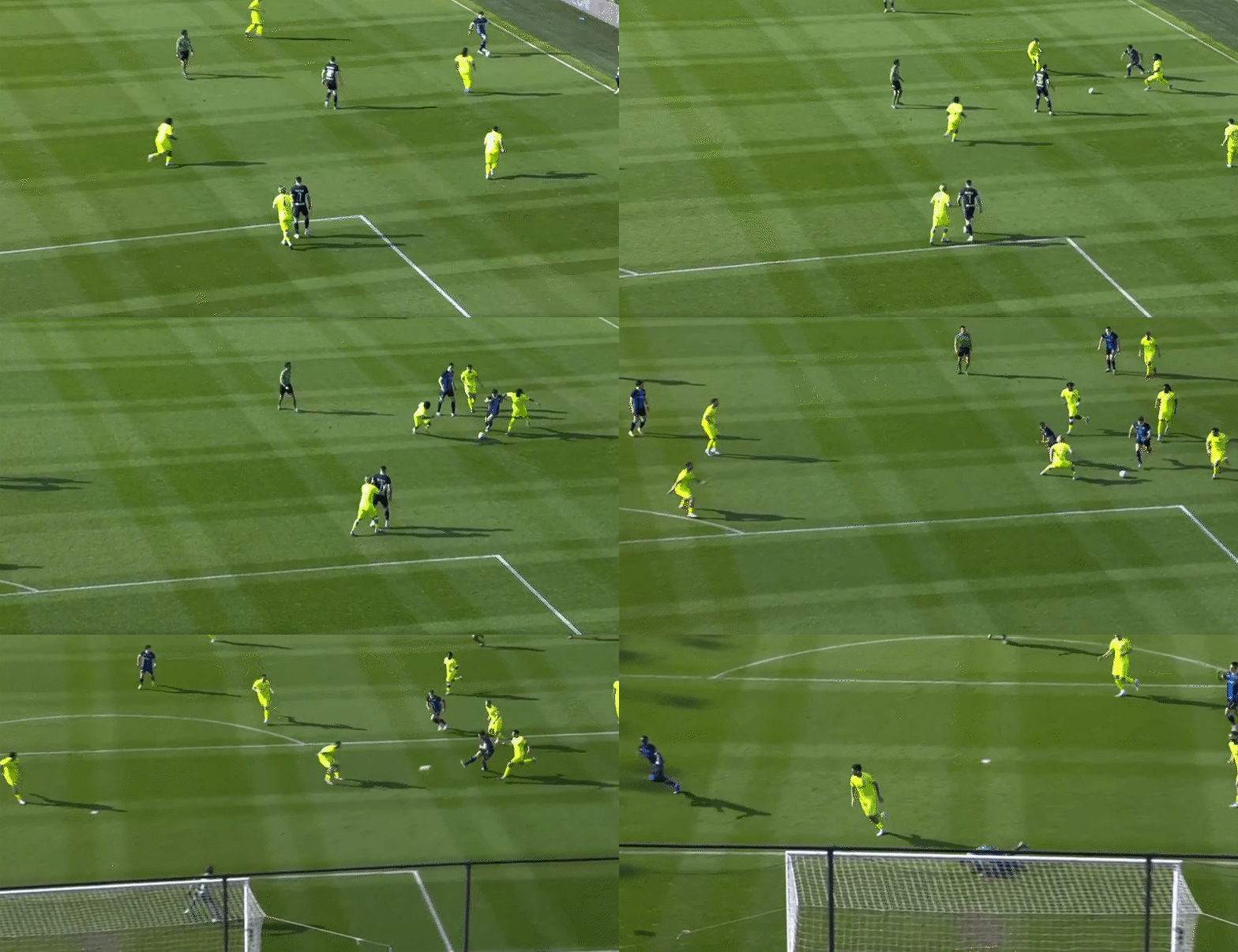
You may call it jinking or shifting; I always call it “tilting,” which is that skill of altering directions quickly on the carry, and making your body go diagonal. It’s different than pure dribbling, which relies more on skill moves and feints and dramatic changes of pace. His little angled moves on the carry call to mind players like Rodrygo and Madueke, and his body moves on a single plane.
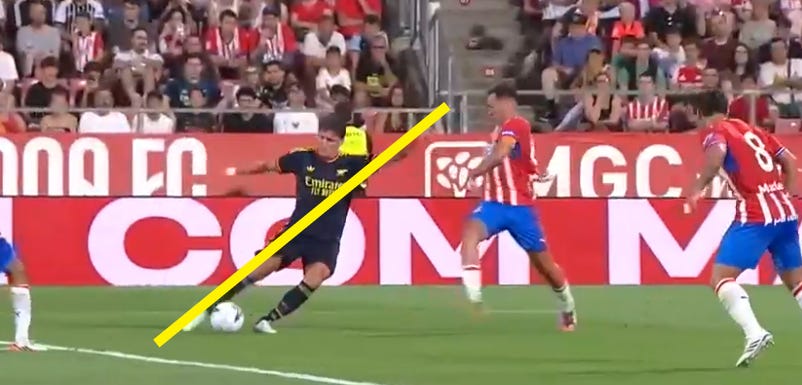
When we pause it on the shot, we see how balanced he can look while leaning, sometimes quite dramatically. This definitely extends to his ball-striking.
Athletically, he looks most limited when in slower, more settled, classic 1v1 or 1v2 dribbling situations, as he has physical constraints there. Basically, he lacks that sense of “wiggliness” that you look for in top dribblers, where their hips and ankles and shoulders can dissociate, leading to all the little fakes and movements that get defenders off-balance. As with Martinelli, this affects how he’ll get off the touchline without runners or combiners in the slowed-down moments.
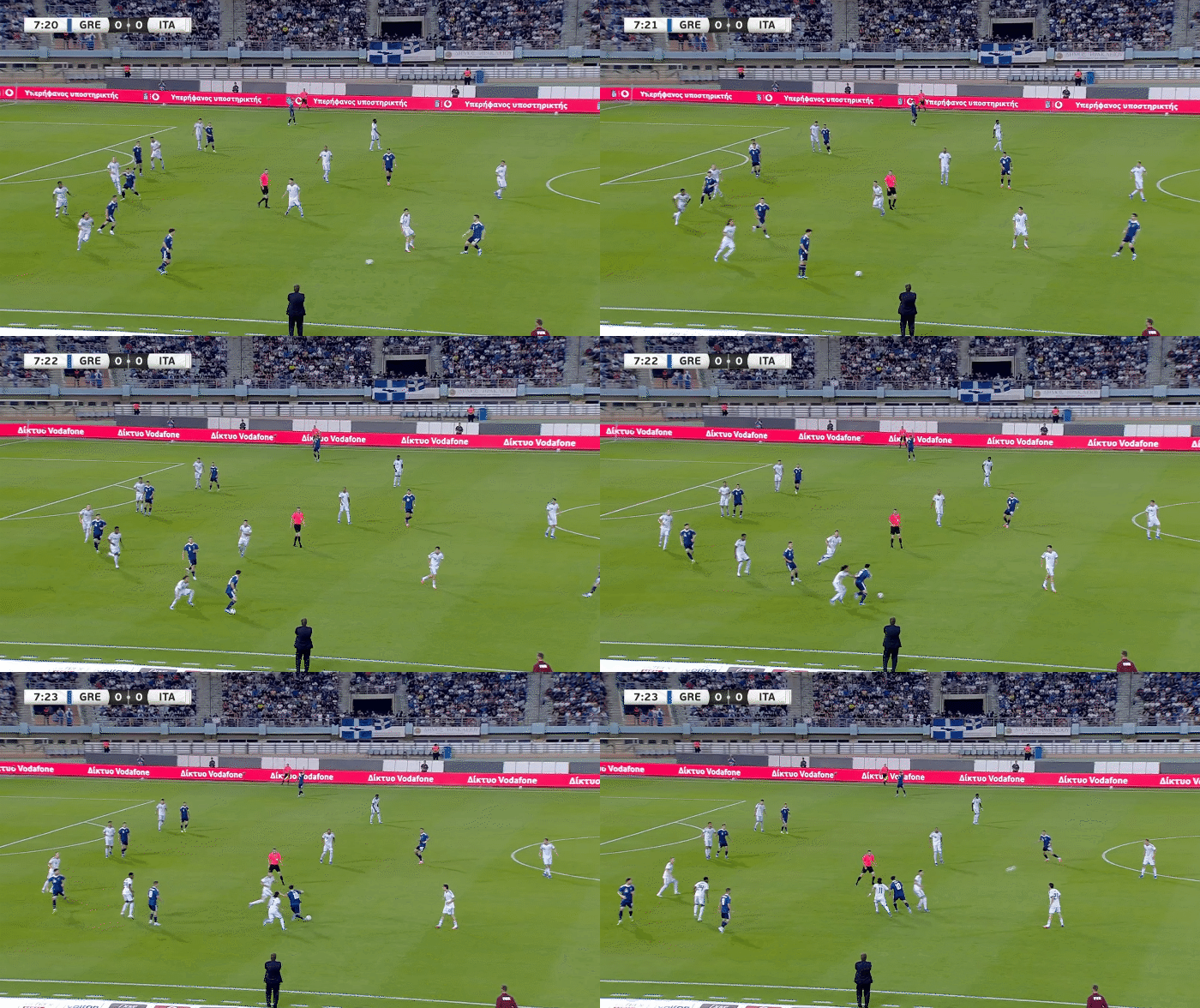
The other question is about the final level of his pace, both short and long. In a moment like this, during that Premier League debut at the Emirates, it felt too easy for Tomiyasu to catch up.
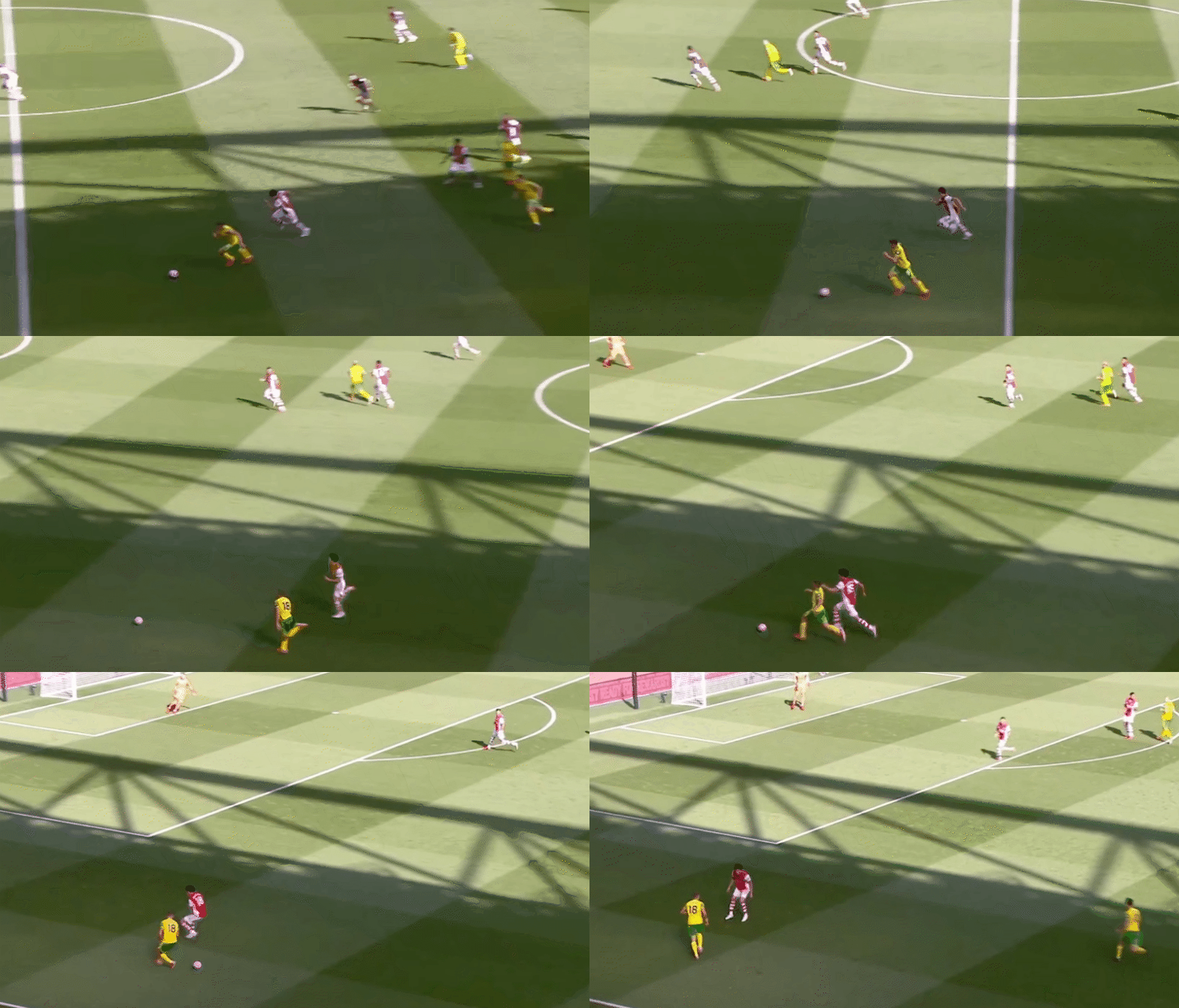
In Belgium, his immediate burst has been so important for him to generate a yard and fire in crosses. If he isn’t able to create a similar amount of separation, his impact will be more limited. I also have some concerns about him simply getting caught and shoved over at times.
What I will say: he does a superb job of avoiding adverse situations. He’s almost always doing the things he wants to do, and avoiding the things he doesn’t.
A more straightforward positive is how reliable his actions are. Using FotMob, we can see how his running stats compare to the Arsenal wingers in last season’s edition of the Champions League.
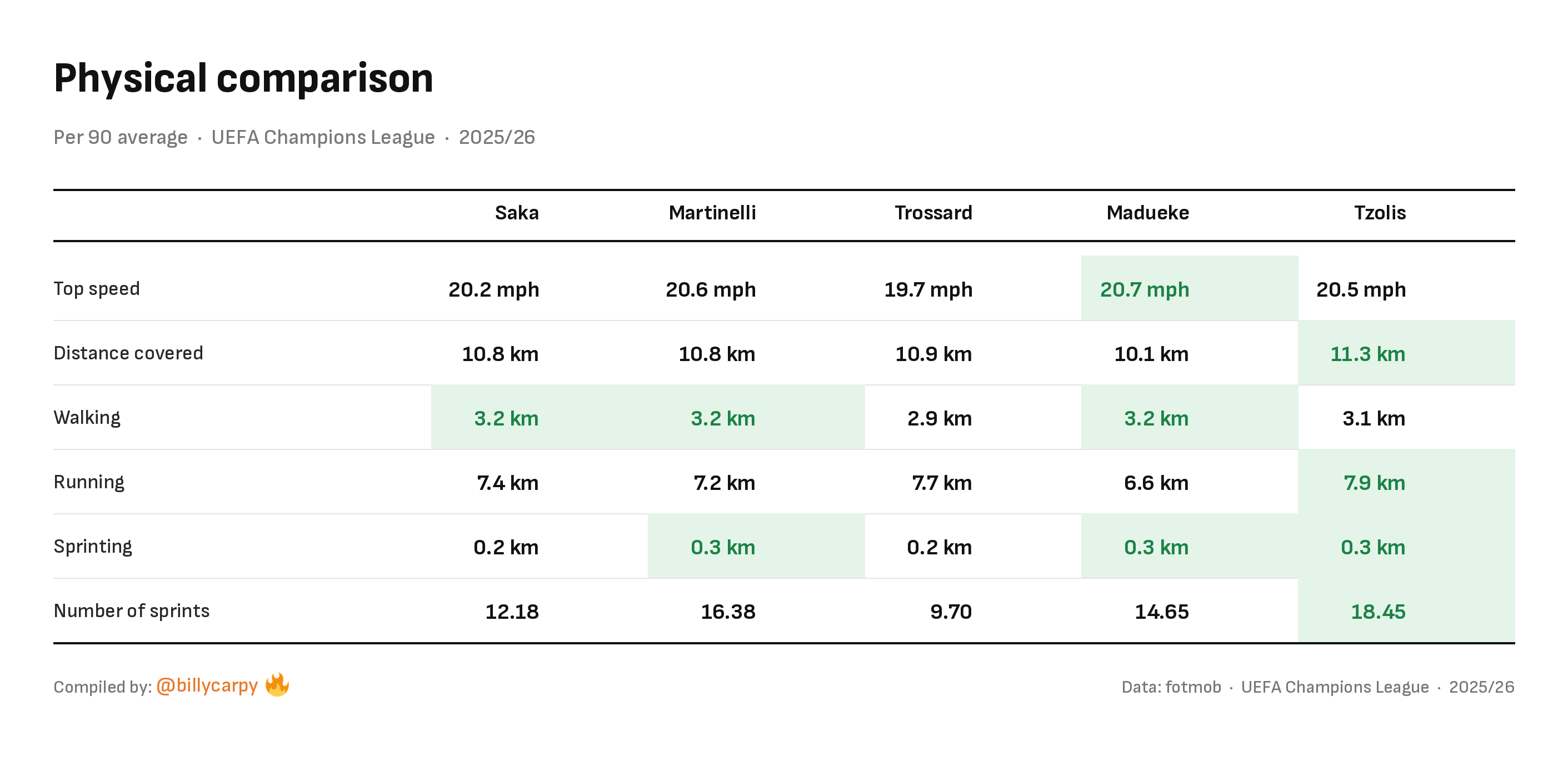
Many caveats are necessary here. A lot of this is situational, a lot of this is based on what kind of model your team is using, a lot of it is noise. But it’s still helpful context.
Meanwhile, I wrote this recently:
I always watch [Harry] Kane training clips, because they reinforce that thousands of players “can” hit a ball like him, but 0 people alive do it with as much technical consistency. And so technique isn’t “having” a technique, but about how many times (out of 100) you demonstrate it.
This repeatability is the physical (and mental) quality that stands out the most in Tzolis. He has endurance and work-rate, sure, and appears to be in great shape. At least in Belgium, he’s not in the full Conor Gallagher/Kai Havertz/Fede Valverde tier of players who have an almost martyrish quality to their hustle; he goes pretty hard but not indiscriminately or fiendishly, and he is sometimes lacking on the counterpress. I generally expect that he’ll turn it up a notch for his new team, as happened with Trossard.
But what stands out is the consistency of his attacking actions. The technical quality of some players can fluctuate wildly depending on their physical or emotional state, and whether they have their legs or not. For Tzolis, if he does something 20 times, it’s going to be at a similar level of quality 20 times in a row.
In general, his greatest strengths are his two-footedness and his technical ability (and desire) to go again. I have some questions about his lack of top-tier agility, and, if associative work is not on offer, how that could limit his ability to dribble at blocks in slower play, and whether his burst will be sufficient to generate space, particularly in transition and for his low crosses.
👉 Playing temperament
Every player goes through a pruning process. When they were younger, most had a sprawling suite of moves they’d employ to varying degrees of success. As they climb levels, the best are often narrowing down to what works. This can be more extreme for some than others. Some great players have built entire careers on a sublime move or two: the Pascal Groß chop-then-cross comes to mind.
There’s a real minimalism to Tzolis’s game. He strikes you as a player with a really accurate self-image, who has tried a lot of things over the years and eventually narrowed it down to what he’s best at, leaning into those as much as humanly possible. Especially in Belgium, a sense of decisiveness and clarity saturates everything.
There is plenty of praise for his work at Club Brugge.
“Off the pitch, his importance cannot be understated,” the HLN journalist, Tomas Taecke, said. “He really turned into someone who was the glue for both the young guys in the squad and the international guys.
“They had a very good atmosphere in the dressing room and that’s a big part thanks to him. He’s often involved in the creative goal celebrations the players do; you might see some of that soon.”
Beneath the surface, there is some complexity and hints of a rogue. At Norwich City, he caused a minor stir when he took a penalty that wasn’t his while facing Liverpool, leading Daniel Farke to admonish him afterwards (“It will never happen again.”)
After a highly successful first campaign in Belgium, he expressed disappointment with the media and with how they had built up his expectations of winning the league’s best player award, only to finish third.
“I was disappointed in the press. That started with the Golden Shoe. Every journalist I met in the weeks leading up to it told me I was going to win. I gave interviews to everyone, my brother flew over from Greece, even on the red carpet they asked me how I would celebrate if I won.
And then you only finish third... I felt used by the media. It felt like you wanted to build up the tension with me and increase the surprise surrounding Jashari. So I felt stupid afterwards.”
Fortuna Düsseldorf's sporting director classified Tzolis as “a bit of a rascal, with a mischievous streak... I like that.”
Maybe he was thinking about the time Tzolis took the final penalty of a DFB-Pokal quarterfinal and went with a panenka:
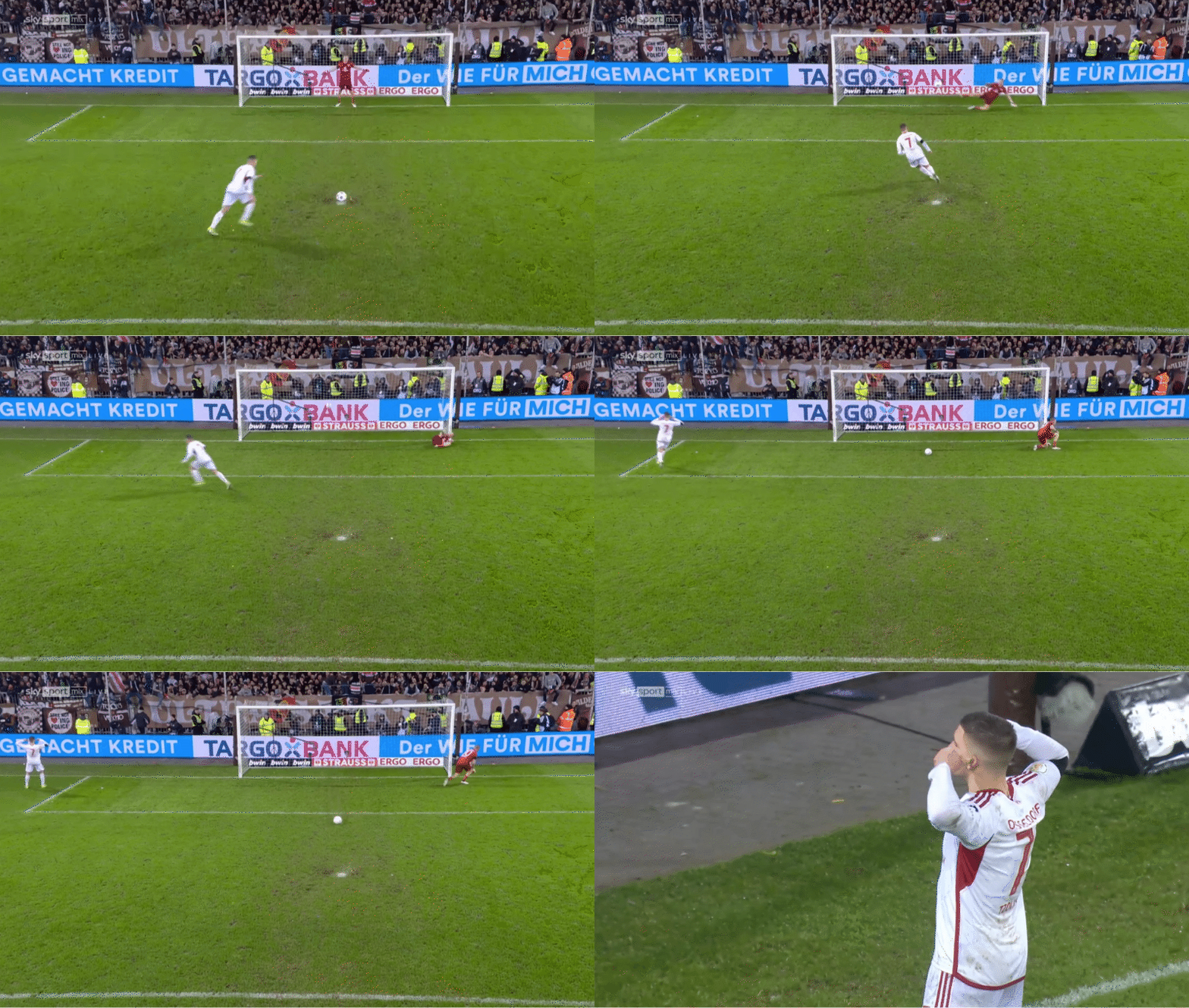
There are certain hints into temperament that I care about. I look for players who communicate a lot, who feel fully engaged in proceedings whether they’re getting the ball or not, who defend hardest right after losing it, who control the ball in deep areas instead of clearing it, who teammates look for in difficult moments, who don’t stay down too long after a disappointing play, and who show the same amount of application right after an unsuccessful moment. There are other clues I really don’t care about. I don’t care if a player really wants to take a pen, or is angry after getting subbed off, or is momentarily incensed with a teammate. It’s professional competition and it’s fine. If anything, that all shows a feeling of responsibility.
Over time, reviews of Tzolis have become simpler and more demonstrative. Fortuna’s captain André Hoffmann said he was a “game-changer” and “an absolute fan favourite. He’s a hard-working and good lad.”
His manager since last December, Ivan Leko, was specific and clear in his praise, which you can always grade higher in reliability than the vague stuff.
“This is one fantastic example. Somebody who was first coming to the training base, the last staying there. Every training was like a game to him … A good lesson to all the young boys that we have, that in football you need to work. Stop the talk. Work. Try to do everything you can to improve yourself every day. Exactly what Christos was doing. I am convinced that he will show, also, at the highest level.”
Most of my time spent watching him was during his time at Club Brugge. In all those performances, I’d describe him as high-effort, consistent, and with an elevated degree of urgency. The only temperament flag I’ve seen is that he doesn’t always have an immediate bite to his counterpressing.
Contrasting with Trossard’s grumpy steeliness, there is also a detectable happiness to his game. He’s often smiling and complimenting teammates, and there seems to be genuine warmth towards him on the pitch. He has, after all, provided them with a lot of goals. You’ll notice this in interviews, too, in which he just seems, well, nice.
That same journalist praised his effect on the team.
“On the Belgian coast, we have lots of small, wooden beach cabins that people rent in summer. It’s very typical for Belgium. It’s not typical for a footballer to rent one but Christos did, and all the guys from the team, when the weather was good, gathered at his beach house. It’s a good example to show how bonded he is to the team.”
I finish this section with two other highly important scouting cues: he wears sleeves and gloves in the cold, and he often tapes his right wrist. You can make up your own mind on the first finding, but I am a long-time proponent of the aesthetics of wrist tape.
👉 Statistical background
To start, we can compare his league numbers to some of the other options. I pulled this back in another century, when Rogers was still available and Barcola looked more likely, and will keep them in for now (though including Vinícius feels unfair). The big context here, of course, is the league difference.
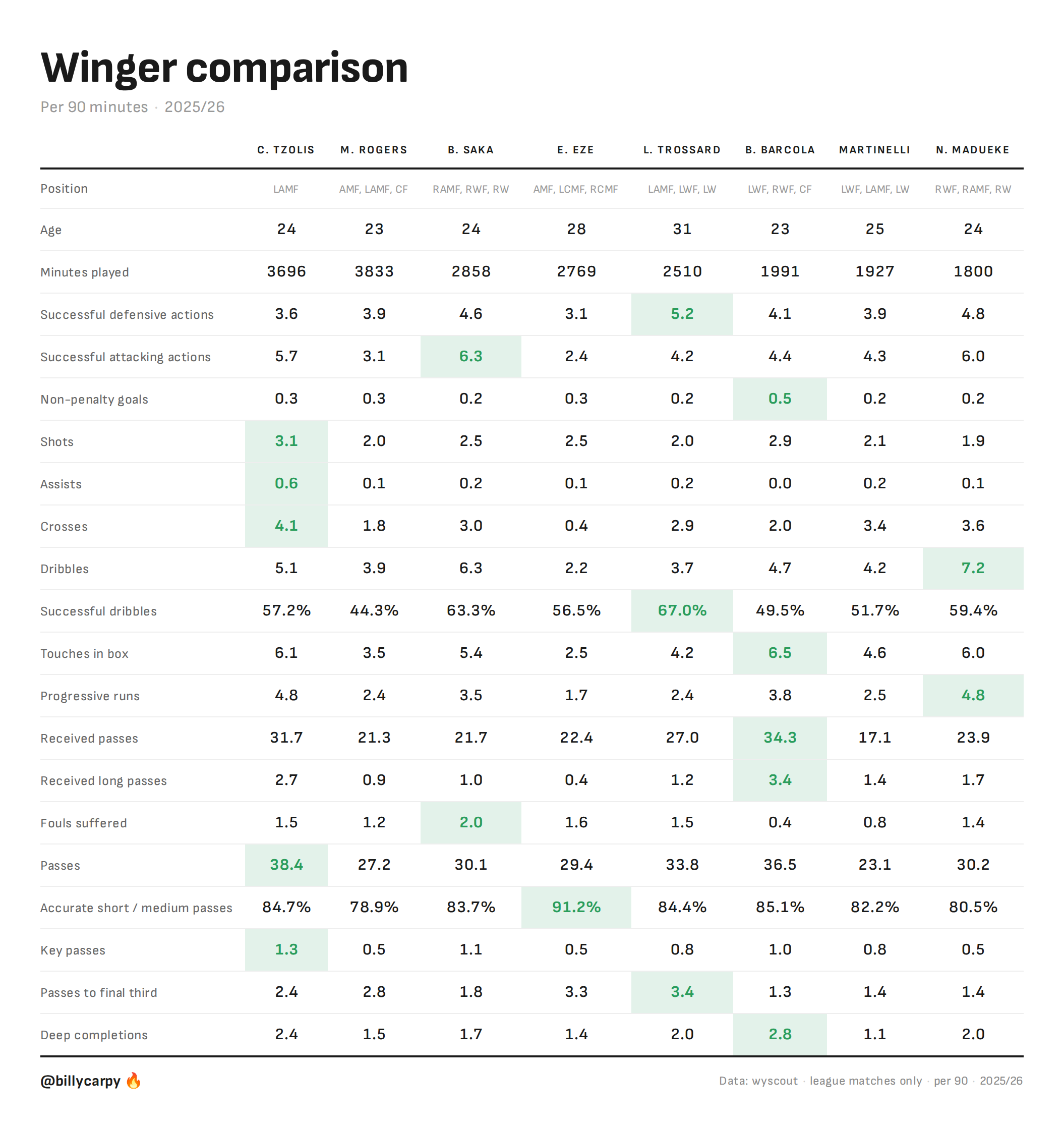
What do we see:
He’s an output monster, as you’ve probably heard. In 36 league matches last year, Tzolis had 17 goals and 23 assists. Across competitions, he logged 51 G+A in 50 matches.
In the last two seasons of the JPL Champions’ Play-offs, facing Belgium’s top teams, he has 20 starts, 16 goals, and 15 assists (for 31 G+A total).
Most of his accumulated attacking stats in the league will shine, especially when compared to the Premier Leaguers. He had the most shots, assists, crosses, and key passes in the sample.
Of the Arsenal grouping, he had the lowest rate of defensive actions, bar Eze, who had different positional responsibilities as a #10 (the context is that Ødegaard never fares particularly well in these counting stats, but it’s still worth noting).
He was quite high volume in terms of touches, so one question is how his game will fare when he’s less of a focal point. He received 4.7 more passes per 90 than Trossard, and a full 14.6 more than Martinelli.
One interesting note is that he received the second-most long passes out of anyone in this sample, behind only Barcola, who has a claim as the best in-behind runner in the world right now.
The rest is what you’d expect given his league and reputation. He racks up numbers.
This wonderful graphic from Scott at Cannon Stats supports these insights.
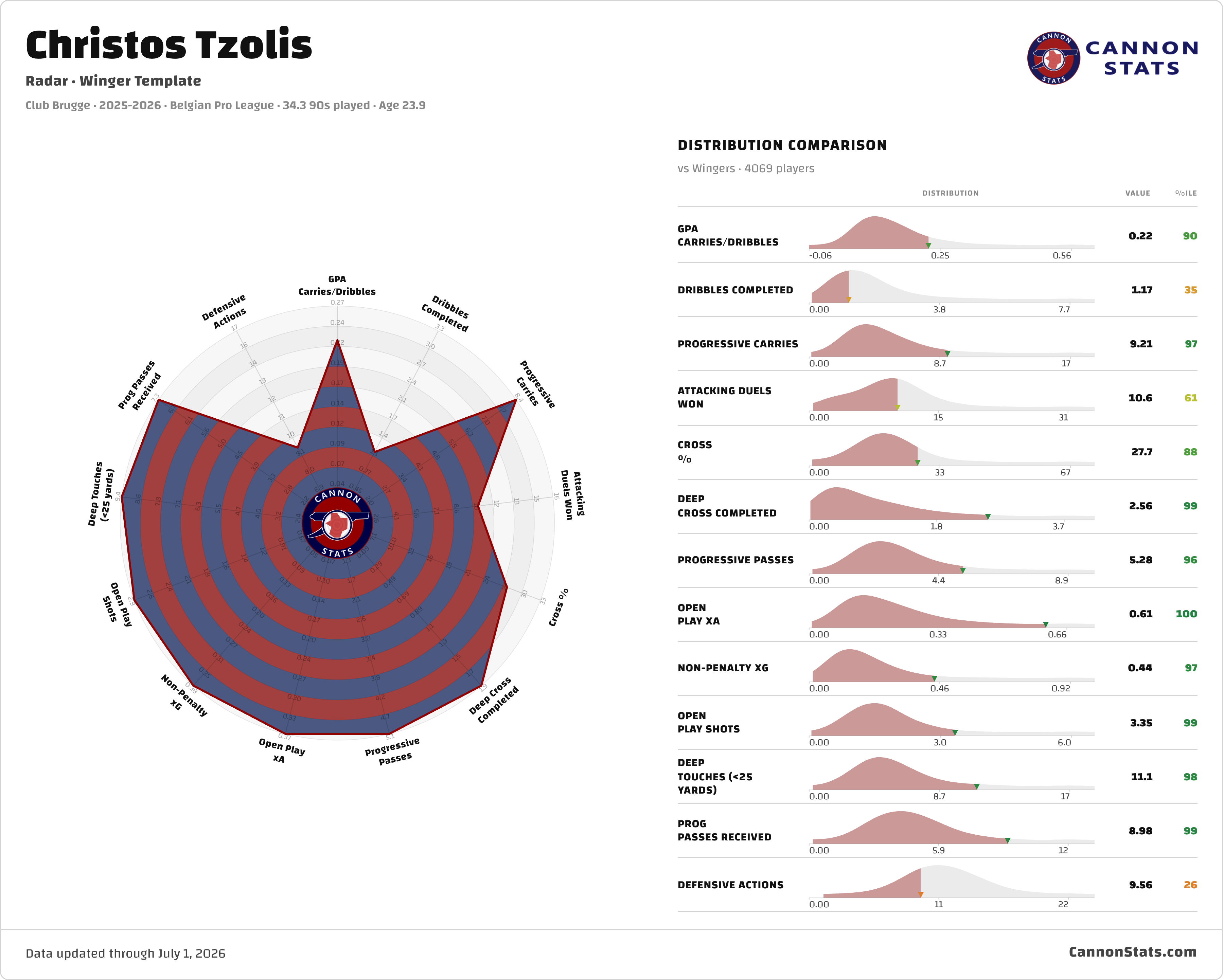
Even when league-adjusted, these numbers are pretty filthy. The exception is the dribbling numbers, which look more pedestrian. But this is why he appeals so much to the analytically-minded. However you dice up the numbers, they come out well.
Transitioning to the Champions League, we see this, which I pulled from Scout Lab:
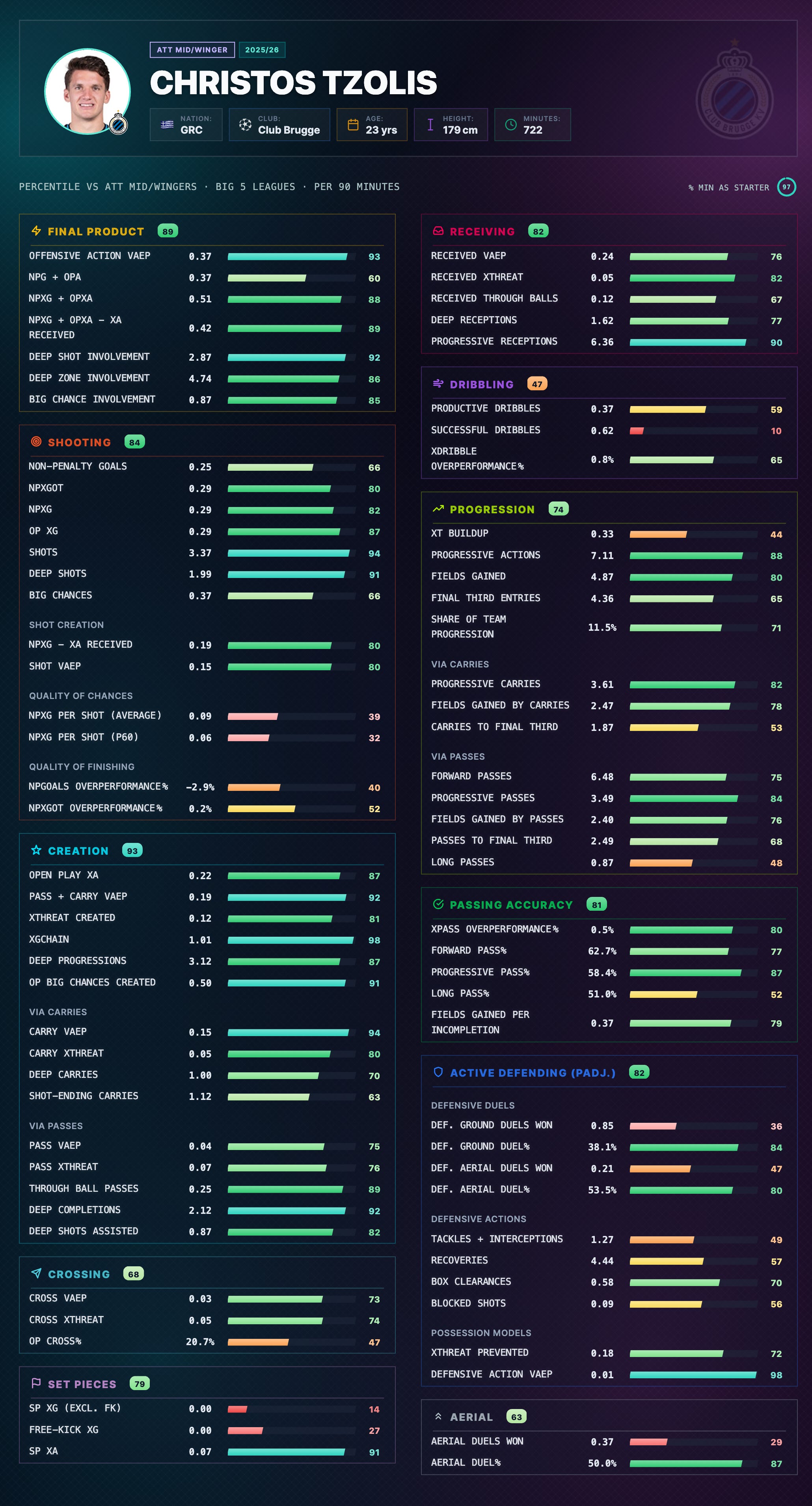
There are basically two takeaways from that one:
The sample size is small (722 minutes) and game-state dependent.
Against top competition, he could still generate shots, receive the ball in dangerous locations, create chances, and rack up useful defensive actions. The numbers aren’t at the Belgian levels, but they are still good. This is one of the more promising bits of information we have.
(You can read more about VAEP here, but the short of it is that it stands for Valuing Actions by Estimating Probabilities, and looks to quantify all of the actions that create goals.)
Last, we can see that general picture replicated in the Champions League grading from Gradient.
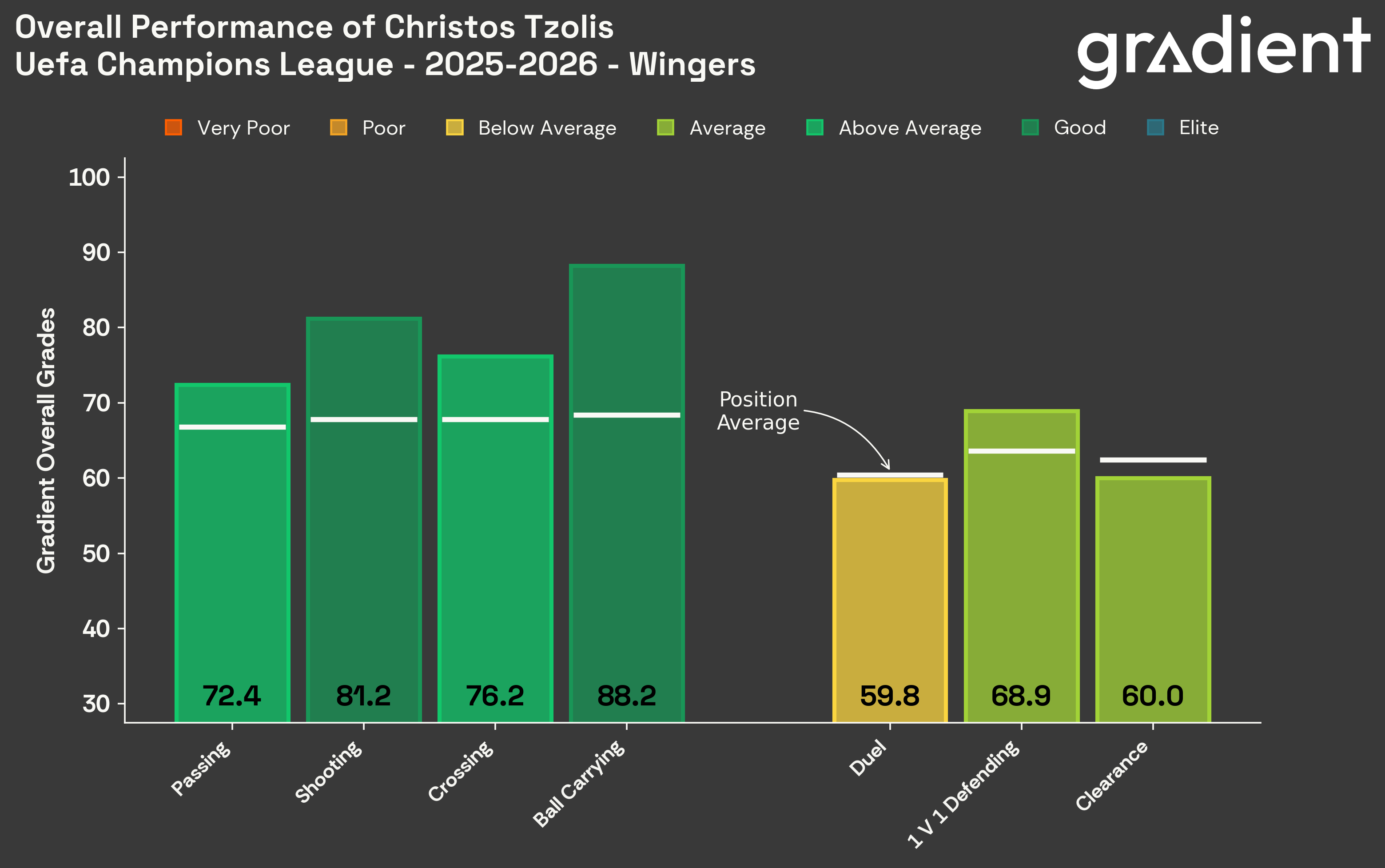
We see a player who was able to rack up superlative, even historic, production in the league, but critically, has replicated a fair bit of it in tougher competitions, but is more average in certain areas. We also see a player who is best when not engaging in attacking duels directly. He’s best when passing, moving, and shooting.
👉 Role and playing adjustment
Throughout Tzolis’s career, he has almost exclusively been deployed on the left wing.
According to Transfermarkt, that comes out to:
LW: 186 appearances
RW: 26 appearances
CF: 11 appearances
AM/SS: 3 appearances
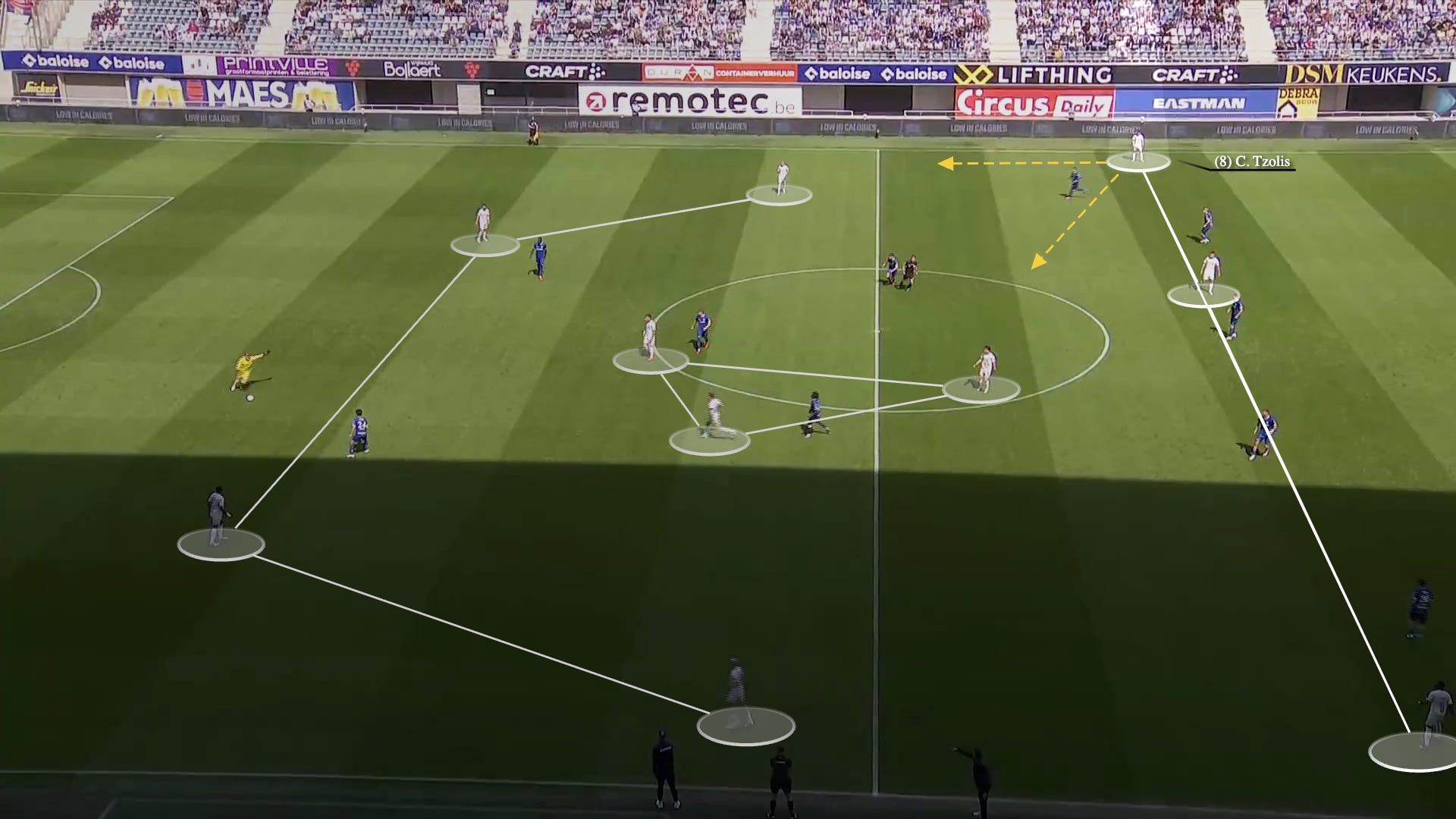
Here’s where he lines up in a typical game for Club Brugge.
Their defensive look can be incredibly man-to-man, even in lower situations.
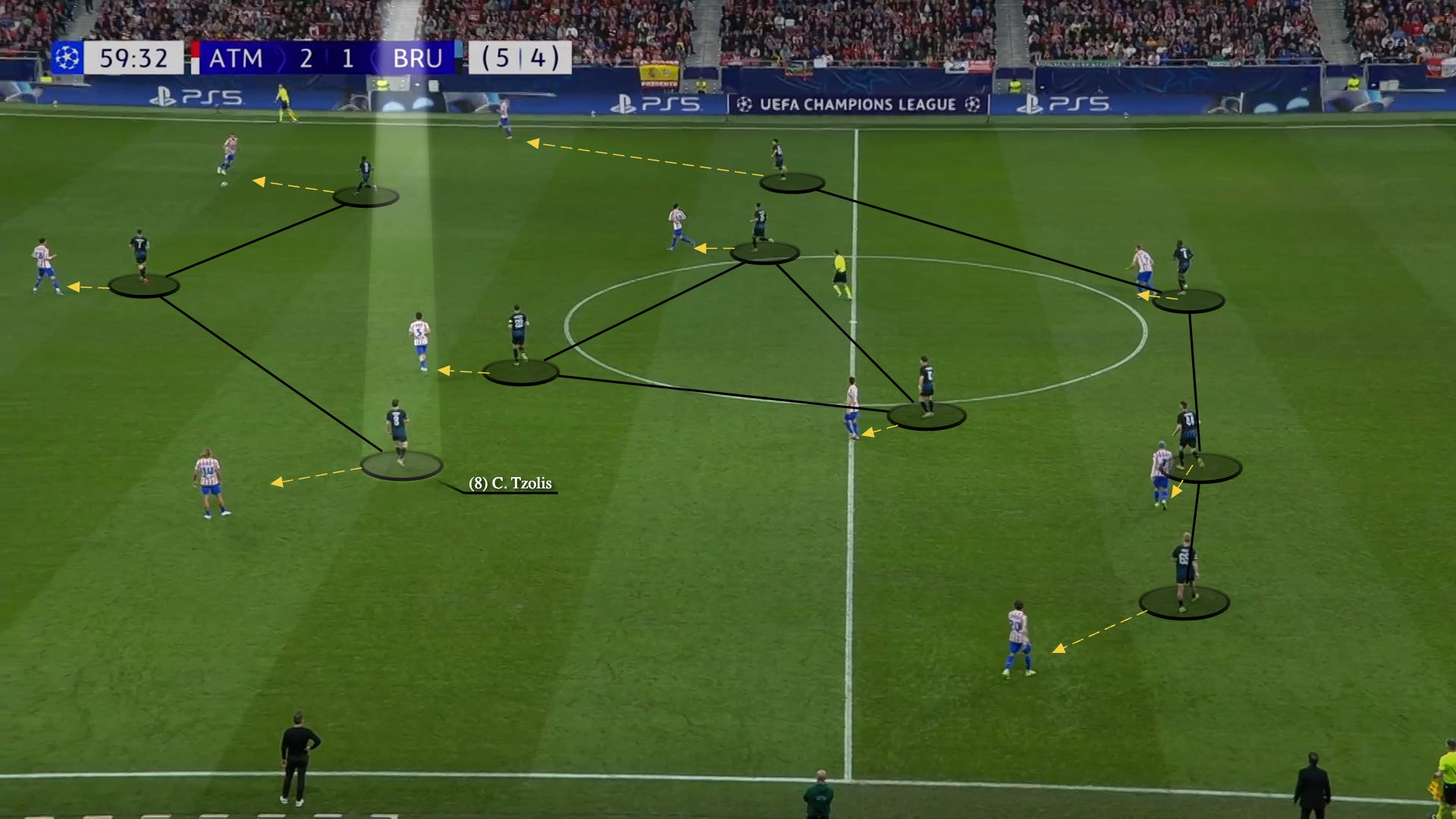
But as much as that looks like a straightforward role of a left-winger, there’s some interesting nuance to how he’s deployed with both Club Brugge and Greece. As a baseline, I watched one typical league game where the location of Tzolis’s receptions looked like this.
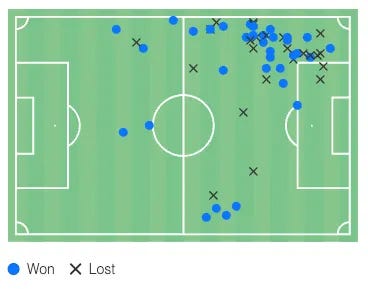
He was mostly on the left, trying to drive play in the wide triangle, but occasionally, he’d float over to the other side to try his luck.
But I also watched this: facing Sweden with Greece, he showed for passes all over.
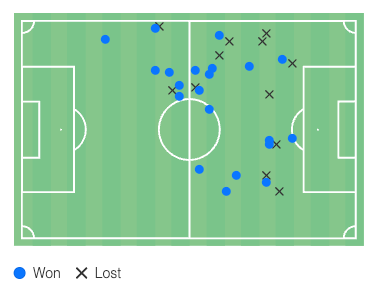
Like many other stars on their national teams, Tzolis often has free rein to do what he wants and cause as much damage as he can. The practical reality is that he usually winds up looking like a left-10, playing the game in positions that, say, Crystal Palace Eze might take up, getting on the ball in more central areas and looking comfortable doing so.
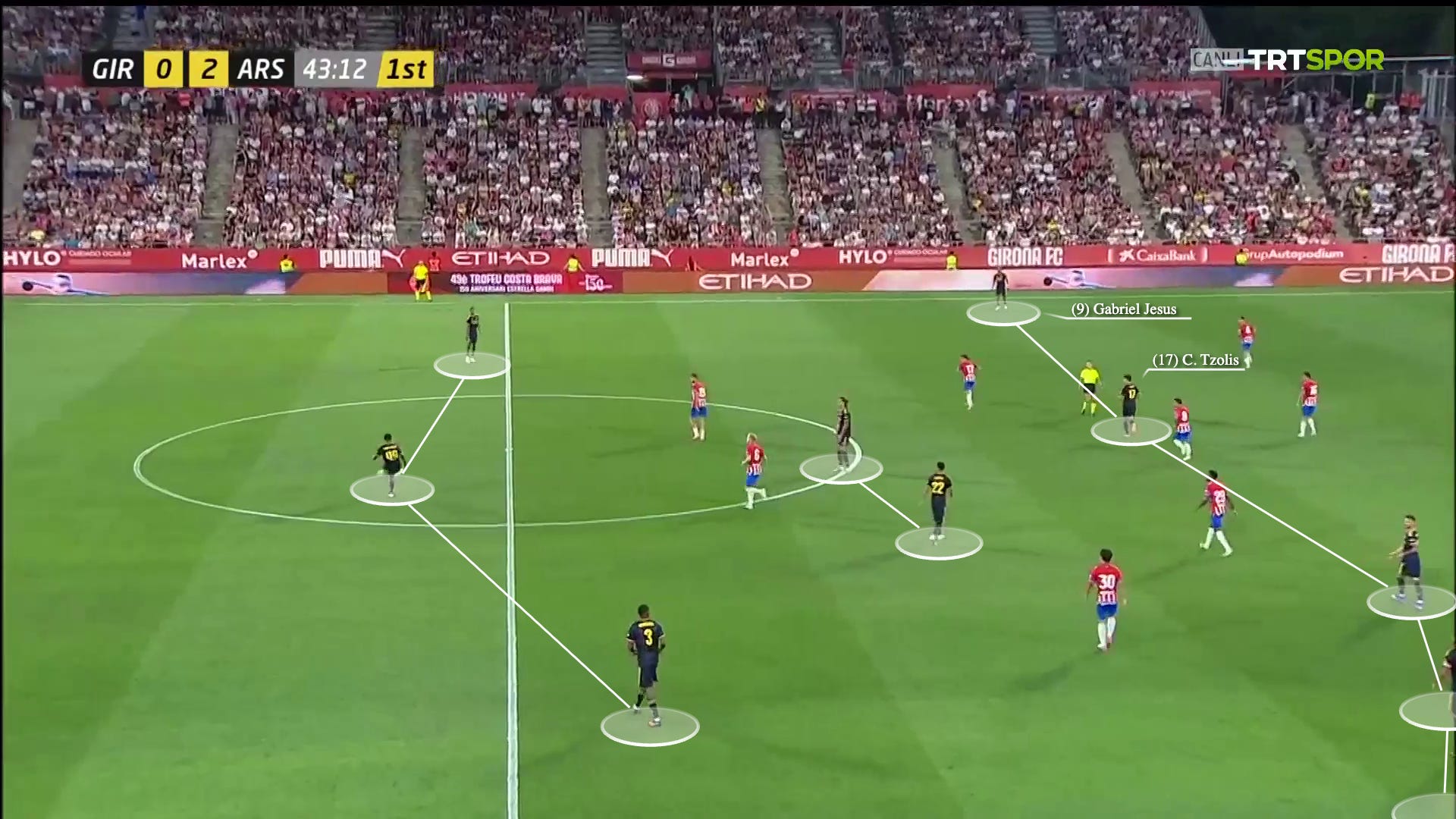
Against Girona, we saw that Jesus was not afraid to play like himself and push Tzolis into the left half-space.
Finally, here are his received passes in a 3-3 draw against Atleti, where he started at right-wing before moving over to the left late and scoring.
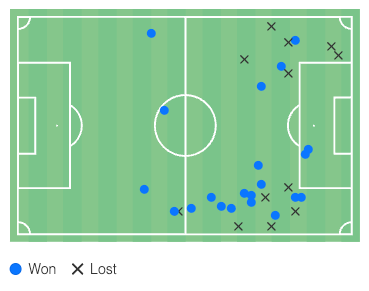
He looked dangerous throughout, logging 5 shots and leading all players with 15 sprints and 9 touches in the box.
Despite all his playing time being over on the left, Tzolis shows none of the hallmarks of a “specialist” left-winger who needs to be in the wide zone to be happy. He’s comfortable all over the pitch, thanks in no small part to his two-footedness and his knack for intelligent movement. He can pop into any triangle in any zone and look just fine, and this is getting more important in today’s game.
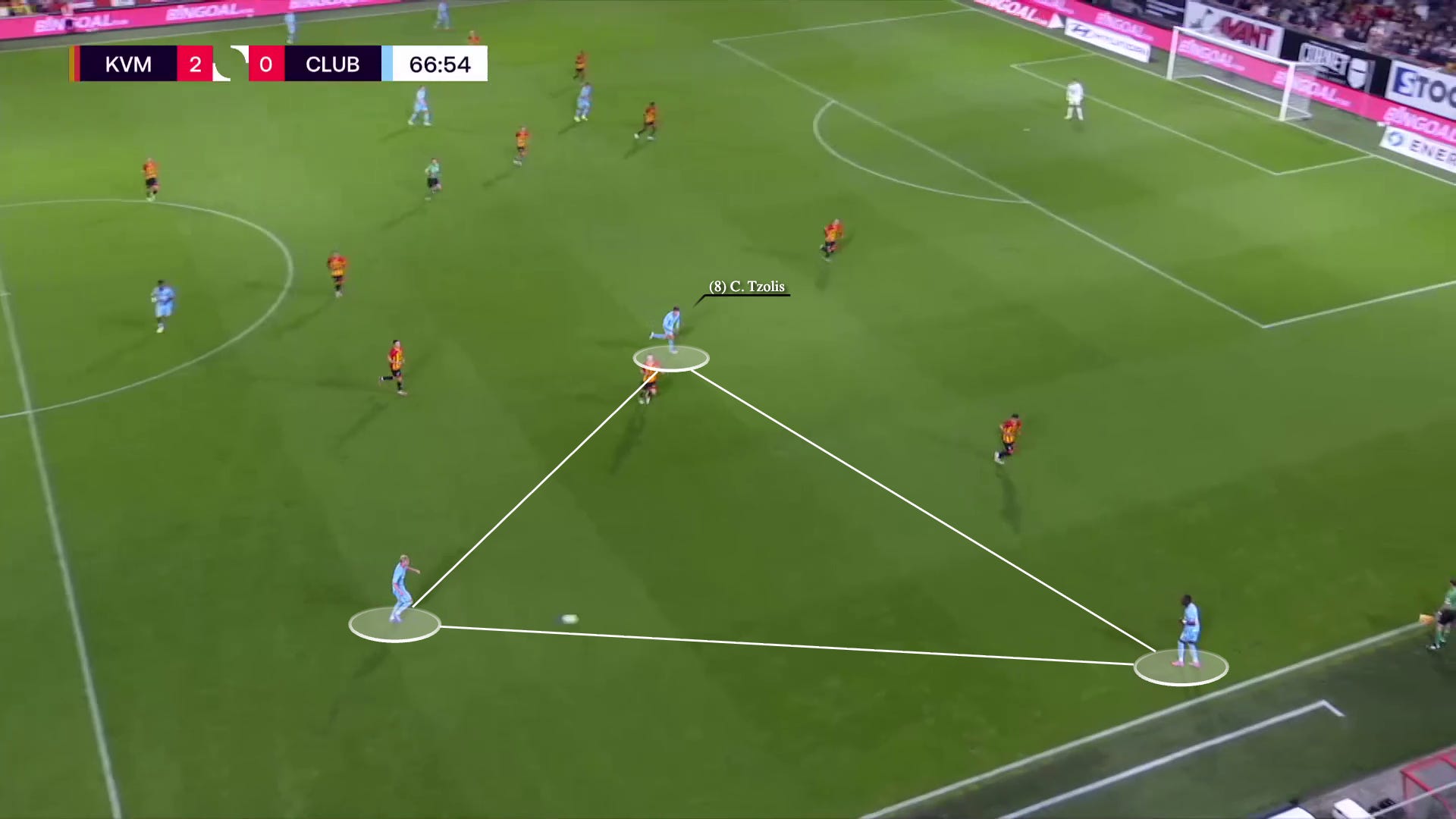
Here he is showing those pass-and-move hallmarks on the right.
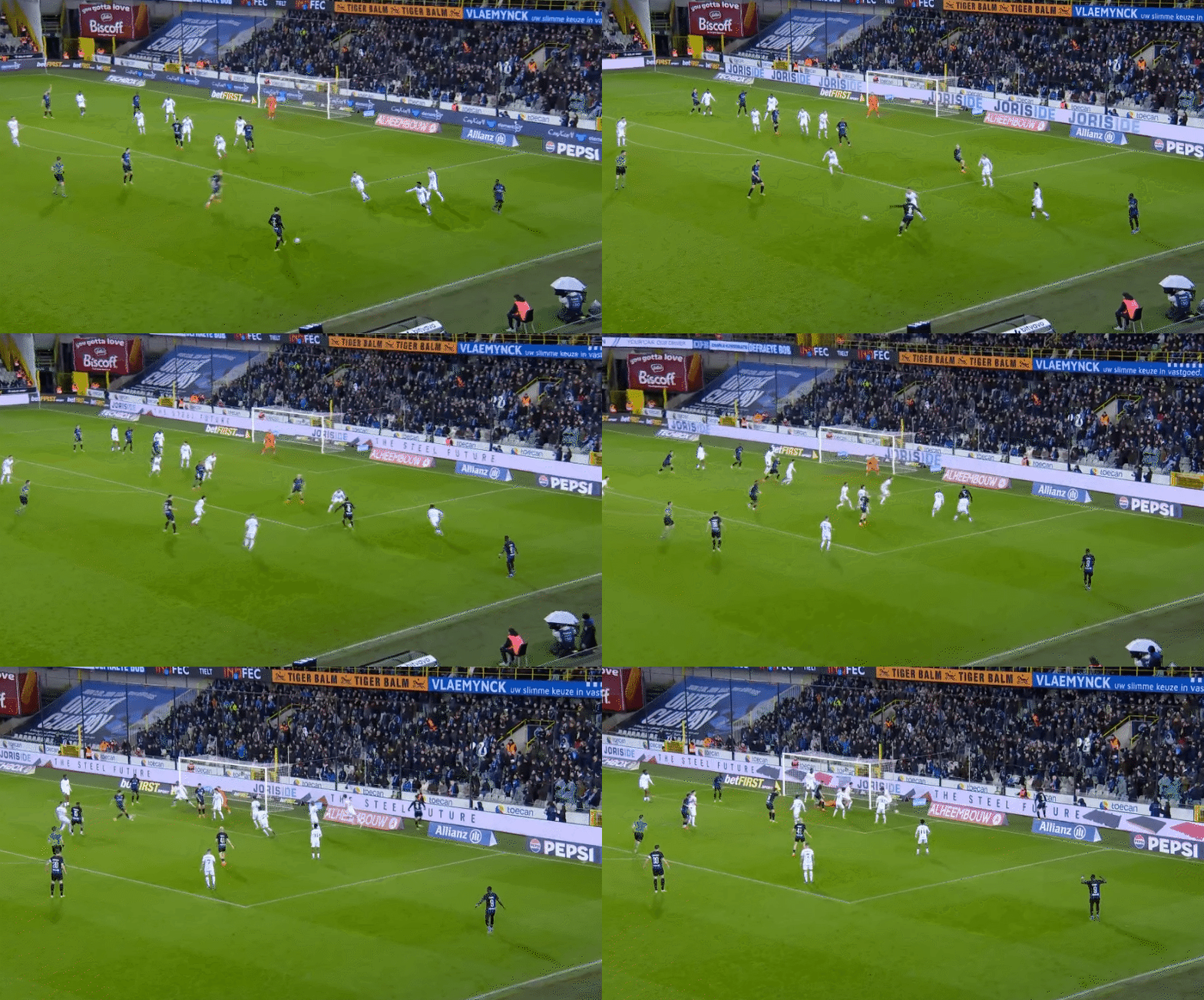
His positional instincts aren’t entirely different from a Trossard, but there are a few main differences. When pushed to the touchline, Trossard has a bigger, wider passing bag; he also has more tight-space skill moves and ball-manipulation skills. On the other hand, Tzolis can be a little snappier with runs, and looks quicker overall. Both of them can take up positions all over the pitch.
👉 League adjustment
I’ve said before that Belgium may be my preferred location to buy attackers. The recent track record supports the idea. Off the top of my head, the list includes Charles De Ketelaere, Igor Thiago, Jérémy Doku, Victor Boniface, Bilal El Khannouss, Victor Osimhen, Antonio Nusa, Chemsdine Talbi, Leandro Trossard, Loïs Openda, Yann Gboho, Matías Fernández-Pardo, Mohamed Amoura, and many others.
When looking at Opta’s average team ratings, it’s a little more muted. The Jupiler Pro League comes in 8th in the world, right below the Championship.
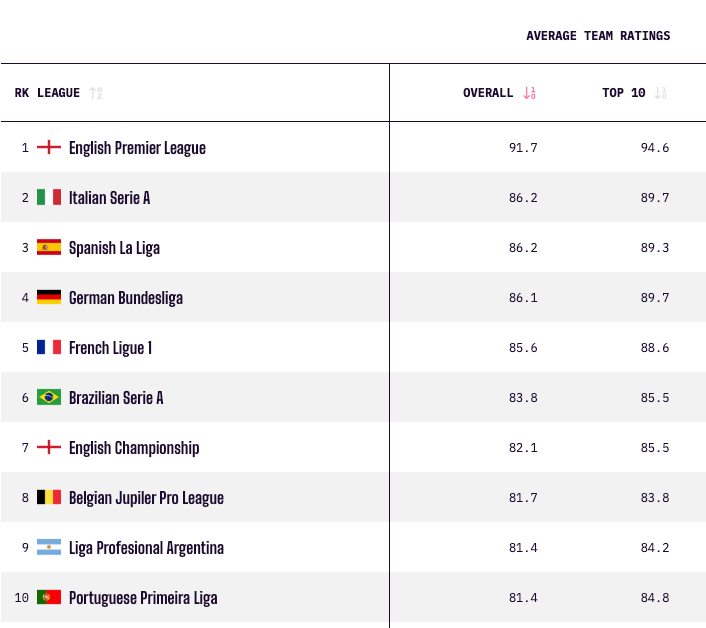
But there are layers to this beyond a simple average of “quality.” Some leagues have huge gulfs in quality within them. This is further exacerbated if the player is on one of those outlier teams: Antony never had to face Ajax, for example. Some leagues are older, younger, faster, slower; some are attritional, some are end-to-end, some are tactically archaic, and others are modern. Llew Davies at SCOUTED has a tremendous piece on Belgium.
Three big bullet points stand out about the JPL:
The league is diverse. Players hail from 75 countries at all, so outside of the “talent is everywhere” truism, there also isn’t much of the stylistic groupthink that can be noticeable in other leagues.
The league is athletic. There’s a lot of running data to back this up, but you can also recall some of the defensive names that have come through the ranks: recent exits include Willian Pacho and Daniel Muñoz; Hincapié’s international teammate Joel Ordóñez played behind Tzolis for the last two years. There are levels, of course, but you don’t see as many of the kick-and-chase roastings of 36-year-olds that you might see elsewhere. The physical baselines are good.
The league is young. According to a UEFA report, it was the most youthful of Europe’s 20 leading leagues, with almost half of the minutes played by footballers aged 23 or younger. This does mean that more mature players can exploit some youthful tendencies, but it also means that these are players who are playing for their big move, and have the intensity to show for it.
When we compare the playstyles of Arsenal and Club Brugge, we get the Spiderman pointing meme.
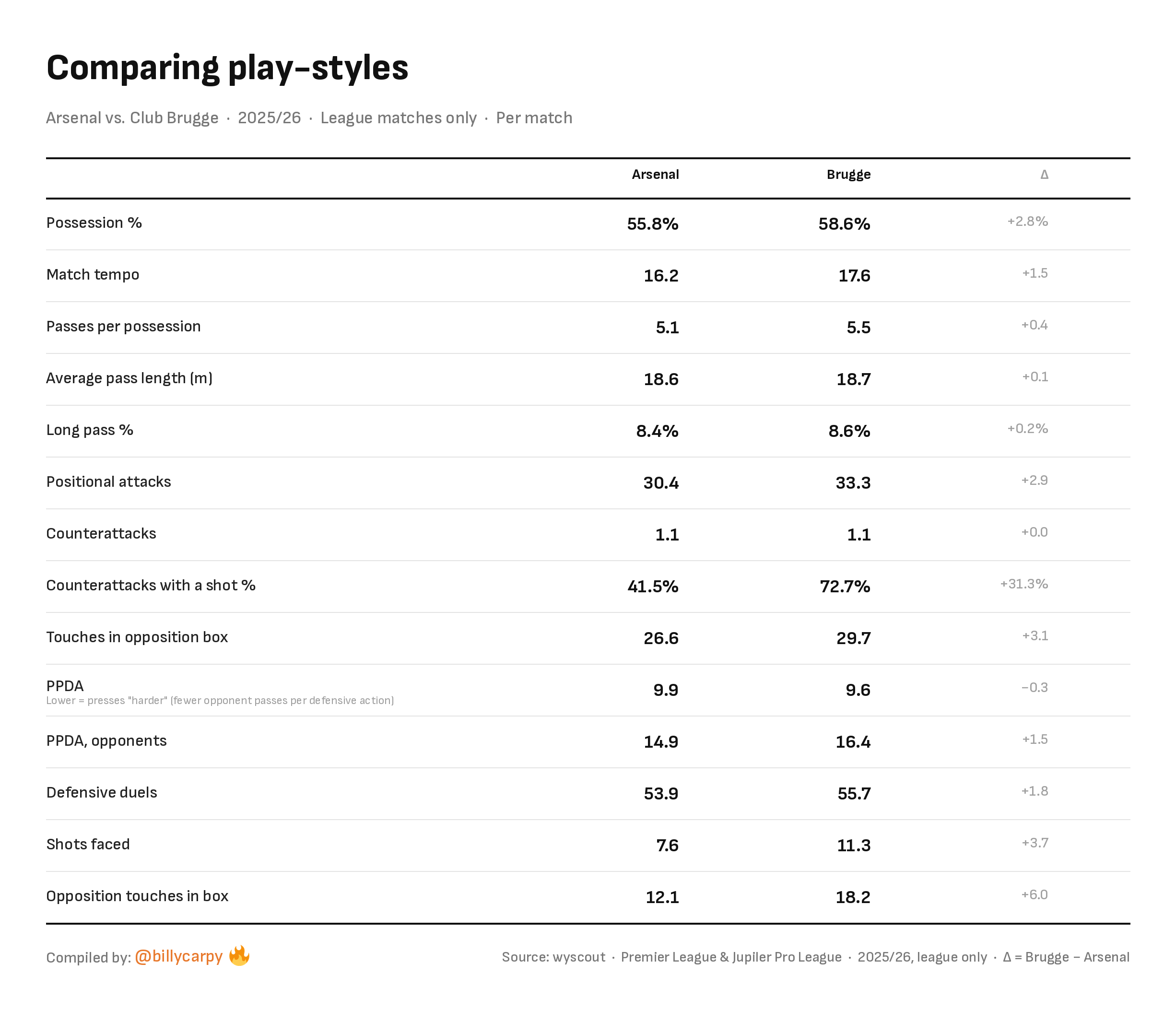
The numbers are eerily similar, with two exceptions: Arsenal were more dominant out-of-possession, while Club Brugge played a bit quicker. The teams had an identical amount of counterattacks, but, thanks in large part to Tzolis, Club Brugge were 31% more likely to finish a counterattack with a shot.
👉 Priors and showing my work
Here was my simple blurb from a year ago, starting with a reprisal of the theme from the last section:
Belgium is my preferred destination to find attackers, and Tzolis is one of the best in the league. He dropped 22 goals in the 2. Bundesliga last year, and now he’s already at 14.2 non-penalty xG plus xAG. He’s quick and coordinated on comps, but I’m still feeling out his final level. I haven’t seen enough to be convinced he’s a top-four type yet.
If you have a dashboard with players worldwide, there’s a good chance you’ve come across his profile because of how big his numbers have been.
But I can’t say he’s the type of player I’d typically target. Despite loving Belgium, I also only put so much weight on lower-league raw goal + assist production, because we know how that can be a mirage, and I tend to league-adjust things fairly heavily. Barring that, we have to look at the base player profile. Everything else held constant, I’d usually look for a player with either supreme physical gifts or supreme technical gifts (or, ideally, both). To me, Tzolis has looked like he has “good” physicality and “good” technicality. But I hadn’t really sat down to study him as a player.
I haven’t wrapped up my final winger rankings for the summer, and who knows if I will, but looking at it now, Tzolis would likely fall in the #12-17 range of possible targets. (Vini is #1, don’t you worry.) Most of the others ahead of him are likely to be more expensive, which is an important qualifier. I wholeheartedly support getting creative to find value outside the frothiest band of players. Whatever his talents, a 20-year-old Gittens went for £52m (€60.2m) last year, for example, and a teenage Yan Diomande is up to €120m+.
For this, I speed-watched the games (or at least all his actions) against Atleti (2x), Bayern, Arsenal (twice now!), Barcelona, Man City, Sporting, Villa, Italy, Portugal U19, England, Atalanta, Sweden, Union St. Gilloise, Anderlecht, and Gent. I then compiled a list of 386 clips in different categories. Here’s what I found.
🔥 On-ball attacking
We can go through this section-by-section.
👉 1v1s and dribbling
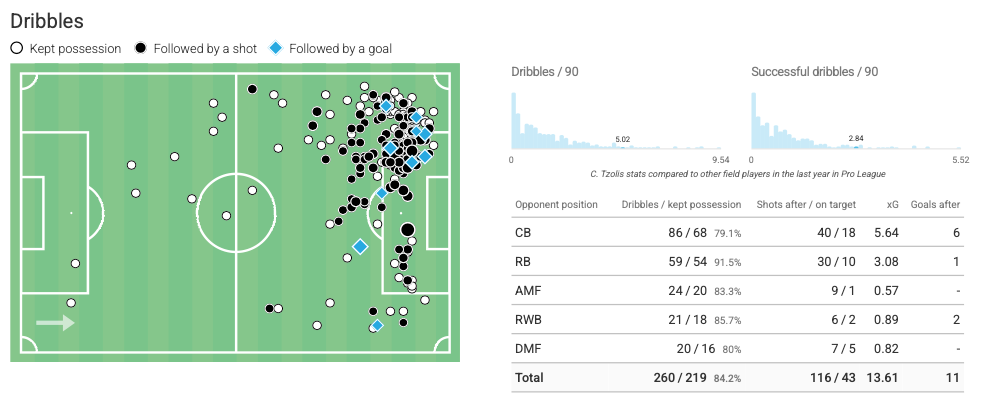
Tzolis has good control of the ball but displays a fairly limited repertoire of true dribbling moves. There’s not a lot of footage of sequences where he changes his pace or balance to bait a heavy step before completely beating them (i.e., getting around and past them).
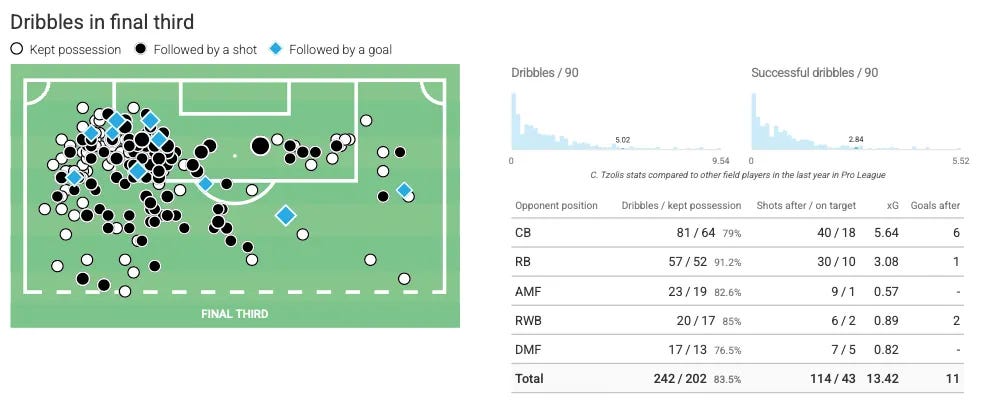
By Wyscout’s definition of a dribble (which is a wider definition than some other services use), he has 5.02 dribbles per 90, which ranks 21st in the league. He chooses his battles wisely and remains efficient when he decides to do it, largely because he isn’t the type to even try to beat full-backs 1v1 in settled situations when he doesn’t have a clear advantage.
He’ll absolutely dribble and shift in transition if he’s alone against a centre-back, and you’ll see above that he created 40 shots and 6 goals off those dribbles. He’s pretty appealing in those situations.
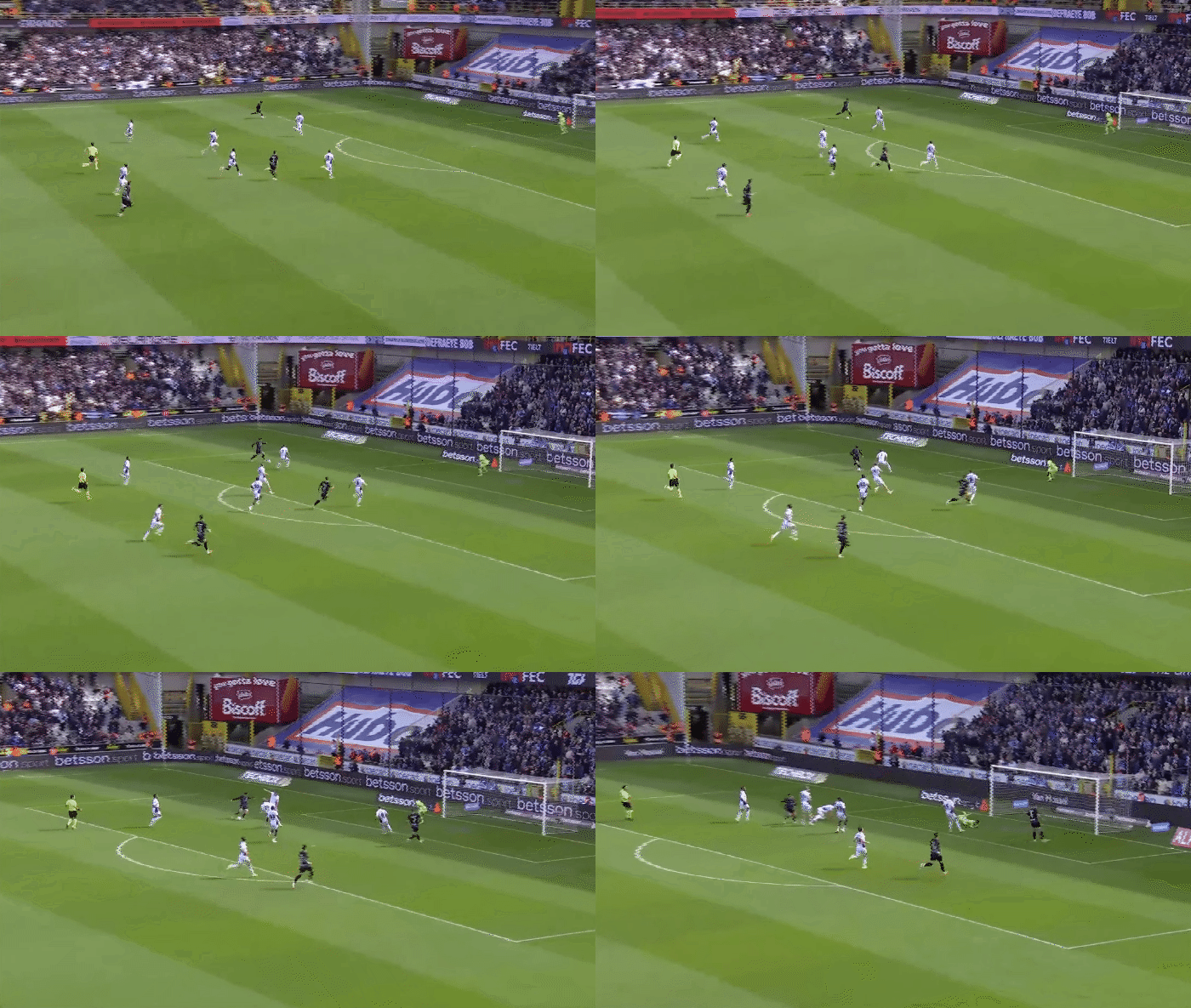
So many of these are about tilting-and-firing, when he finds the right moment to go diagonal and cross or shoot. This one’ll already look familiar after Girona, and it’s proof he can get this kind of shot off a defender like Koundé.
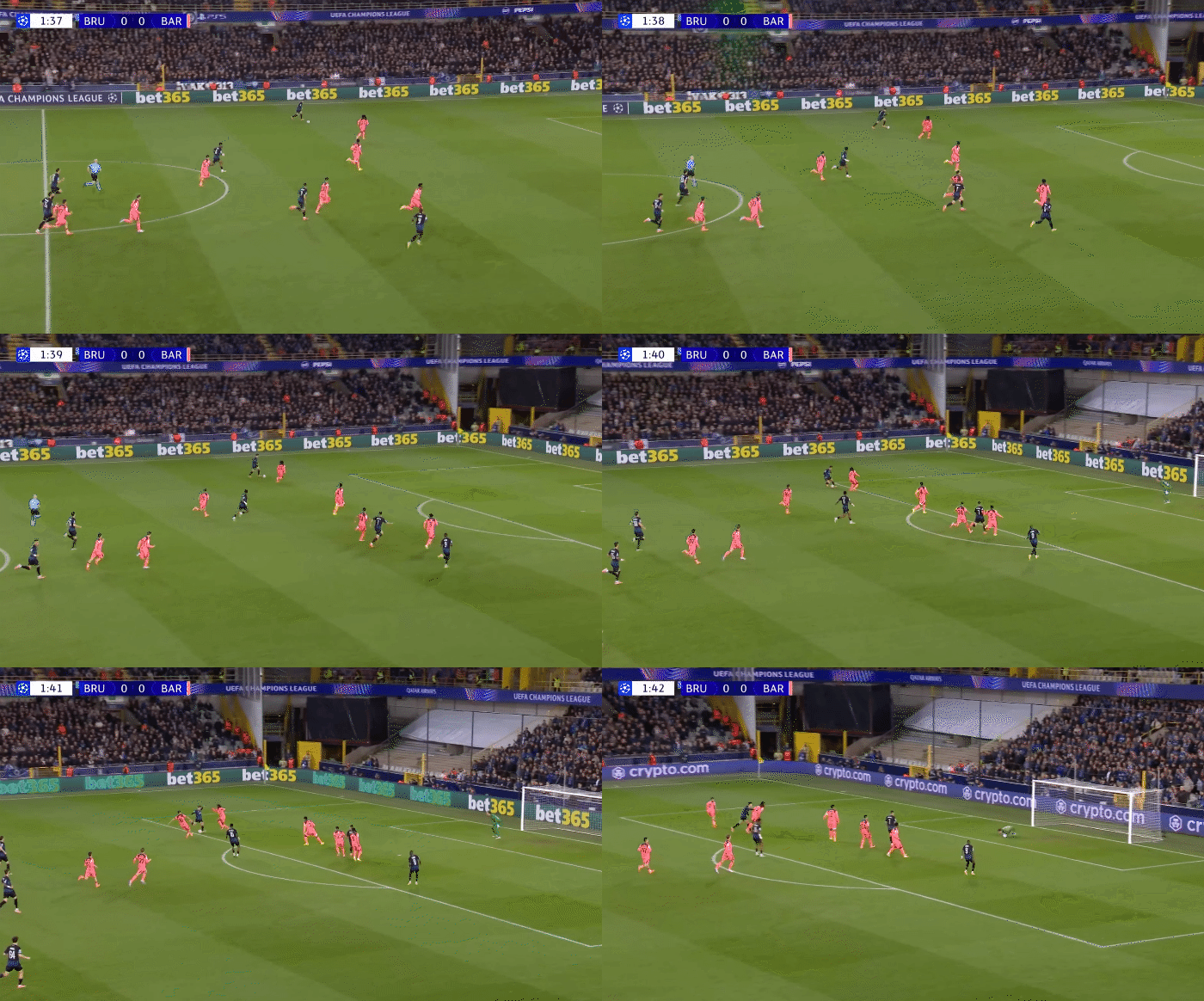
And in more settled situations, it looks like this, with a cross more likely.
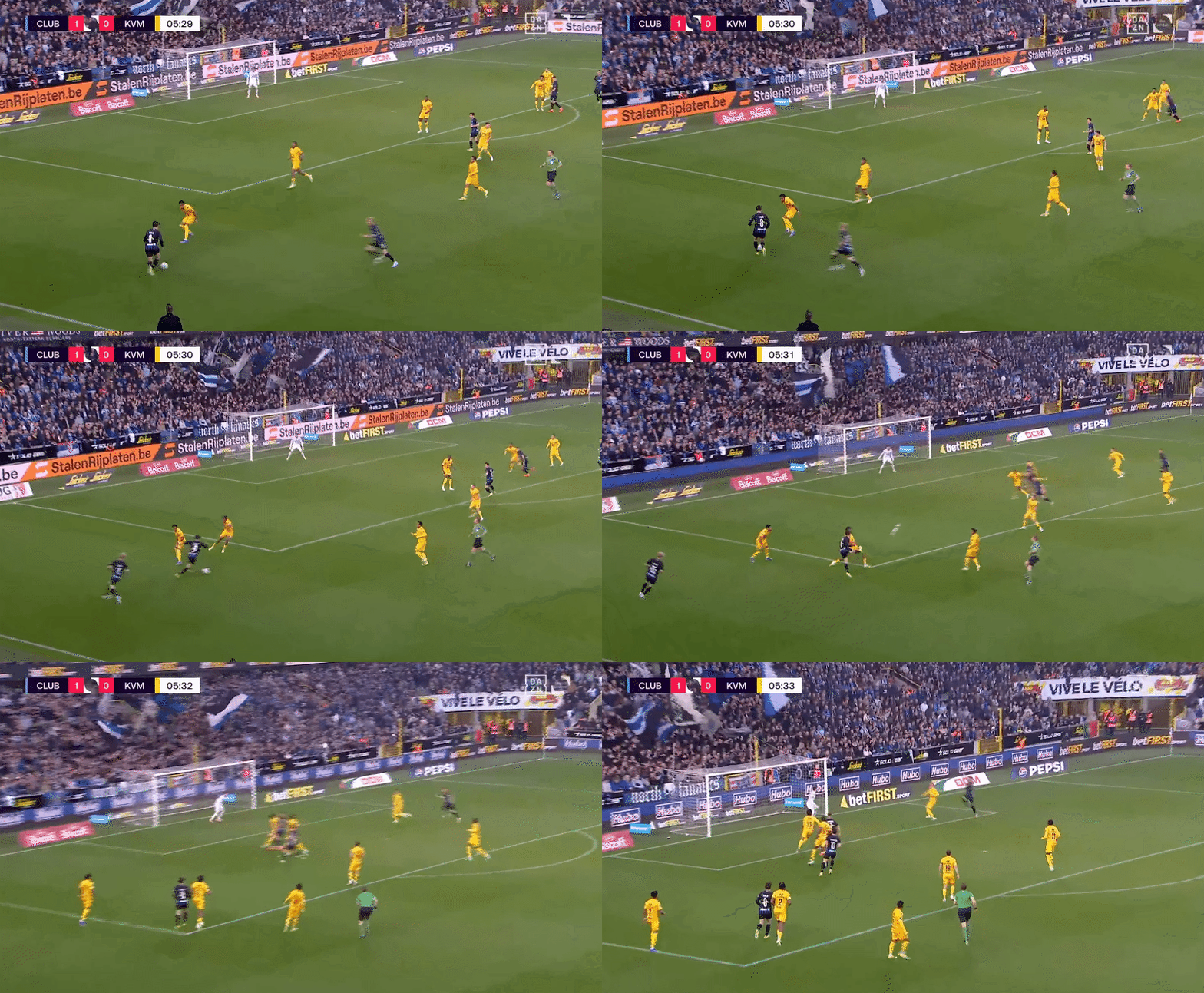
Here’s a more average example by him, just to give you perspective. His first steps are quick, he gets a defender to backpedal, but he’s not trying to get around them. He’s more trying to get a yard for a brute-force, direct final action.
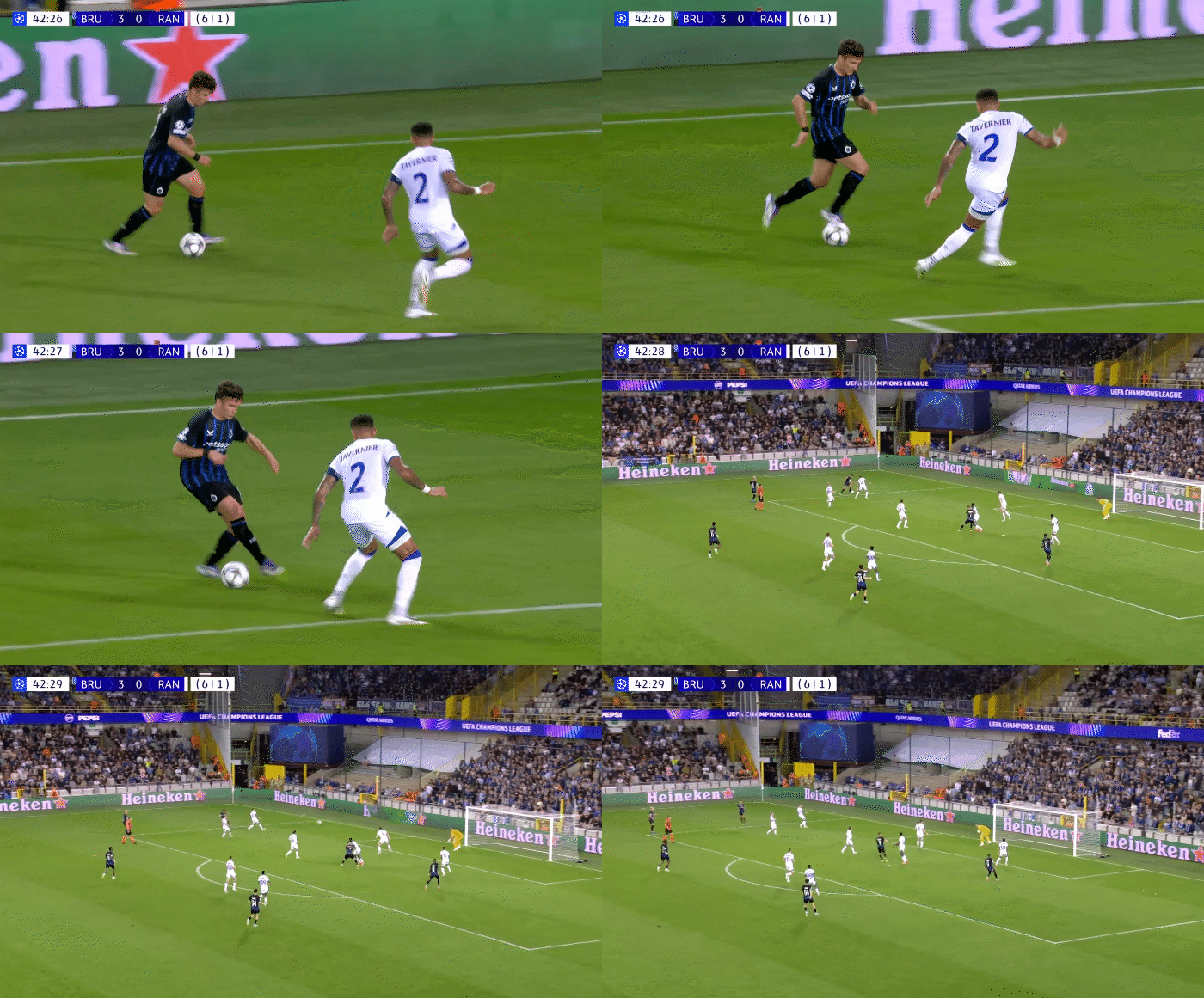
But dribbling is a young man’s game. And if he’s down in 21st as a 24-year-old in a league he’s dominating, it’s unrealistic to expect him to collapse a block with these direct attacking duels too much in the Premier League. And I also like giving him the ball with momentum, because there are times when he’s not the most demonstrative scanner, or he doesn’t use his hands quite enough. This can cause him to be surprised by the situation behind him.
What he does have is plenty of exit strategies to make a defender uneasy. He can go left or right, fire in crosses at different tempos with both feet, rip quick shots at will, and pass-and-move with the best of them. His tight-space manipulation is comfortable, but he doesn’t regularly demonstrate those sole rolls or little style moves of the most technical wingers.
The thing I checked most was how he looked physically against the likes of Matty Cash, Axel Disasi, and Ben White. He didn’t overpower any of them, and he didn’t look overmatched either. Some of his quickest actions (fired-in crosses or shots) still came off. Mostly, he is intensely realistic. If he doesn’t have a beat on somebody, he isn’t going to attempt lost-cause dribbles or lose the ball repeatedly. He’s going to try other things.
That shows up in the data when you compare his work in Belgium to that in the Champions League. His dribbles and progressive runs fall, but his success rates actually rise.
He doesn’t feel like the type of player you want to leave isolated on the touchline without help. Once he has co-conspirators, he can do some damage.
👉 Carrying
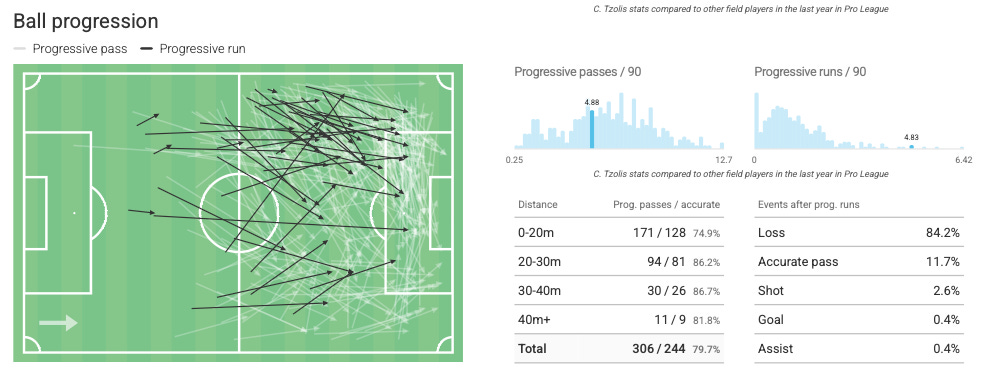
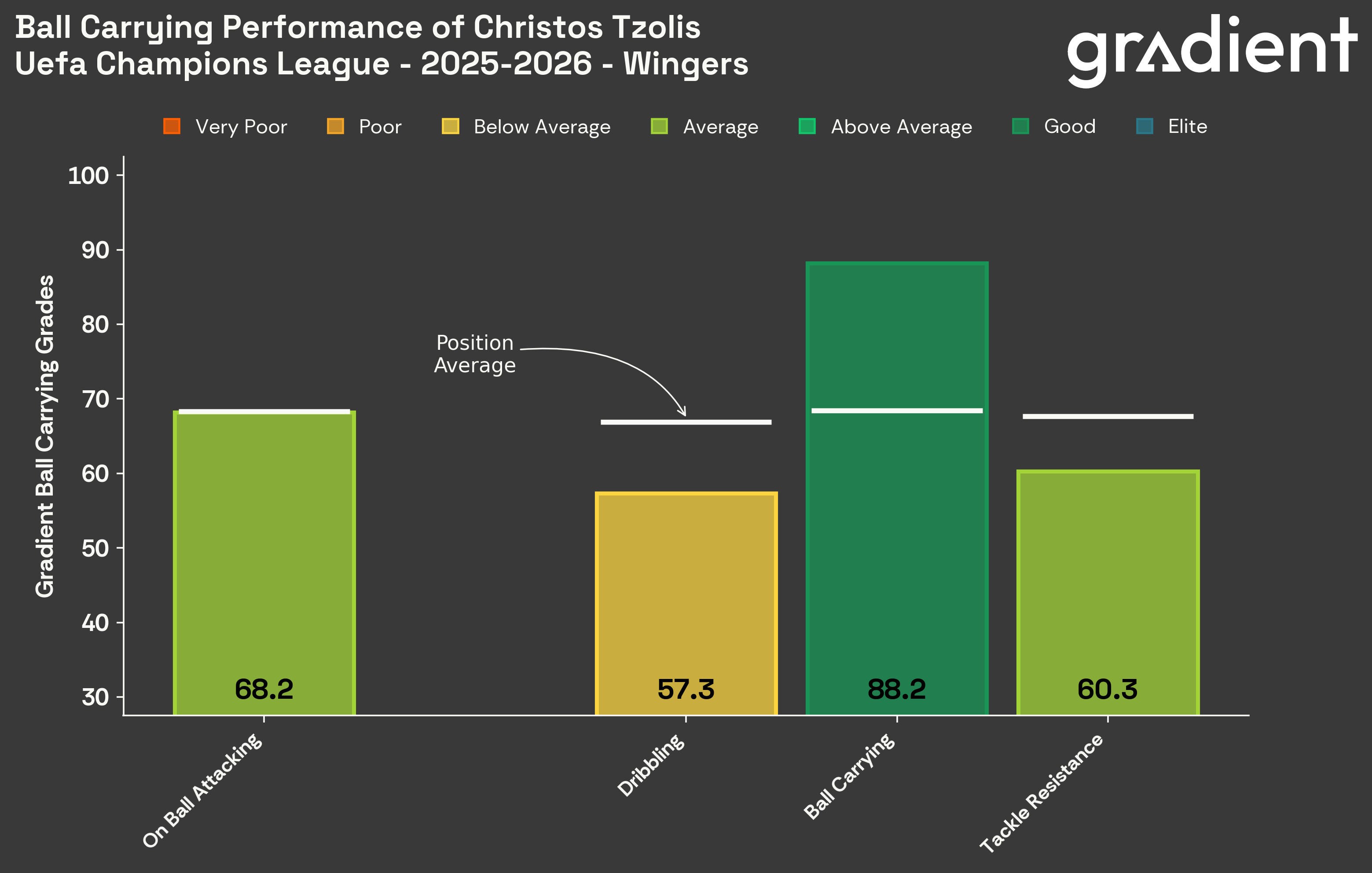
Tzolis is an effective carrier of the ball. He’s an extremely opportunistic “rest attacker,” cheating high when the ball is won.
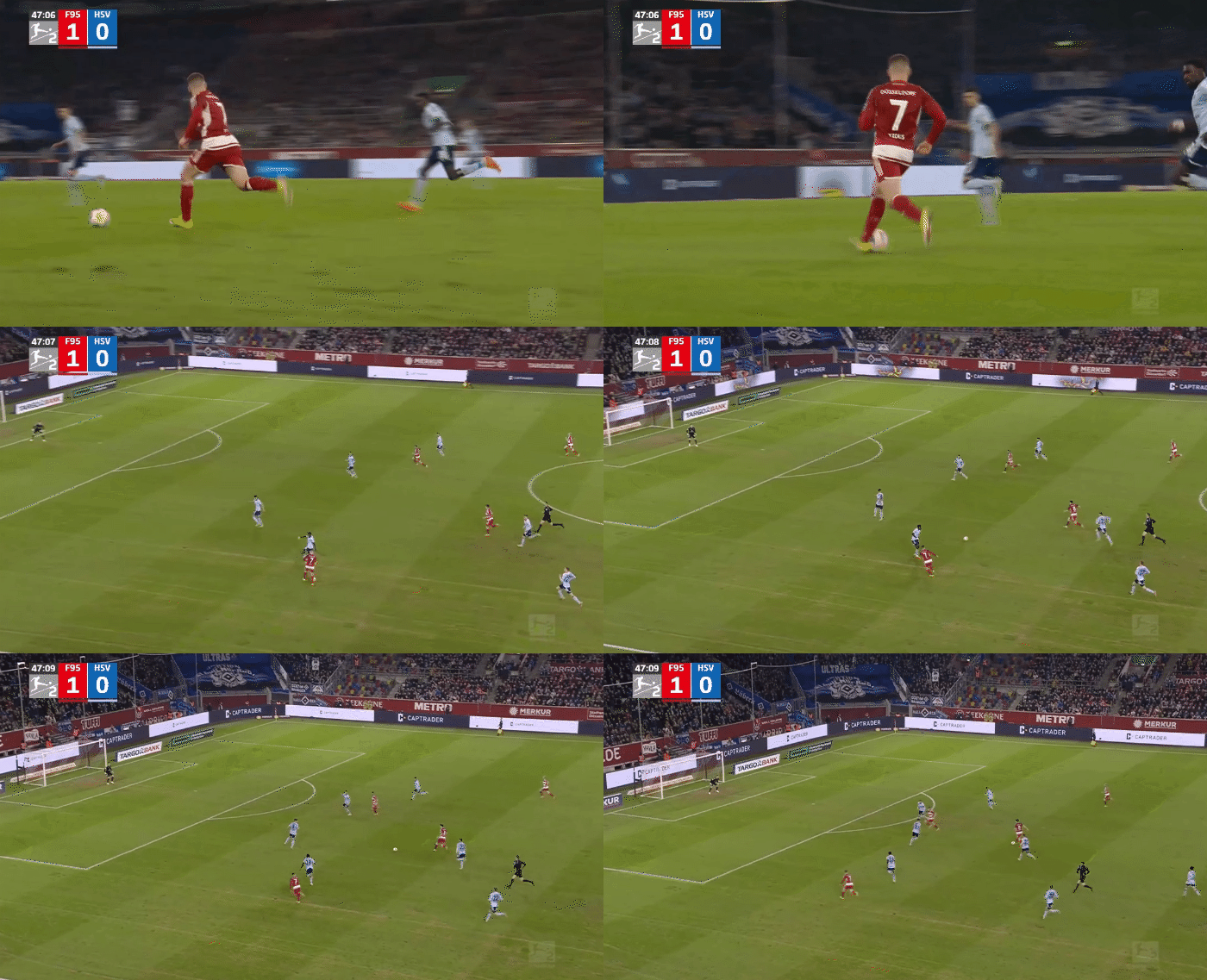
In one of the goals we already covered, you can see the inciting incident. As soon as the opponent started looking liable to lose the ball in possession, he was off to the races. I could screenshot a lot of these situations, where he is the first to smell blood.
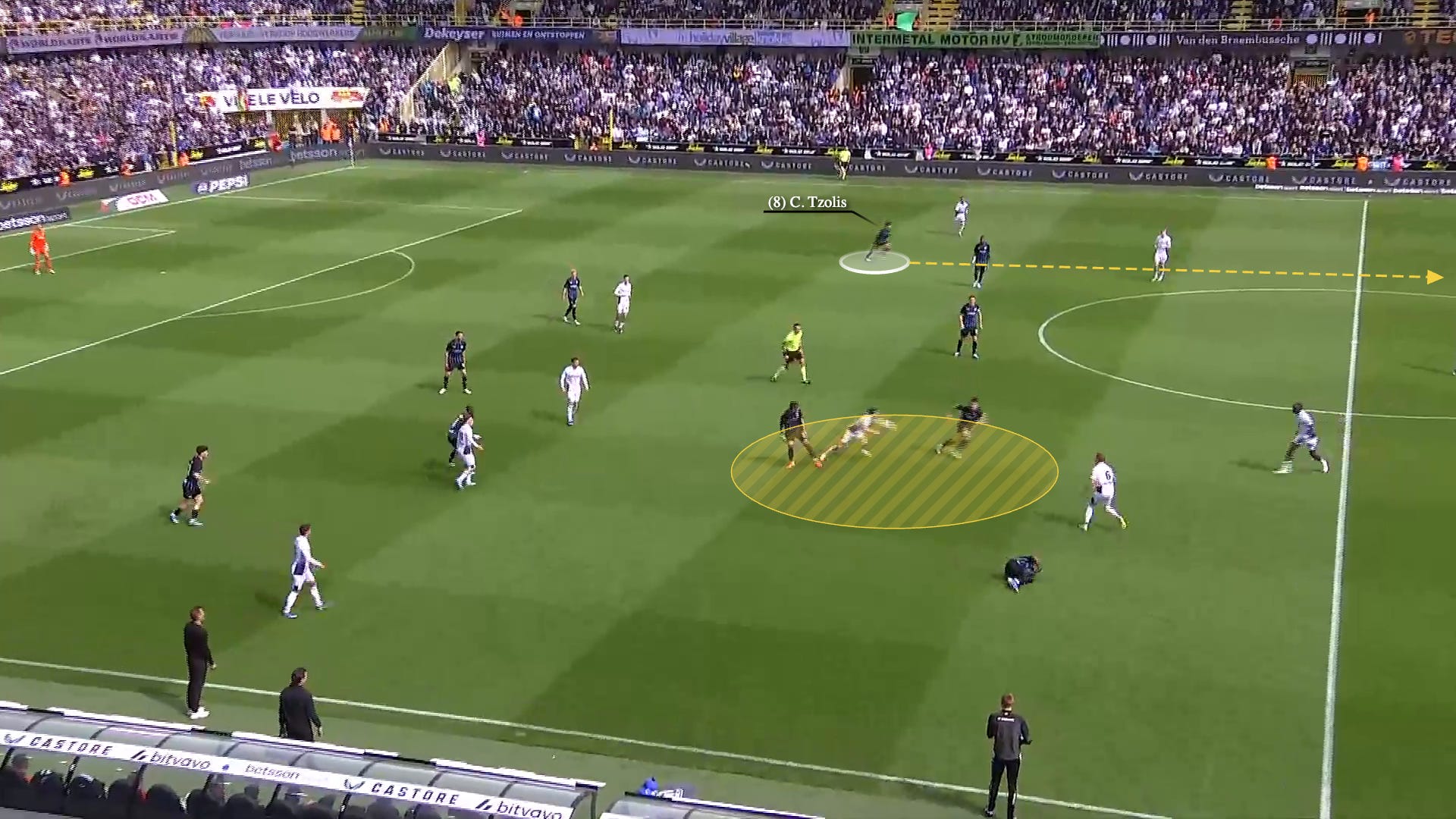
From there, he can get up to speed quickly.
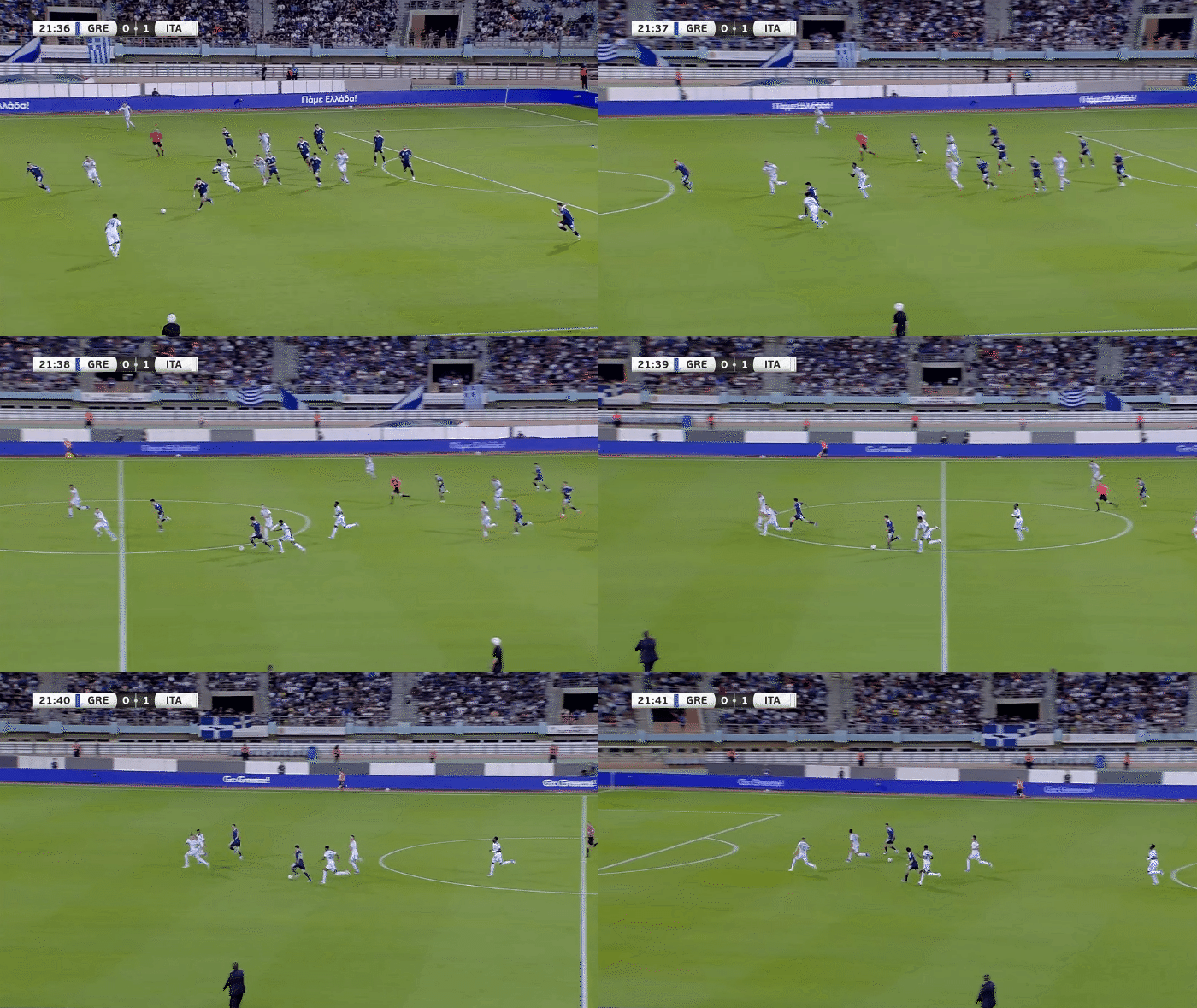
His top speed isn’t at the top echelon, so I have a concern about him getting caught and dispossessed on these longer carries.
That said, his judgement on carries is absolutely sublime. There are endless clips of him driving forward and delivering the ball or shooting at exactly the right moment, as ruthlessly direct as possible. It’s hard for defenders to jump his timing because he doesn’t need to slow down to execute his action.
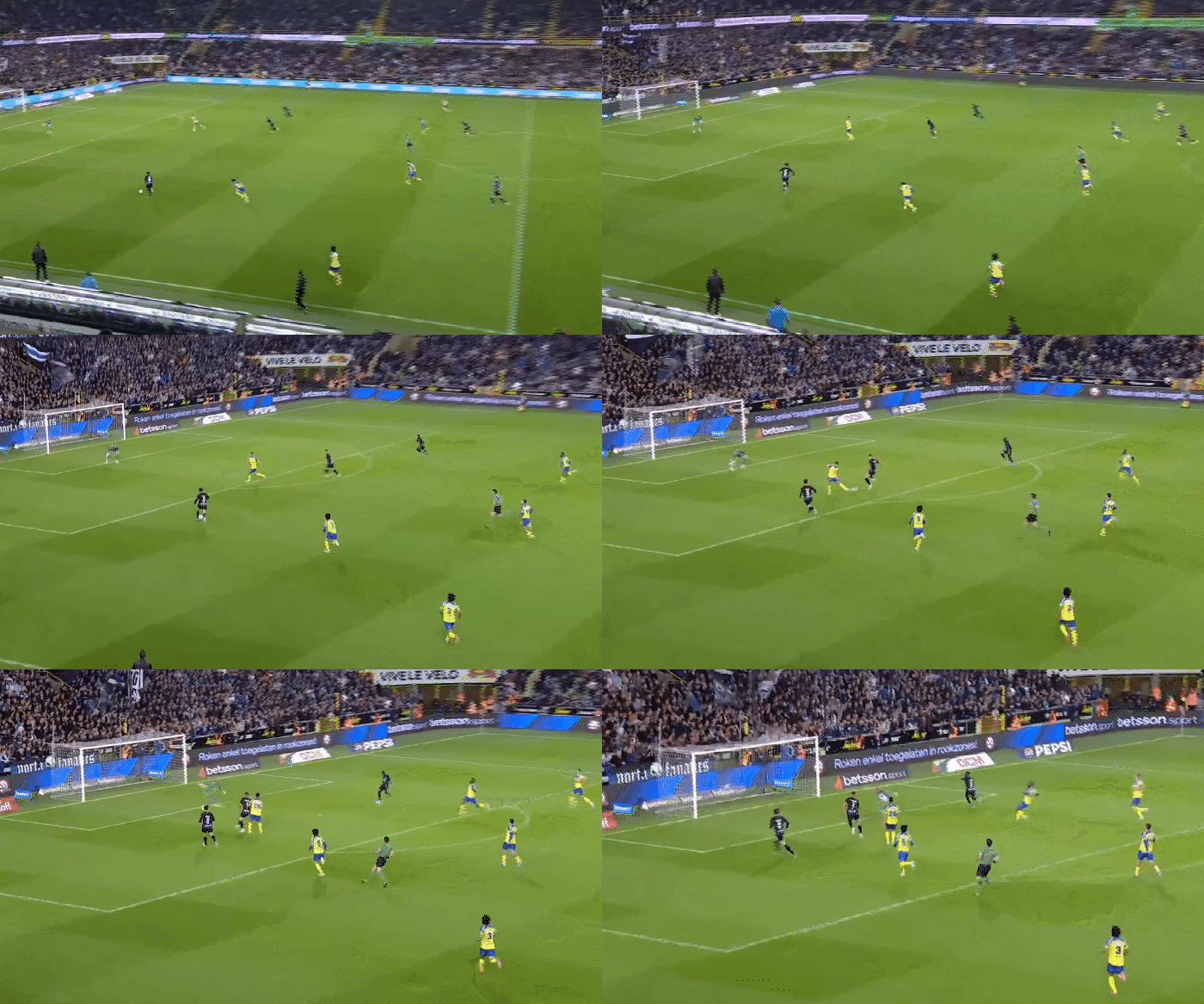
With play so often originating on Arsenal’s right, he projects well at receiving and driving through the middle, and he can pick up interesting positions off loose balls or broken presses, carrying and then distributing the ball.
…and in the Champions League, a lot of this is borne out in the on-ball grades from Gradient.
🔥 Movement
Tzolis’s movement is one of his most attractive qualities. He runs a lot, and he runs well, and does so in a way that shows a keen understanding of how to manipulate opponents and their blindspots.
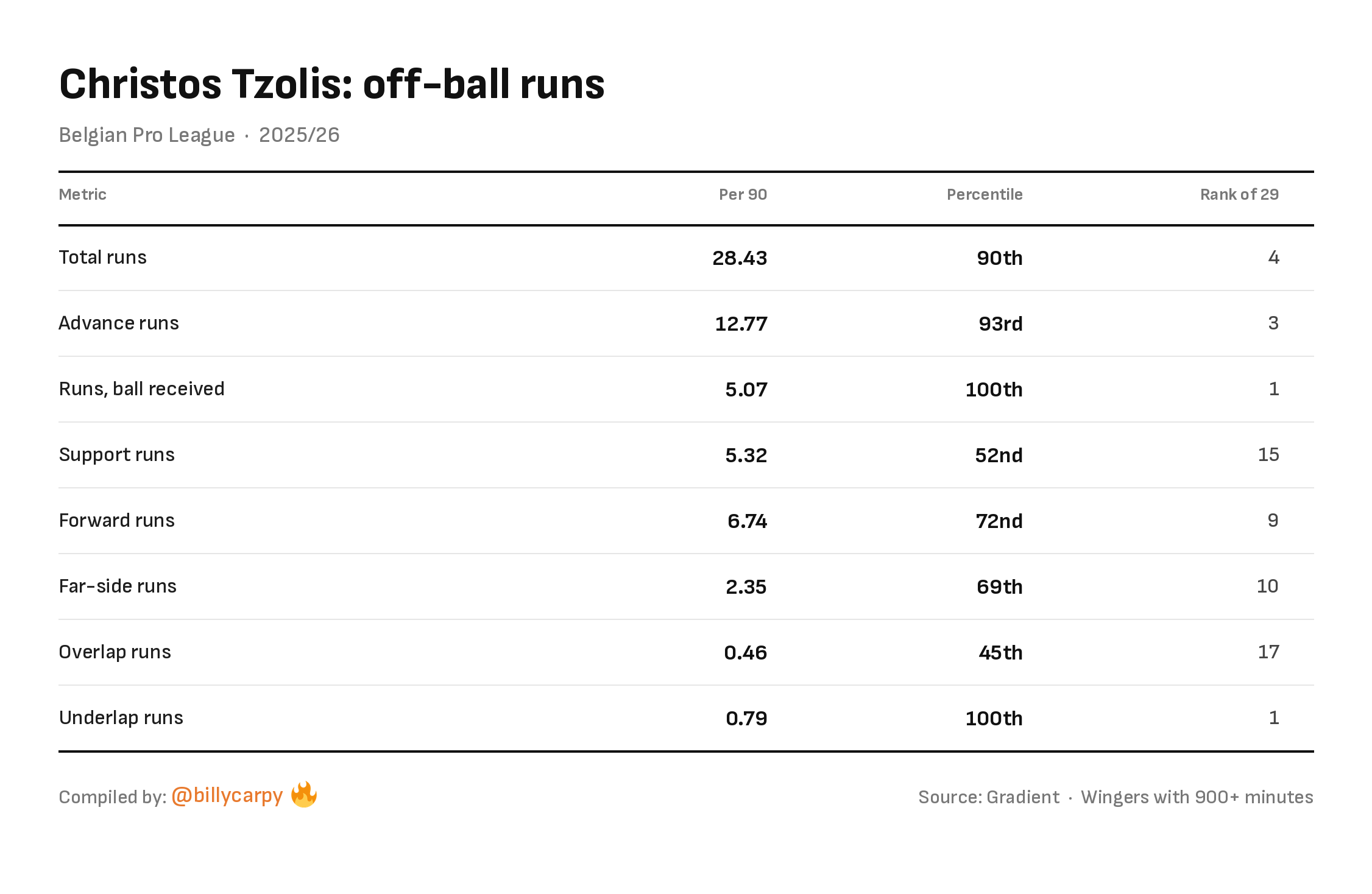
As we see there, he is amongst the league leaders in total runs, advanced runs, and forward runs, and he leads the entire league in runs where he receives a ball (indicating both responsibility and quality), as well as in underlapping runs, which is an interesting tidbit.
👉 Forward runs
The first thing that keeps standing out is how he can get teams sleeping on the counter, and is often the first one reacting.
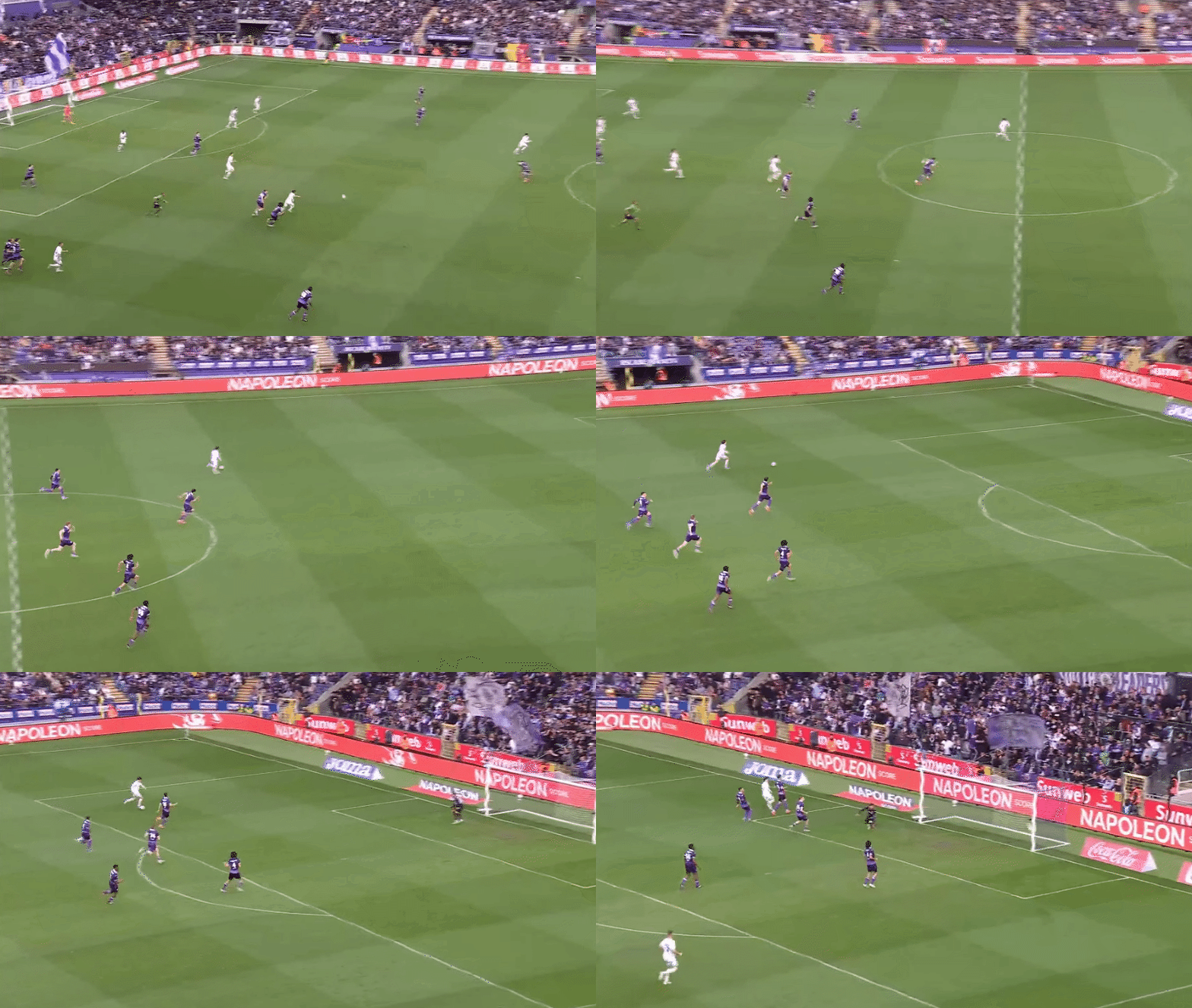
If you screenshot that clip, it’s a big compliment to him. While he’s got a step on everybody, it’s much harder to score from a situation like this than it seems. You need your left foot, and you need to act immediately, or all the space will dissolve.
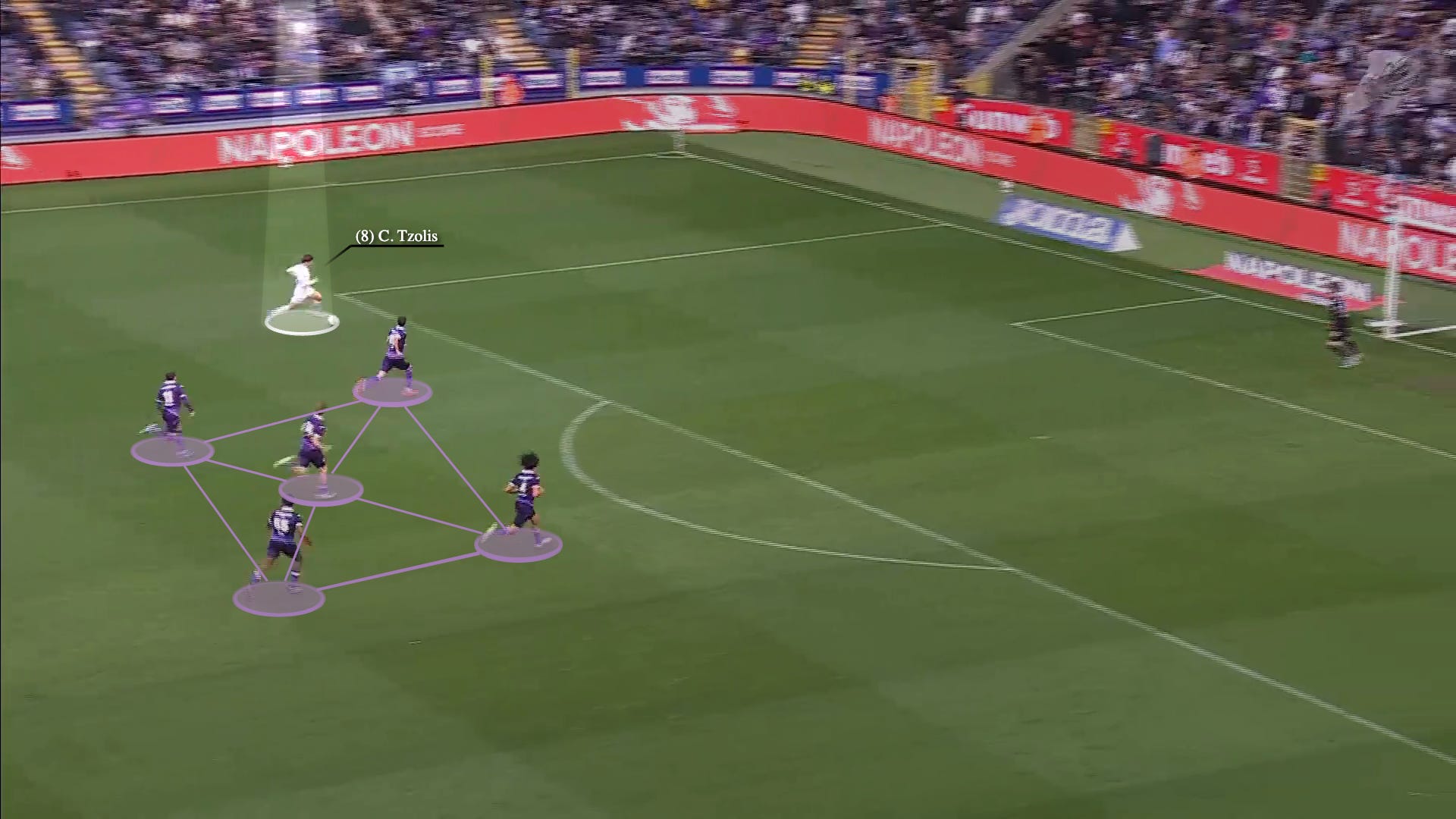
This quality of leaning forward is a recurring theme, as we saw earlier.
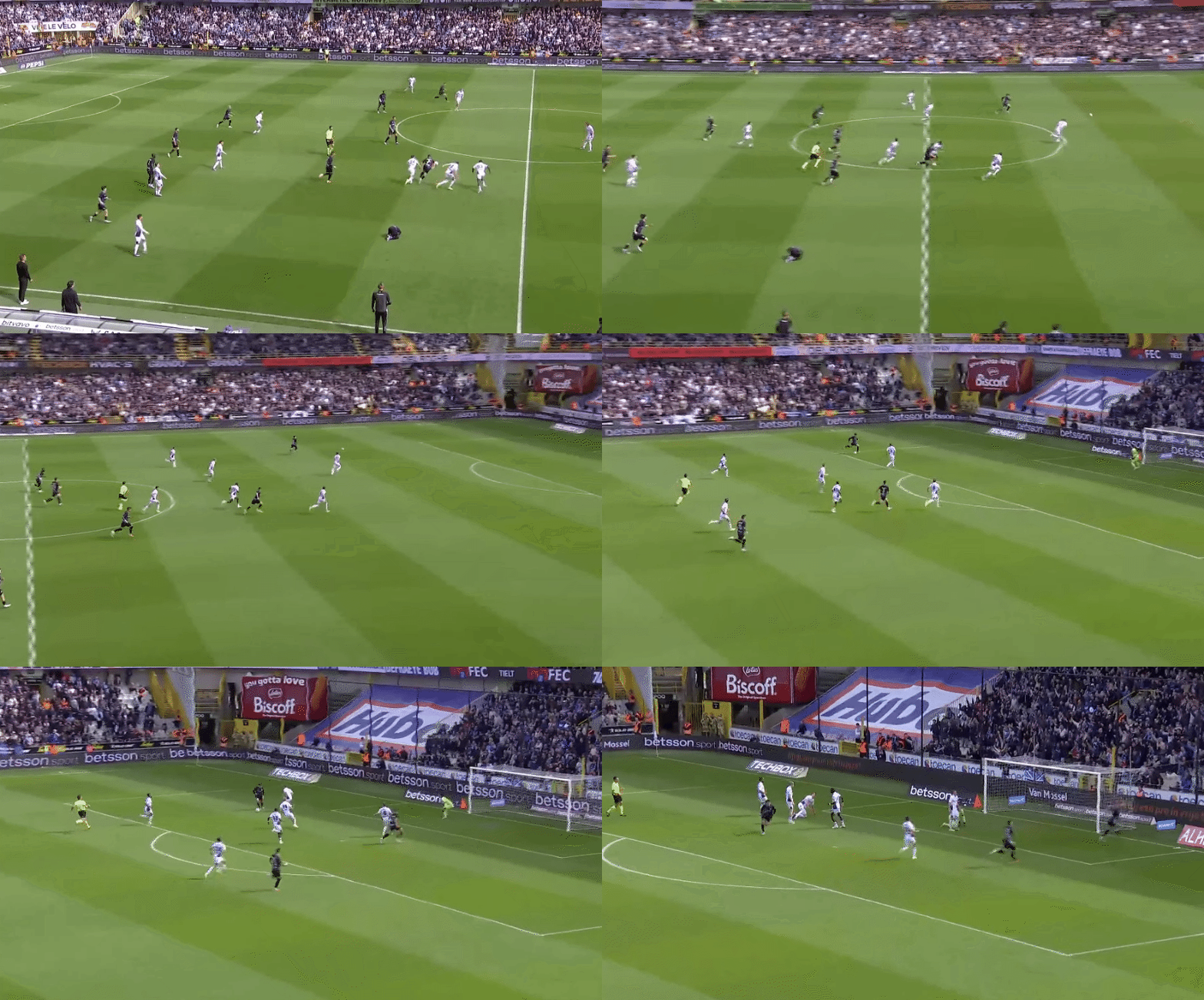
Here, he keeps grabbing space on the blindside.
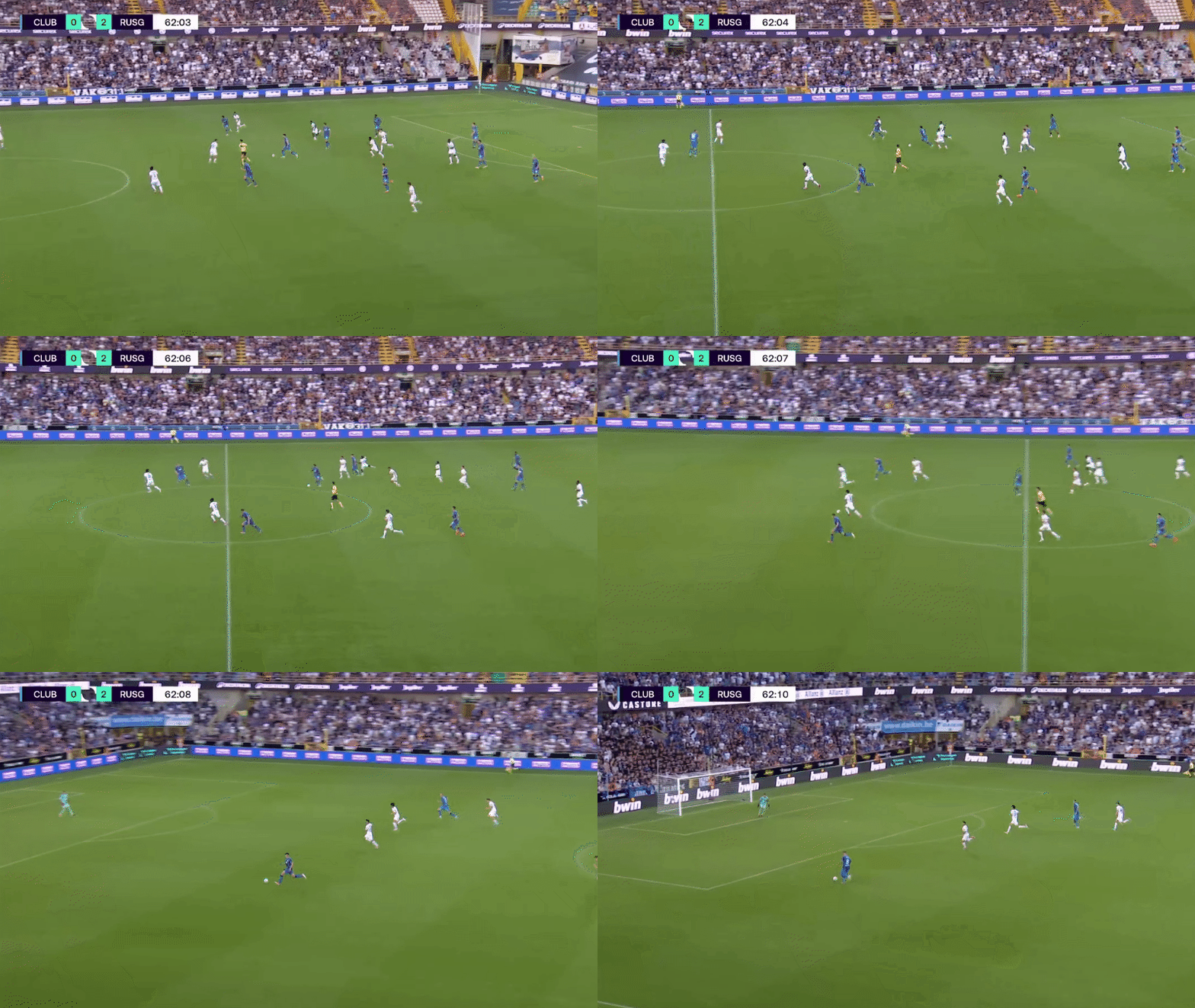
I would add that I’m not sure he’s best used in those mega-deep block games, where we defend for 90 minutes and try to counter from there. The deeper we defend, the more distance that he’ll have to cover on the counter-attack, which is more time for the opponent to catch up, considering his lack of Martinelli speed. Tzolis is better when we’re playing in a higher block, and he can nudge forward.
👉 Tight-space movement
The knack for movement applies to his work in more congested spaces, as well, perhaps even more so. This is the kind of move that you hope will translate.
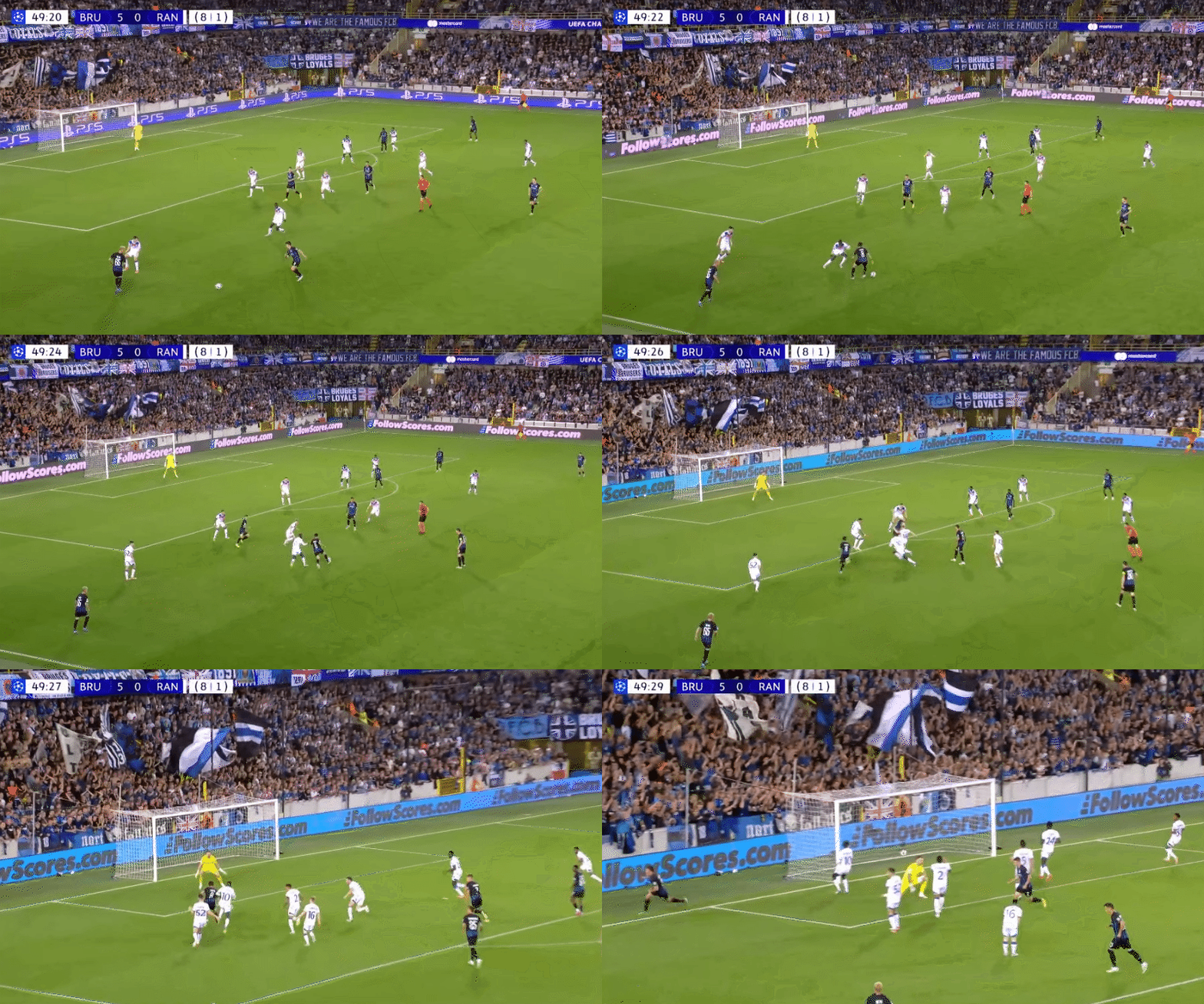
…and this is probably the most indicative clip of the whole thing.
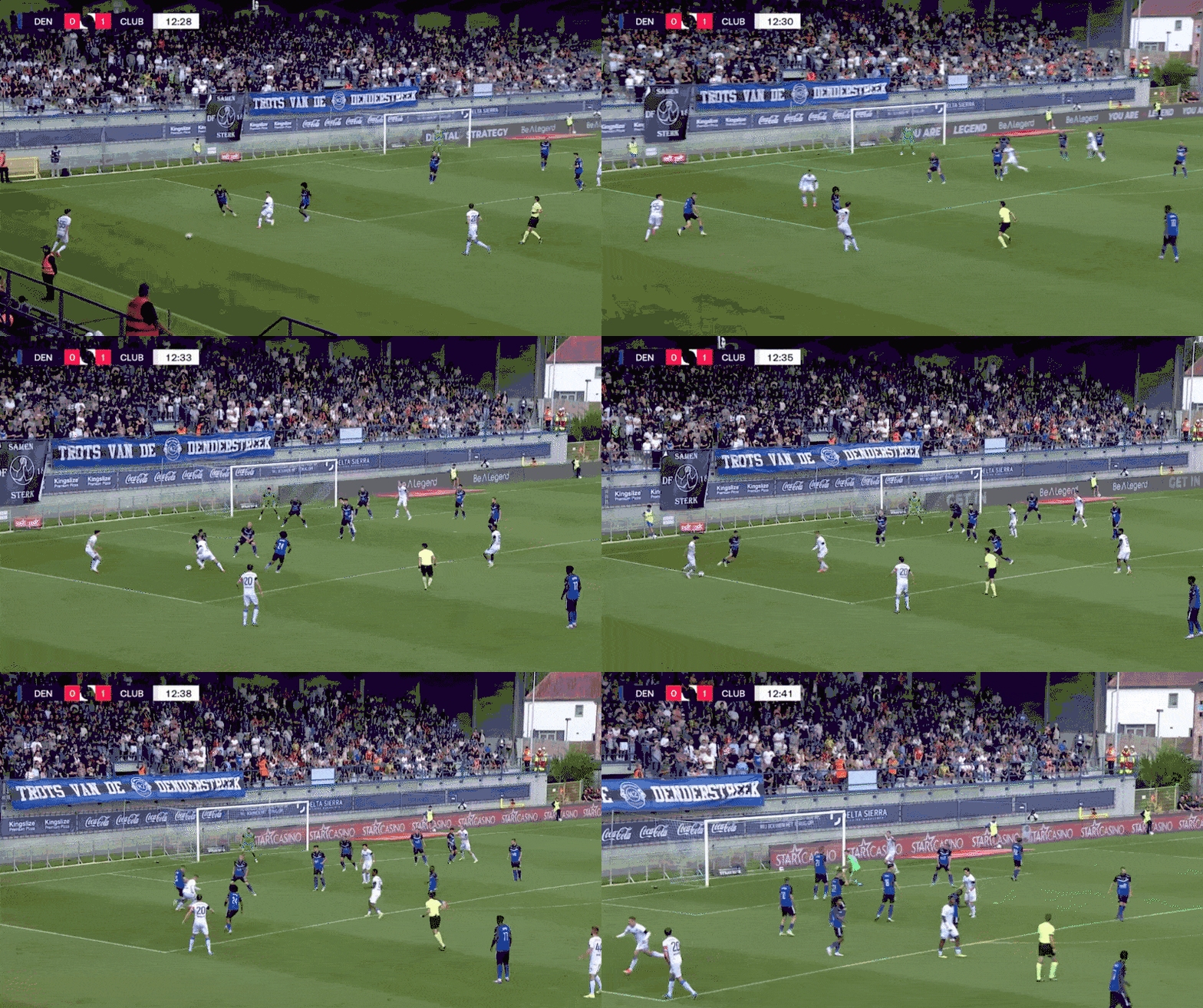
One can imagine him playing in a wide triangle with the likes of Calafiori and having a lot of fun. And in truth, this isn’t too poorly defended, nor would Premier League defending necessarily change things too much here. He can just keep moving, deking, moving until he has a small crease and then he fires it in.
He’ll keep garnering comparisons to Trossard, but in that game-winning goal against West Ham…
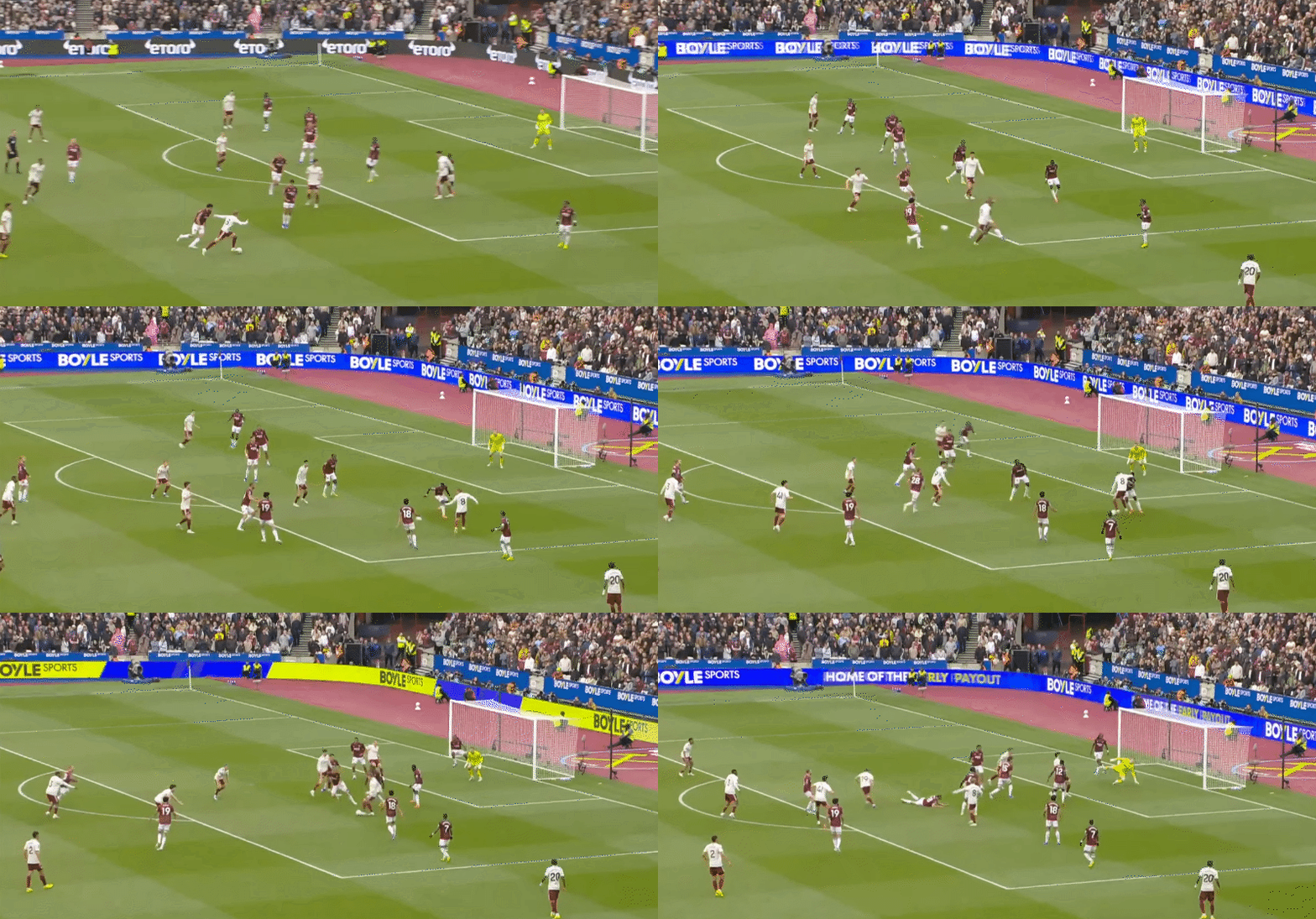
…the player Tzolis may have most closely resembled is Ødegaard.
👉 Shoulder runs and underlaps
Something I find to be refined is how he can quickly adjust himself to the play to be in the defender’s blindspot.
We see that here for Fortuna, in which his teammate gets free on the carry through the middle, so he offers the complementary diagonal run, and then loops around onto the shoulder right when the defender has to angle himself to the ball-carrier.
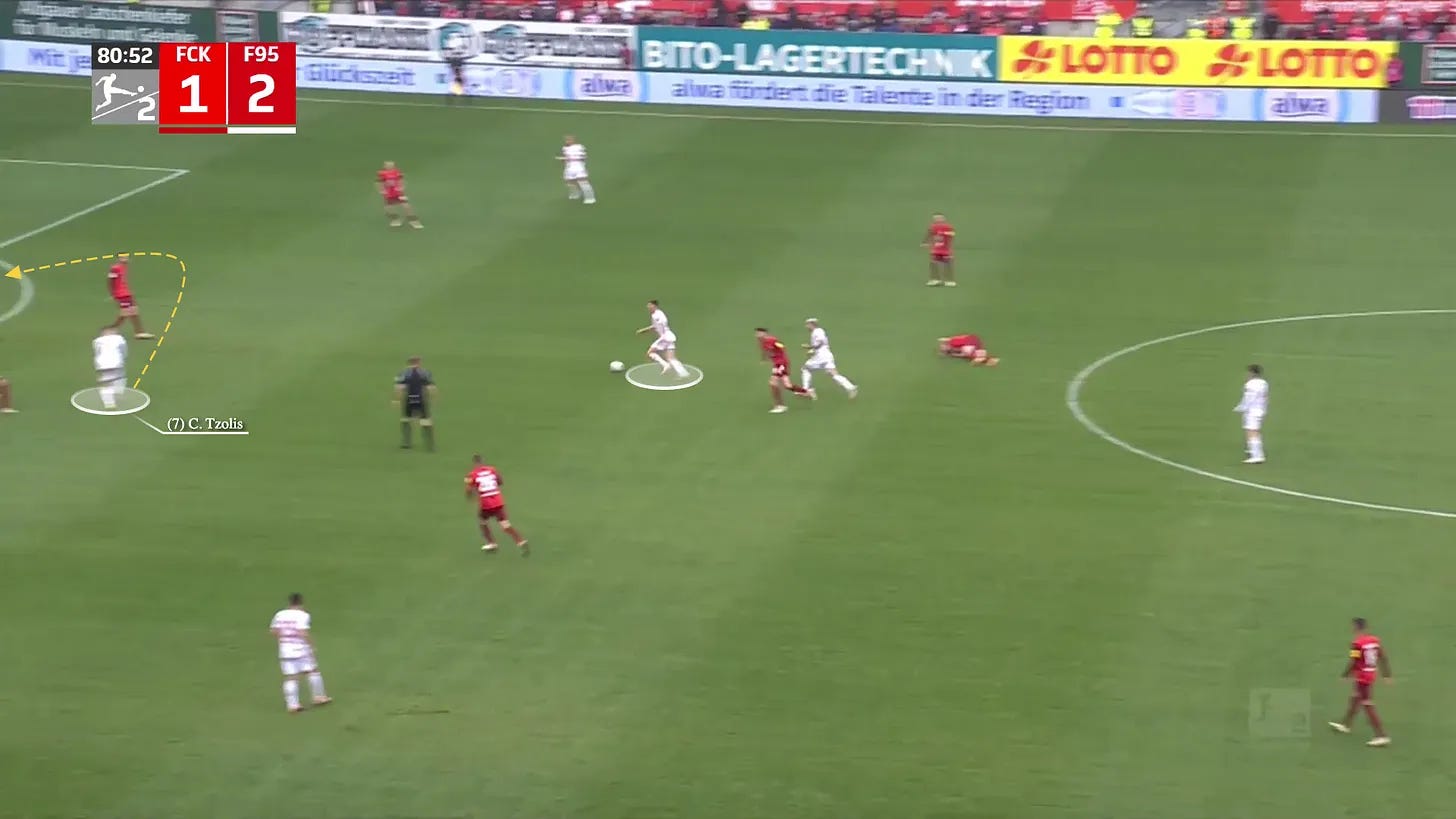
That means he inevitably gets lost, because it’s almost impossible to track a carry like this and a run like this at the same time. He sneaks in for the goal.
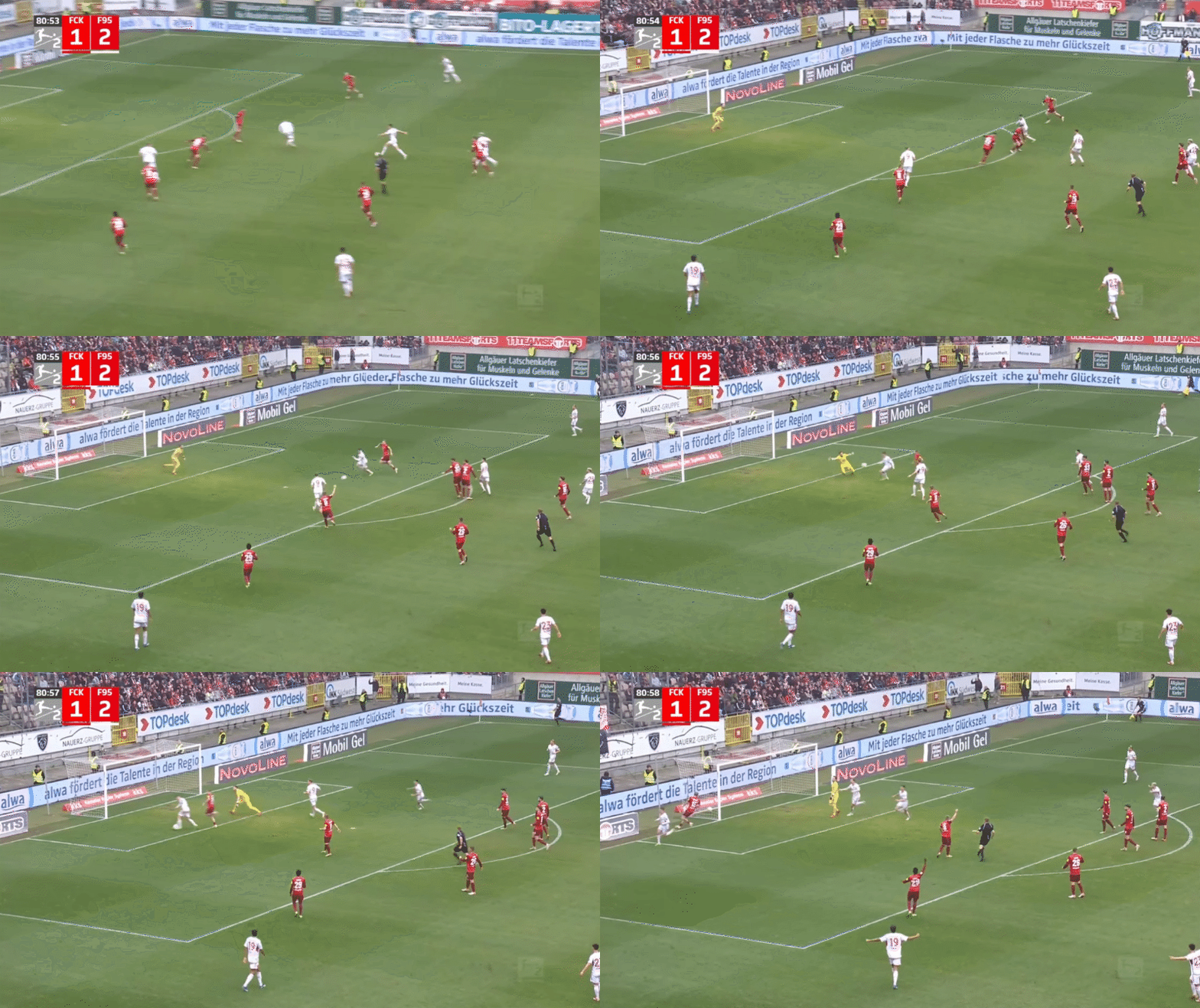
Perhaps his most effective run is the underlap, particularly after he’s released the ball. As we saw, Gradient credited him with the most underlaps in the whole league, which is surprising coming from a winger, and I think they have a fairly narrow definition.
The standard way we’ll see these underlaps come about is like this.
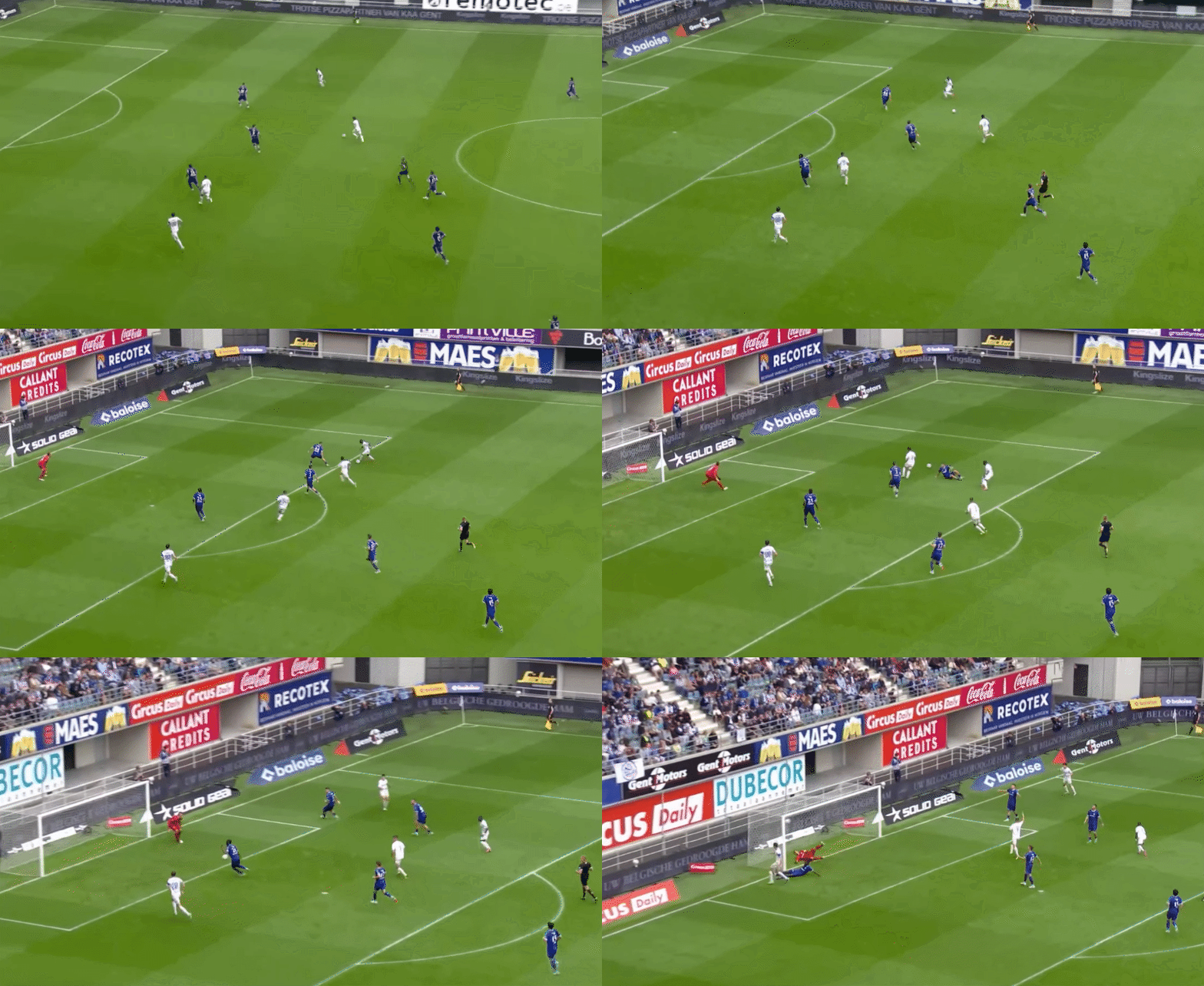
And in more settled play, he’s always passing and moving, not unlike Calafiori.
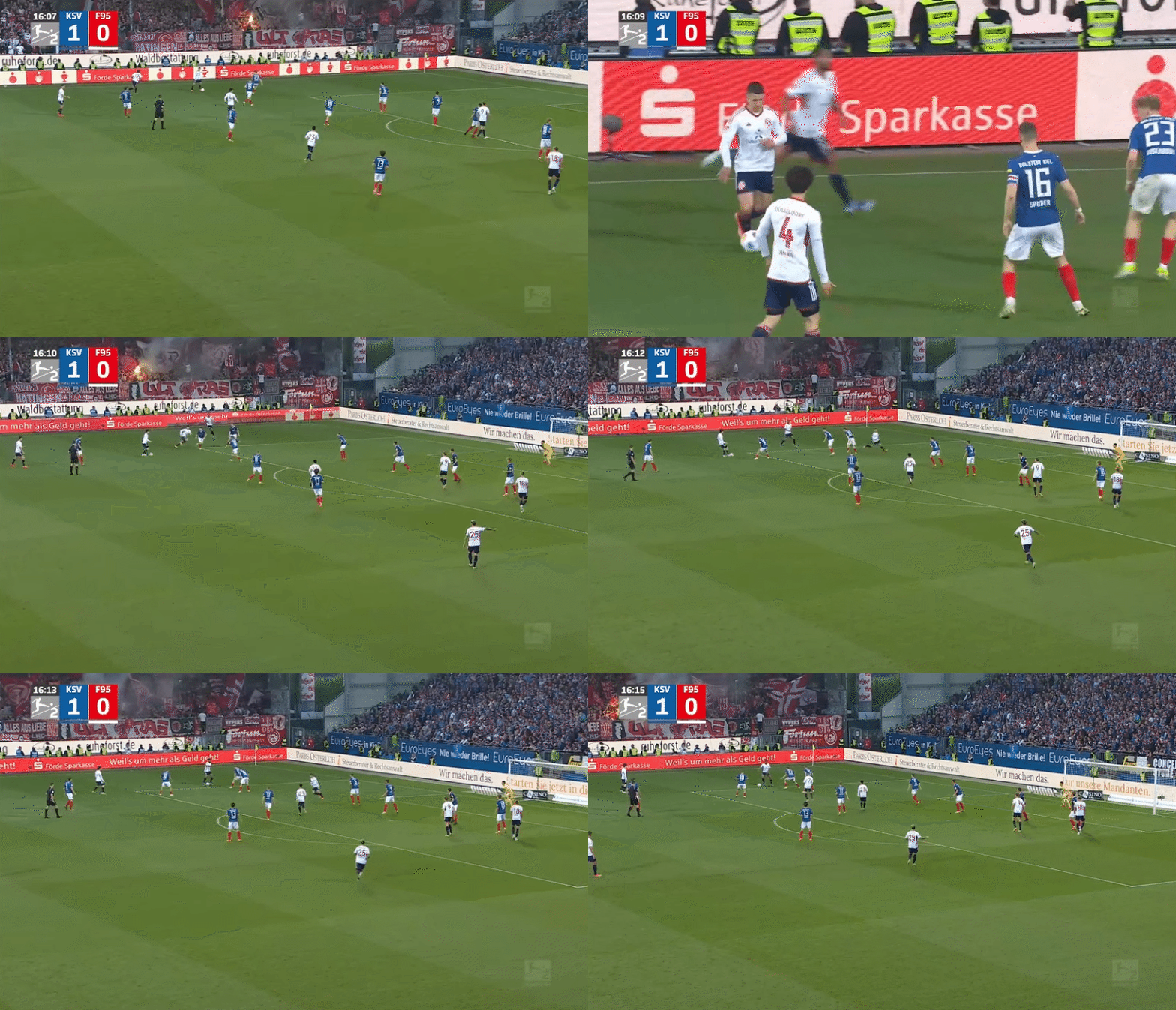
Even the best dribblers in the world can find it difficult to beat a 1v2 in a settled situation in the Premier League. A bet on Tzolis is a wager that this kind of quick movement, quick passing, and quick shooting is just as viable an option.
👉 Arrivals and back-post runs
Tzolis, again, has a good feel for timing in the box, and has scored a lot of goals by waiting as the line is pushed back, so he can find the soft spot in the “second six-yard box” where a majority of goals are scored.
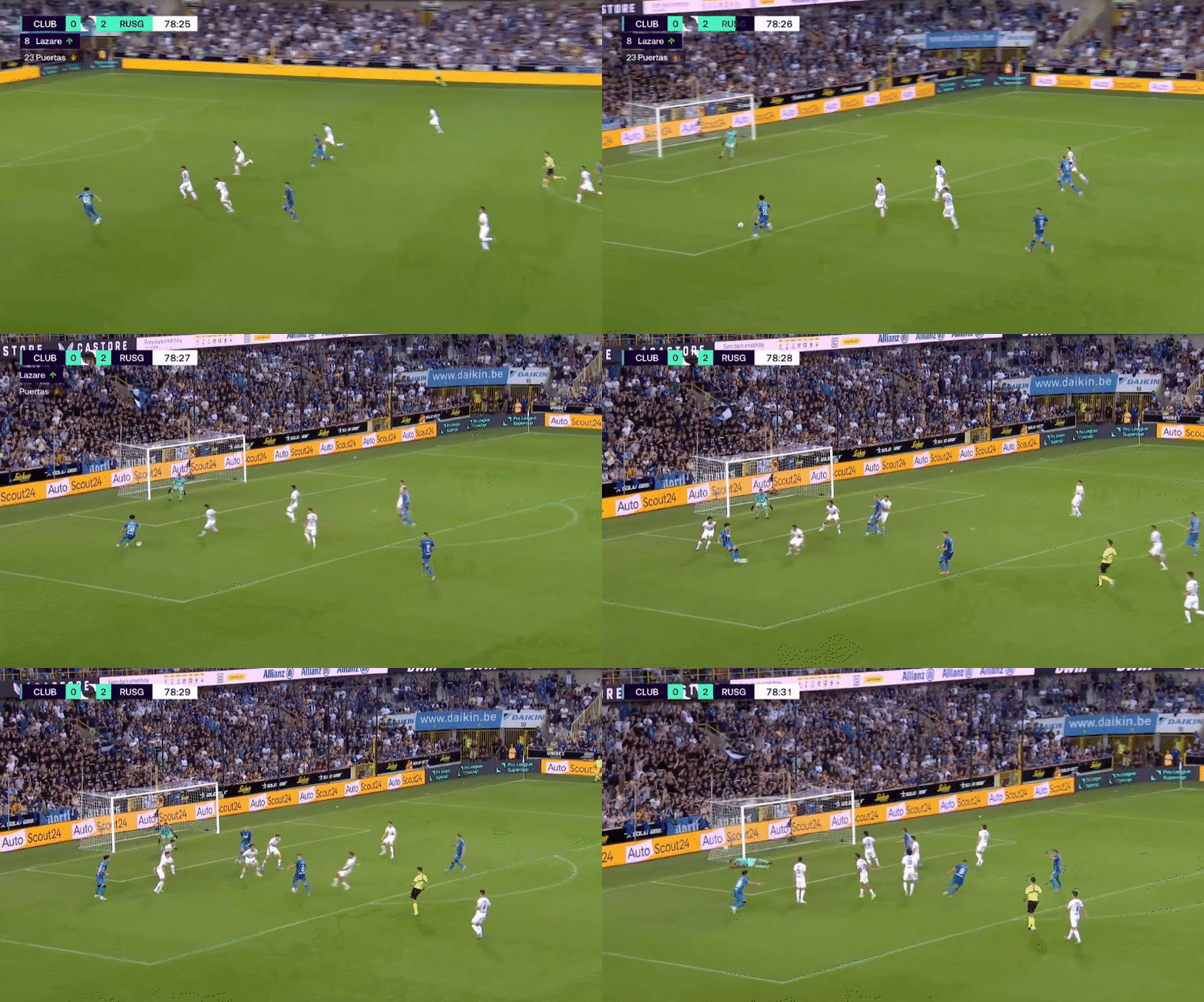
We’ll get into his shooting later (spoiler: he generates quick power in crowded situations), but I haven’t seen him do a lot of “pure” back-post arrivals in settled situations. It feels like he has the tools, but whether it’s because of tactics or play styles, he hasn’t found himself in those spots a whole lot.
🔥 Passing & interplay
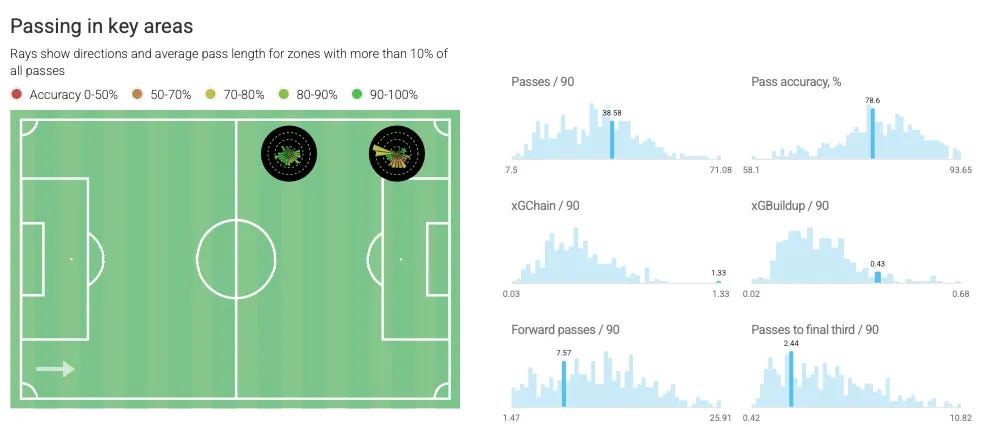
When you picture a creative outlier, you may imagine Neymar or Kevin de Bruyne, spraying the ball around at will. Tzolis, on the other hand, logged 23 assists with a different bag of tricks (though he does have KDB’s underlap+cutback move).
I haven’t seen too much to suggest that Tzolis would struggle in deeper areas, but he generally stays high. His numbers are better for creating within the final third than for advancing into it. He’s been on the ball more than a typical Arsenal left-winger, as we’d expect from a star of a lower league, but given how many goals he generates, he’s not terribly ball-hungry, and his touch-to-chance ratio is still quite high.
You really have to watch a full Belgian league game to sense how much of a looming shark he can be. Whenever somebody logs 40 G+A in 36 games, it’s no stretch to say there’s a Salah-like feeling to his impact, and, like Salah, he’s not always on the ball, but whenever he is, it feels like a near-certainty that something is about to happen.
Elsewhere, when compared to top wingers in the Champions League, he fares pretty well. This is almost exactly how I’d score him by eye in all these categories:
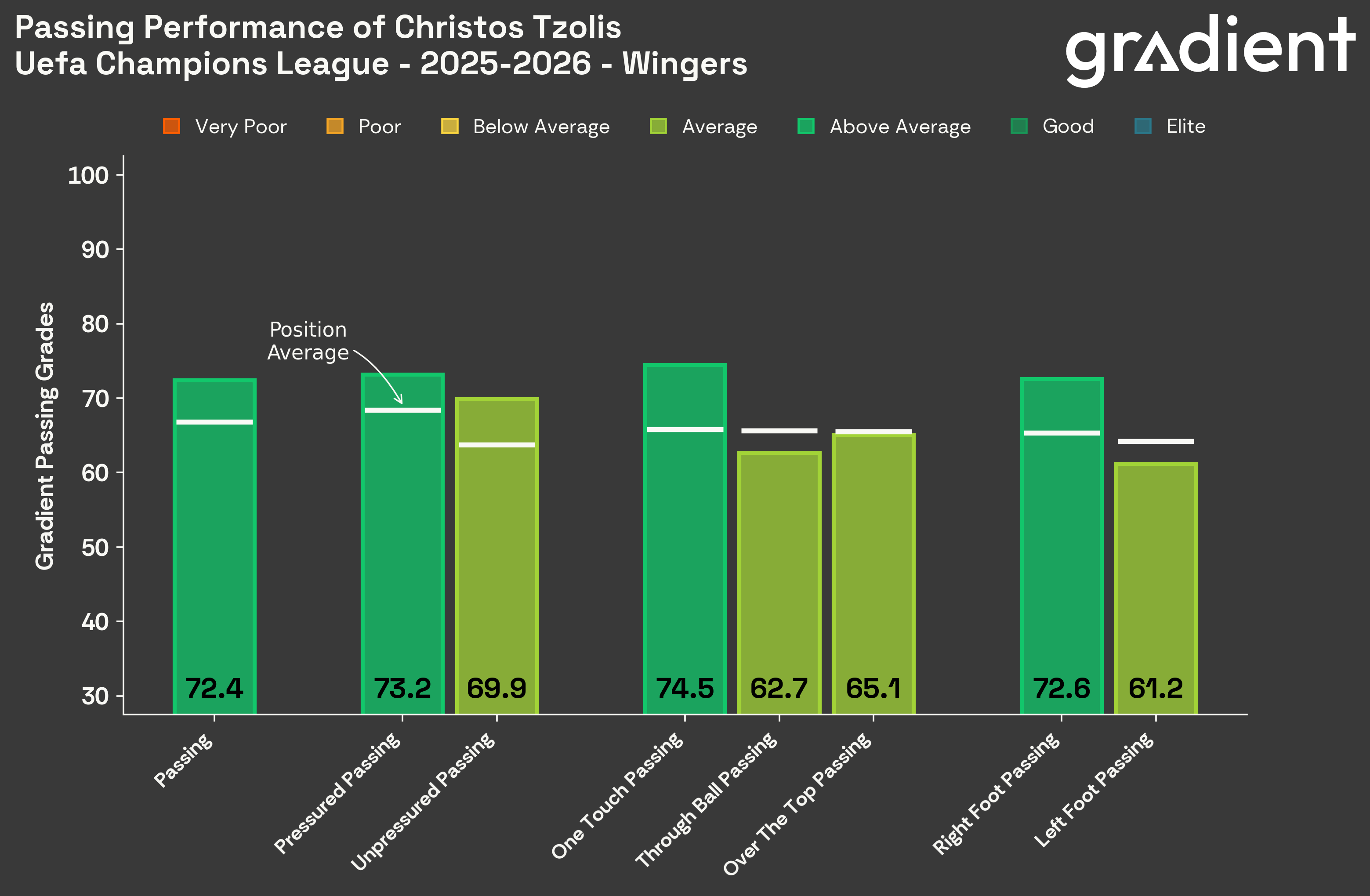
As a receiver, he is mostly clean, but not in that perfect, 10/10, can trust-it-regardless kind of way. He has bouncy receptions here and there for sure, and isn’t always well-prepared for contact through the back.
He is most skilled at receiving through, either in behind or on the outside.
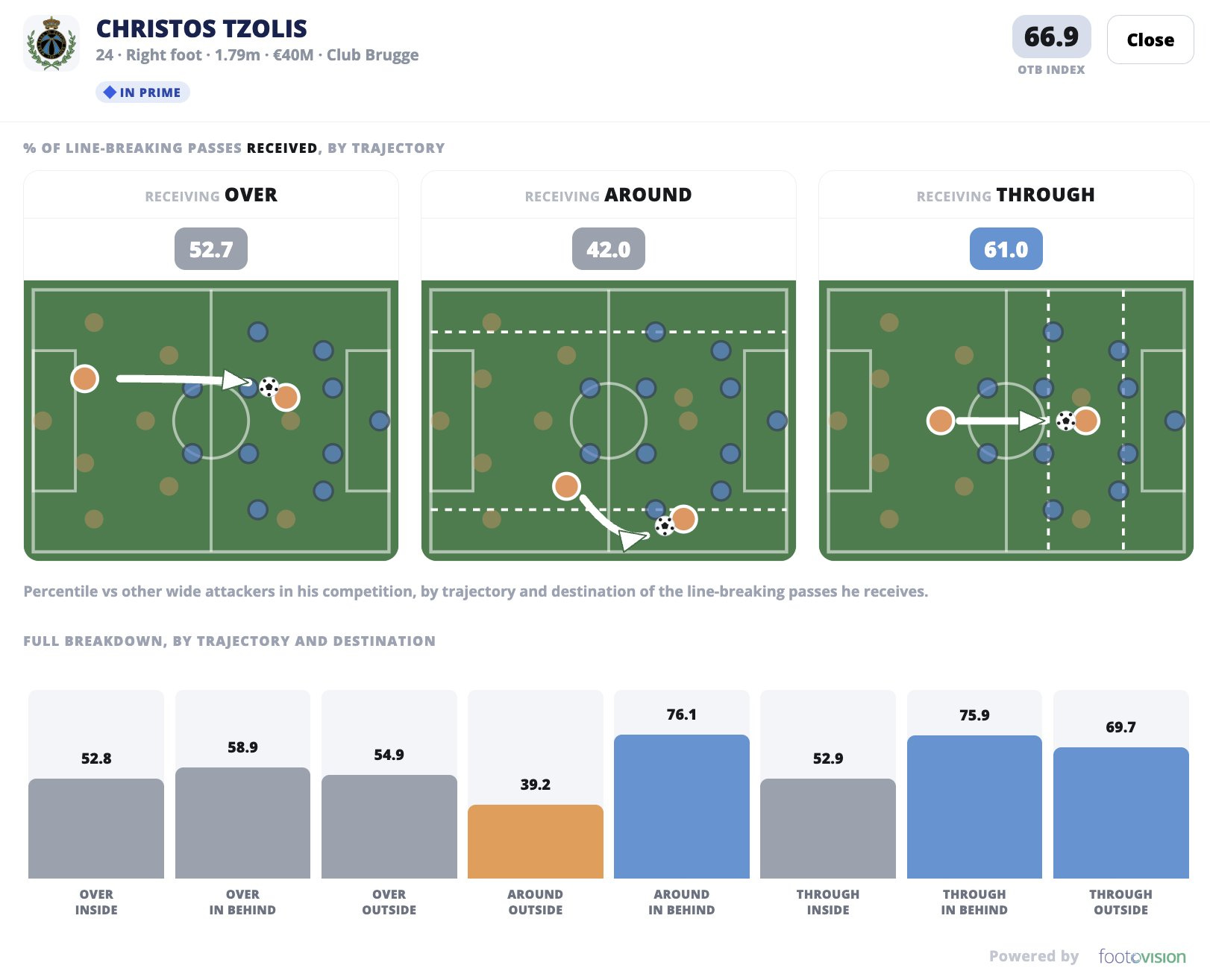
(Those graphics are great by the way.)
We can investigate this more closely on a category-by-category basis.
👉 1-2s, link-up, and combination play
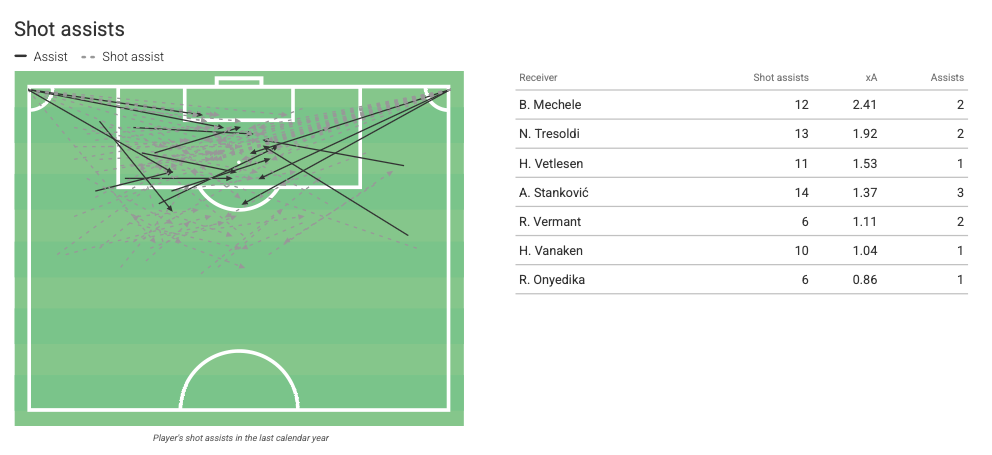
In terms of creation, Tzolis’s single greatest strength is his quick passing. All the advanced analytics support what we see in the footage. His ability to be decisive, trigger moves, and then keep them going is a serious power.
This initial interplay shows how he likes to get off the touchline.
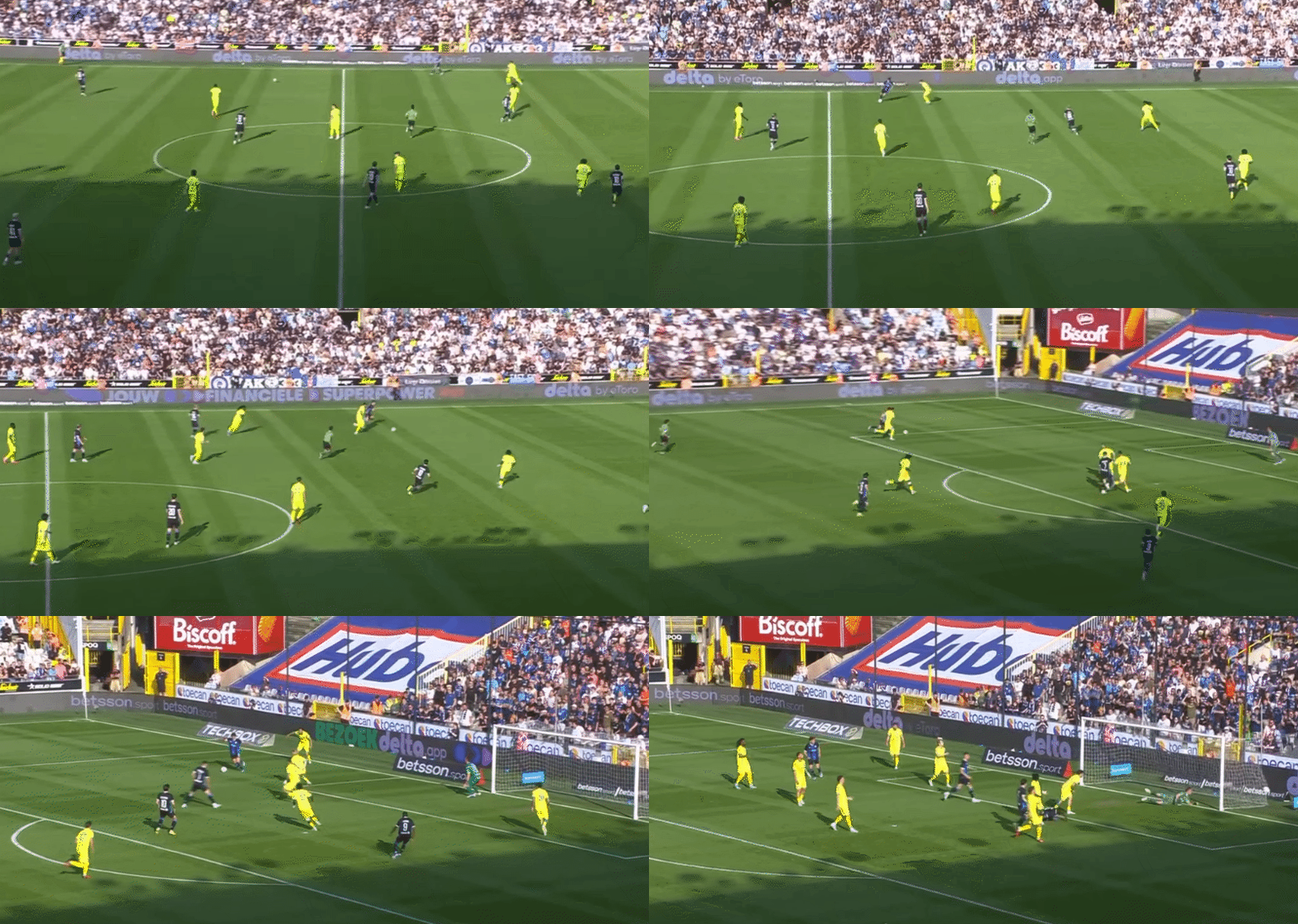
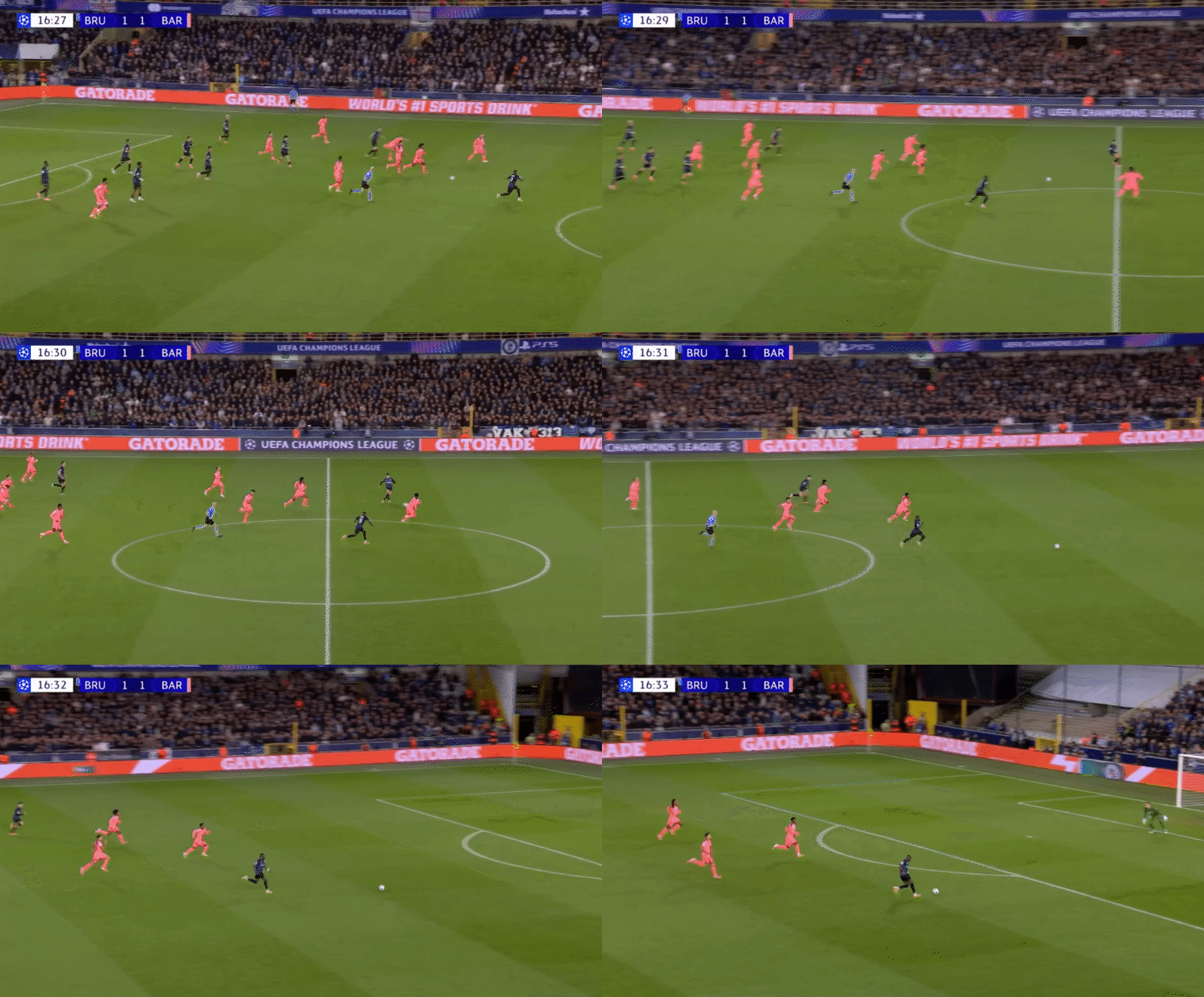
In these short combination circuits, he is exact with his ball placement, putting his teammates in a considerate position to continue the momentum of a move. His assists don’t even tell the whole story, as they’re backed up by second assists (5) and third assists (4) as well, which are also among the league leaders. His numbers also don’t drop when he’s pressured.
Look at him generate an entire goal sequence from scratch.
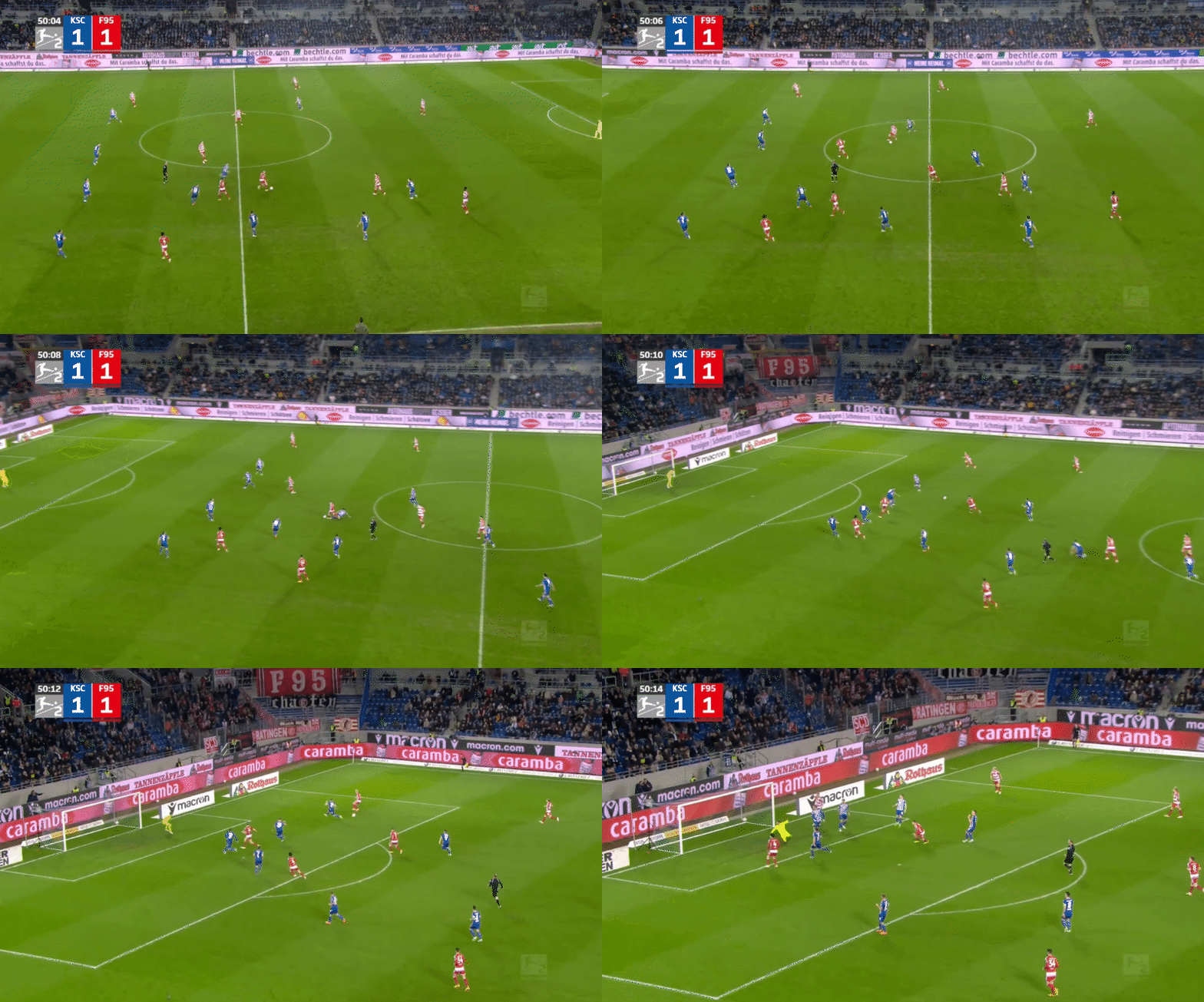
His first-touch passing was also helpful here.
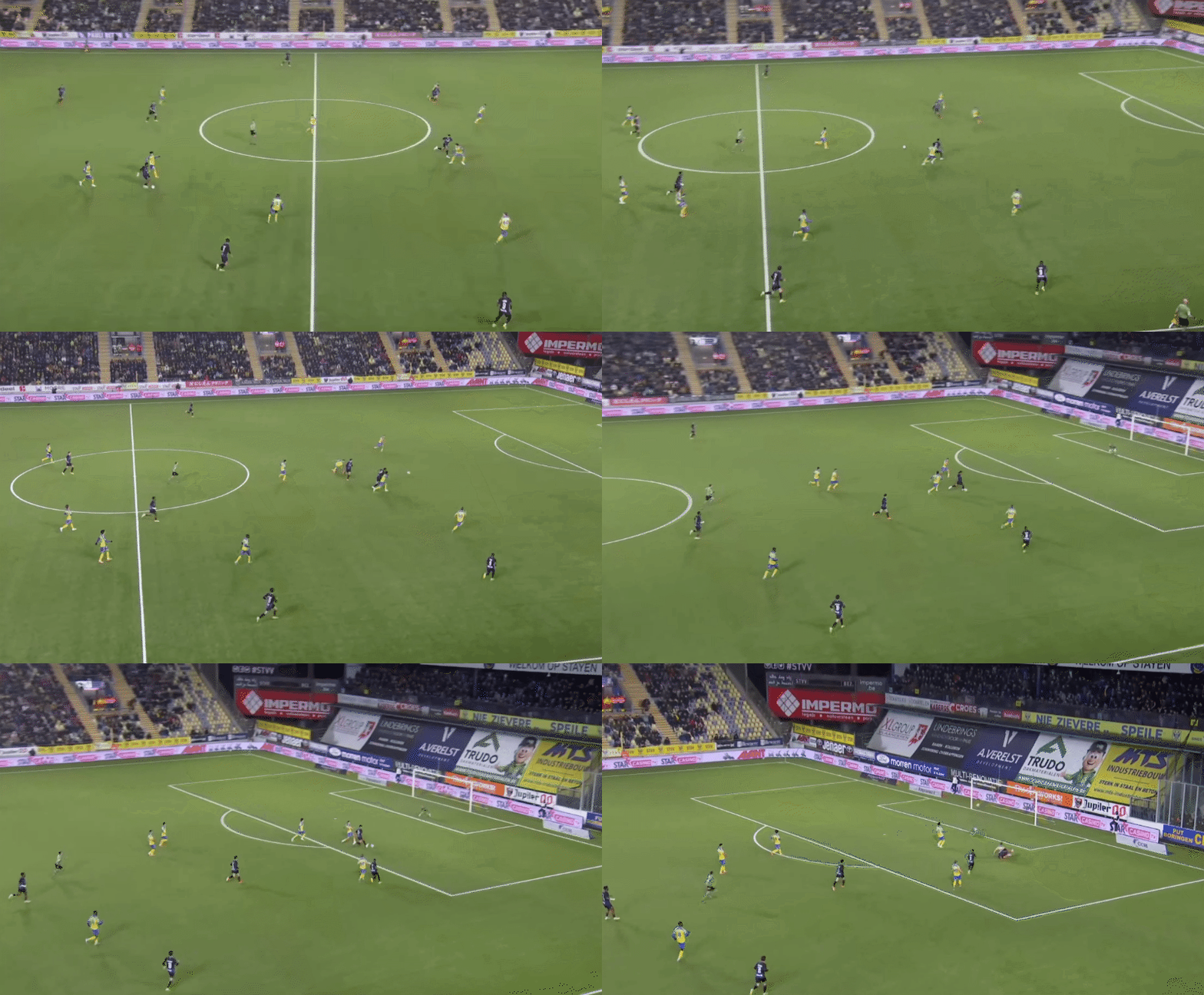
And here, against Barcelona.
His advanced passing percentages are right where I like them: not overly safe and high-percentage, not overly risky and wasteful. (Eze was actually too high-percentage last year). This all means he’s always in the “xG chain” because he combines these passes with 100th-percentile “post-movement” ball receptions and 100th-percentile underlaps. He is a give-and-go merchant, as an annoying person might say.
I feel pretty confident that his brain and foot will translate on these 1-2s, and the big question is whether full-backs will be able to catch up as he makes his darts behind their backs. It’s right on the edge.
👉 Killer balls and big crosses
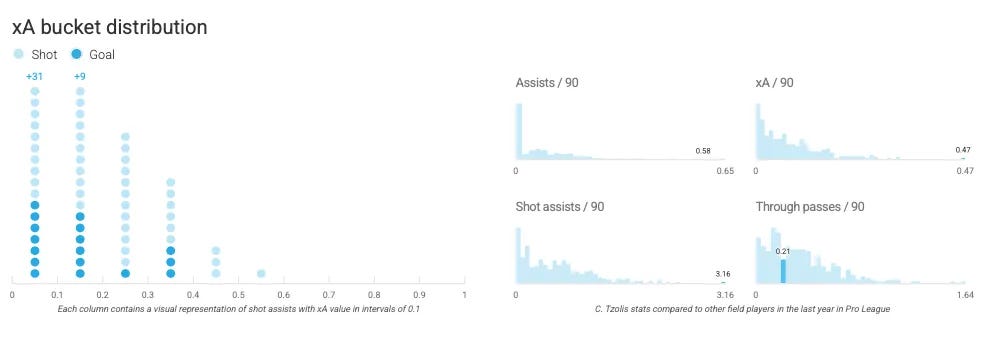
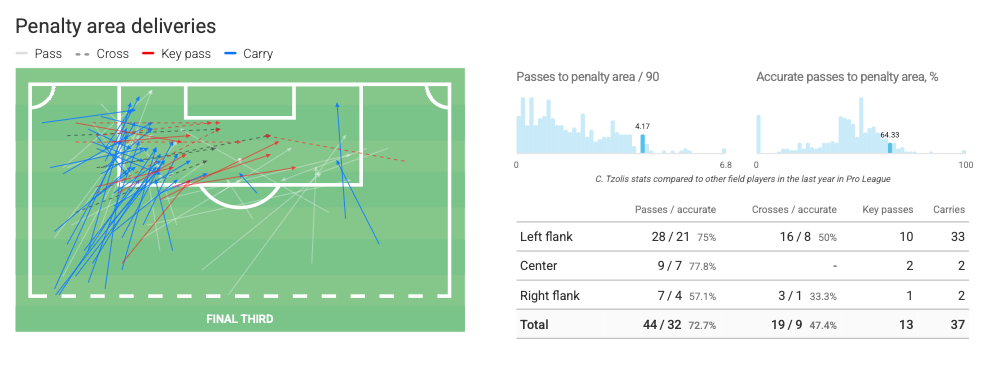
Tzolis is an accurate, clean crosser of the ball, especially when unpressured, but his wider collection of passes isn’t particularly varied. Like many aspects of his game, he usually sticks to the basics.
He fires in a lot of crosses in the league.
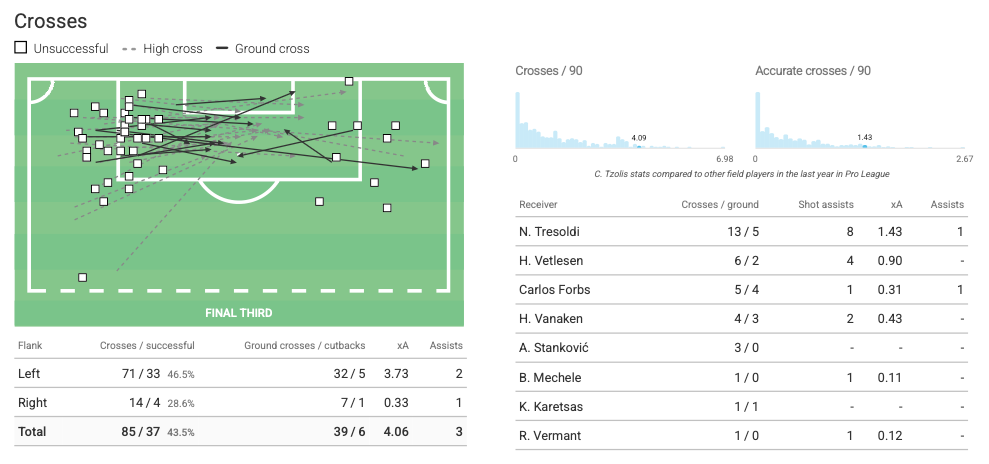
The open-play assist numbers from crosses may not be quite as high as I’d expect before embarking on this, considering the cumulative totals. We also notice some changes when he plays in the Champions League.
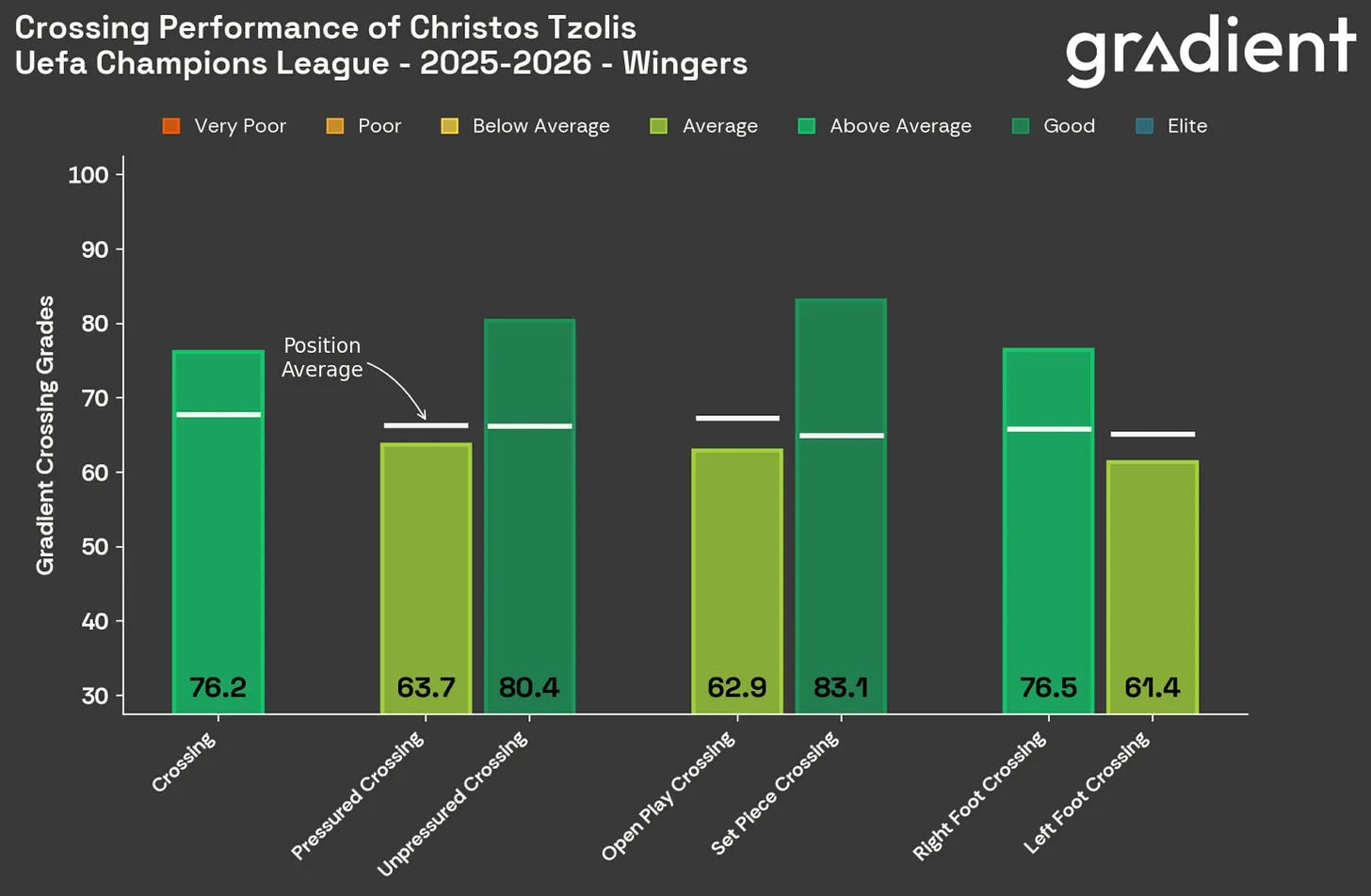
His crossing volume dips, and the difference between his pressured and unpressured crossing gets fairly wide. The drop in volume is explainable, as they had less of the ball, and his overall chance creation dropped, too. I’d wager that it’s mostly about possession. He may just struggle to get these crosses off at the same clip, as well.
Most of the time, a Tzolis cross looks like this.
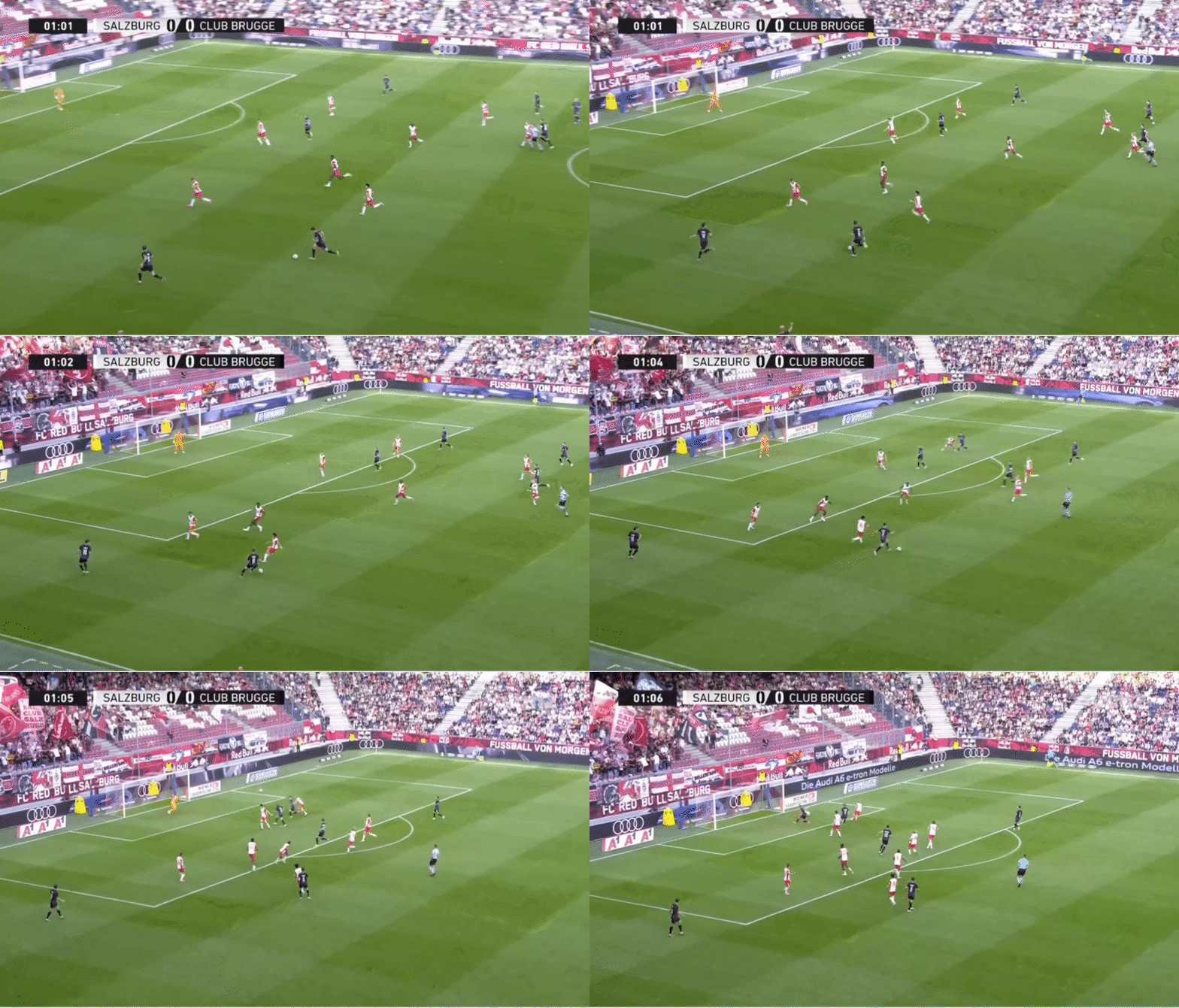
…and another one.
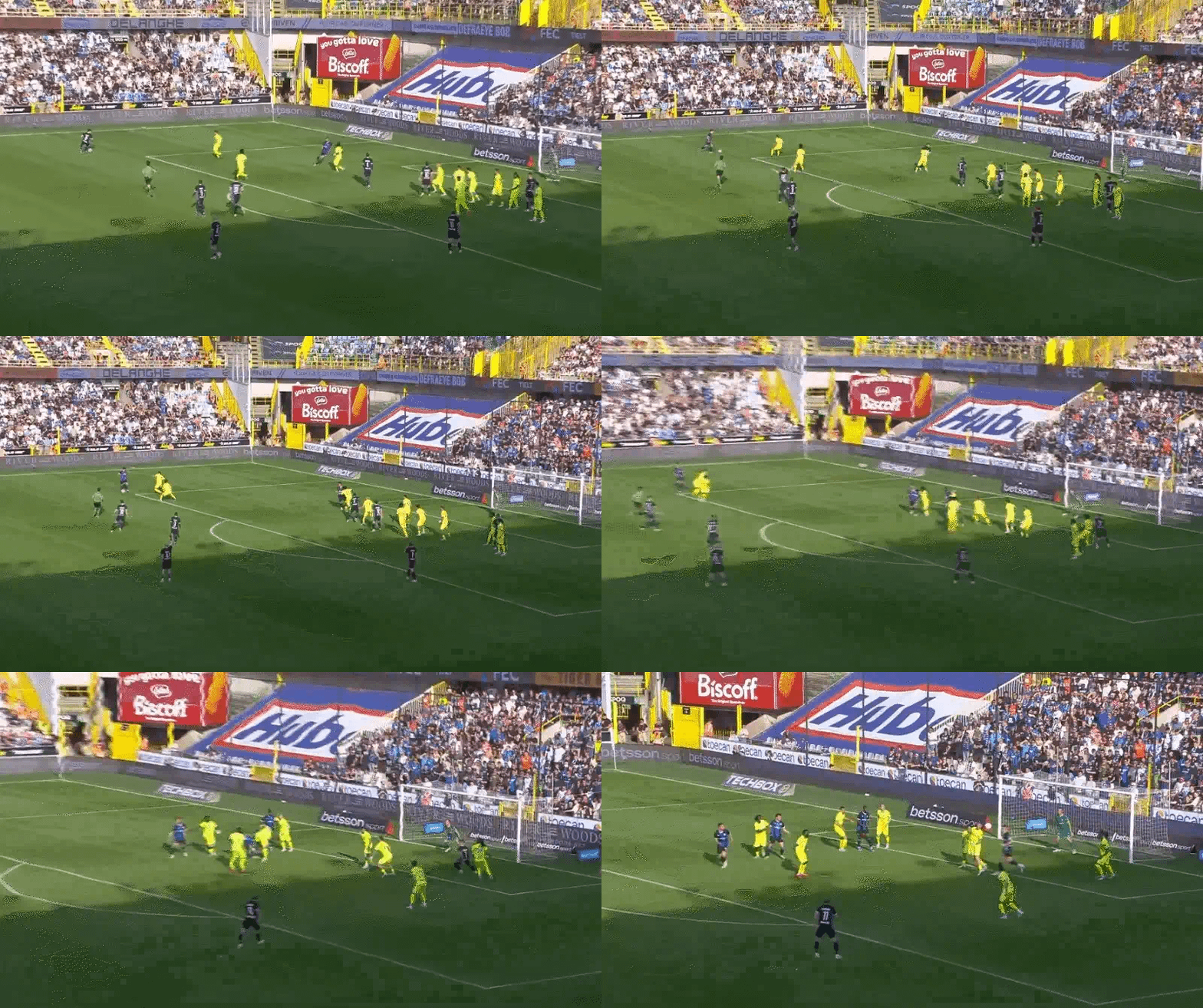
He can definitely hit a ball, and he does so with, I’m bullshitting here, an 8/10 whip. For the crosses hit with that bend, it’s mostly with his right foot. As a result, he appears much better at crossing from the left than from the right.
👉 Through-balls, cut-backs, and low crosses
This is where things look less consistent.
He barely attempts through-balls. While there is the occasional opportunity like this:
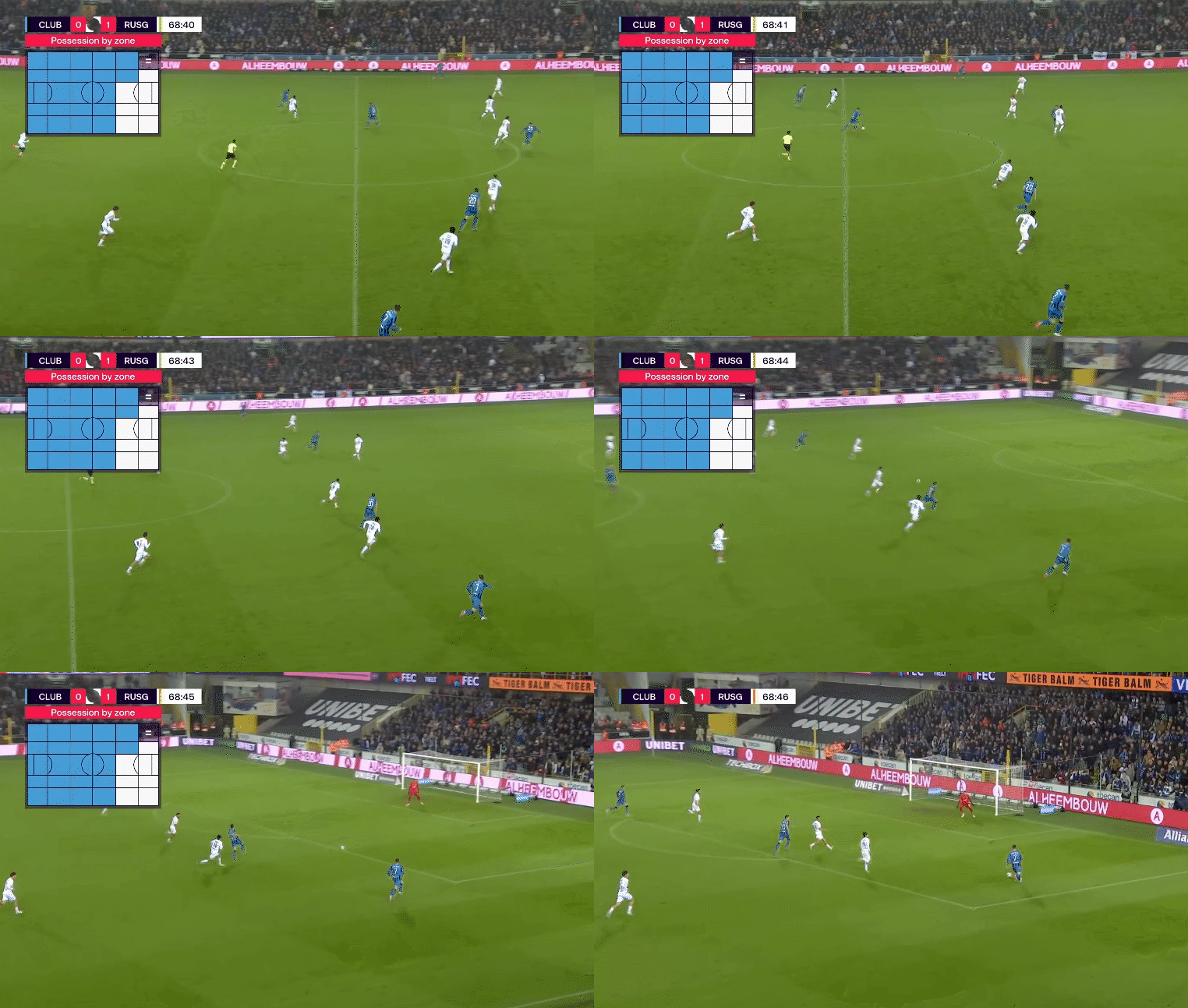
…or this underlap-and-cross:
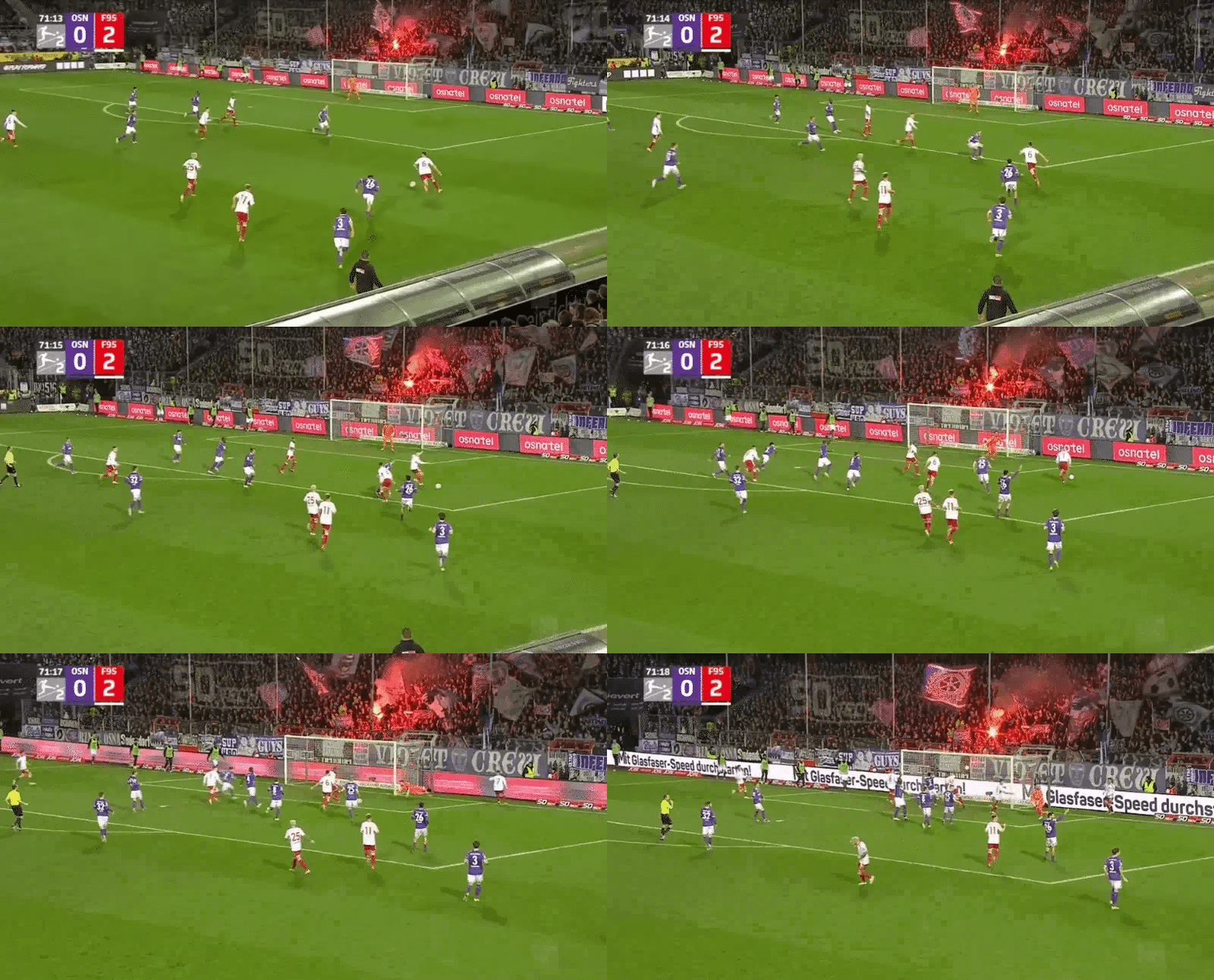
More often, it simply doesn’t occur because he is too far up the pitch, and if he does try one, the weighting of it can be up for grabs.
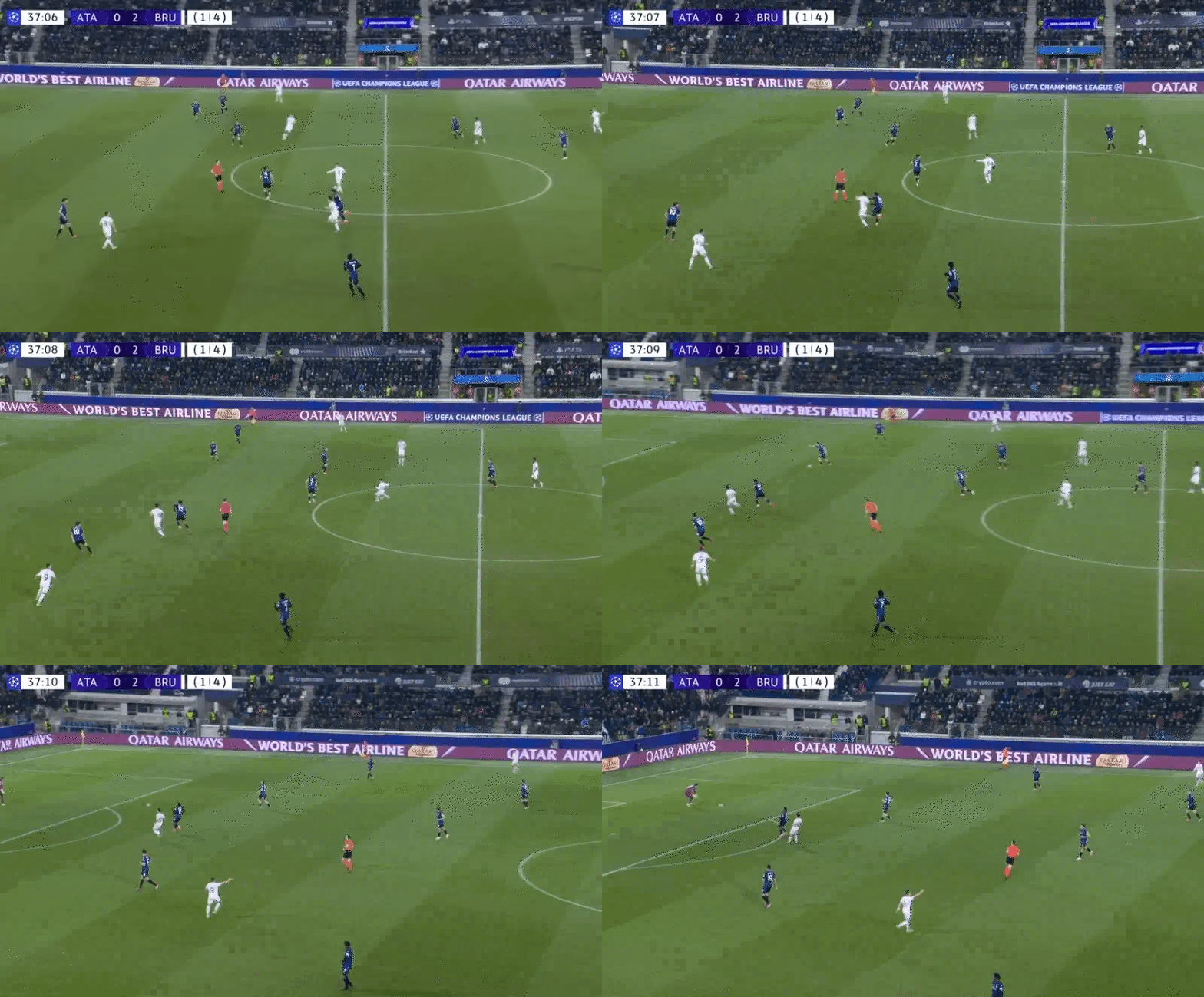
His cutbacks look sharp. I do have that lingering question about him generating the quick bit of space necessary to consistently fire off a cross in the league, without getting blocked. But moments like this, against Llorente, make me feel better.
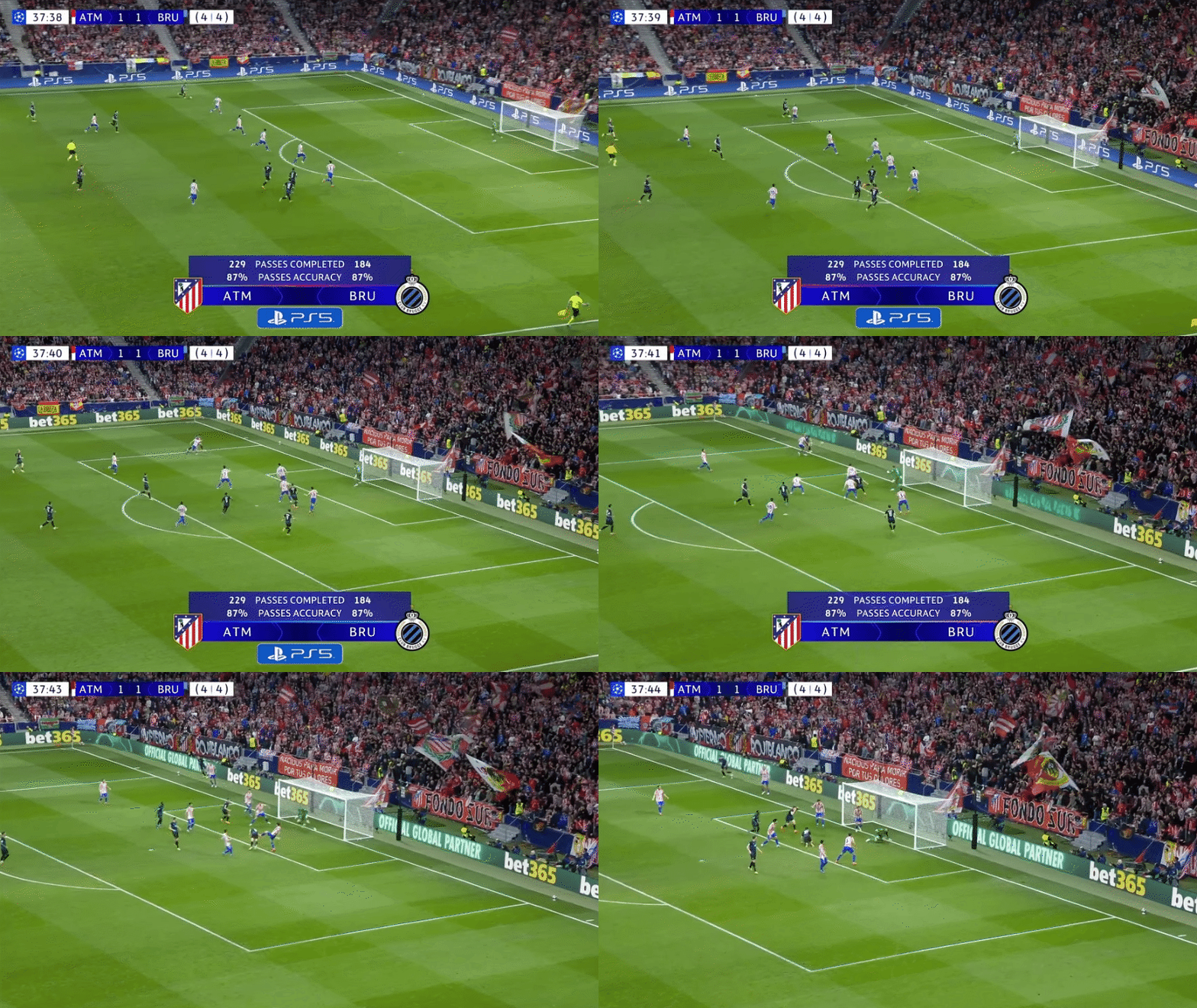
According to the data, he was 6/39 on ground crosses and cutbacks, but according to my eye, there’s plenty of potential there.
TL;DR: he’s better at playing the ball to feet than into space.
👉 Long-balls and switches
There aren’t a lot of clips to survey here, and that’s the point. He hits long-balls at an above-average efficiency, but the volume is low. His foot can definitely hit a switch. But he’s much more likely to be at the end of a long pass.
In general, he’s splendid at tight-space associative play, and I generally would expect that to continue. But there’s one reservation from all this. As I wrote in Go Again:
For the creativity that did exist, much of it was enshrined in the feet of Martin Ødegaard and Leandro Trossard. Trossard led the team in passes above expectation, and Ødegaard led in through-balls, line-breakers, big time passes, and so much else. Trossard remade himself, again, into a wide playmaker of the highest degree, and it sure looks like he’ll be sold. With Trossard gone, many Arsenal fans are still plugging in lineups without Ødegaard, or, at least, envision him rotating more (as I do). We should be cognizant of the costs of this all.
With Saka fighting fitness and Ødegaard out so much, Trossard met the pressure and put in one of the best passing seasons in the league, especially when he was out on the touchline. We can remember those trivelas, looped passes to Gyökeres, or the through-balls to the underlapper. I don’t expect Tzolis to bring that level of creativity from wide. He will bring a different kind; it’s just a question of whether it’s sufficient.
🔥 Shooting & finishing
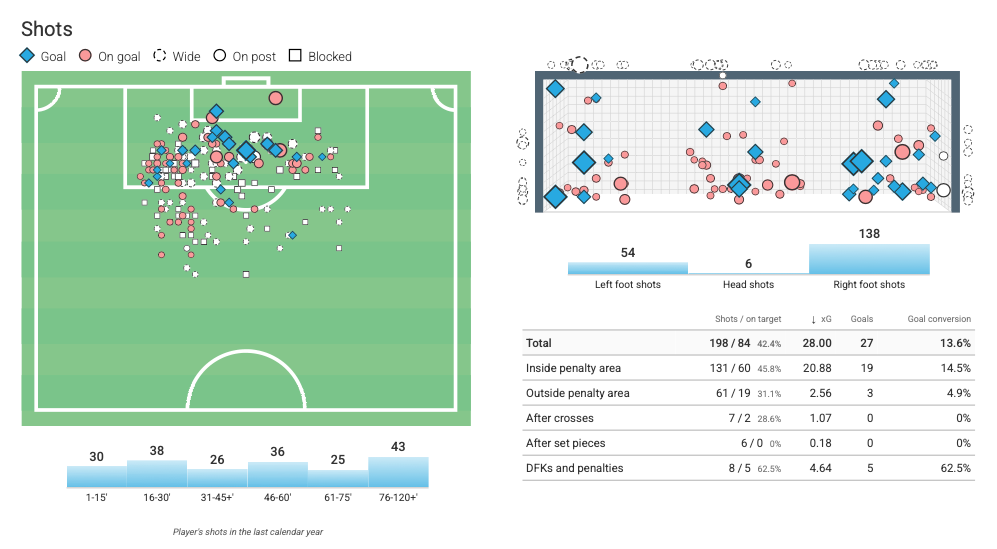
Tzolis’s shooting is the single thing I’m most enthusiastic about. I don’t say that because he’s some massive xG overperformer who scores worldies every week; in the league, he had 14 non-penalty goals compared to 14.24 non-penalty xG. I say it because he has all the signs of a shooting style that can travel to the Premier League and still generate plenty of volume and production.
This is because of what he doesn’t need to be successful. He doesn’t need space, he doesn’t need prep touches, he doesn’t need it to be on his preferred foot, he doesn’t need time for a long backlift, he doesn’t need a clean situation. He is a player who can hopefully create shots, xG, and goals that others can’t.
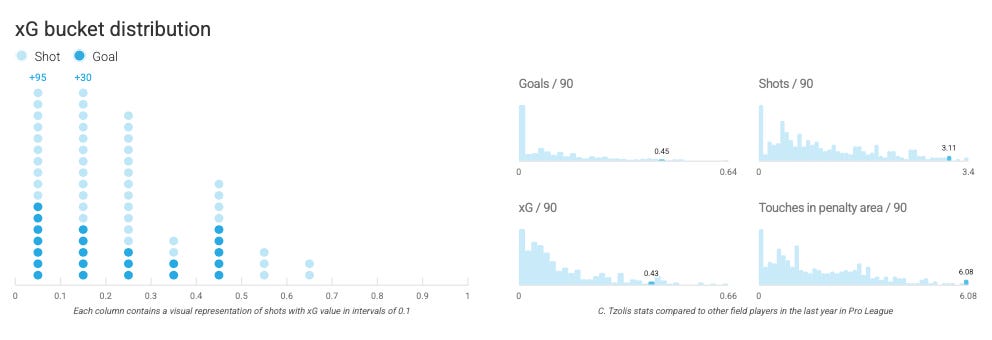
We can take a long tour through his clips to see why this feels promising.
Here’s a layoff to him that he leathers immediately.
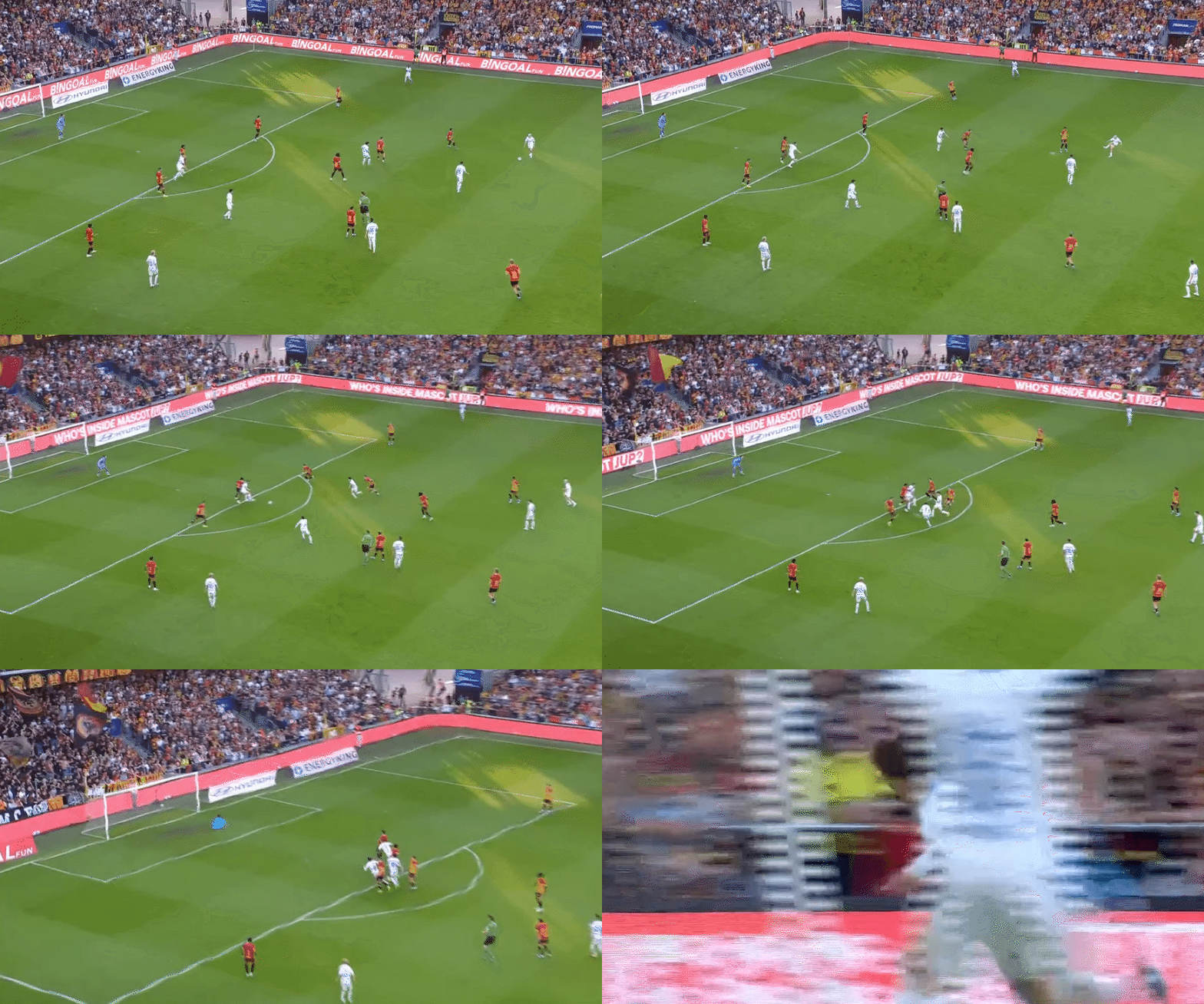
Here’s a possible pen that a teammate drew: no worries, Tzolis shows up to the spill and destroys it home with his left, first touch.
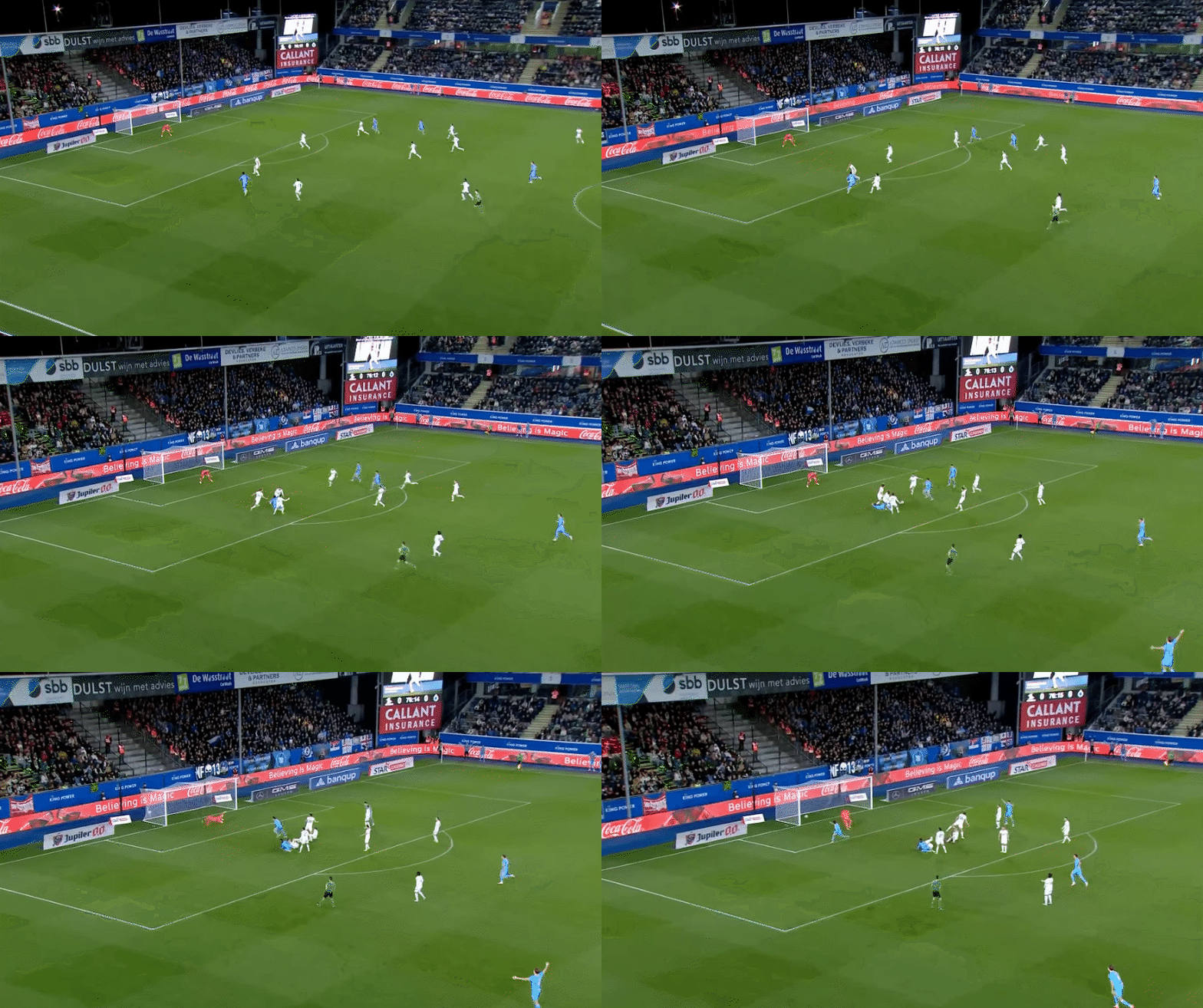
Here’s the little cut-in that he’s scored so many times.
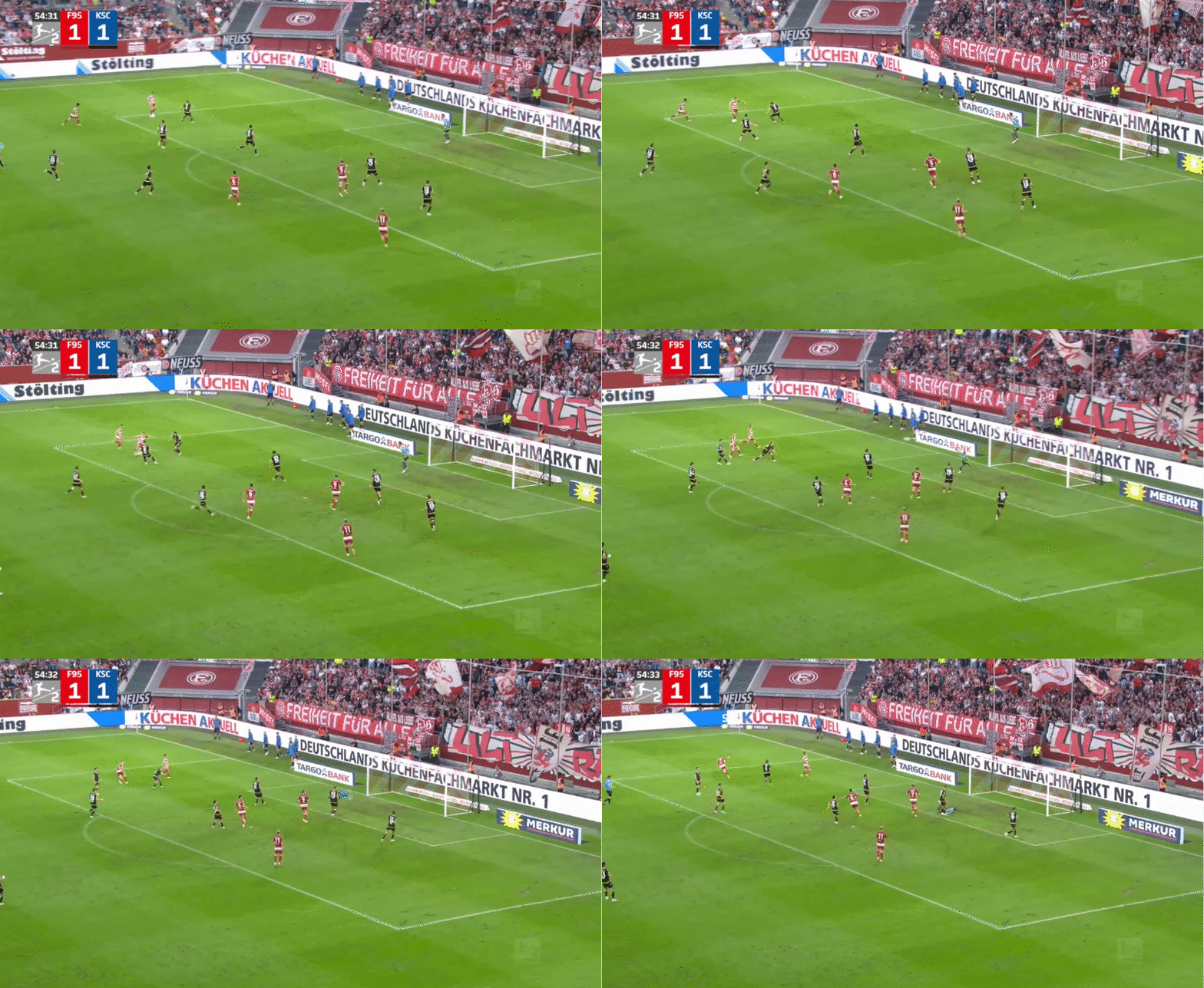
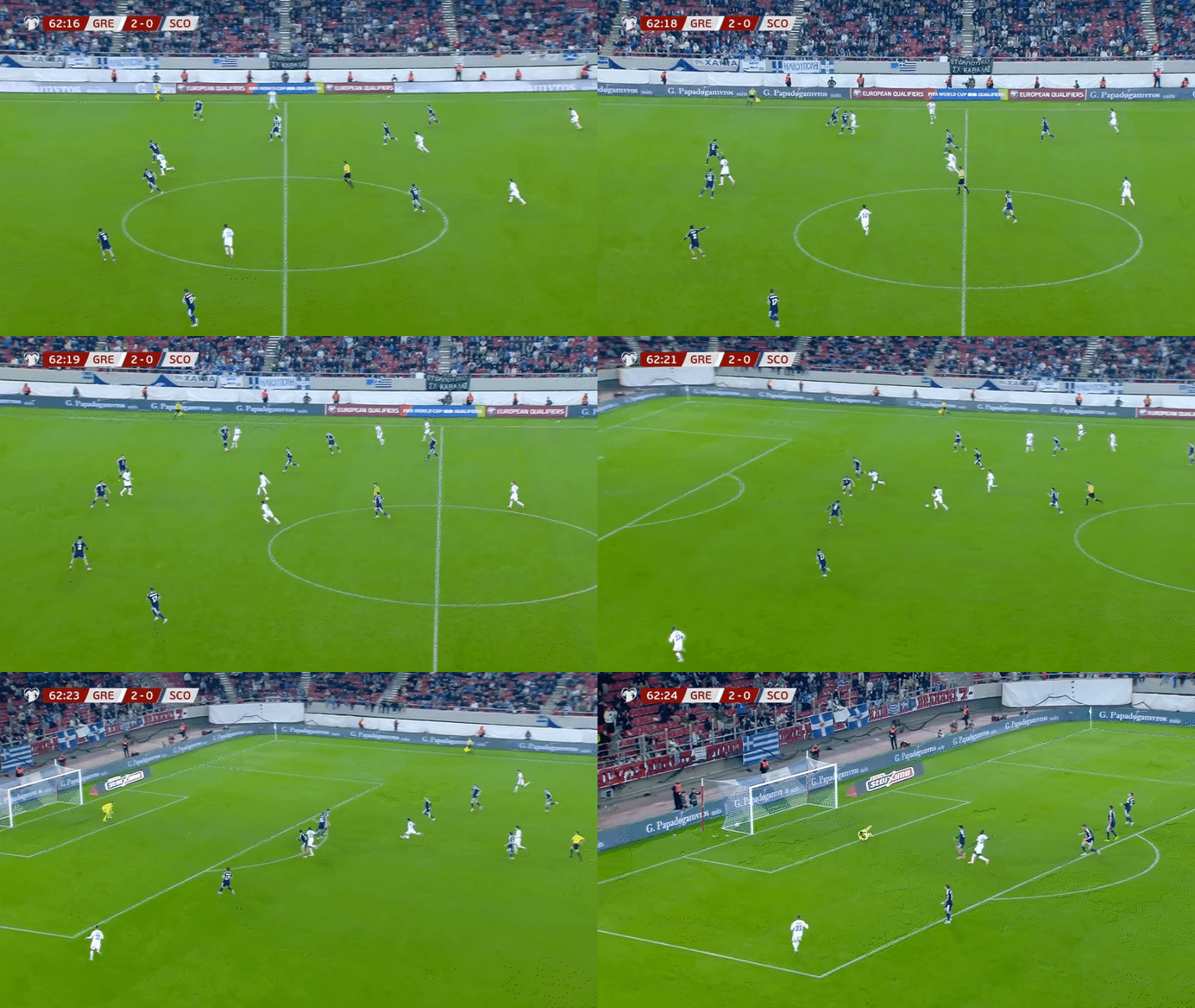
Longer range, we have this dagger against Scotland.
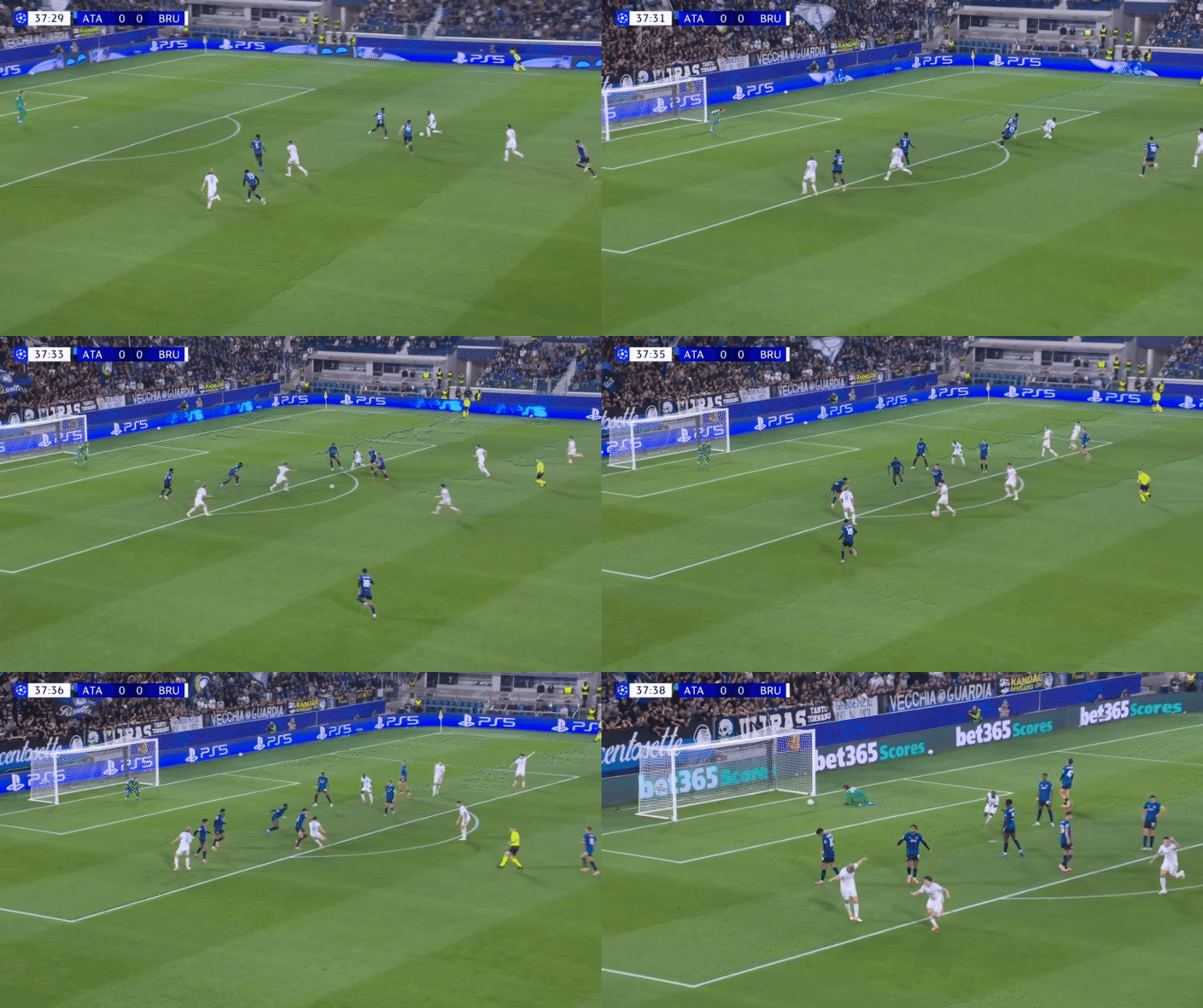
And we have a couple of goals that feel like Pure Trossard. This was an impressive one against Atalanta, in which he arrives, baits a block with his left, cuts back, and winds it in with his right.
Do you remember this Trossard goal at the World Cup?
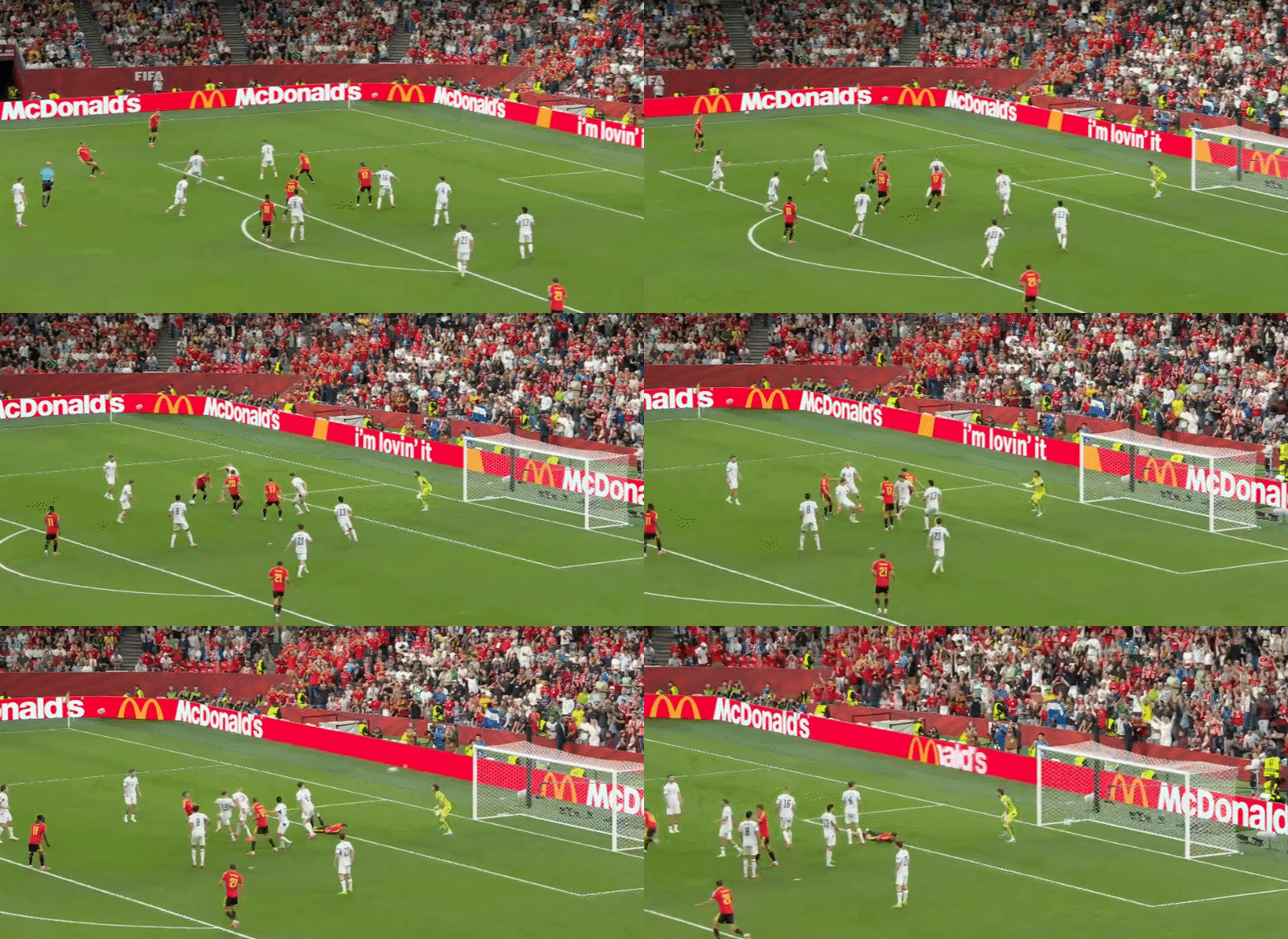
I thought of it when watching this: Tzolis receives at the penalty spot in traffic, shoots with his left, gets blocked, then hits it first-time with his right and scores.
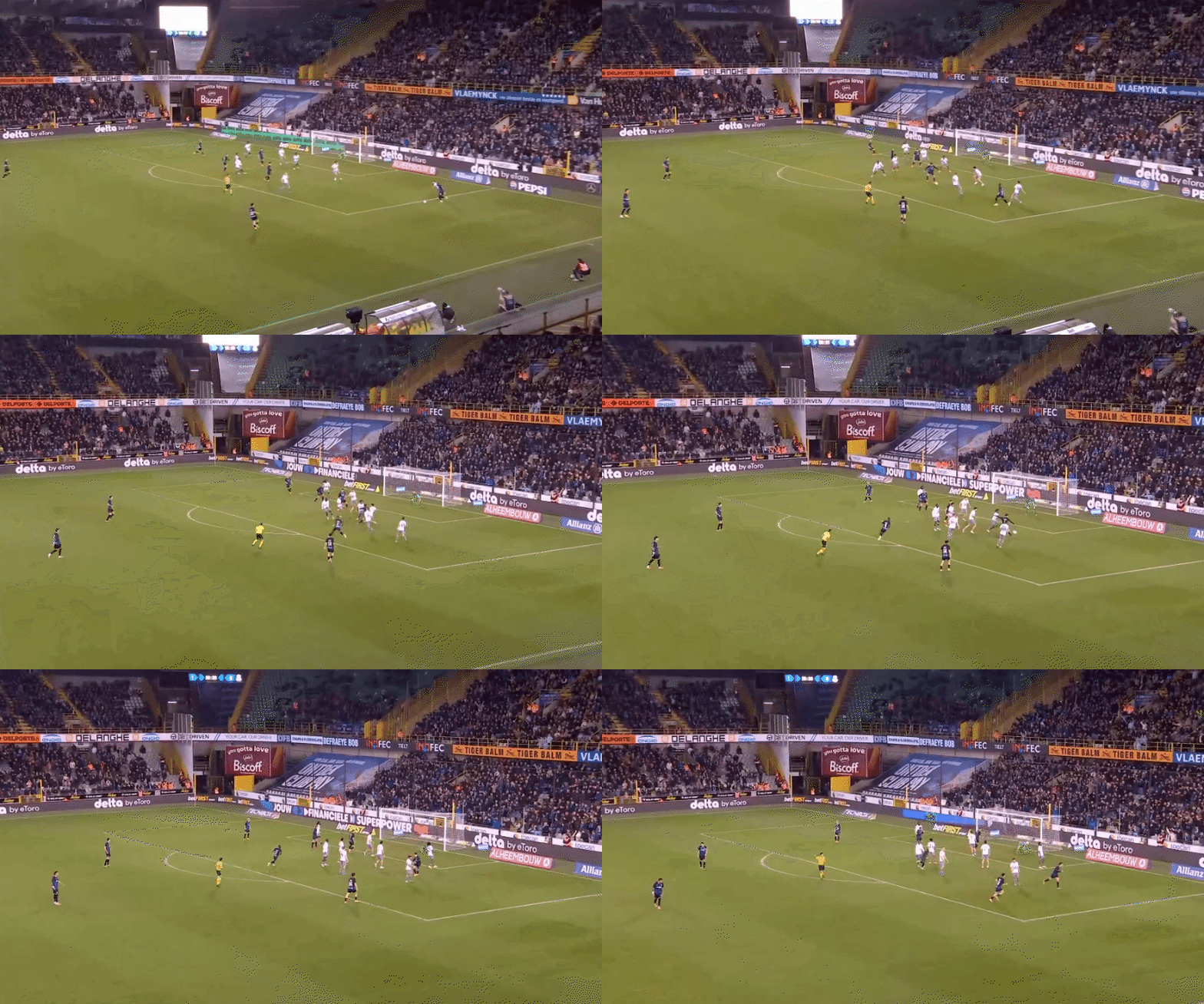
These skills apply to transitions as well, because he doesn’t dither. He carries to the spot and shoots at whatever angle is on offer, usually with the foot that has the best chance. It should be noted that his two-footedness shouldn’t be overstated, or put in that final tier of Cherki and Dembélé. All considered, he’d still like to shoot with his right. But he’s quite comfortable with his left.
In the Champions League, he was able to replicate his shot volume from the league, though he shot from farther distances (i.e. materially “worse” locations). While his pressured crossing numbers dip when facing tougher competition, because a cross naturally needs some time to set up, his pressured shooting numbers in the Champions League still look great. Gradient ranked him 5th out of 145 wingers in the competition on the metric. I think this might be something subtly true about him: he is better in chaotic, quick, crowded situations. I’m not against the occasional pot shot, but I’d aim to focus his shooting to be in the box as much as possible.
There’s a chance the speed of the league can cut down his volume, but overall, I’m optimistic about his shooting.
🔥 Set pieces
👉 Penalties
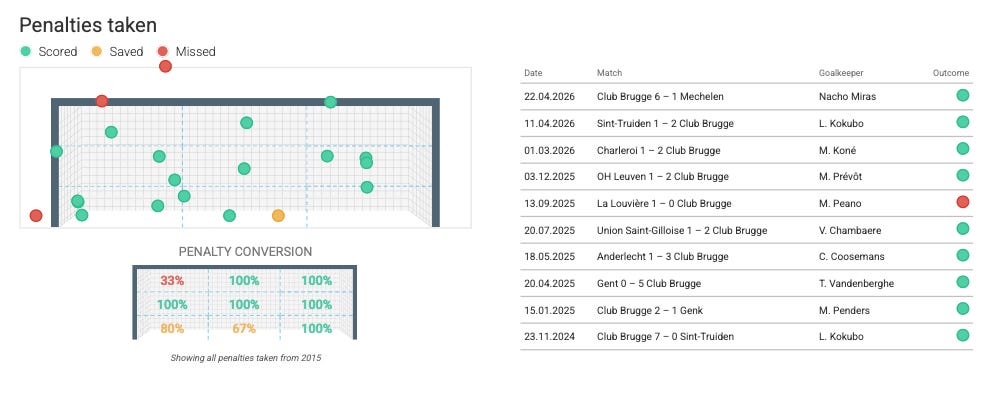
He’s a good penalty taker. Here are his career numbers, in which he’s made 12 of his last 13.
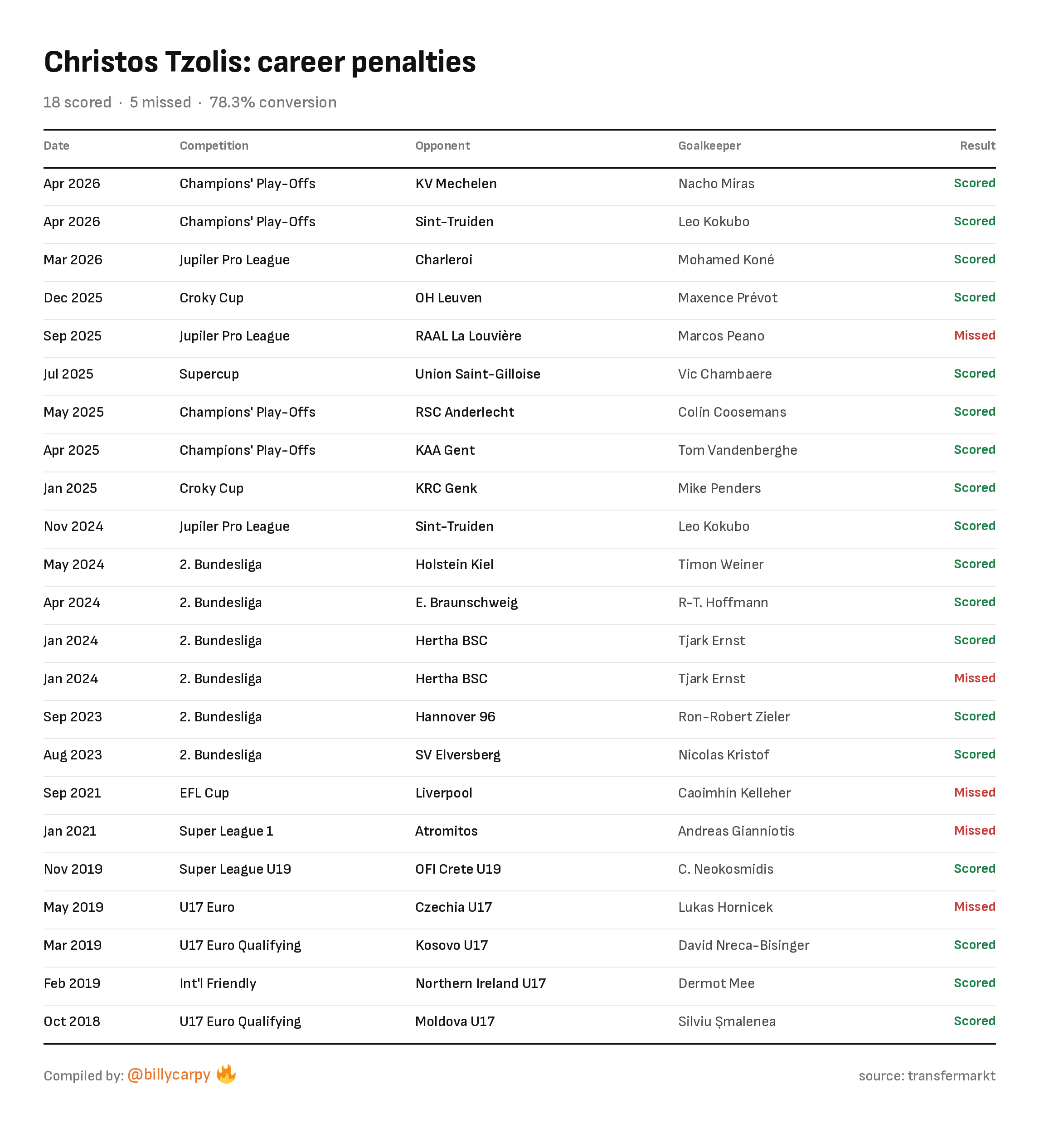
He’s not easy to read, mixes up his locations, and looks confident.
👉 Corners and dead-balls
I often argue for “profile cover” instead of “positional cover.” I’m essentially saying that you have to look at the overall characteristics and qualities of the team and make sure that you have depth in those qualities, regardless of whether they play the same position or not. Saka and Rice’s deliveries are one of the great advantages of this team. While Tzolis isn’t fully on their alien level, he’s really #nice, and Arsenal have displayed a spooky ability to improve people on this front (think Madueke).
As Opta tells us, he created 135 (!!!) chances in all, and 52 (!!!) of them were from set pieces.
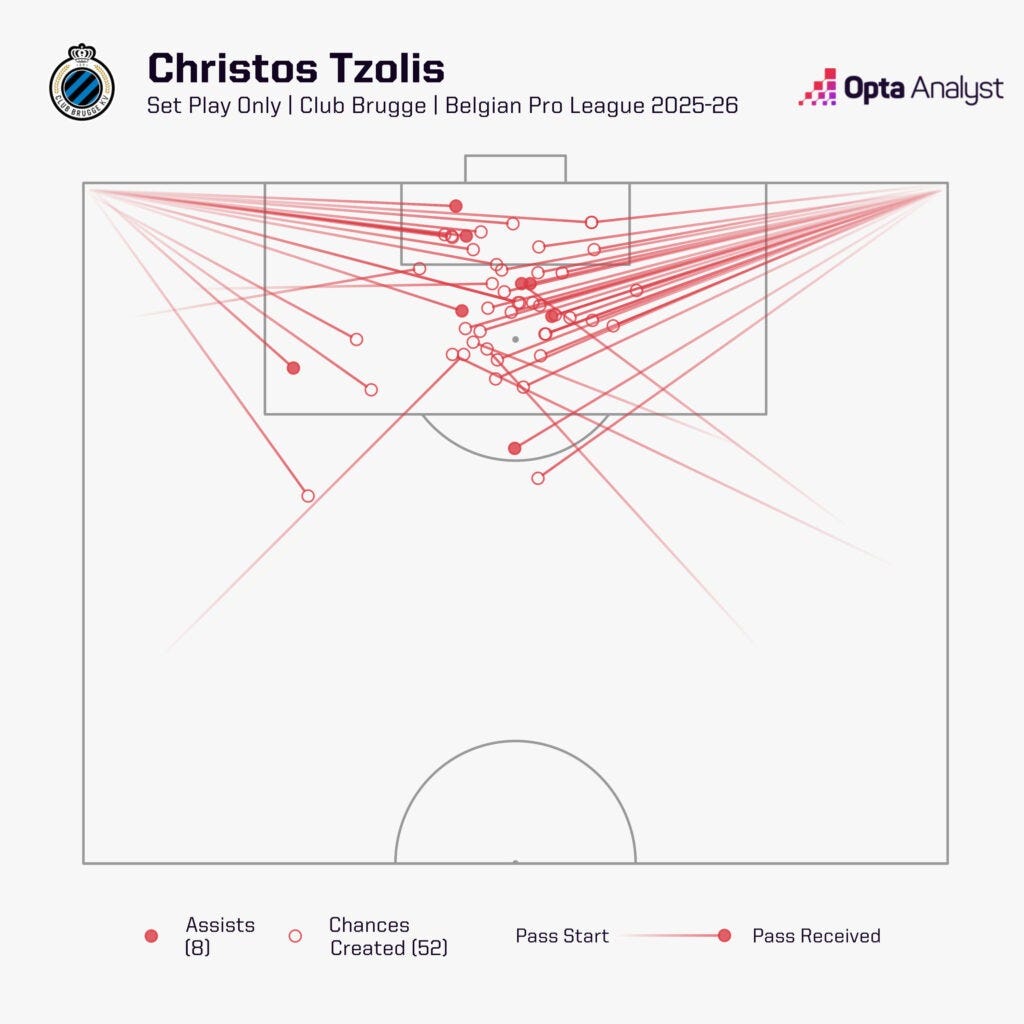
It’s a good sign that he took corners from both sides. In a mysterious, subjective sport, this is one of those qualities that is closest to a meritocracy, as it shows that he’s most consistent in his deliveries in training and has earned the right to take so many.
Outside of the odd cup games or emergencies, there is a low likelihood that Jover deploys him at the right corner flag, which will cut his volume in half. I believe he added four assists over there on Saka’s side, which is another factor to consider when assessing his statistical output. He will lose some counting stats by default, as he won’t be taking many penalties or right-sided corners.
He’s quite good and consistent on these.
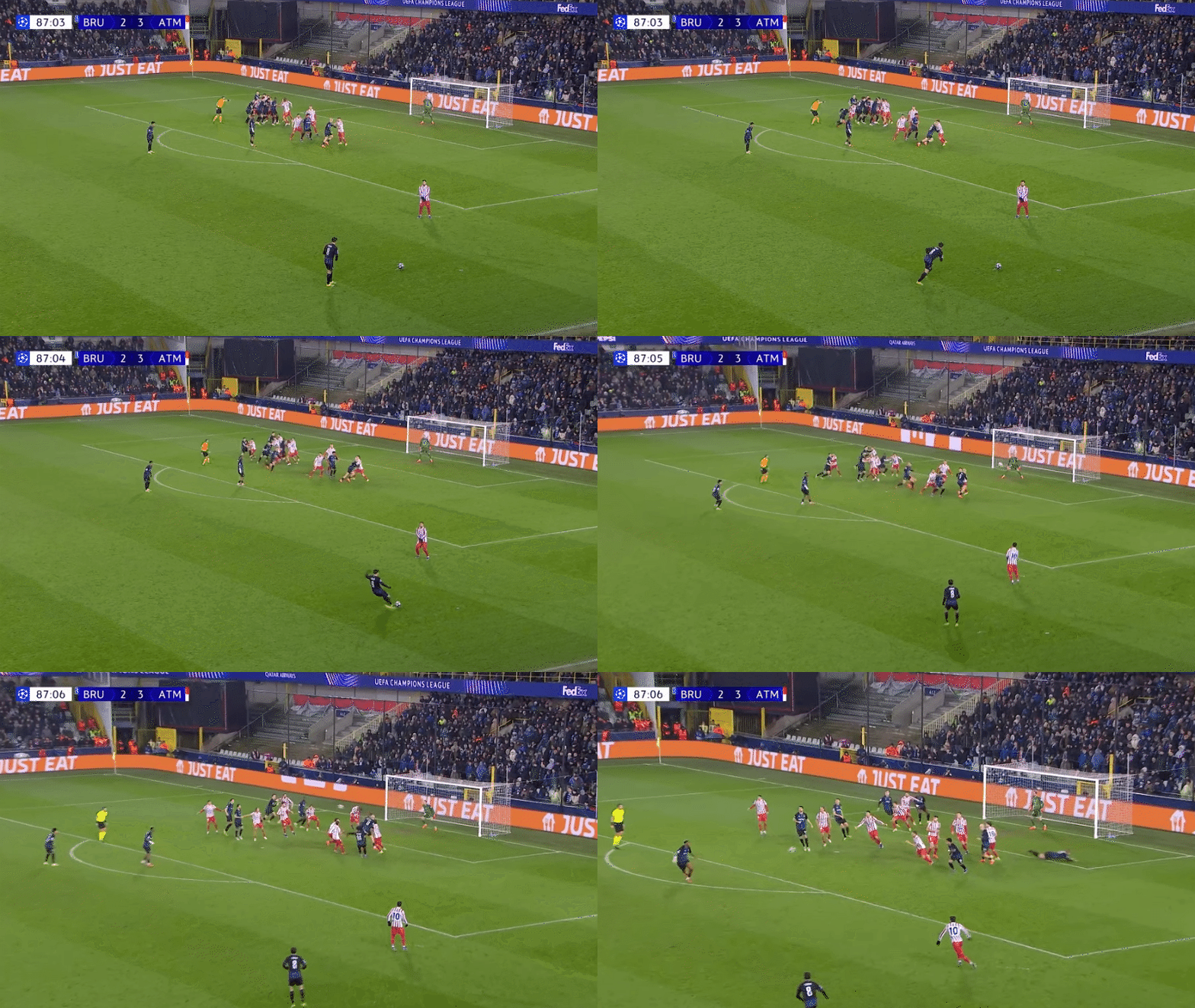
Because he takes these dead-balls himself, I haven’t had much of an opportunity to see how he does on second-phase cleanup (i.e., crashing the box on a rebound and firing it in). But, like Eze, that is a quality that feels right in his wheelhouse, and I expect him to get a goal or two on those.
🔥 Duels, out-of-possession, durability
👉 Ground duels
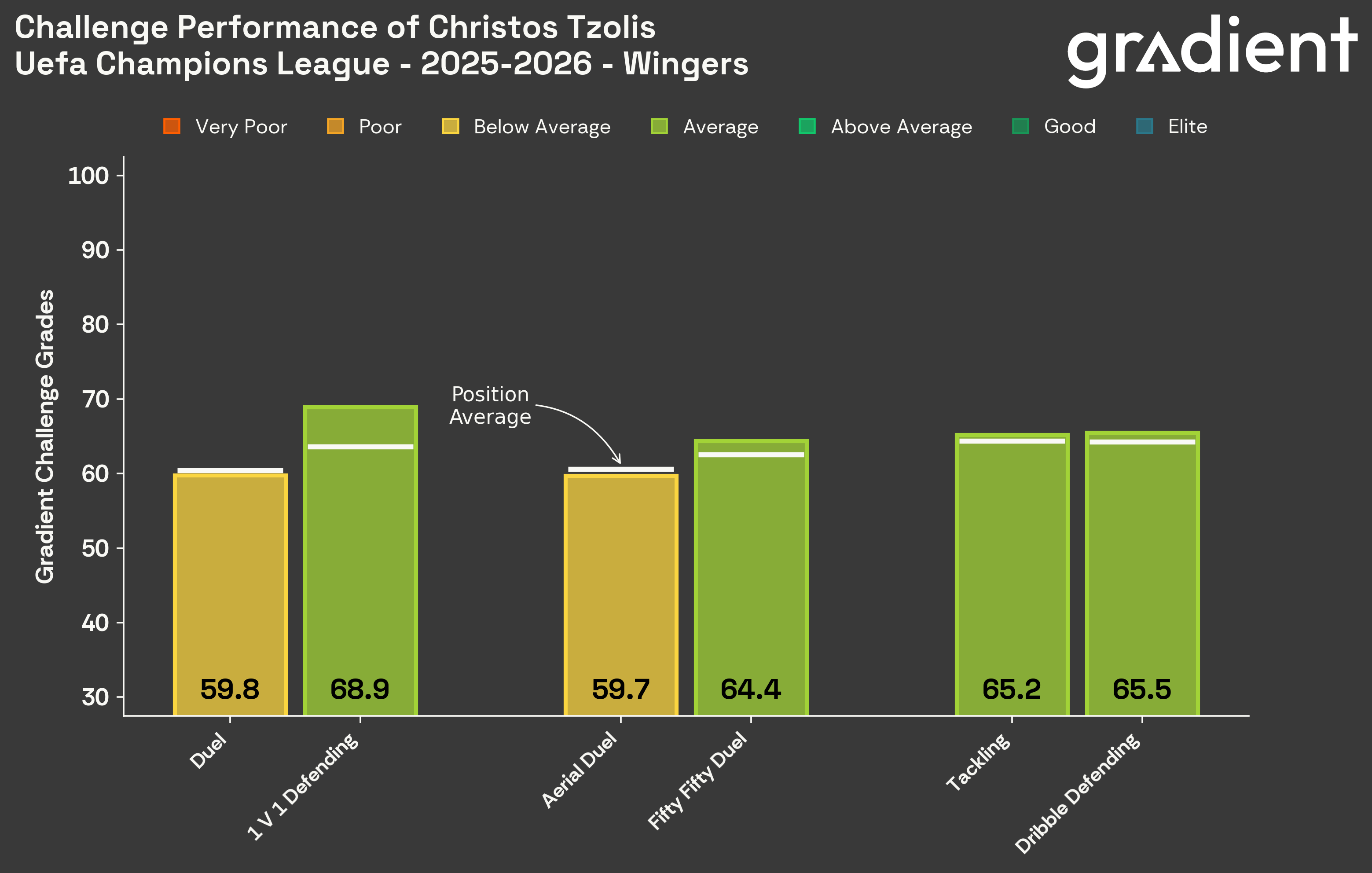
Tzolis is fairly strong and balanced. He has quick feet and quick steps and can use that to get his foot on a second ball, but he’s not going to overpower players shoulder-to-shoulder. As you’ll see above, his overall duelling grades in the Champions League fell firmly in the mid-tier.
We can see how he’s engaged here.
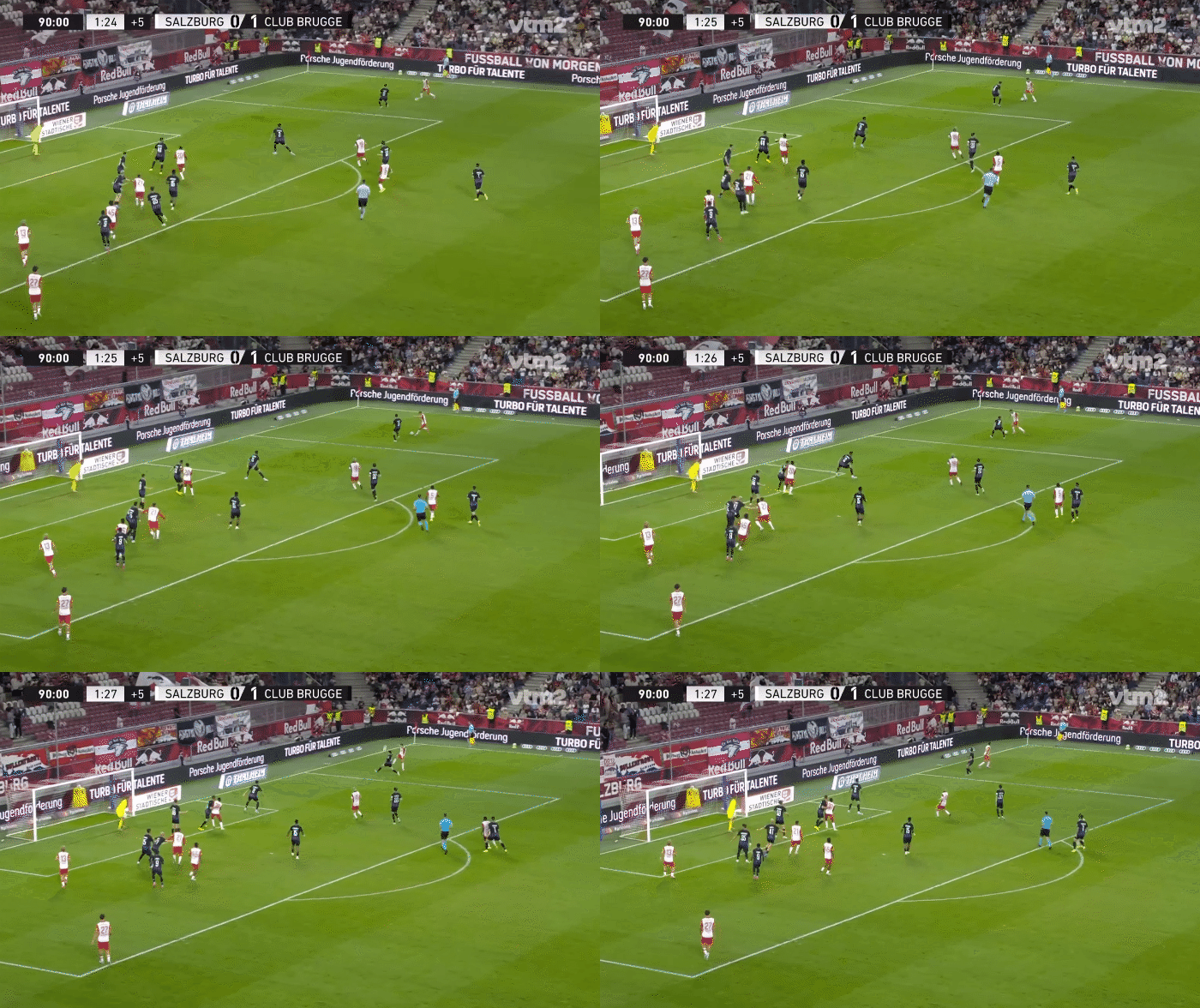
When in an attacking duel, the opponent matters. Facing a great full-back, he can struggle to find a physical advantage. They might be a little stronger and a little quicker than him, which is why he looks to “associate” his way out of it. Against a centre-back, especially in space, he can be quicker and more decisive in his actions, and create more luck, especially in transition.
In 50/50 balls he rates at about average per Gradient, and to date, that feels right to me. He doesn’t avoid physical contests but doesn’t necessarily initiate too many either; his reactions are quick, and his feet are good at generating control in tough situations.
But one of my biggest worries is that it doesn’t feel like he uses his hands enough for leverage.
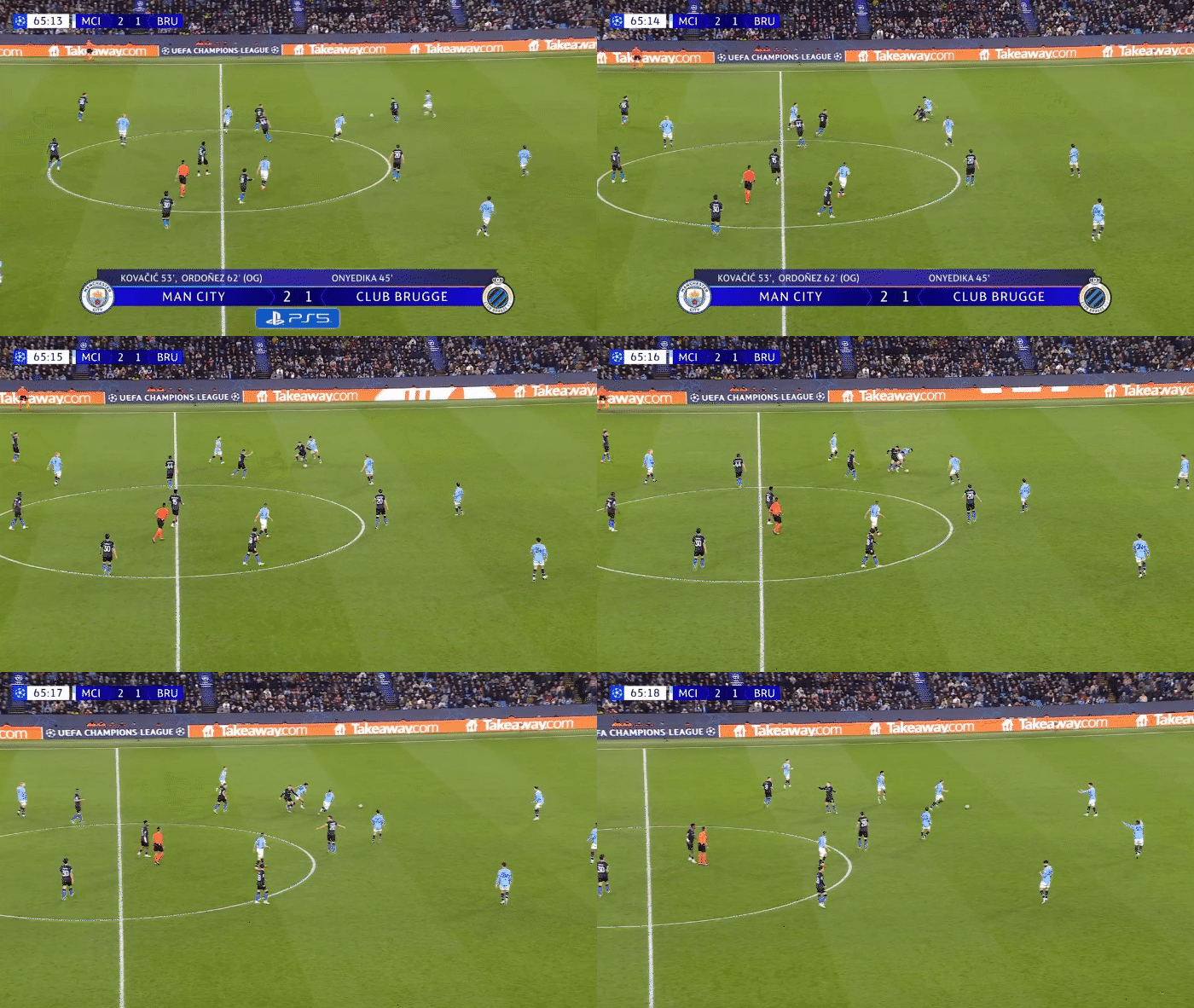
I’m a loser, so when there’s a decisive action in a game, I often watch it back at half-speed to understand how a certain player gained an advantage. What always seems true is that the best players are constantly using their hands to win the high ground against their opponent. To me, this also goes a long way to explain why the introduction of Lewis-Skelly has been more successful than that of Ethan Nwaneri.
There are still some examples of Tzolis losing the physical battle.
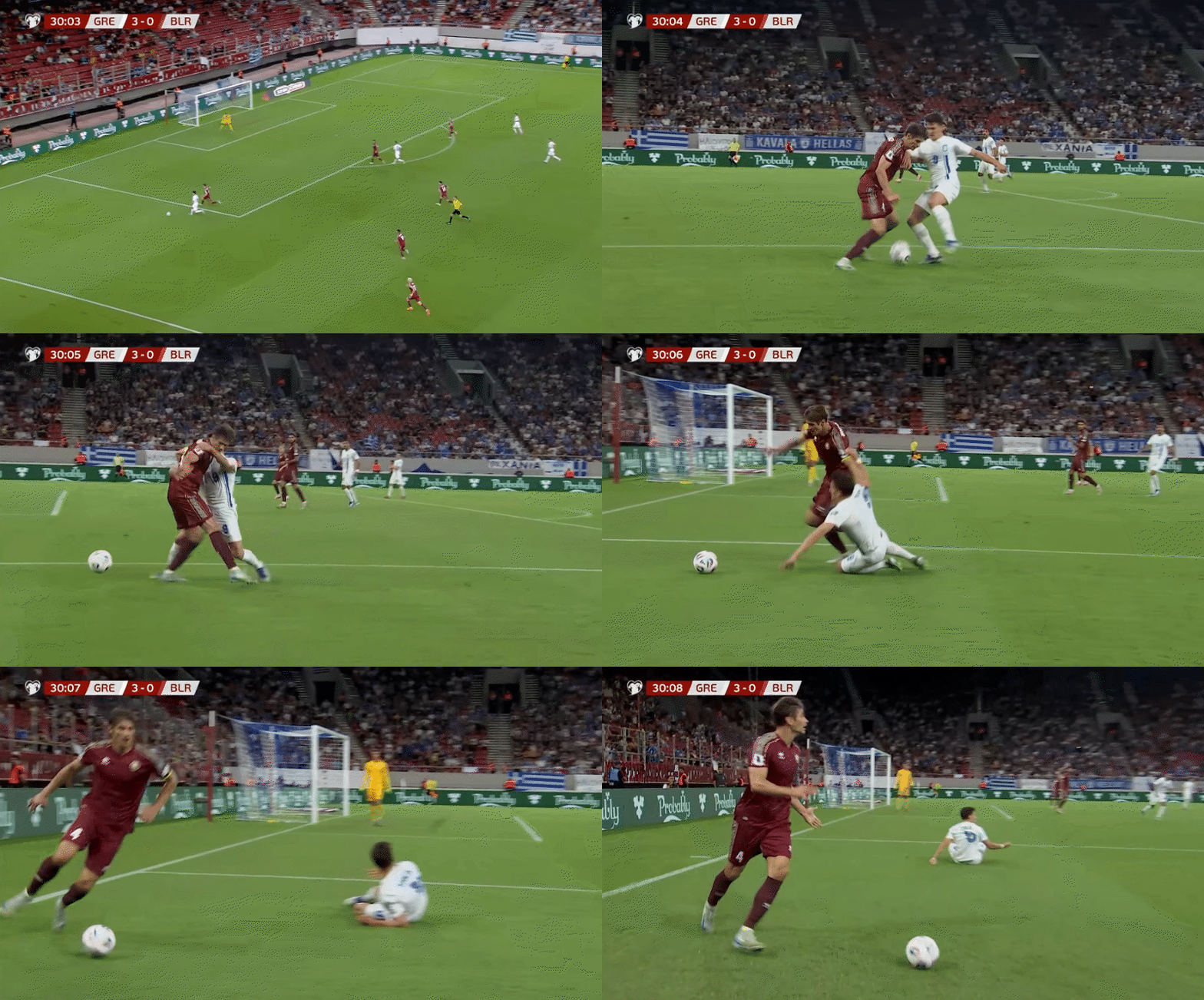
With all that said, he should have much fresher legs without starting fifty-plus games a year, and with Arteta’s expectations so clear, I expect him to turn it up a notch.
👉 Out-of-possession
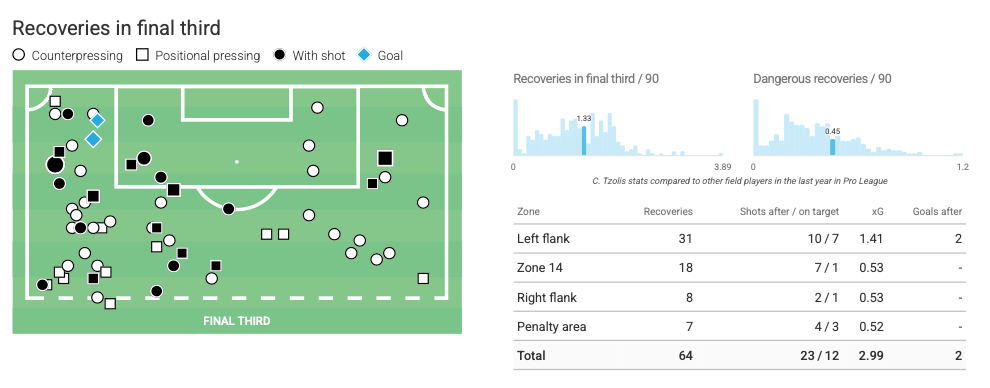
Tzolis is a pretty able defender, with potential for more. I fully expect his intensity to be at the required level.
KDB actually gets the cross off here, but I think Tzolis does pretty well. You can see how controlled his stops can be, which helps him get back-and-forth.
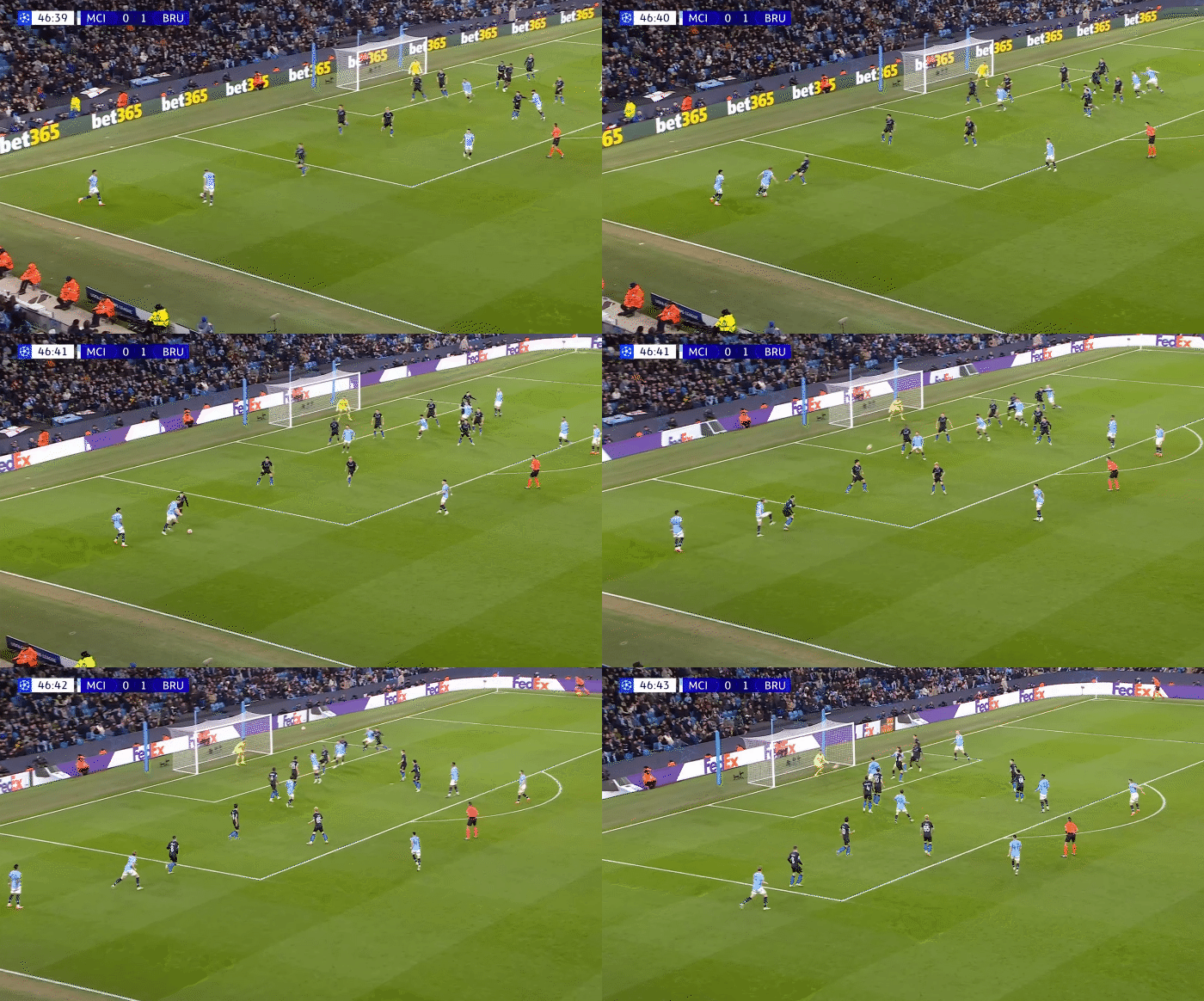
As it stands, he does a particularly good job of tracking runners and defending carriers. The Arsenal press shape (with the striker usually shading the play to Arsenal’s right) often means the left winger has to cover a lot of ground, and can back up the team by squeezing to the middle: this is a good place for him to thrive. Club Brugge looked very man-to-man to me, but I saw no issues with him spotting press triggers and jumping at the right time. He had almost no clear errors throughout.
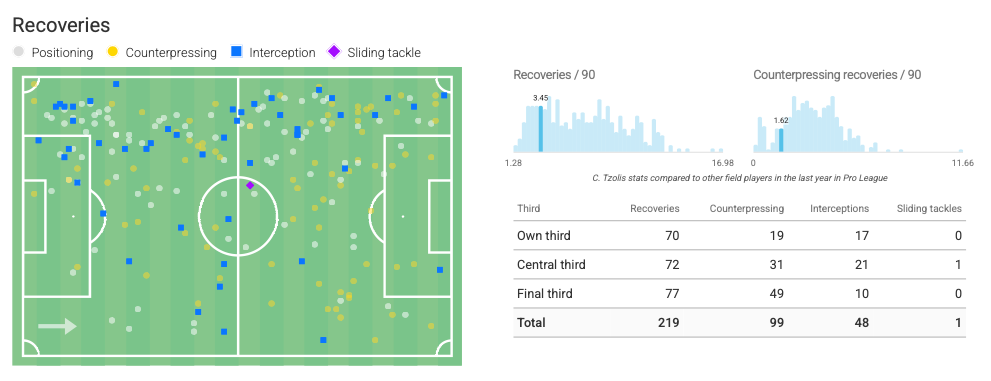
I’d like to see those counterpressing recovery numbers higher. Club Brugge pushed high; it’s a pretty end-to-end league, and the opportunities were there.
In more settled positions, he does a fine job of staying on his feet (just one sliding tackle all year), not switching off, and running with the underlappers.
For posterity, here’s a sliding tackle I saw against another Arsenal target, Ezri Konsa.
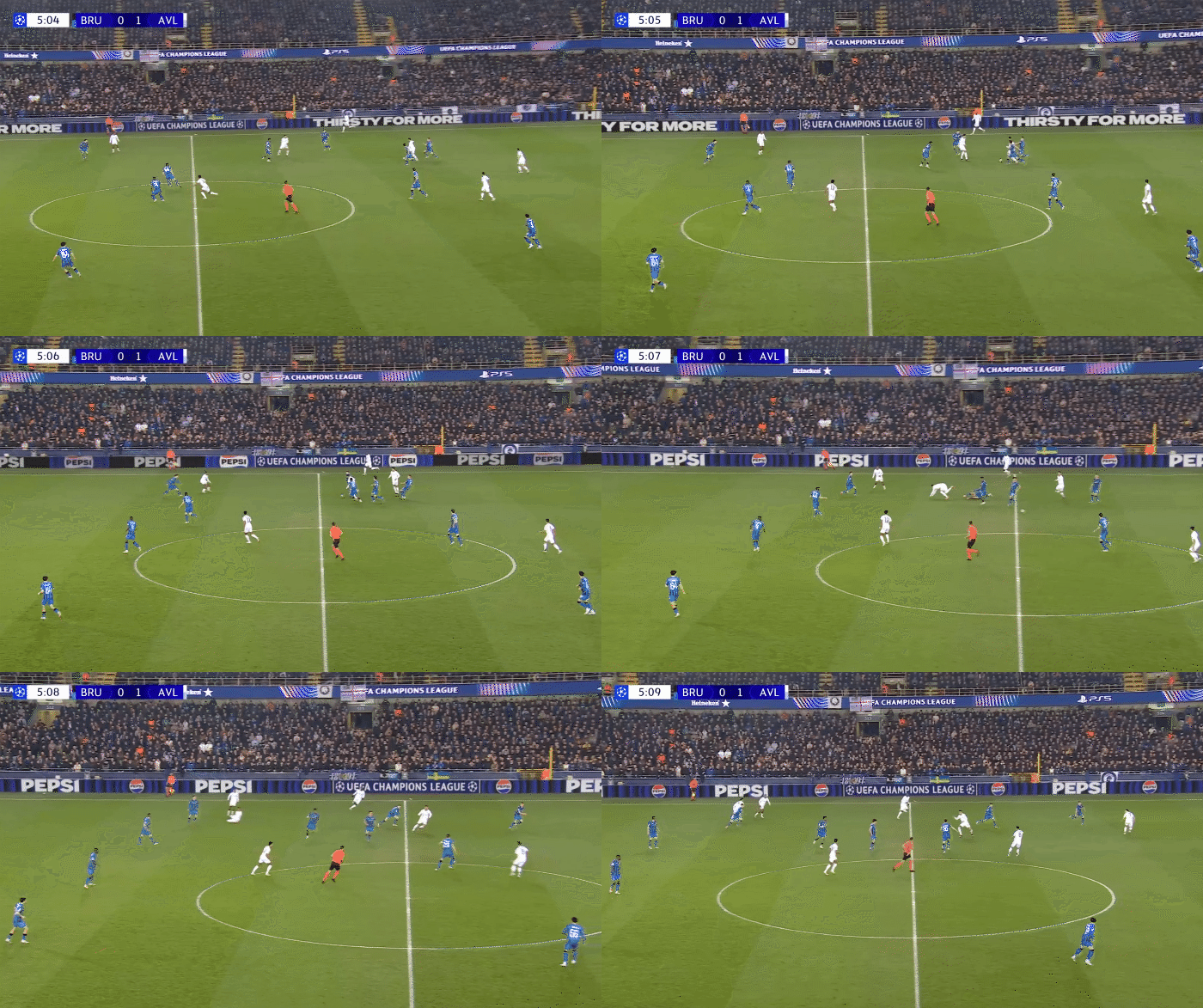
One issue is that he can try to poke at the ball when more patient defending would do, overcommitting and running across players.
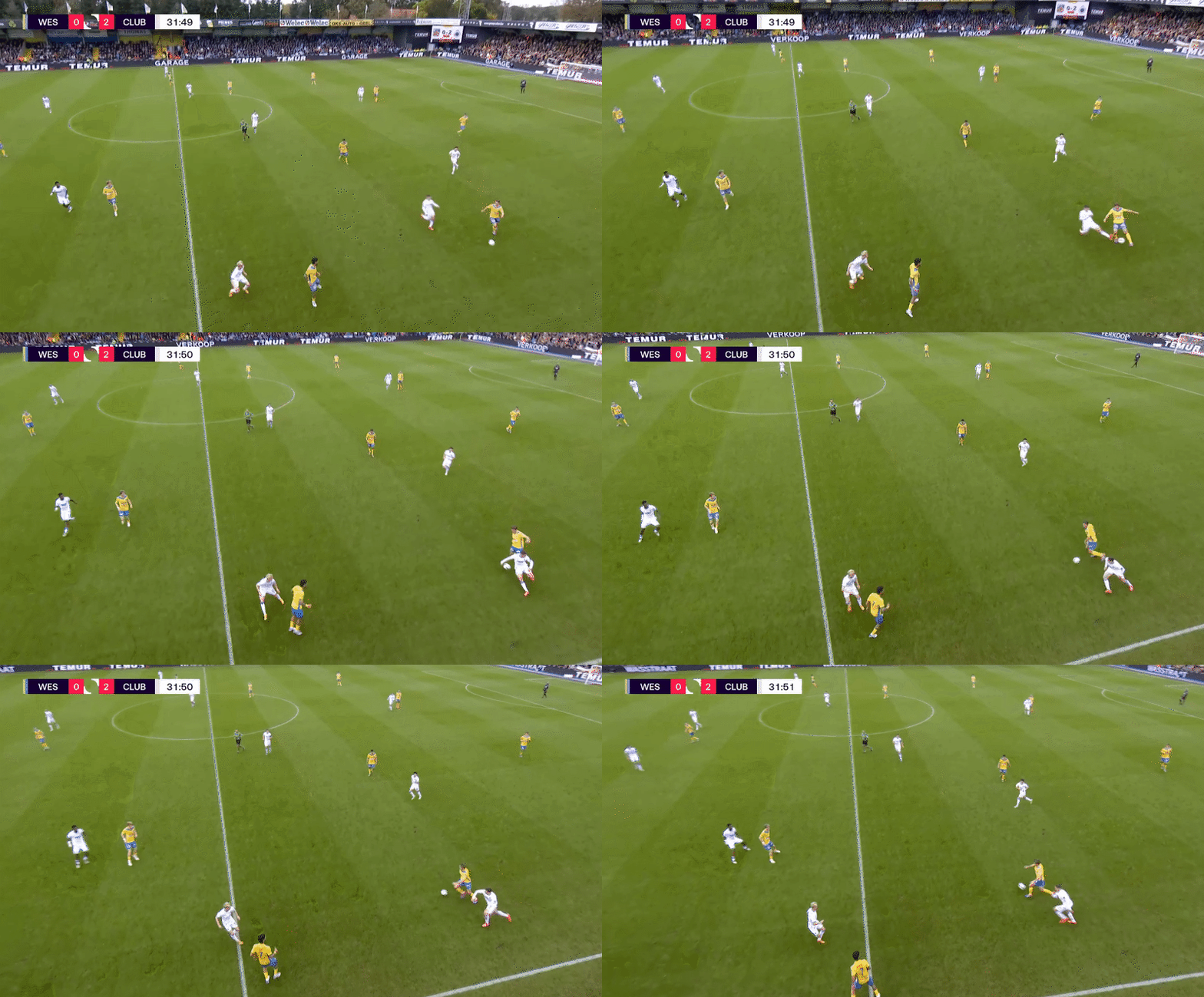
It happens a little more than I’d like. This is rough.
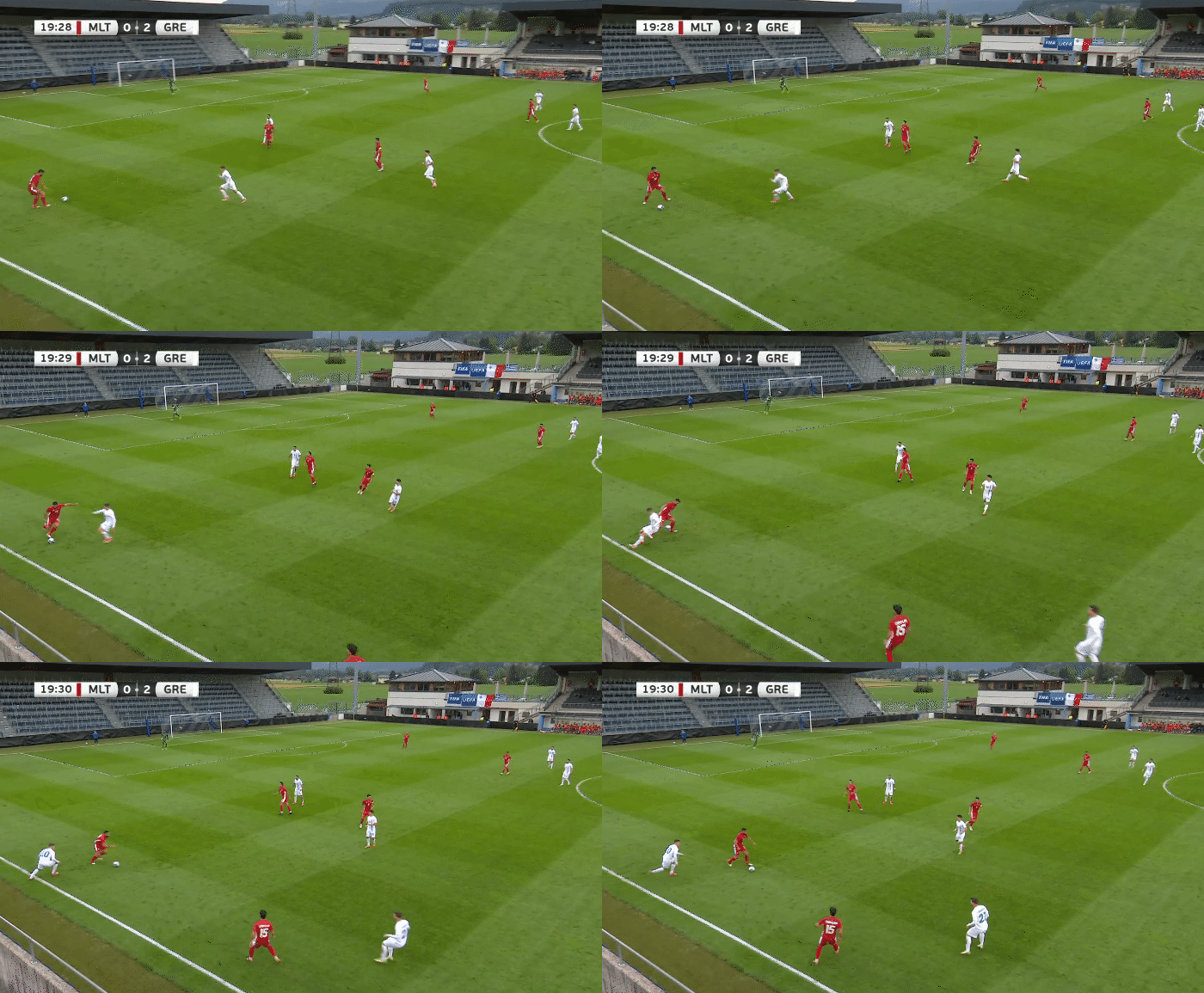
This one looks like an attacking clip, but it’s actually him defending (as you’ll see by the conceded goal). I don’t mind that he blocked a ball towards the goal (it was a weird bounce, and it happens). I just don’t like how much momentum he carried across his opponent, when he could have slowed down and been in more control.
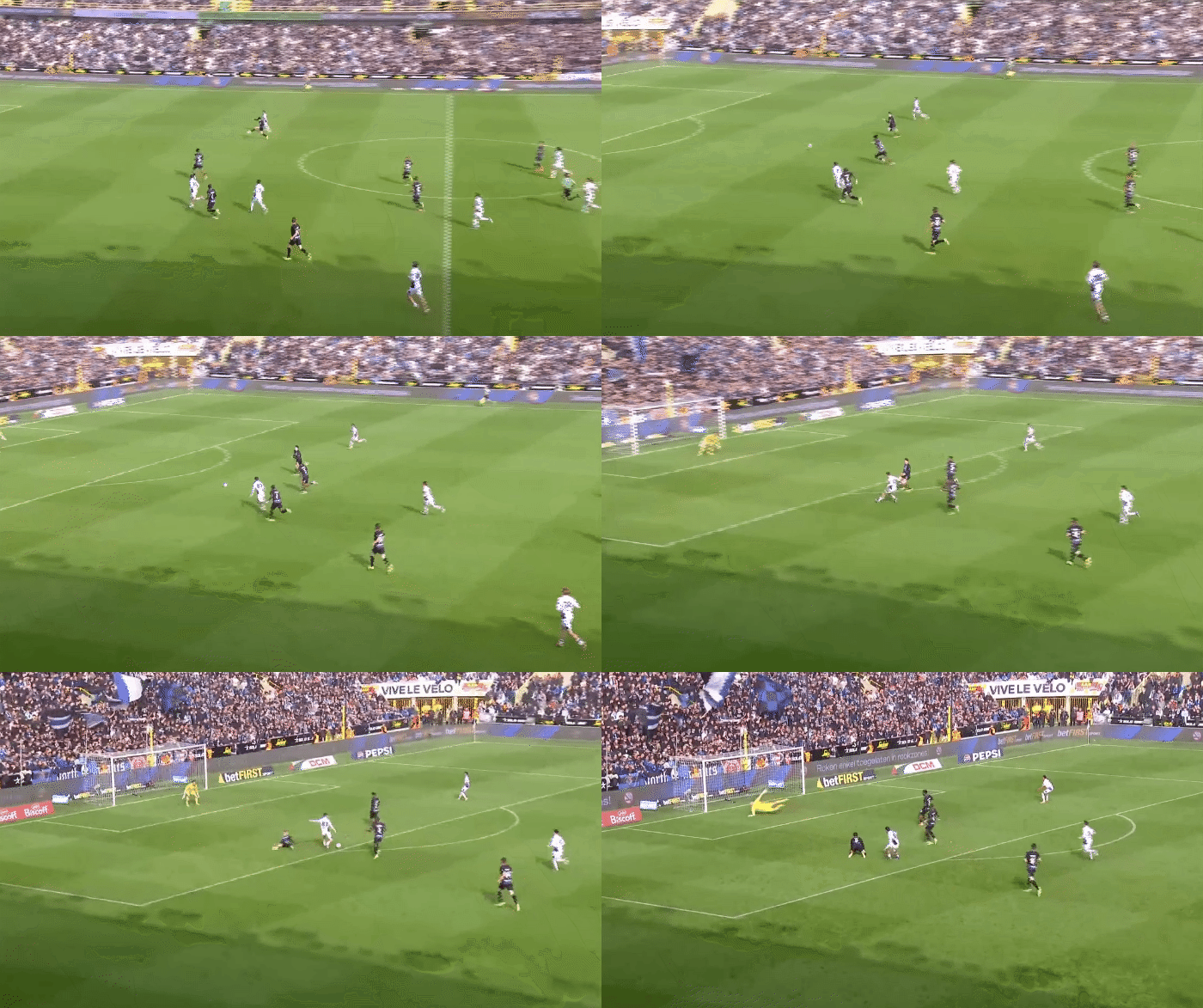
But I think it’s been improving, too.
He’s not much of a factor in the air, at either end.
👉 Durability
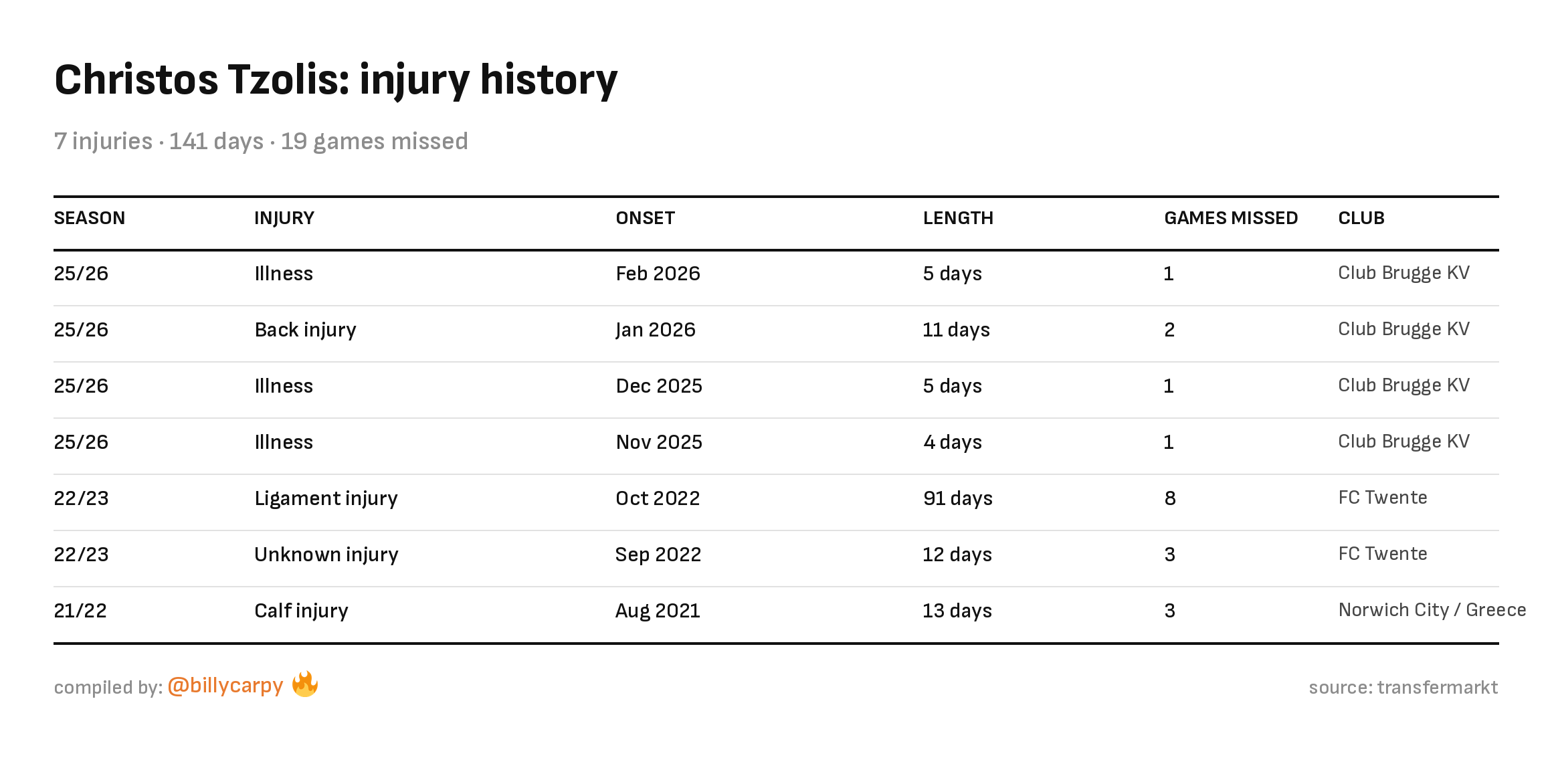
Tzolis has an acceptable injury record. He’s also played through pain. In 24/25, he broke a rib and had a double fracture in his hand without ever missing a game. The one blot is a partial tear of his MCL back in 2022.
There’s always a risk when players scale up into a more physical league, but I have no major concerns here.
🔥 Summary
👉 Role
This’ll be the most boring one of these sections yet.
I think he’ll play left-wing!
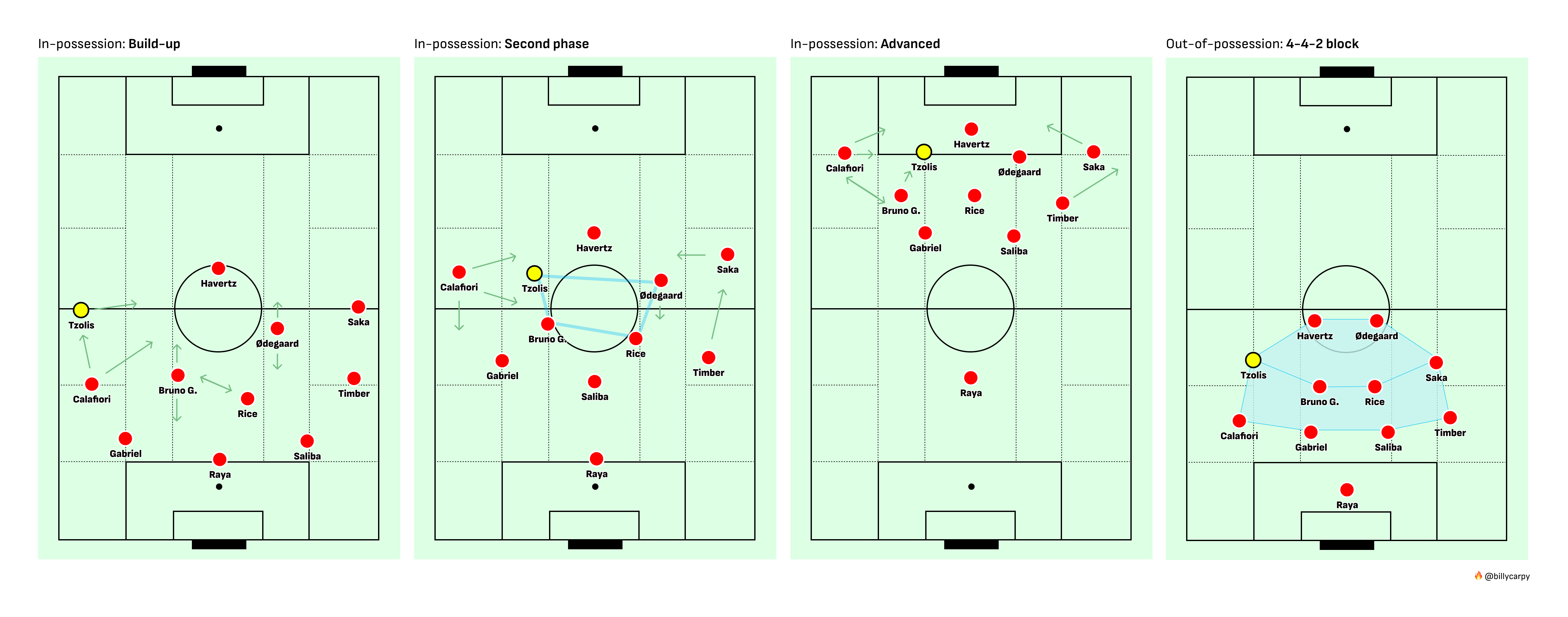
(No, I don’t have final thoughts on Bruno and Rice’s sides. Think they’ll interchange a lot regardless.)
The role at Club Brugge has prepared him well tactically for what will be asked of him at Arsenal. You’d like him to play a version of left-wing that has all the access to the middle he wants, instead of parking him out on the touchline, because if he is out wide, he needs help.
He’s capable of playing right-wing too, but I don’t expect him to feature there much at all. The other possibility is a front-two with somebody like Havertz. Even beyond the Gyökeres/Havertz pairing, I see some hints that Arteta is investigating a 4-4-fackin-2, which isn’t a nonstarter for Tzolis, and might even be his final position, but I still wouldn’t expect it very soon.
As far as surrounding partnerships go, I’d want a flexible profile at left-back who can play “beyond, below, or beside.” Tzolis will have a lot of fun with Calafiori, as they have similar brains, but at the very least, the left-back shouldn’t be clogging the left half-space. Tzolis should have full access to that zone, especially to cut in and shoot. I worry that Calafiori and Tzolis could be like ships in the night, with Calafiori starting the big games and then coming off, being rested in cups, while Tzolis plays the exact opposite minutes. Then I look at a wide triangle of, say, Rice and Hincapié and Tzolis, and wonder where the penetration or wide playmaking is coming from. It’s a concern.
I think an associative striker is important too. Tzolis does so well with wide overloads and quick, played-to-feet interchanges, and you want the wheels to be as greased as possible for that, because he’s not quite as good at playing others into space.
I’d say that deep, dynamic progression matters as well. He’s a good advanced receiver of the ball and is skilled at bringing down long balls on the run, but you need somebody who can deliver exact balls in these situations so he can keep up the advantage he gains from his first step and idea.
📉 Bear case
This may not work out. When surveying for reasons why, the first is injury, of course, but his record’s not too concerning. Another reason is just that his usage will naturally decrease. I’m not certain how much lower-touch he’ll actually be, as Club Brugge and Arsenal have similar styles, but he’ll innately have less of the ball, and, more importantly, less of the “main character energy” he had in Belgium, where you blindly hit it up to your star and expect them to resolve the situation. The biggest “expectation setting” thing is that by default, you are cutting his production and reducing his minutes, not to mention limiting his penalties and taking away the right-sided corners, where he was productive.
Other factors are more about the jump up to the Premier League. I don’t think there’s much of a reason to look back at his time with Norwich City with any sort of critical eye; it was a weird situation. But the biggest question is just how his immediate burst translates to the Premier League.
There are two situations he rightfully depends on for production. The first is how he gets a step on somebody in settled situations to fire off a cross. The second is those quick “lean-and-shoots” on a defender. I tend to remain optimistic about his ability to get his shot off, but if he keeps getting blocked in the wide areas on crosses, it could limit his options. It could also lead him to settling for lower-quality shots, as he sometimes did in the Champions League.
The long pace of Premier League defenders could definitely affect his transitional output, and if he’s not able to press his strengths, then we’ll wind up missing some of Trossard’s recent strengths more (mainly, creativity and work-rate). He still needs to work on overcommitting (running across) opponents as a defender, and also needs to hand-fight a little more on reception, which gets tested a lot in the league.
One of the first things I’ll be looking at is whether he can get a step when he darts behind the backs of Premier League full-backs on a give-and-go. Because he leans heavily on association, he could also be pretty dependent on the players around him to be successful. I’m near-positive that he’ll work well with Calafiori, but in a doomer situation, they won’t play as much together as we hope, and he doesn’t jive with the left-back or left-8.
If some of these concerns come to pass, we could wind up wishing we’d gone for a more universally higher-tier option, physically or technically, instead of Moneyballing it. In an ideal world, you press your unfair advantages after a title, and a signing for this role feels like Desire Doué going to PSG: of course they fucking get him. Tzolis could wind up feeling like a signing for Napoli or Crystal Palace instead of the returning Premier League champions.
📈 Bull case
I started by saying that Tzolis isn’t necessarily the type of player I’d usually target. But in a world of excess and groupthink, where teenagers are going for €100m+, I wholeheartedly endorse bringing your own model to the market and acting on it. Value must be elsewhere.
There are a few things that make Tzolis attractive as a target. The first is his floor. Even if you target a £50m+ winger these days, there are no guarantees of fitness, out-of-possession effort or detail, how they adjust to going in and out of the lineup, their effect on training, or how variable their performances will be from week to week. The characteristic that we data-and-comp geeks consistently undervalue is consistency. Can you go again and again, 40-plus times in a year, whatever the situation, with a similar level of quality? That’s your floor, and it almost always explains why coaches love some players more than others. Tzolis has that.
But he has an interesting ceiling too. You come away from studying Tzolis with a distinctive feeling that this is a certifiable goal-bagger, and he may even carry some swashbuckling, true star qualities. And what’s intriguing is that while his assist totals are a bit noisy, and while he could run-and-gun better in Belgium than he’ll be able to in England, so many of his goals do look like they’ll translate in the Premier League because of his shooting style and flexibility.
The final thing is about game-state. Arsenal, and indeed every top club, face dramatically different situations week-to-week, and even within games. I felt like one of the attacking problems last year was that Arsenal lineups could feel too extreme, either all runners (Martinelli, Gyökeres, Madueke) or mostly ball-to-feet players.
I feel hopeful about Tzolis beating up on lower sides in the cups. In those, he’ll also help Jover’s boys bank on corners in the absence of Saka and Rice, which provides depth in its own way.
Then, if the game evens out and gets more back-and-forth, Tzolis makes great decisions in transition (arriving, moving, shooting), though I don’t prefer him in those deepest-of-block games. And finally, if the opponent is parking the bus, or it’s a late-game, need-a-goal situation, he’s a tidy tight-space operator too, offering quick passes and quick shots (and corners if needed). There’s flexibility within his profile that can help balance lineups by itself.
My confession is that I wouldn’t feel great about going into the season with only Martinelli and Tzolis at left-wing, as I feel the team would be short on true dribblers and wide creators. For today’s purposes, I have big respect for Tzolis, and some niggling concerns I’ll be waiting-and-seeing about. This is a really interesting bet. If it works out, he’ll be a lot of fun to watch, with plenty of goals to show for it.
Anyway. More signings to come. More articles to come. Sorry these things take forever.
Do not forget that I love you.
I was going to "LIKE" the first comment, then the second and the third.
Then I had to chip in. This was really top notch work!
Let's hope that Arteta and staff can bring him along to EPL level.
At the same time Arteta has Eze and Mandueke as improvement projects.
COYG!
The 🐐. Great work Billy, huge fan of your stuff