
Go again
Five ways to improve the champions, and what it all means for the summer business
“When you’re young you think that time moves forward. At 80 you know that it doesn’t, it stands still. We’re the ones that move.”
— Bob Dylan
“Yesterday’s price is not today’s price.”
— Fat Joe
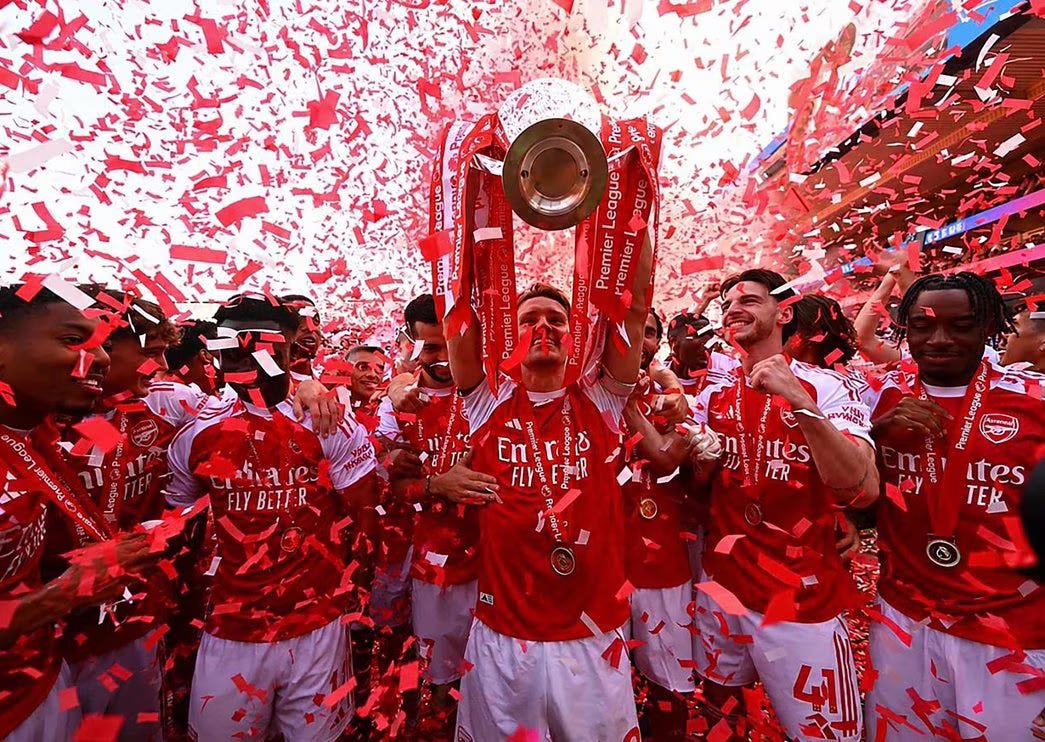
I hope you are doing so, so well. The World Cup has provided a helpful distraction from rewatching clips from the season, still basking in the glow of our beautiful year, one difficult and glorious and perfect. During this cooldown lap, a few season retrospective videos have been released, and they’ve done nothing but reinforce the idea that the campaign wasn’t nearly so much a slog as it sometimes felt. There were plenty of grind-it-out second halves, it’s true, but the clips show that any frustrations were quickly dotted with moments of joy and release, and not just at the end. Step back from the painting, and the strained brushstrokes disappear.
In those clips, there was Eze raining five taunting goals on his jilted suitor. There was the Big Gabi header at the death at St. James’ Park. There was the Martinelli flip on Donnarumma (and there were many Martinelli moments, more than you remember. And oh look, he just had another one for Brazil before going out). There was the classic Saka ‘I’ll do it myself’ rescue performance in which, other options failing him, he curled in one corner off the post and then the head of Johnstone, and a winner off the head of Mosquera (theirs, not ours). There was the Villa explosion, with that delicious Zubimendi central goal, that Jesus clincher, and that Trossard bomb, all of which combined to force Unai to forget his manners. Speaking of manners, there was a frankly rude Havertz goal to knock Chelsea out of the League Cup, celebrating by pointing to his badge of choice. There was, fuck, and I mean fuck, that Dowman cameo.
And near the end, those clips include It’s Not Done, and the stubbornly worked Ødegaard assist to Trossard, with the Belgian putting one foot on the ball and one hand on the trophy, then that VAR review, then 4-4-2 guys, then outright pandemonium. Once the dust had settled, Havertz roofed one and everything was briefly possible and then life intervened and that’s fine because it had already given us so much.
There was plenty else, and words don’t do any of that justice, certainly not mine, so I just rewind and hit play again.
I’d been hesitant to start the transfer shenanigans too soon, for fear of that modern problem, where what’s next is always more alluring than what’s here. It’s only been a month. It’s a special time, and you shouldn’t chug a good single malt.
Alas, silly season comes for all.
Heard melodies are sweet, but those unheard
Are sweeter; therefore, ye soft pipes, play on;
Not to the sensual ear, but, more endear’d,
Pipe to the spirit ditties of no tone
I’m not sure Keats was writing about the symptoms of transfer mania, but I don’t think we can rule it out.
Anticipation, the unknown, the imagined, the inferred, is intoxicating. I know this because I can’t post a word online without somebody asking me WHAT ABOUT YANN GBOHO? SHOULD WE SIGN HIM? It’s not always Yann Gboho, but you get the idea.
I am no better than anyone. I recently had what addicts refer to as a “moment of clarity” as I remembered that the actual World Cup was on, live, available on my very own television, with real teams and flags and anthems and everything, and I was watching (this is a safe space) the Greece U21s face the Portugal U21s in a fanless 2023 match, catching up on something called Christos Tzolis. It is a sickness.
🔥 Strengths to fortify
Proceed we must. And I’ve been gathering notes, watching transfer targets, and refining models and dashboards, don’t you worry. There is so much to come. But we can’t start there.
The overlooked step is fortifying previous strengths.
Leaning on some advanced data from Gradient, here were six strengths that popped out from last year.
1. Set pieces
Ah yes, more mind-blowing perspective from ol’ Billy Insights.
Still, it’s OK to linger on it: we scored 25 set-piece goals (excluding pens), which was an all-time Premier League record. The advanced stats back it up further. Arsenal had 25 above-expectation legal blocks (DAB+ was #1, by 2.5x the league average), with Timber a standout performer on those. We also saw the best deliveries into the six-yard box.
I generally think people are ascribing old narratives to Arsenal set-piece routines. We’re really past the days of “Ben White hugs the keeper,” and we saw a lot of different looks as the season went on. And all this means that, when combined with open play, Arsenal were second in goals and third in xG, per Opta. In a broader sense, “scoring goals” was hardly a crisis zone, but it could definitely be improved.
On defensive set pieces, things looked good, too. Arsenal offered the fewest set-piece goals conceded (7), and overall, achieved the most instances of above-expectation set-piece positioning. I’d previously had some issues with defensive set-piece execution (it felt like there were too many “leaders” and some communication breakdowns), but those mostly look behind us now.
The league sees this and is desperately trying to catch up. It’s the single area where you can presume the highest growth trajectory from other clubs, as nobody can afford to ignore this in the league, not in a Postecogluian fashion. While Arsenal have some unassailable advantages (Rice and Saka, for one, and Very Tall Players, for another), we can’t rest on our laurels.
2. Defensive and positional discipline
Arteta always talks about suffering, and Arsenal indeed did it better than any team in the world last year. Gradient says Arsenal had the fewest positional mistakes in the league (basically half the league norm), the fewest big positional mistakes, the fewest unsafe clearances, and the third-fewest errors leading to goals all season (5).
This shows in the disciplinary record, too. Arsenal had the fewest yellows, no reds, and no penalties conceded. (I know how your brain works because I know how my brain works, and I expect a bit less fortune on that next year, just because.)
One substory that I think goes undercovered is the defensive aerial win rate:
By many metrics, Zubimendi was the #1 aerial midfielder in the league.
Rice, who previously was more so-so, was right behind him, winning at a clip of 67.6% and earning a #2 aerial ranking among midfielders from Gradient.
This extends to the backline. While Saliba was the highest-ranked player in the league on positioning, Gabriel continued to be exceptional at these aerial scraps, while Gradient ranked Calafiori and Timber as the joint-2nd best aerial full-backs in the league (and that’s only because Jake O’Brien cheated by being 6’6”). Hincapié was 7th.
Defensively, Arsenal pressed high but were pretty passive in direct interventions, and often dropped back depending on game-state. When they did mount a pressure, they had a top-3 success rate, and forced the 2nd-most pressure-induced turnovers. In such a long, attritional season, it didn’t always have that final level of aggressive, forward bite, but the coordination of the whole thing worked incredibly.
3. Ball security
We’ll call for more risk later, and I’m sure you’ve shouted for more of it, as well. But we can’t overlook the advantages of what we saw. Arsenal have led the league in “fewest dangerous possessions lost” for two years running, which can’t be disentangled from the defensive record.
4. Shot-stopping
At the team level, there were only six saveable goals conceded all season, fewest in the league. Raya was incredible (we certainly felt it whenever he was gone), but that’s a team metric too. Teams block in unison, and the likes of Hincapié and Mosquera struck me as good additions on this front.
5. Box entries
On a per-possession basis, Arsenal got in the box more than anyone else. They led the league in carries leading to a half-chance or better (with 21), and were second for dribbles into a dangerous position (73). They also had the highest success rate when opponents tried to tackle our dribblers.
That’s a fair compliment to both the dribbling and carrying talent of the team. While it feels like Saka was always battling something, he ultimately gritted his way to 31 league appearances and 25 starts, and these statistics are in large part due to him. He was top-10 in the league in open-play xA and open-play chances created. If you watch his season back, you’ll know how many counting stats he lost to statistical anomaly (deflections, own goals, the like). He had more carries and more dribbles into dangerous positions than anybody at Arsenal.
Once around the box, Arsenal led the league in “unsaveable shots,” which is a nice counterweight to the idea that we just need to improve “finishing,” at least in the sense of their best shots. My belief is we have to increase the number of shots taken via quicker triggers and more two-footedness, but the idea that ‘we just have to finish better’ is overstated. Every fan remembers their misses and thinks their team could do a better job. That’s fandom for you.
6. Depth and late-game
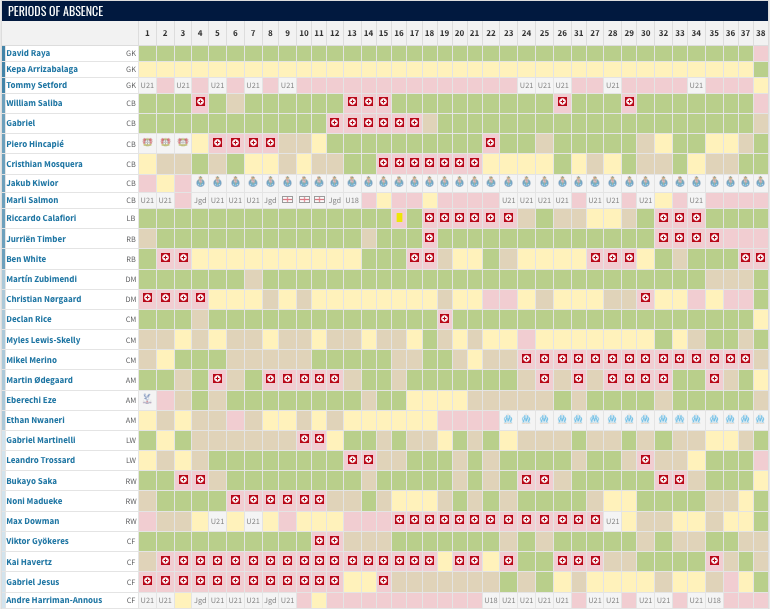
Ødegaard, Saka, and Havertz didn’t start a league game together until Matchweek 37.
The underlying theory of last summer’s transfer window, that this was a battle of attrition and it required a deep squad, was conclusively proven right. In the first leg against PSG last season, the bench featured the likes of Ismeal Kabia, Jack Henry-Francois, Nathan Butler-Oyedeji, and Raheem Sterling. It’s fair to say that things changed for the better.
Arsenal were again beset by injuries throughout the campaign, and in my view could have managed some players more conservatively, but still limped to the title. Along the way, they led the league in second-half goals, and more than doubled anyone else’s second-half goal differential (+24; the next highest was +11). They had 11 goals from subs, which was tied for second-most, and 9 more than Man City (who had all of ... 2).
🔥 How the league is changing
The league is getting closer together.
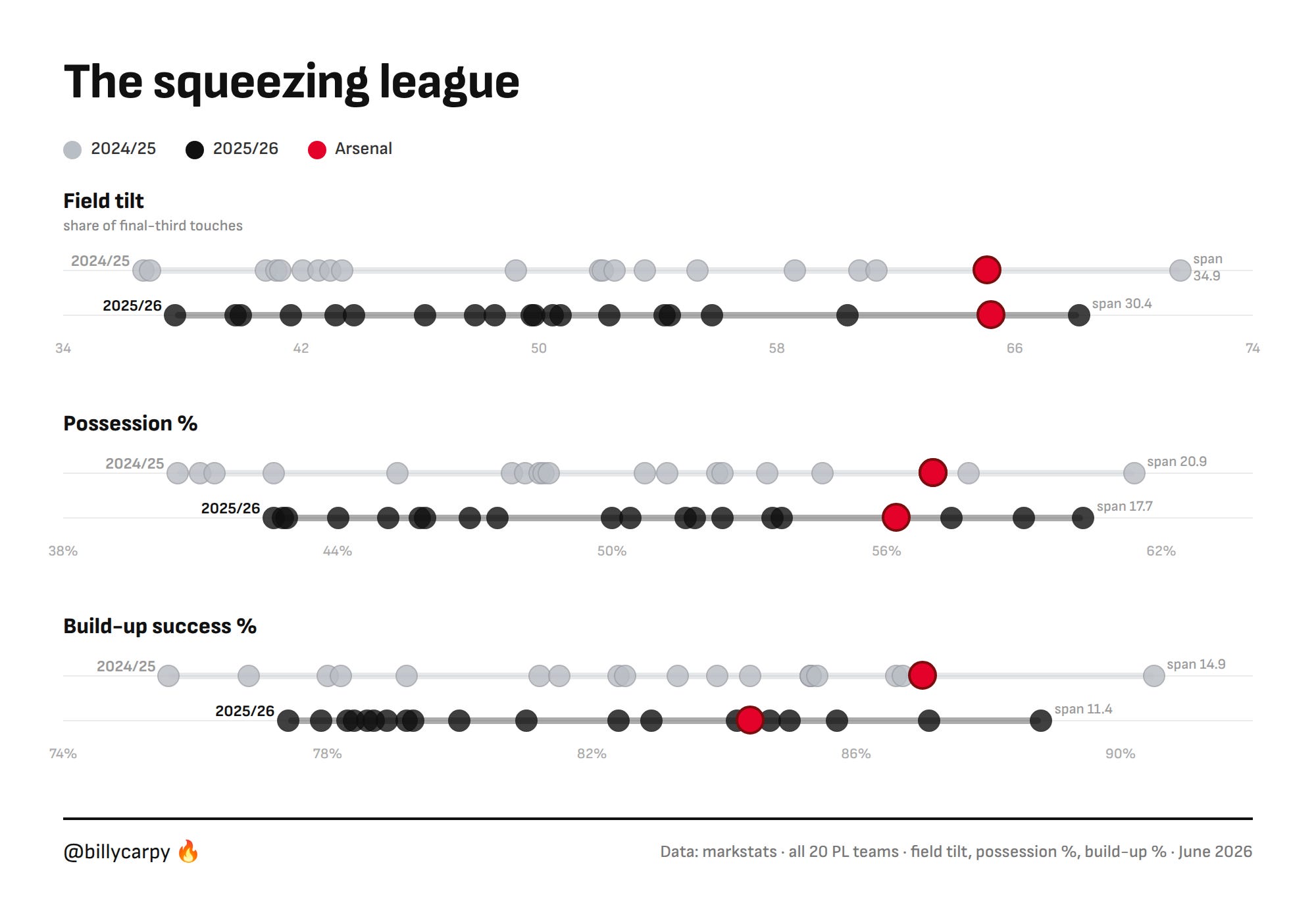
Of note:
Attacks are getting marginally harder to generate league-wide.
The league-average build-up passing success fell from 83.0% to 81.6%, with 12 of the 17 returning teams completing at a lower rate. Arsenal’s own drop is steeper than the league’s.
Territorial control is harder to generate, and the strong teams are tilting the pitch less decisively.
League-average “dangerous possessions lost” barely moved, but the spread tightened even harder than field-tilt. Teams are converging on how rarely they cough up the ball in dangerous areas. I’d say this is an undercelebrated way in which the league is evolving. Leeds, for example, opted out of being a savvy feeder-sales club of young starlets and went for size, age, and experience. This type of player is less likely to make mistakes and more likely to punish yours.
For Arsenal, dangerous possessions lost ticked up from 15.1 per game (2024/25) to 16.5 (2025/26), but even at the higher figure, Arsenal still conceded the fewest dangerous turnovers in the league. So the backline stayed excellent (and perhaps, too risk-averse) when protecting the ball in its own danger areas.
I also wanted to check out clearances. My conclusion is that Arsenal clear the ball a little more than I like (more than top-5 clubs, less than everybody else), and are good at getting it out of danger: they rarely hit it to a place where another attack starts immediately. But because the clearances are so “safe,” they aren’t likely to turn into lucky counters, and can enable the opponent to regroup and mount another, slower attack without Arsenal being able to spin up the press.
To skip to the end, this means that top teams must invest in elite creation and ball-striking, forever and ever. The dead-simple country logic is that if territorial dominance is converging to the mean, the only edge that still scales is what happens in the highest-leverage actions. Just watch the World Cup to see the effect of superstars like Messi, Mbappé, and Merino.
Bournemouth may be able to hit it long and squeeze the tactical gap between you and them. But the hope is that you have better, rarer, less attainable players making the most decisive touches. So more of those, please.
(Editor’s note: I wrapped these sections up a week or two ago, but before publishing, saw Rohan published a piece with many of the same conclusions. Go read him, go love him, he’s great.)
From there, we must take stock of any qualities that are headed out the door, and appropriately backfill them. In the rush toward ‘ways to improve,’ sometimes you can skip that step and pay the price. If Trossard, Martinelli, or White leave, for example, we will feel the loss of their qualities, as we did with Xhaka. I still reckon Liverpool miss Trent Alexander-Arnold’s passing from deep.
But today’s real aim is to look at our squad’s performance with some frankness and sobriety, pair that with whatever insights we have about how the league and the game are changing, and consider ways to move forward. Without that, recruitment is vibes and hunches.
It can feel gauche to look back at the season critically, with so much to celebrate. So naturally, I’ve spent the last couple of weeks going through the footage and the data, as well as all my pieces throughout the season, spending a little more time with those grind-it-out games, those that didn’t appear in the end-of-year montages.
The name of the game is simple: fortify all the strengths, and then turn up the open-play xG.
Here are some ways Arsenal can improve.
🔥 What to improve
1. Increase efficiency long and over-the-top
Here’s a vignette from the Wolves debrief:
Wolves, the bottom dwellers of the league, were down. They committed their press forward, a man for every man. By our powers of deduction, we know that means the advantage is more likely to be long, so Raya does what he’s trained to do, and happily sends it over the top to their backline. Especially in today’s game, this is widely viewed as the correct decision.
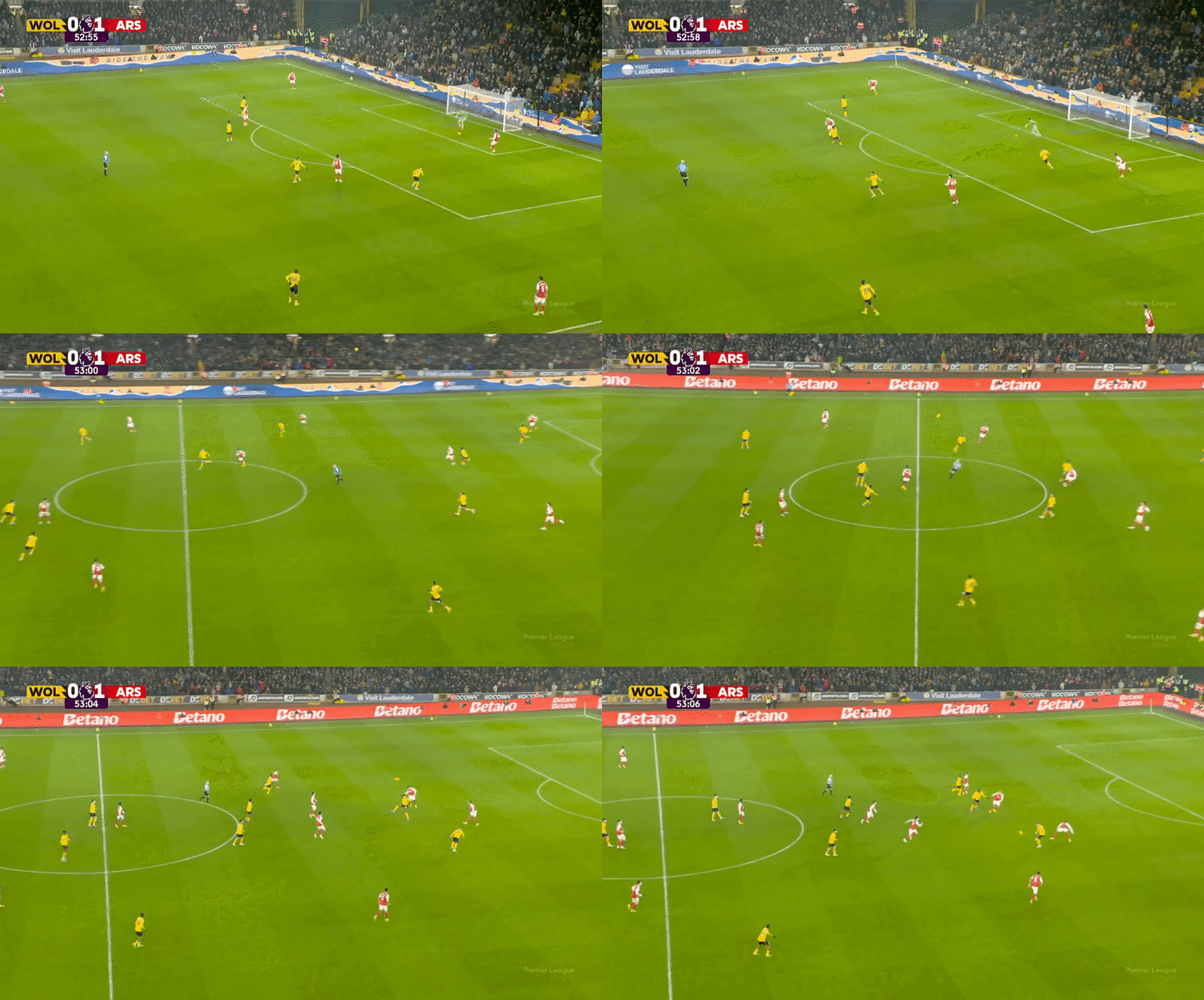
While the numbers are fine, the delivery isn’t ideal, the jockeying is nonexistent, other players look 10% more tired than they did at the beginning of the season, the ball is lost, possession returns to the opponent, and we’re left wondering why we can’t (fucking) sustain a (fucking) attack (fucking).
In contrast, Arsenal held onto a 1-0 lead away at Brighton and were in a position where you might expect to see Raya hoof it. But Trossard, Calafiori, and Havertz had just come on, and instead, the decision was made to gather and regroup.
Zubimendi dropped into the soft spot, and a midfield overload was achieved.
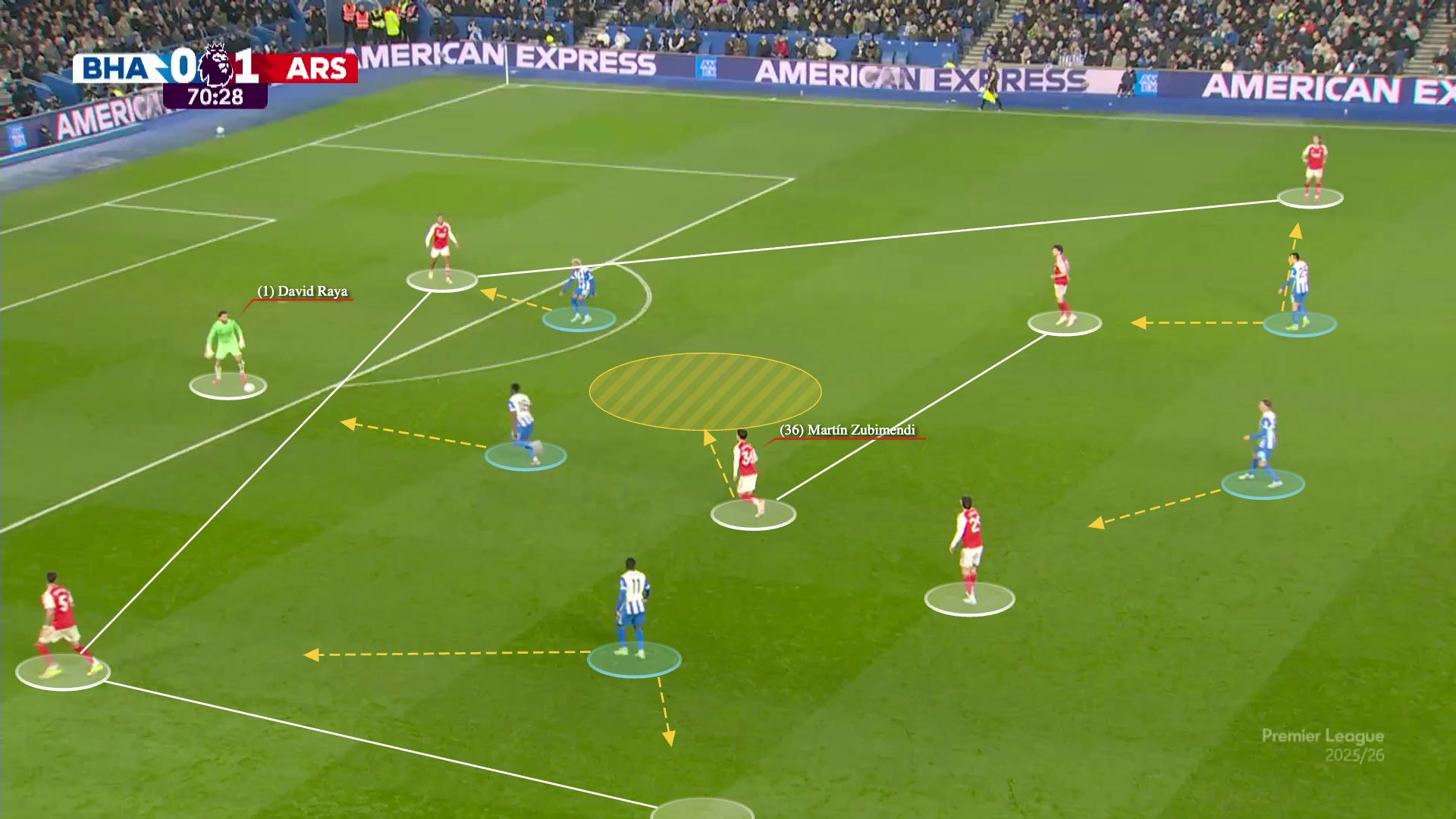
Before long, Havertz was the free man, then Rice, then a dominant spell of advanced possession and counterpressing.
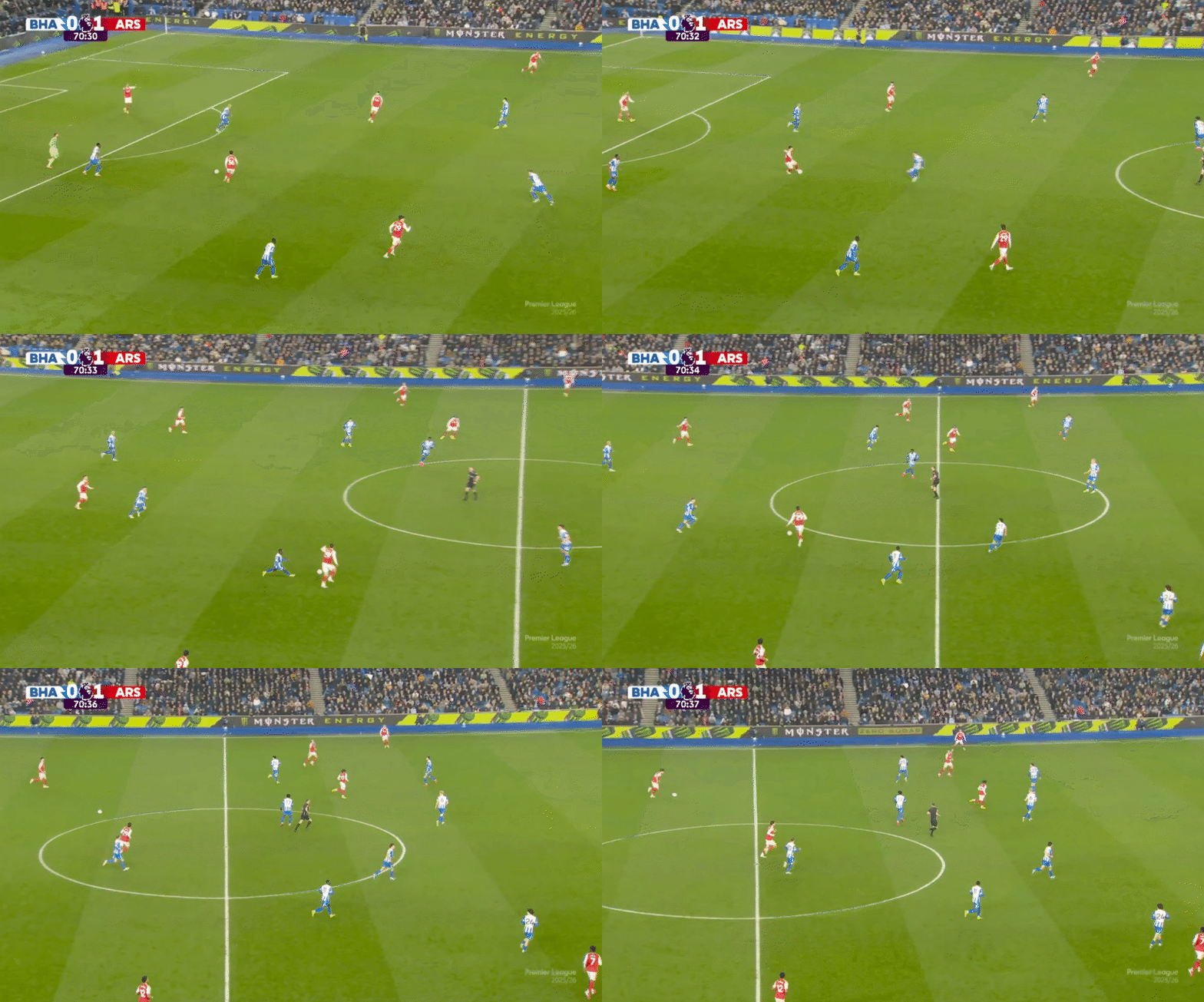
From that point on, Brighton failed to log a single shot.
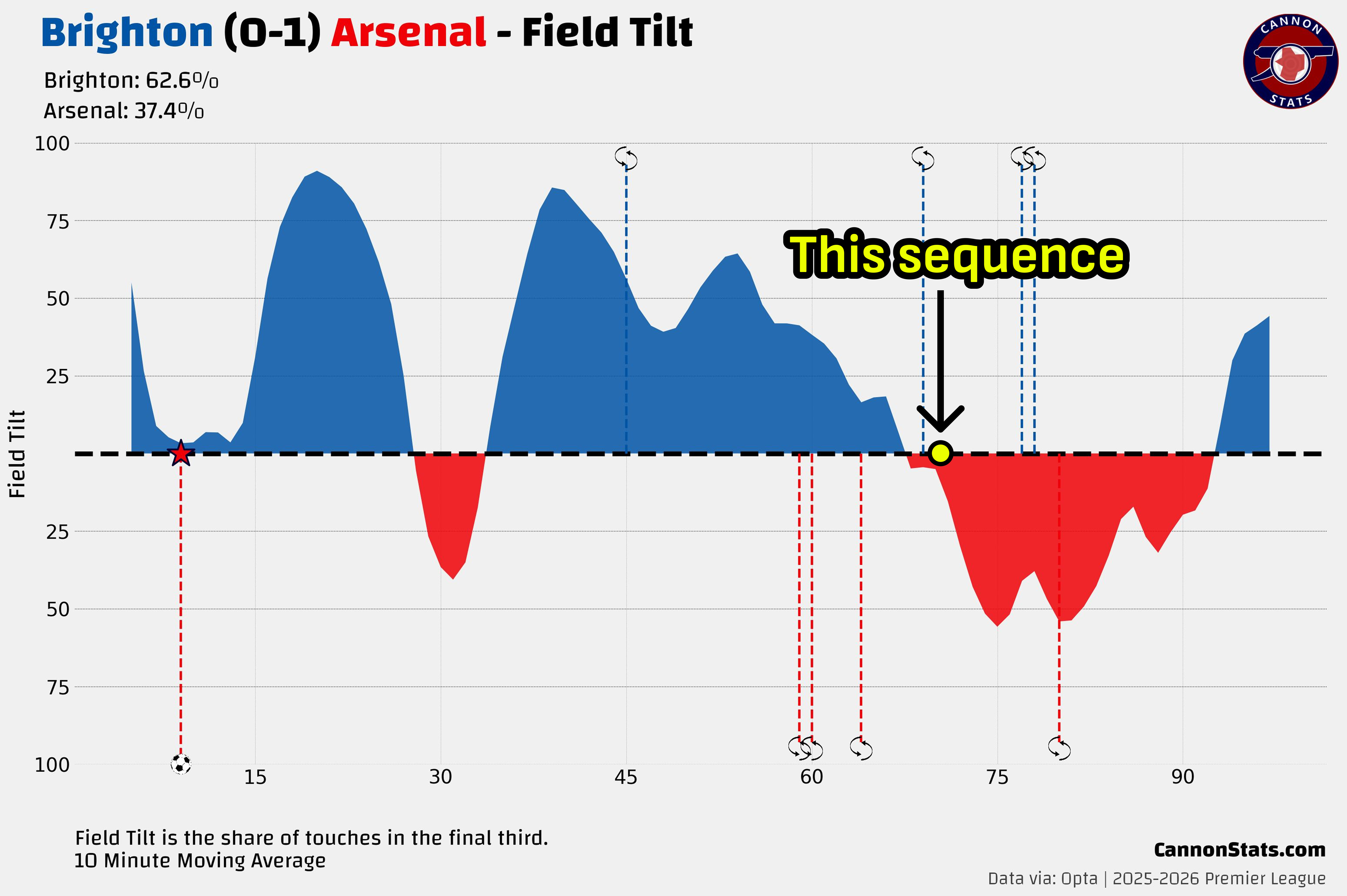
As I said at the time:
Among other things, this illustrates how backpassing and regrouping are more often signs of composure than of conservativeness. Hoofing, at least hoofing without the requisite talent or numerical advantage, is the easier, more ruffled alternative.
If a player, or a set of players, can demonstrate steadfast composure, it reverberates throughout the pitch.
‘Eschew the long-ball’ is precisely the kind of thing that is easiest to say from our vantage point, where our silly opinions have little consequence. That shining Brighton example started with Rice lifting a ball in buildup, which is what you have to do to find the free man these days. But this has its risks.
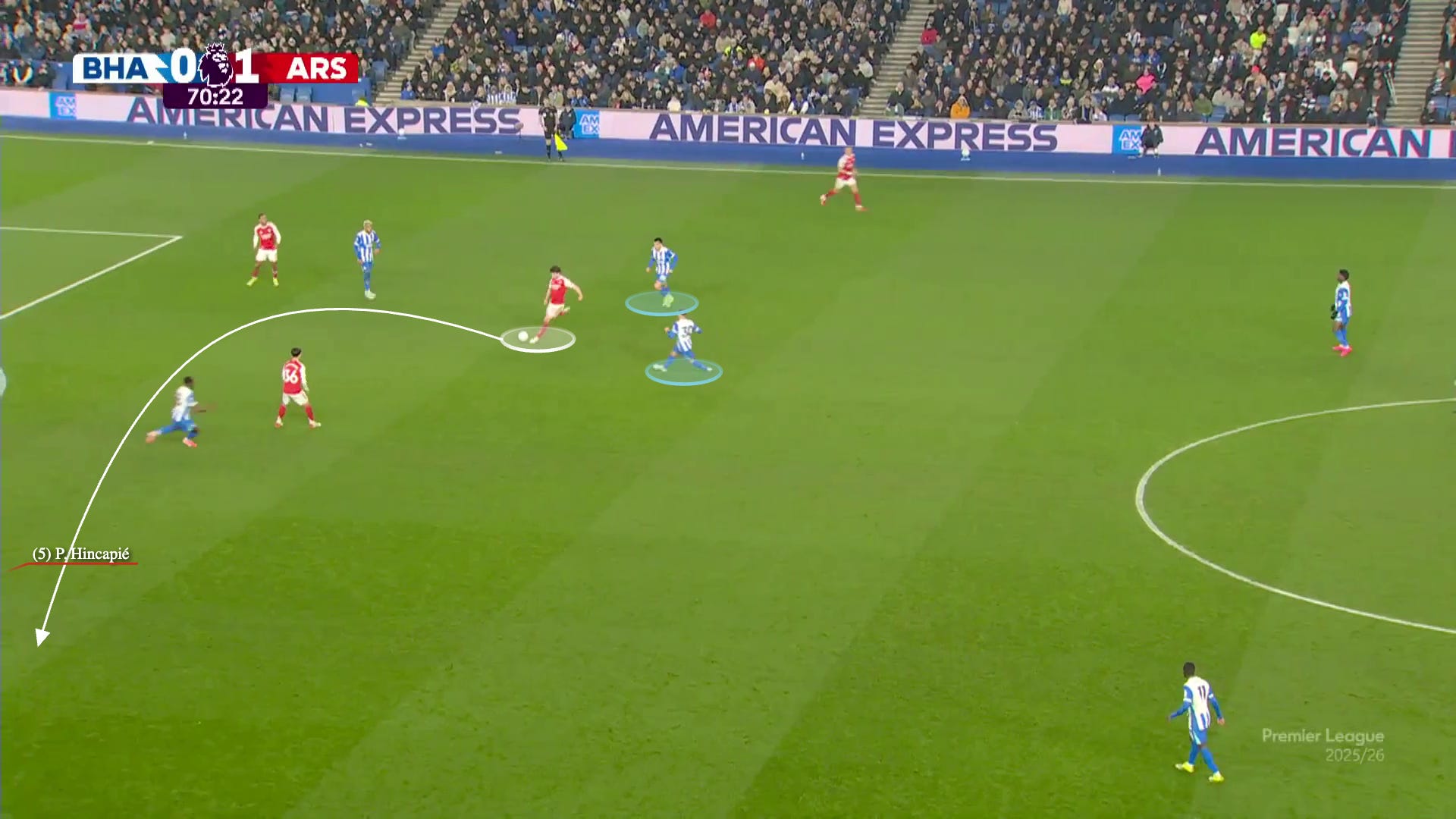
In a changing league, individual pressures are especially effective and deep losses are especially costly. Arsenal are built on duels and second balls, and, particularly if you have a lead, it’s not a bad thing to have the ball in the air, taking up time.
But Arsenal would often send it high without a qualitative advantage (Gyökeres improved but was still not average as a dueller on these high balls), or a quantitative advantage (often, Raya would kick it to the frontline, even if the opponent had a +1 waiting).
Looking through the stats will confirm this:
Per Wyscout, Arsenal lost the ball ~9 times per 90 more than last season.
Even with Havertz and Merino’s injury issues, Arsenal engaged in 6 more aerial duels per 90, and hit 5 more long passes per 90 (also per Wyscout).
Much of this originated from Gabriel, as opponents tilted play his way:
In 24/25, he had 6.6 losses (41.7% in own half) and 2.3 clearances per 90.
In 25/26, he had 7.7 losses (50.6% in own half) and 3.1 clearances per 90.
On the season, Gyökeres participated in 246 aerial duels that originated from a teammate’s pass. The next highest for Arsenal was Mikel Merino, with 71 … which is to say that Gyökeres participated in 175 more “opt-in” aerial duels than any other Arsenal player, and, only including players who have played CF in the Premier League, he was 36th in aerial win rate (30.2%). 19.2% of his aerial duels went above expectation, which was 44th best amongst strikers in the league.
This also applies to “balls sent over the top,” which was not a flattering statistic for Arsenal. On those passes, Saliba was 3/30 (10%), Timber was 4/34 (11.8%), Gabriel was 14/62 (22.6%), and Raya was 18/78 (23.1%). The three best were Hincapié, White, and Calafiori. The very, very important reminder is that it is not only a passing statistic: you need somebody to go and receive it.
What you notice is how little of these over-the-top balls are being struck to midfielders in the half-space. If Gyökeres is pinning, you very rarely see Eze or Ødegaard sprinting in behind.
Arsenal were tangibly different from Man City in this way. They sent it over the top 183 more times than the bad guys. City did it at the lowest rate in the league, while Arsenal did it the 4th-most, and Arsenal had the 6th-lowest completion rate on these (26.3%). I’m temperamentally inclined toward steadier possession, and was constantly interrogating my premises on this. Am I frustrated because of how my team is sending these low-percentage balls over the top, or am I just yelling at clouds, adjusting to the way the game is changing? The reality is that I’m good with doing it, just … do it better.
According to Gradient, Arsenal won 45% of their 50/50s, which was 18th in the league (379 of 839 won), surprisingly. This is a product of both conditions (how was the first ball fought for? how close are others around?) and energy levels.
I looked at those 50/50 duels some more. On those, Gabriel, Hincapié, Timber, Zubimendi, Rice, Lewis-Skelly, and Merino did well. On the other hand, Gyökeres won 33/88 (37.5%), Trossard won 12/51 (23.5%), Saka won 19/50 (38%), and Ødegaard only won 4/26 (15.4%). This makes sense when you think of the respective locations of those battles. A winger is going to have a hard time against a defensive midfielder or a CB on a bouncing ball. But it still should be improved. At his best, Ødegaard has been on the edge of these physical battles, but this season, he got injured twice while diving into them and looked hesitant to engage after that. It led to some transitions the other way, and was an issue.
…but also according to Gradient, Arsenal had the fourth-best rate of winning the ball that was intentionally struck to “create a contest,” at 32.1%. Regardless, when isolating to goalkeepers, Pickford, Sá, Lammens, Kelleher, and Sels all had higher completion % on “creating contests” than Raya, and I’d like to see that improve.
This graphic shows how things have changed.
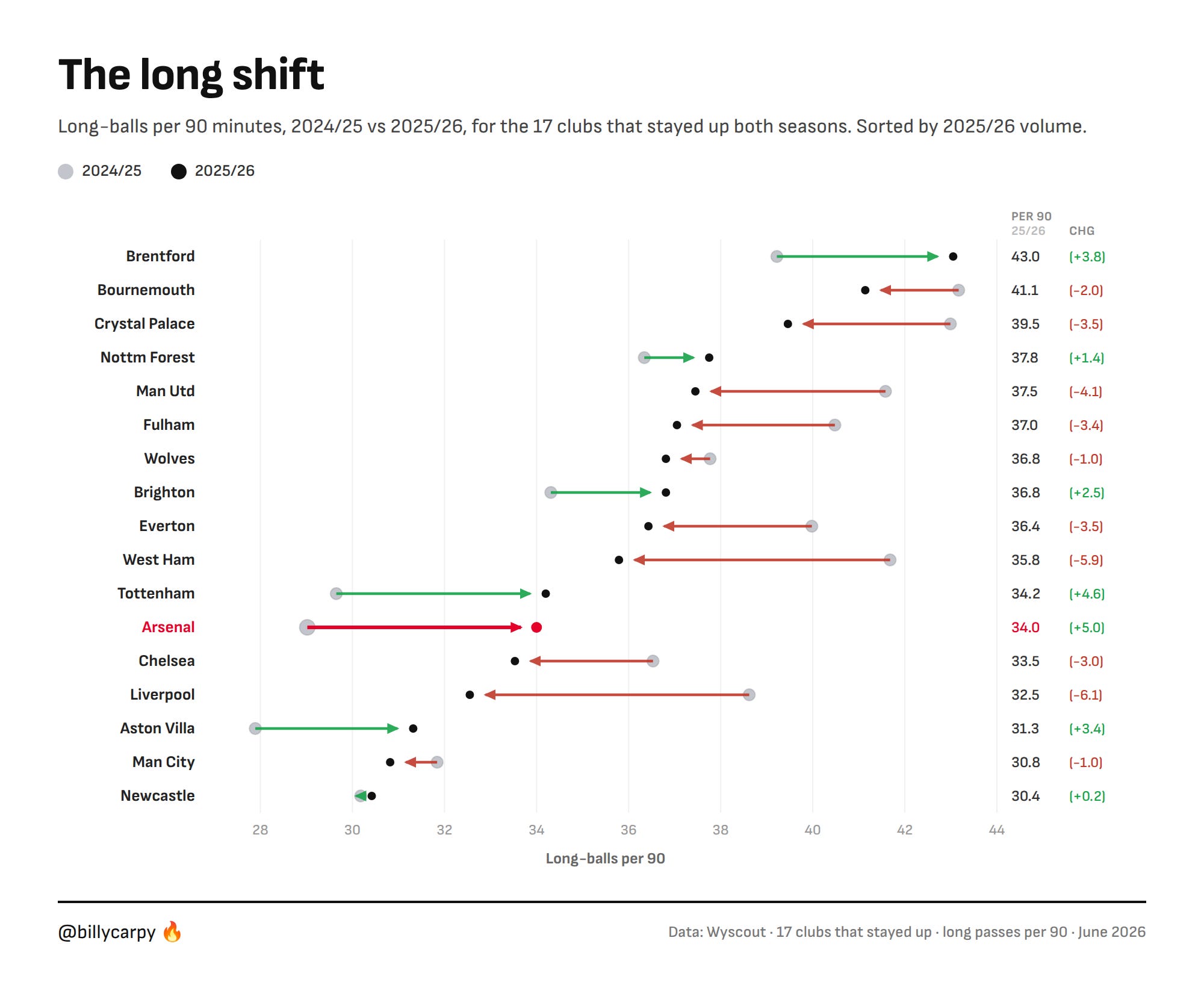
On a league-level, it’s changed less dramatically than I may have thought, but Arsenal increased their long-ball percentage more than anyone in the league. This places them above the likes of Chelsea, Liverpool, Aston Villa, City, and Newcastle.
This is not fundamentally a bad thing. We can notice that two of the most underachieving teams (West Ham and Liverpool) had the sharpest drops in long-balls, which didn’t seem to benefit them. West Ham tried to be more positional without the players to do it, and Liverpool had a terrible time trying to generate attacks through less chaotic, more structured (synonym: boring) possession.
This chart shows some interesting things, too.
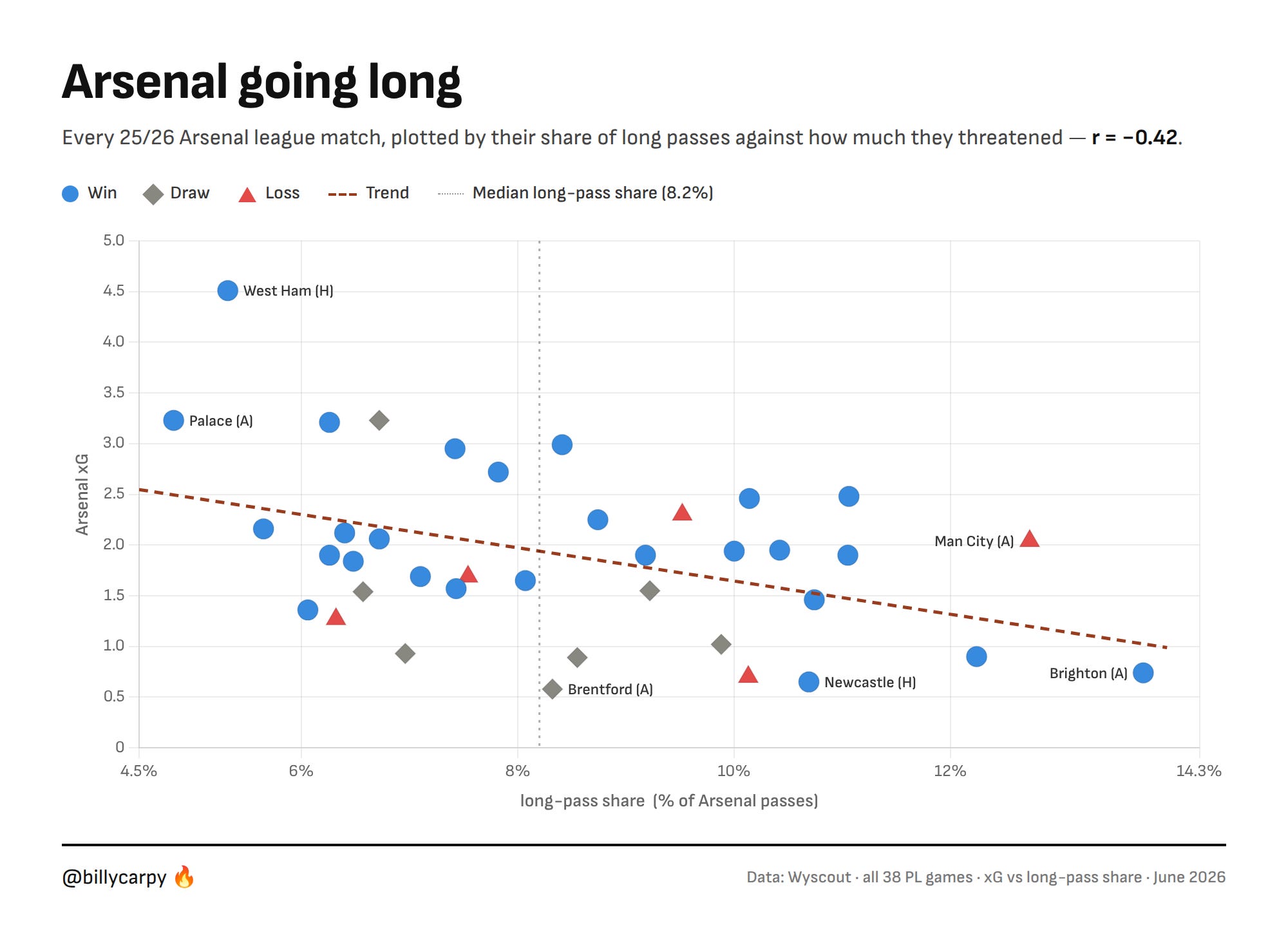
…and I solemnly hope everyone’s takeaway is more nuanced than “going long causes you to lose games.” Correlation and causation, you know.
What we see:
This shows a moderate negative correlation (-0.42) between Arsenal’s creation via Wyscout’s xG model when passing long. In so many words, Arsenal went long more in the games where they created less.
When we split at the season median (8.2% long-pass share), the longball-heavier half Arsenal averaged 1.62 xG, and the ground-passing half averaged 2.19 xG. (One caveat is that this uses Wyscout’s xG model, which isn’t always my preference.)
The big caveat: Arsenal went long more often against the better/deeper opponents (Man City away, Brighton away) who suppress xG anyway, so the chart shows the long version of Arsenal was the blunter one, not that going long directly causes low xG.
Now, it’d be tempting to look at this information and say that Gyökeres wasn’t good at receiving long-balls and that’s the primary thing that needs to be fixed. And there is plenty of truth to that. All the deeper stats confirm real issues with his receiving and carrying in the Premier League. But as we’ve covered all year, deep build-up and long-balls have a one-hand-washes-the-other effect. The better you are at one, the better you are at the other, because of how profoundly it impacts the opponent’s pressing look.
And so the conversation naturally flows to what we do about it.
The first step is to simply win more high, aerial 1v1s. More minutes from Merino and Havertz should help, and Gyökeres has improved, but this was mostly a quality issue this year. Lineups without somebody as a target man never feel quite right, because the assumption is that we’ll still go long, and the assumption is that we may not win that battle. I’d also personally hope for a more decisive Merino transition to the #9.
In conjunction with that, my brain drifts toward adding physicality at the #10, and/or the #9. The objective here is to win more second balls. I had a little hipster contrarian suspicion that perhaps Rice and Zubimendi surprisingly underperformed some expectations on second balls in the double-pivot, just because they were floating around and often arriving from far away, but those were quickly disproven upon rewatches and a tour through the stats. The deeper midfield numbers (from Zubimendi, Rice, and Lewis-Skelly) on 50/50s are nothing to address: they were great, as you’d expect. The drop-off comes further forward. Gyökeres struggled with winning position; Saka and Trossard weren’t necessarily the first to retrieve, because of their immediate burst relative to fresher full-backs; Eze and Ødegaard often weren’t willing or able to truly scrap.
Next, as I’ve yelled all year, I’d like to keep more unplanned long balls on the ground. When you go long off the cuff (in a rushed clearance, or a hoof), you put the receiver in a rough spot. They receive the high ball without the second-ball cocoon of teammates around them, which makes the knockdown almost impossible to recover and the possession almost certain to die. This is largely what happened against City, and also has something to do with the number of build-up players we have deep, which we’ll cover later. I’d consider rotating Gabriel a bit more than he does currently, with either Saliba sliding over or Calafiori filling in.
2. Improve balance of lineups
Regular readers will know how frustrated I got about Forest away, which I felt was there for the taking. Instead, we saw Rice pinning in the left half-space, a trio of runners as the front-three (Martinelli, Gyökeres, and Madueke), and Timber in the left-back for some reason, depriving him of rest. It ended 0-0.
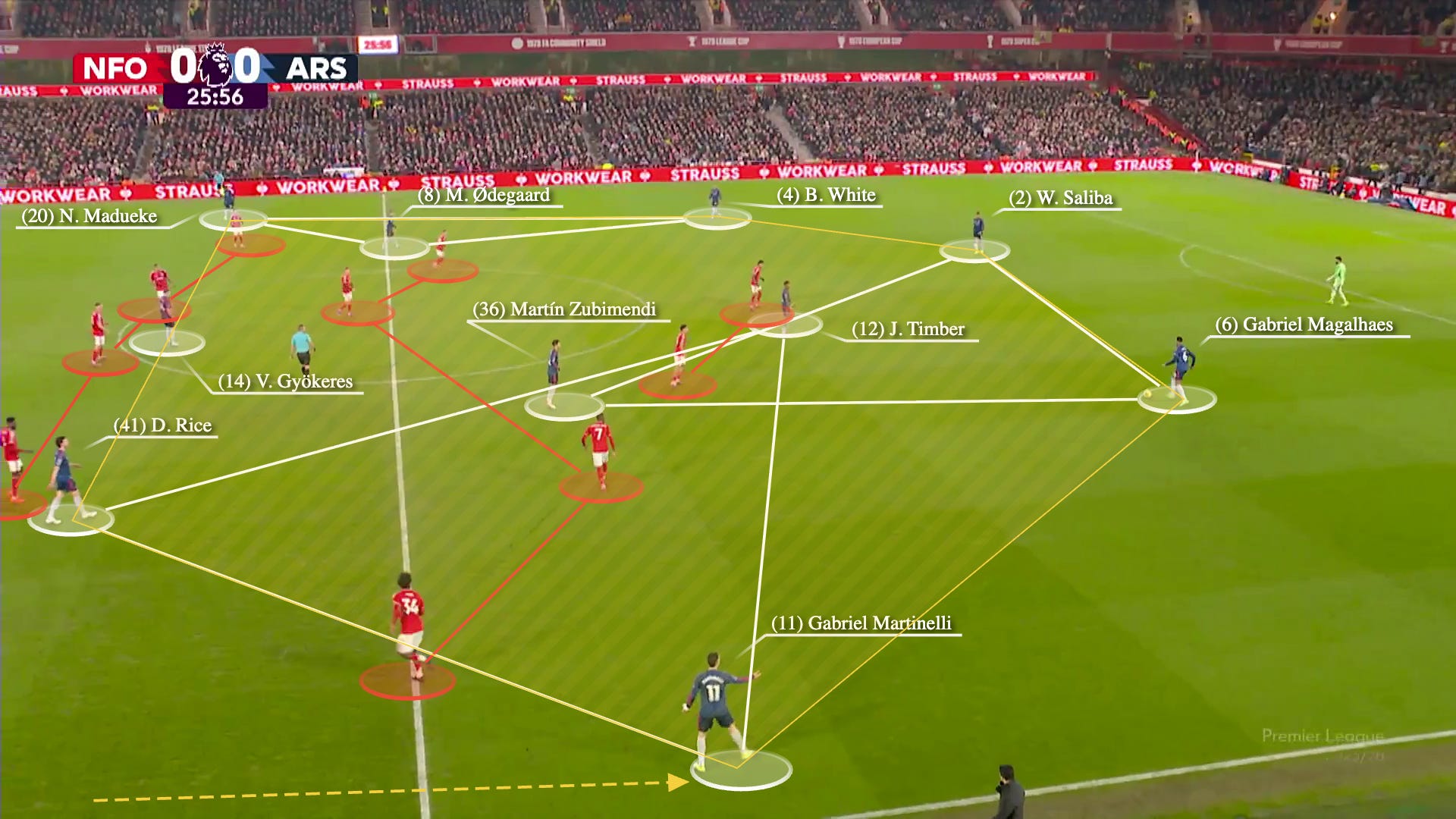
It wasn’t something we needed to see before discarding. And it wasn’t something we needed to see so much after that.
The critiques were as such:
Without Merino or Havertz, there was no aerial outlet.
The middle had no coherent method for generating threat on its own.
The left didn’t either, and notably so. Facing Dycheball, that grouping consisted of Rice as a pinning player in the left half-space, Martinelli running at a fairly settled block, and Timber inverting into midfield, onto his wrong foot as a left-back. Who is dribbling to unsettle this block? Who is providing wide help? Who is providing the killer ball?
With Timber staying low as a pivot, and Rice high on the left, this also constrains Zubimendi’s movement. He’s not going to join the high attack as much because he has less rotational coverage.
The front-three had two off-ball runners and Madueke.
…and it was not the last time that we saw such a setup.
In a previous piece, we linked to a study titled “Quantifying individual and teammate effects on small-sided football performance through repeated-game observations.” In it, researchers had 31 players compete in 3v3 games, then repeatedly reconfigured the teams to estimate the effects of different groupings.
[T]eammate combinations explained more variance in team success (20–23 %) than individual players (11–12 %), though substantial residual variance (64–69 %) indicates performance depends on multiple factors beyond these measured effects.
Continuing:
We found that while individual players contributed meaningfully to a team’s goal differential (11–12 %), their impact was consistently outweighed by the effect of teammate composition (20–23 %).
For Arsenal, what was missing wasn’t skill or “quality,” not in a broad sense. It was a composition problem. We often saw wild swings between lineups that felt too big-space (running, carrying, shooting) or those that felt too small-space (cagey, cramped, tight moves). Too often, a balance wasn’t struck.
We can look at this line by line.
👉 2a. Balance the frontline: better mix of runners and creators
Across the season as a whole, Arsenal average 1.04 xG from open play per 90 minutes. In the minutes when Gyokeres and Martinelli share the field, that number craters to 0.29. Add Noni Madueke to the equation, a more effective outlet for progressive passes but a volume dribbler who is prepared to gamble with possession, and you drop to 0.14.
There is a straightforward question here: if they all want the ball passed to them, who is going to pass it to them?
We see the drop-off in the Gradient ranks for passing.
LW passing ranks (of 109 total wingers):
Trossard: 4th
Martinelli: 85th
RW passing ranks (of 109 total wingers):
Saka: 37th (and #1 overall in crossing)
Madueke: 71st
Striker passing ranks (of 61 central forwards)
Havertz: 15th
Gyökeres: 60th
If we are going to work around the block, this puts additional pressure on these wide areas to create. These creativity issues were impacted by Saka’s fitness, then exacerbated by the absence of Ødegaard, who led the league in through-balls and passes breaking the final line on a per-90 basis.
The real issue is that these front-three profiles are so binary. While Havertz, Trossard, and Saka (not to mention Merino) can fill so many different types of role within a position, Gyökeres, Martinelli, and Madueke don’t offer the same flexibility. They want to run. This means less fault tolerance within the setups if the first three are out, as they often were.
The secondary issue is the Gyökeres/Havertz pairing, which doesn’t look like an ideal striker partnership to me, but persisted, perhaps due to some false-positive performances earlier in the season. They won 4-0 against Leeds, but both first-half goals were on set pieces, and there was only one first-half shot otherwise; Gyökeres’ goal later was when the game was stretched and Havertz was off, and both were off for goal #4. From there, they were the starting duo for both the Carabao Cup final and the Bournemouth disaster game. Gyökeres has been used as an off-ball, pinning striker, and Havertz looks best as an off-ball, space-interpreting runner. There are potential game-state uses, but a strike partnership just needs more dribbling and passing.
Ideally, there’d be another flexible profile up front: somebody who can run and create with the ball at their feet, or playmake and shoot.
👉 2b. Balance wide triangles: an orchestrator, a dribbler, a runner
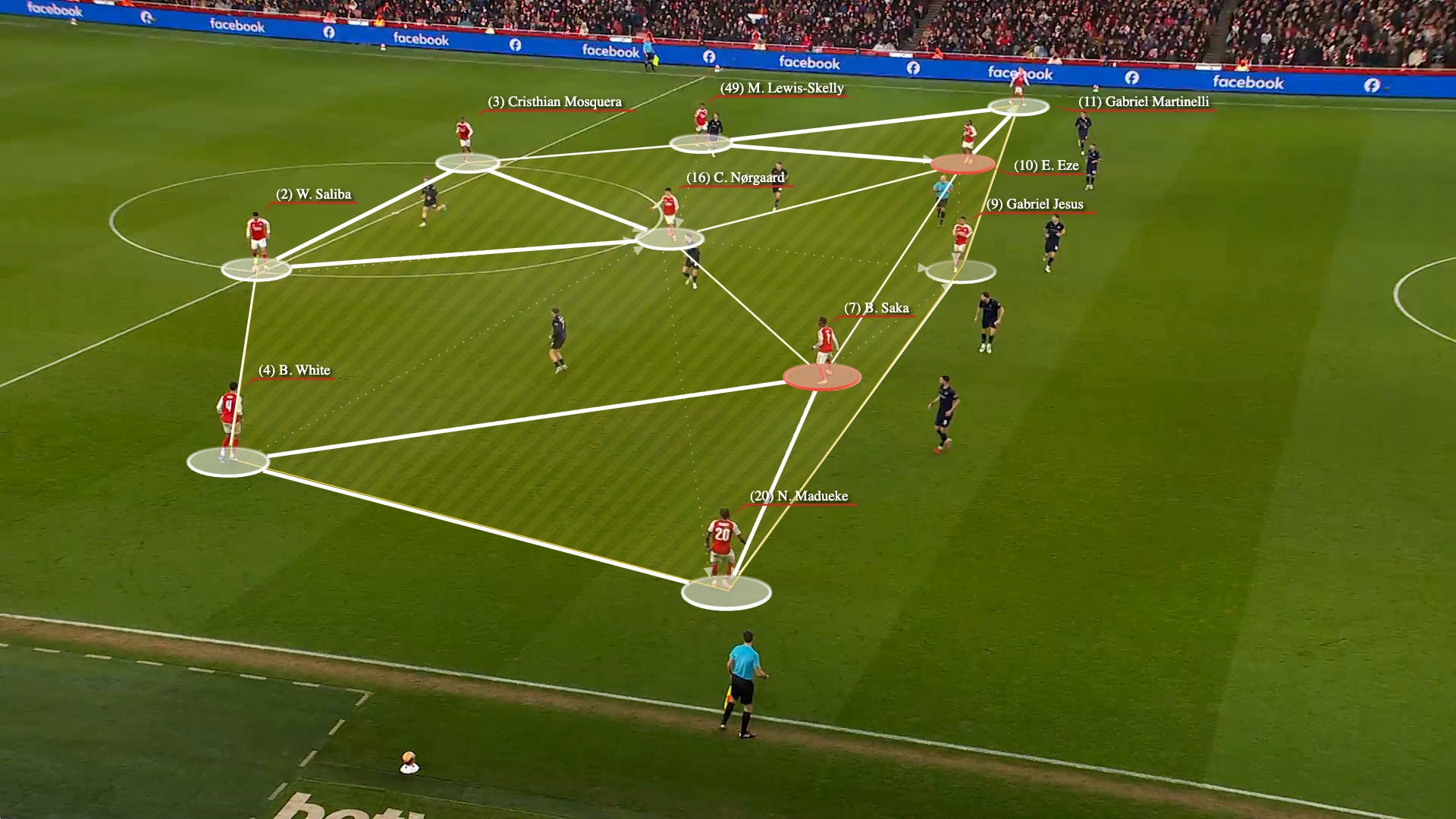
In that same piece, I argued that we’d like to see three adjoining profiles in wide triangles:
(Below) An orchestrator: somebody who can dictate play and pick apart the opponent shape with passes.
(Beside) A dribbler: somebody who can drive at opponents and collapse the shape, starting a cascading effect.
(Beyond) A runner: somebody who can interpret space and pull it apart: “decompacting” the shape horizontally, diagonally, or vertically.
It wasn’t always the case.
Calafiori and White are extraordinarily “fault-tolerant” profiles, who can fill all three of these roles as necessary. They were often out, and it’s unlikely (or at least unwise) to assume White’s availability and health moving forward.
Hincapié looks best wide. But that pushed Trossard in, and Trossard was often the best wide playmaker on the squad last season. When Trossard was out, the trio of Hincapié/Martinelli/Rice often lacked the dribbling or pure playmaking dimension you’d look for out of a wide triangle. This helps explain one aspect of the Tzolis links, as he has some nice qualities when pushing toward the goal.
The right still mostly worked, often thanks to Saka’s dexterity. He and Timber are a little imperfect (they often both want to get into the half-space, and neither is a pure overlapper), but were still mostly positive. The triangle looked least threatening with Mosquera, who is awfully tidy on the ball for a CB, especially those little manipulative touches, but he doesn’t have that final, midfielder-like gear of carrying or creativity that the modern full-back position often requires.
It sure looks to me like we need a full-back (or adapted midfielder) with some of those orchestrator/dribbler qualities.
👉 2c. Balance the double-pivot: a player for every gate
For much of the year, we saw a swirling pivot, in which Zubimendi and Rice interchanged, and the former tirelessly covered every blade of grass to manipulate the opponent shape.
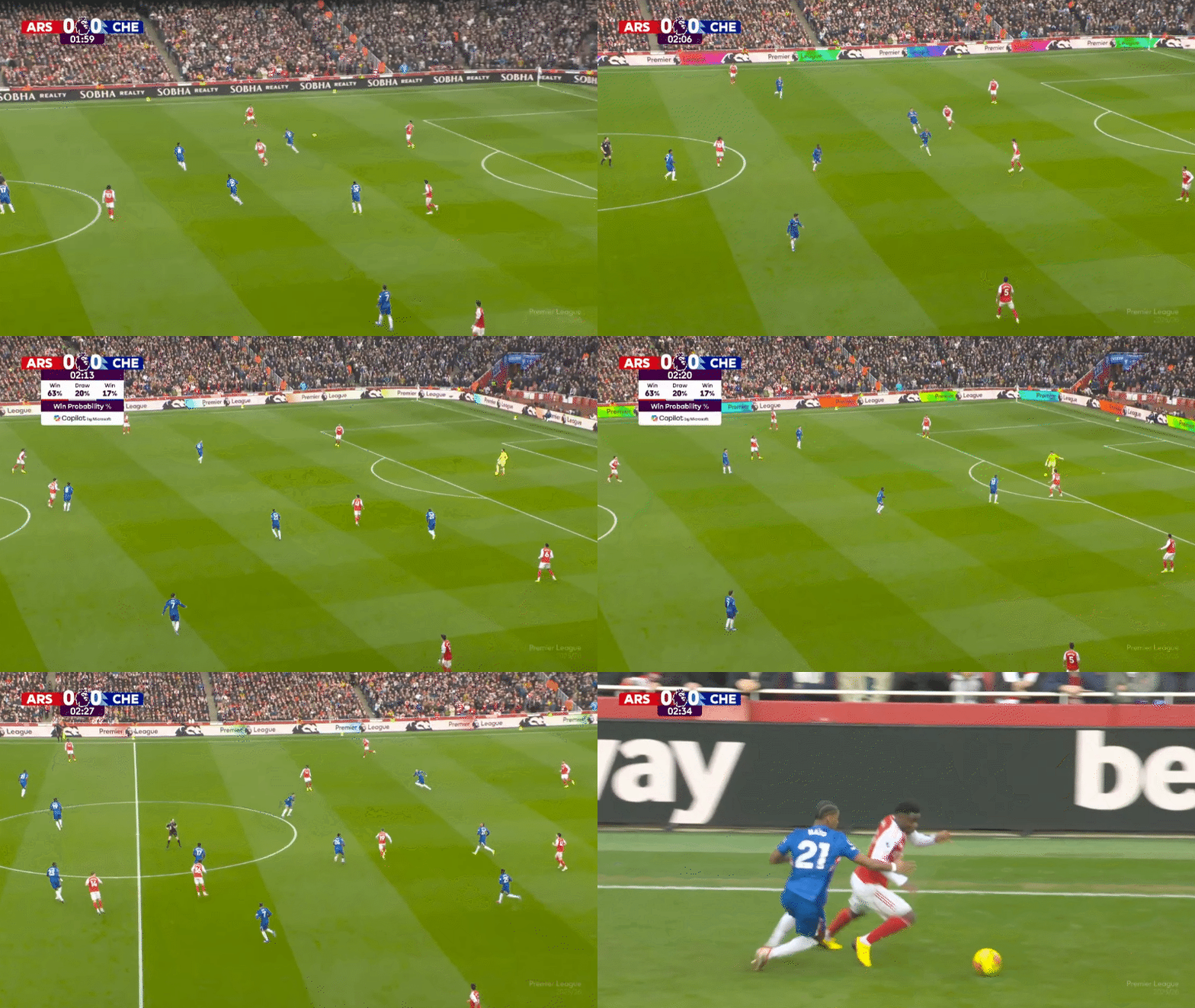
It worked to great effect. Arsenal were atop All The Things, Zubimendi played every Premier League match, and he had nine goal involvements. Along the way, he had some of the most efficient defensive stats in the league. He would slap the ball forward immediately on ball wins and headers, but in more measured possession, we kept things safer.
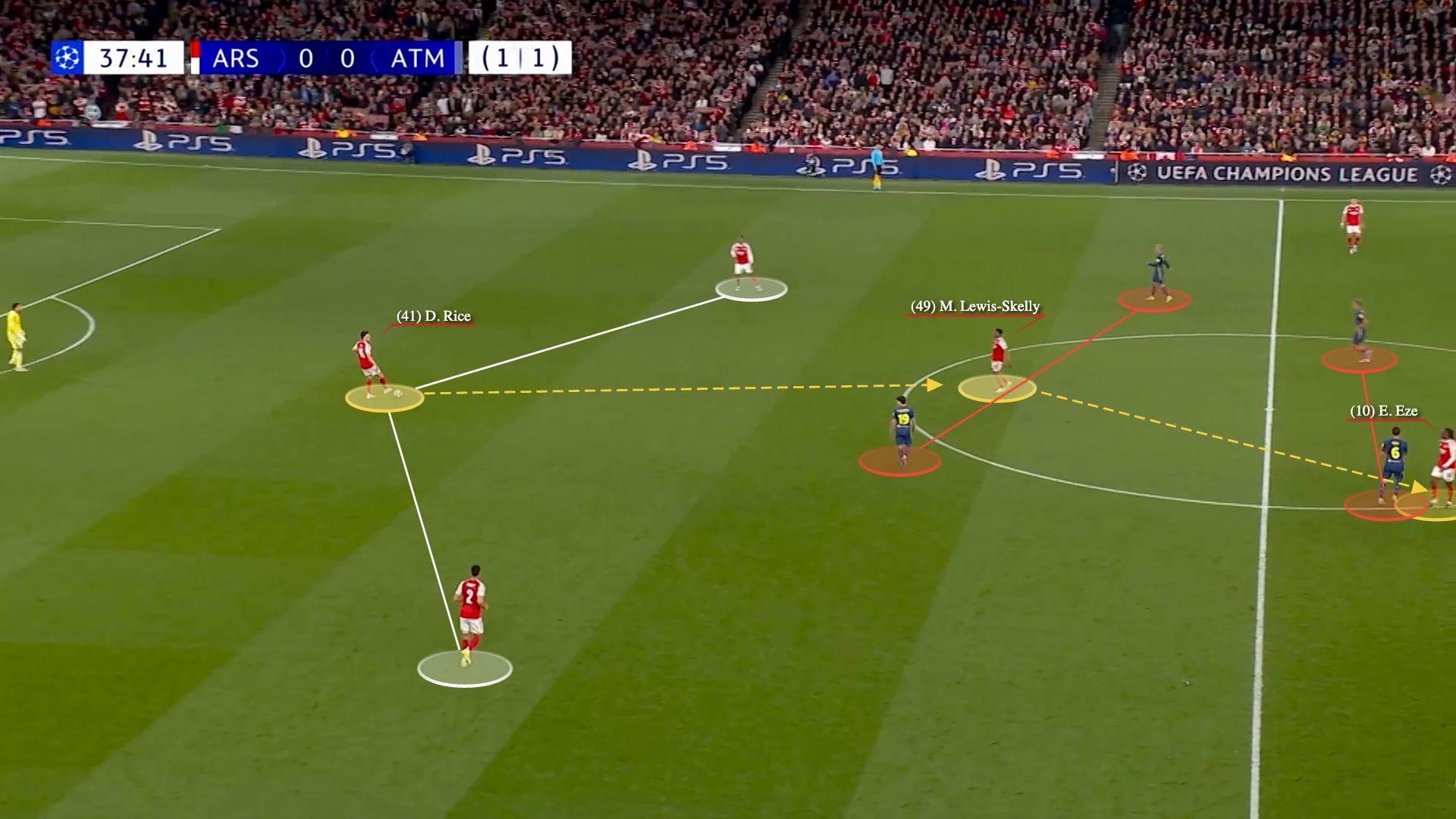
But when he and Arsenal started flagging in the spring, Arteta went with his “gut feeling” and turned to Lewis-Skelly in the midfield. In addition to the fresher legs, this worked for another reason. Rice and Zubimendi have a lot of overlap, as you’d expect in a double-pivot. But Rice and Lewis-Skelly diverge in a key way.
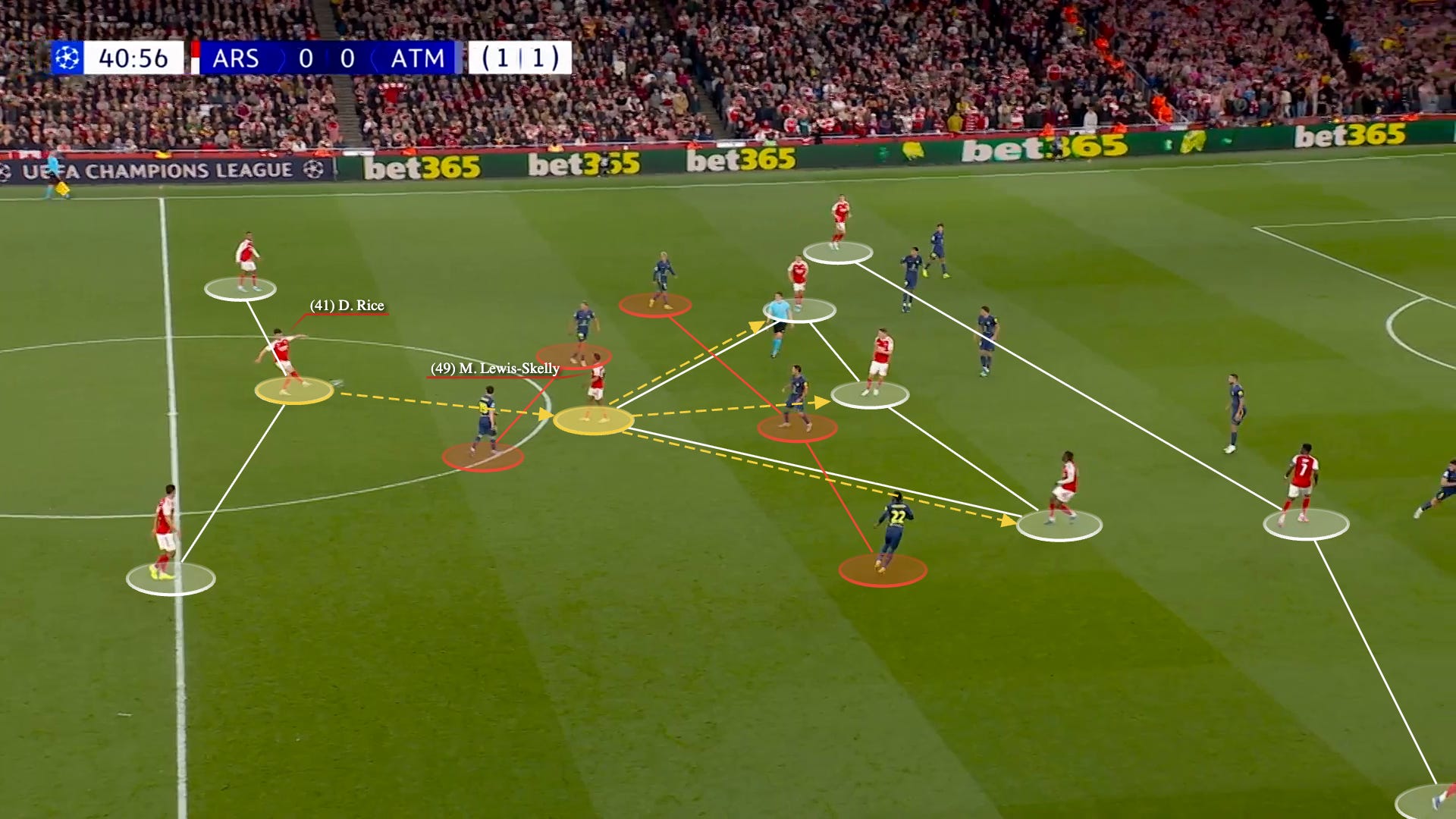
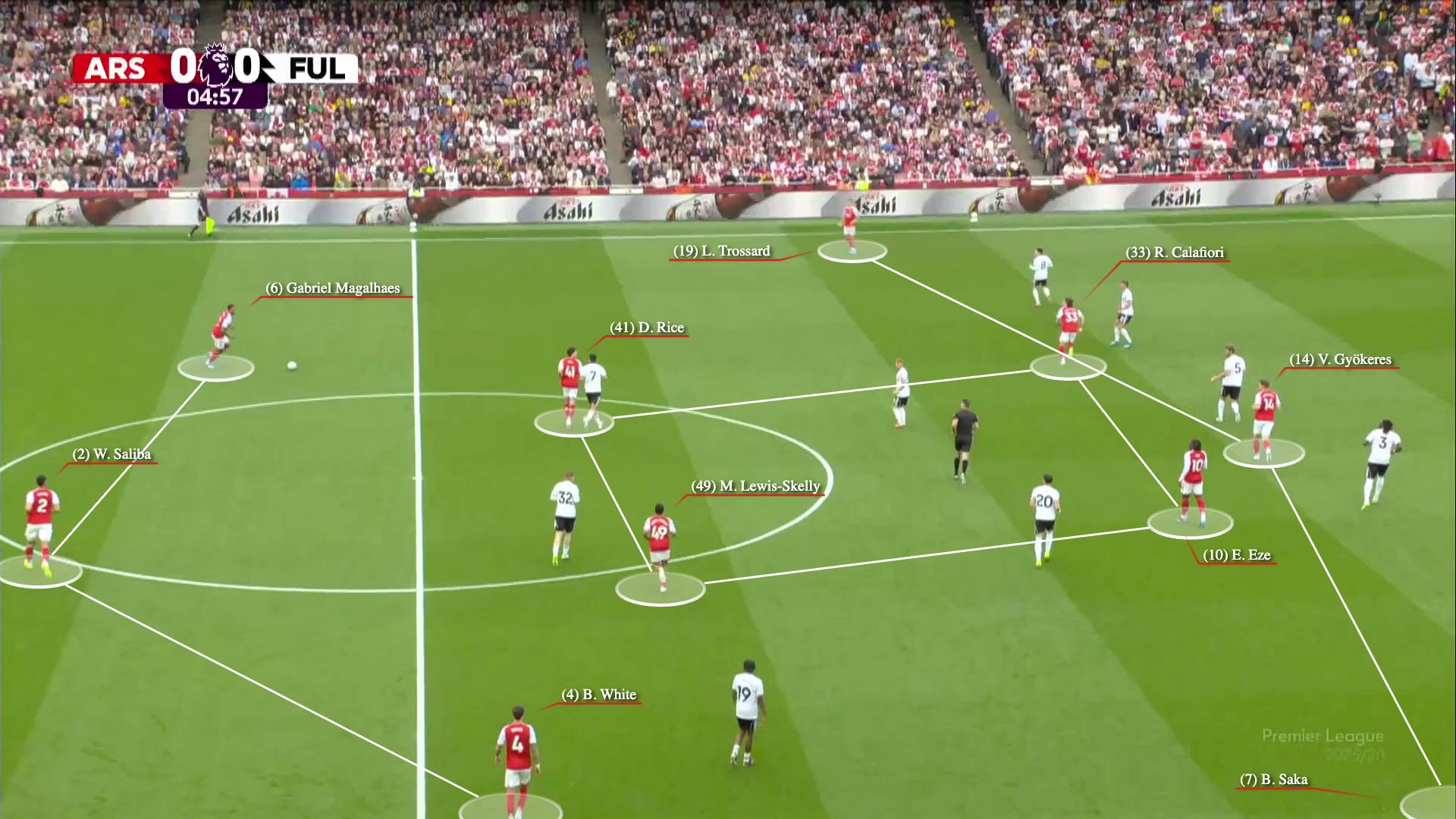
What worked was this: Rice facing play, Lewis-Skelly sitting behind the “first gate,” and then the likes of Eze and Ødegaard behind the second gate.
It led to central options, like this.
Still, when I compared their statistics, you can see how well Zubimendi stood up to the small sample size, and how some of those simple conclusions need nuance.
Across the year:
Zubimendi actually had more line-breakers than Lewis-Skelly.
12.1% of Zubimendi’s touches included a turn. 7.9% of Lewis-Skelly’s did. That doesn’t necessarily illustrate the danger of what happened next, but is still interesting context.
Zubimendi was less likely to miscontrol and miscontrol under pressure.
And when isolating it to the tiny sample size of midfield minutes, we saw how similar the two players could actually be … with one big difference:
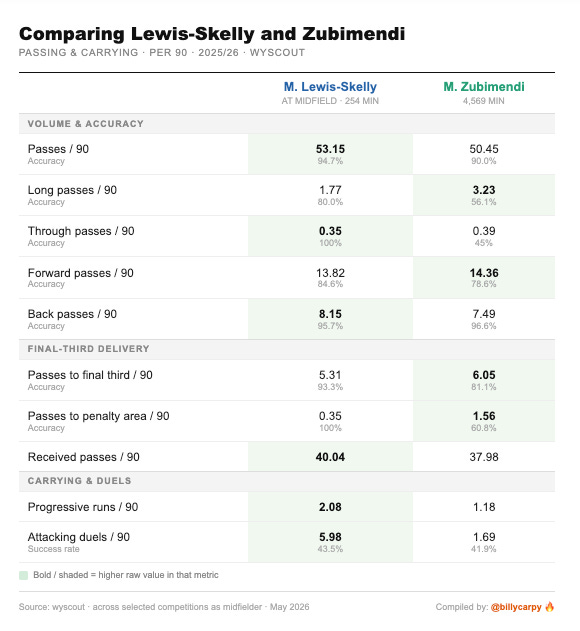
What gives?
The difference is in those last two rows. Lewis-Skelly was far more likely to engage in attacking duels in the middle of the park. You know the type of action: there’s a bouncing ball, he brings it down, and instead of getting rid of it, he welcomes pressure, rolls somebody, carries forward, and then releases it.
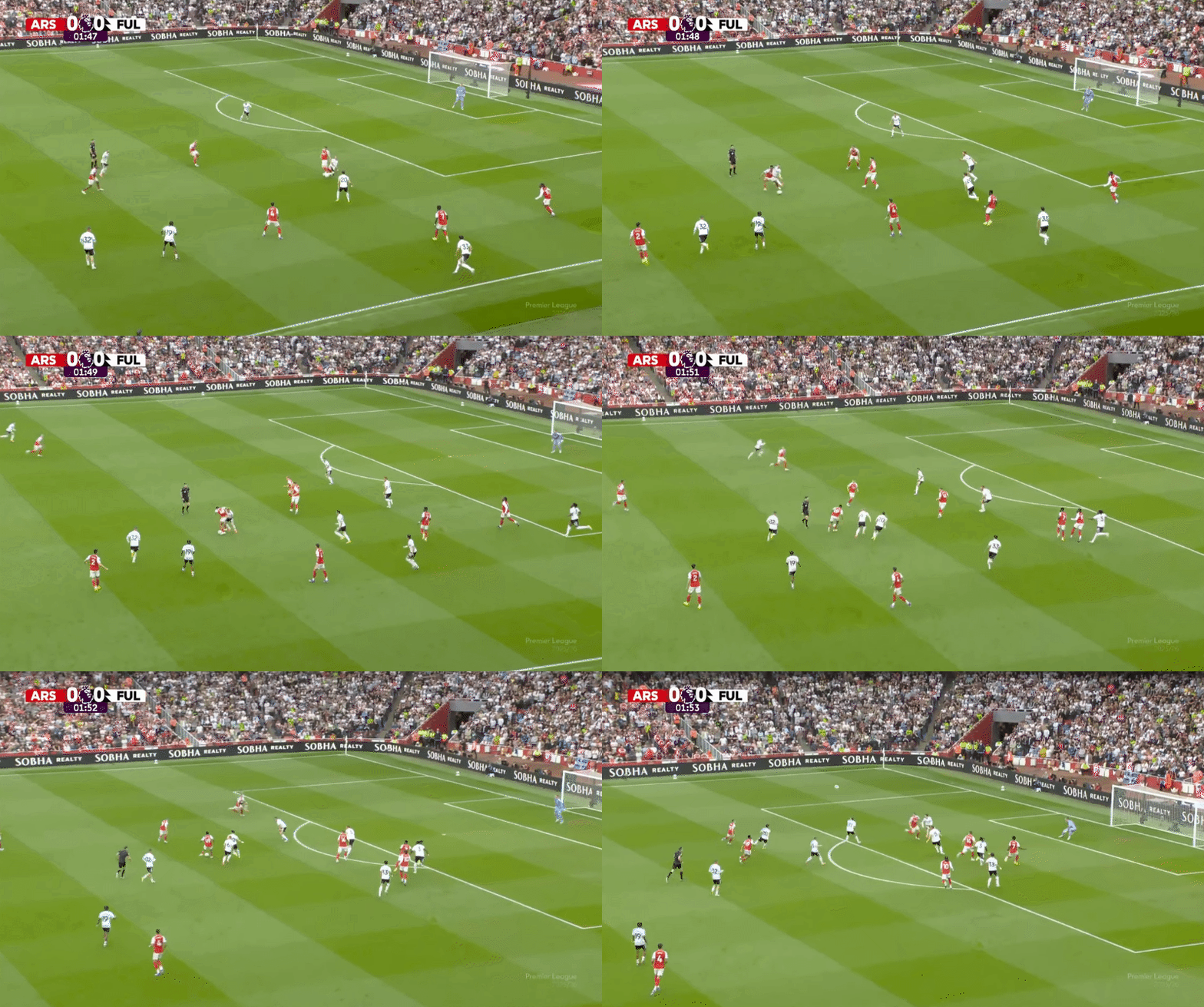
It was a vital part of getting opponent blocks out of shape late in the year. Because presses are so man-oriented these days, everybody has a defender on their back, so your choice is either to move them around and create space for somebody else (the Zubimendi method) or to just try and beat your man (the Lewis-Skelly method).
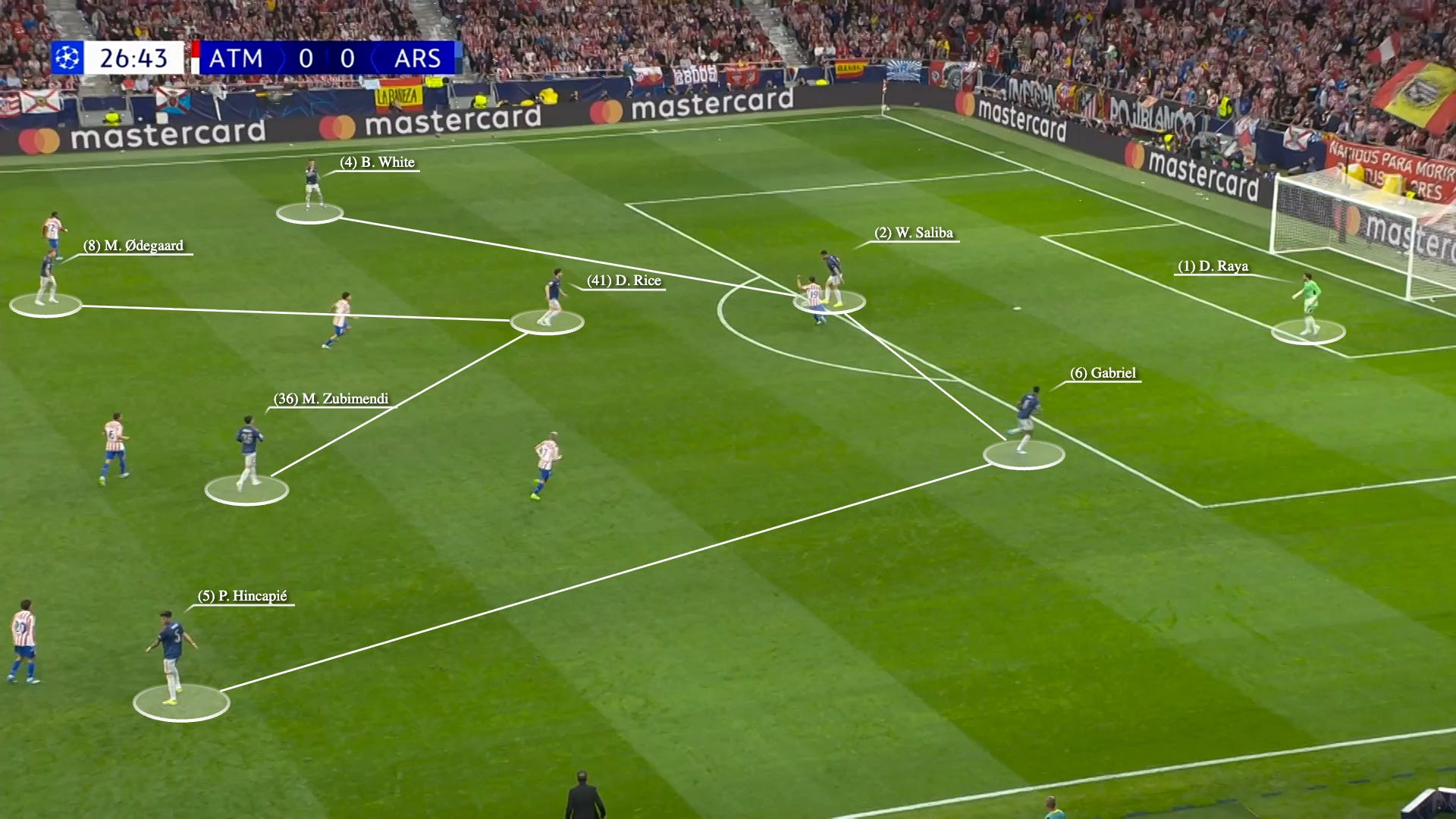
With the Rice/Zubimendi duo, I personally thought things looked best when Rice stayed low, facing the play, and Zubimendi played a bit higher, where he can cause chaos and do interesting things on the edge of the box.
With Lewis-Skelly and Rice as a partnership, I liked it as a box look, like this, with great pocket players ahead of them.
There are a few things to balance in the future:
When paired with Rice, consider playing Zubimendi a bit higher as a default.
Lewis-Skelly’s attacking duels clearly had a good effect on the attacking dynamics. A full year of that should be helpful.
An issue moving forward: Lewis-Skelly and Zubimendi both look great alongside Rice, but don’t make the most sensible pairing together, though that could improve. This is because their shortcomings aren’t offset. Lewis-Skelly can be overeager to engage in a duel and lose it at inopportune times, and Zubimendi may not have the “long pace” to clean it up.
In general, I harp on the cognitive load of these midfielders in an Arteta system a lot. They are not playing within a narrow portfolio. You’ll see Zubimendi splitting the CBs to progress play, then playing an off-ball role in the full-back zones, then getting free as a winger and taking a shot, all while playing every league game. I referenced this piece:
“The more choices you have to make, the more it can wear on your brain, and it may cause your brain to look for short cuts,” said Dr. Lisa MacLean. “There are four main symptoms: procrastination, impulsivity, avoidance and indecision.”
[…]
“If your brain is worn down, it may cause you to become more reckless with your decision making or not think things through,” she added. It can also “cause you to simply do nothing, which can cause even more problems.”
There just needs to be another physical partner in the mix, and these players need to rotate more, for mental sharpness as much as physical sharpness.
👉 2d. Balance the backline: 3-4 serious ball progressors
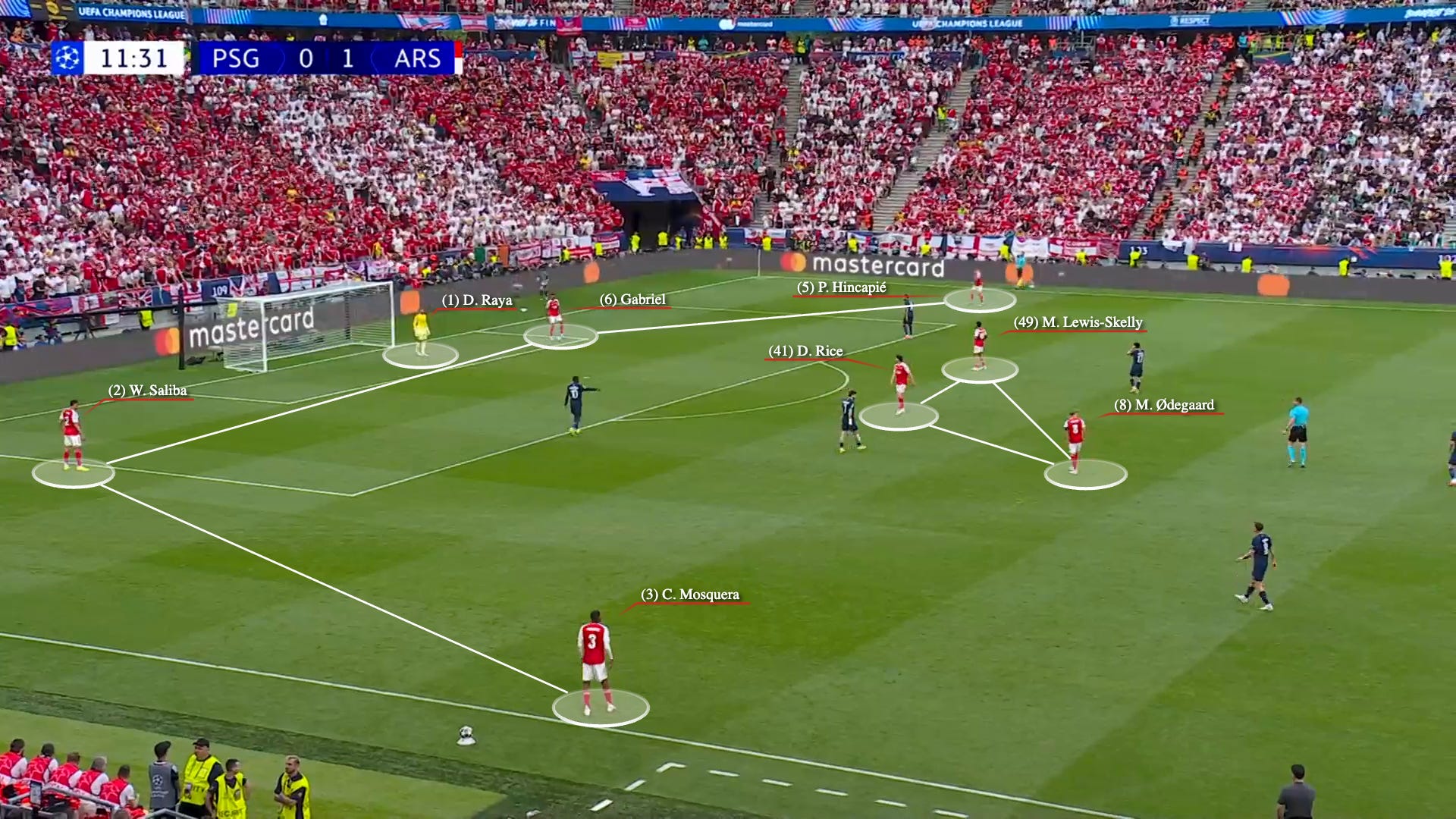
With Calafiori and White often out, Gabriel struggling more, and Zubimendi being lower-touch than was perhaps expected, the team was often below the critical mass of confident, press-resistant, varied deep passers. This then compounds because Arsenal signed two former CBs, Mosquera and Hincapié, to help with FB depth, with that pair starting the Champions League final.
The problem is that in this system, full-backs are often receiving the most consequential touches of any build-up sequence, usually because the far-side full-back is the free man once a defensive shape leans. When that’s the case, security isn’t enough for that role. They need to show that next level of midfielder-like personality and creativity.
There needs to be reinforcements to the deep passing bag, and the ask of the full-backs has to be accounted for in squad-planning. This likely means that midfielders should rotate there some more.
3. Upgrade the passing bag
Arsenal were the hardest team in the league to dispossess. On that:
They were the best when facing tackles.
They were the second-best at “carry security.”
They committed the second-fewest unsafe passes.
Plus, all the other stuff we covered earlier.
We cannot understand the defensive record without acknowledging that every decision comes with tradeoffs, that receivers and movers play a big role in all this, and Arsenal have plenty of fine passers as-is.
Now, this is an article about how we can improve, so this is where the data can pile up:
Arsenal built the league’s third-most 10+ pass sequences (478) and third-most “build-ups” (112), per Opta, only converting those 112 sequences into 4 goals. In comparison, City generated 208 similar sequences for 11 goals.
Per Gradient, Arsenal played the dead-lowest share of “passes above expectation,” and received back-to-goal at the lowest rate in the entire league. Both of these mostly demonstrate tactical intent, in that they reinforce the idea of building around (or over) a block instead of through it. But they are also a quality question.
In advanced areas, my bugbear is cutbacks. Madueke and Saka are nasty at them. Arsenal attempted the 4th-most in the league, but were 18th in completion percentage, which was a full 10% lower than the league average. To me, it feels largely like a movement issue.
We see this dance between dynamism and security in the stats on line-breaking, in which Arsenal actually outpaced City in last-line breaks, but fell behind in the earlier build-ups.
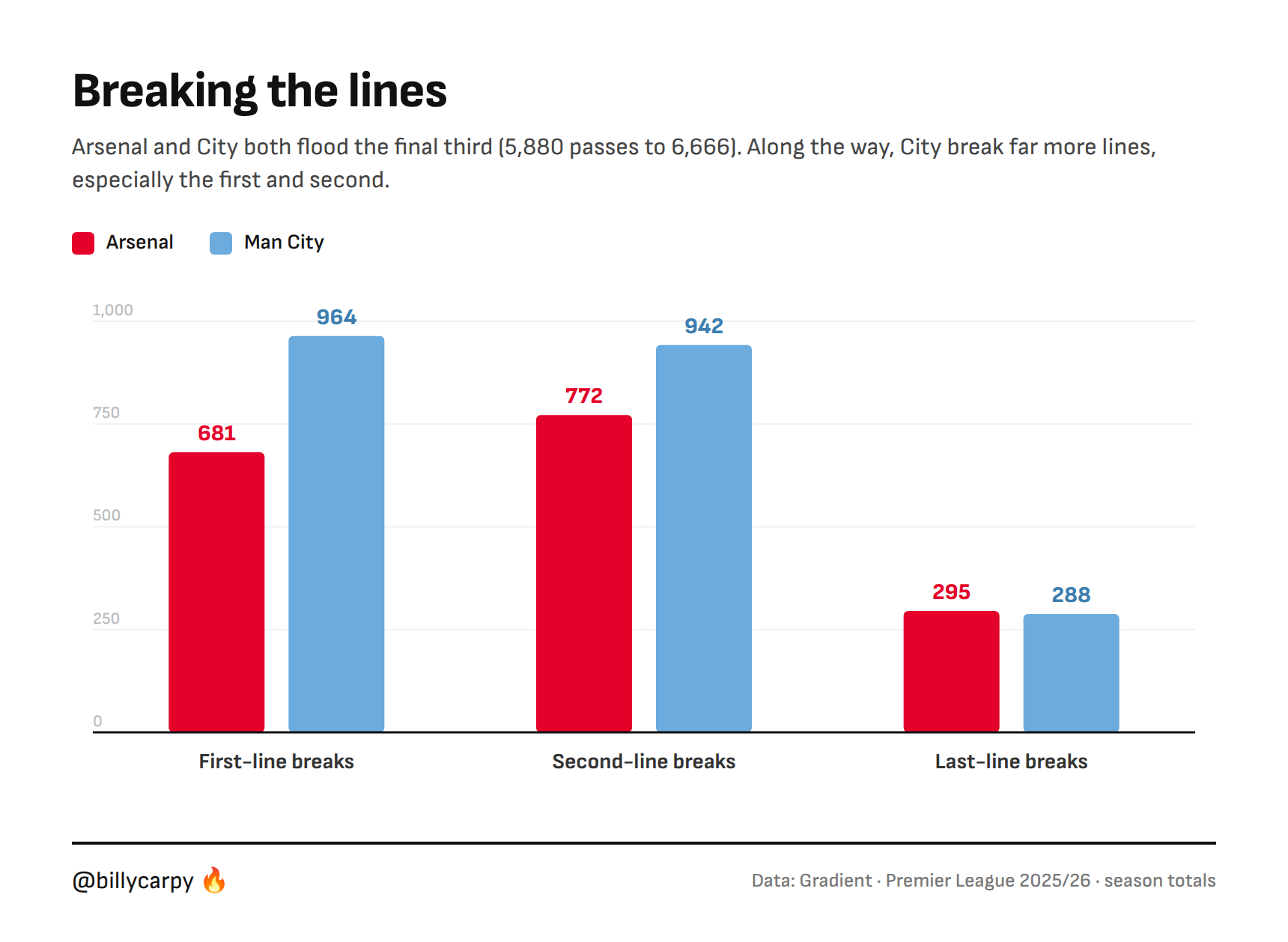
In general, Arsenal were tenth in the league in line-breakers attempted, and 13th in completion percentage. Man City were first in both.
There are three things worth reinforcing in all of this:
For one, shut up man, but: this approach won the league, and directly contributed to the stellar defensive record.
For another, Arsenal were still solidly top-five in everything from through-balls to chances created to assists to key passes to goals.
For the creativity that did exist, much of it was enshrined in the feet of Martin Ødegaard and Leandro Trossard. Trossard led the team in passes above expectation, and Ødegaard led in through-balls, line-breakers, big time passes, and so much else. Trossard remade himself, again, into a wide playmaker of the highest degree, and it sure looks like he’ll be sold. With Trossard gone, many Arsenal fans are still plugging in lineups without Ødegaard, or, at least, envision him rotating more (as I do). We should be cognizant of the costs of this all.
Arsenal were the most secure passing team in England, and in the aggregate, they created plenty. But it’s clear to me (and likely you) that a little more first-line manipulation, a little more passing personality (and intent) in the middle of the pitch, and a few more killer balls would go a long way.
(I wrote this all before the Bruno Guimarães links solidified. I think you probably know how I feel about that, as he’s been a recurring feature over the years. In so many words, signing a player like him is how you win shit again, and how you win more shit. More to come as the story develops. 🙏)
4. Stop easing off
Arsenal were rarely in real danger, and rarely in a real hurry.
I pulled this to get a better idea of the real story.
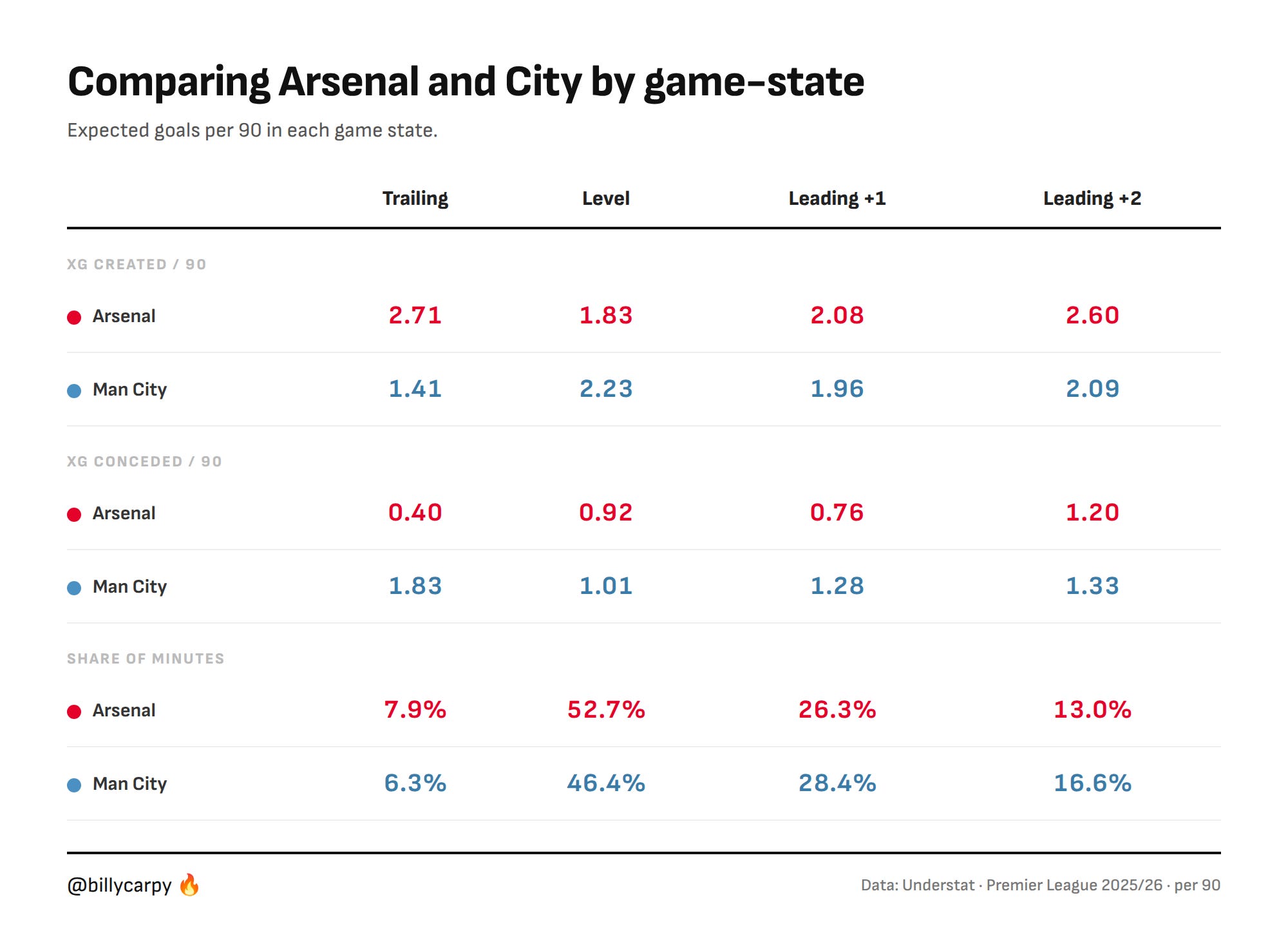
With a caveat that this uses Understat’s xG model, this doesn’t tell us a perfectly linear story, but we can try:
Arsenal were never down by multiple goals in the entire league season.
In fact, across 63 games this season, Arsenal trailed by more than one goal only once, that 0-2 defeat to Manchester City in the Carabao Cup. Of the 6,282 total minutes played, Arsenal were losing in only 466 of them. Manchester City accounted for 193 of those minutes, or 41% of the total time Arsenal were losing. lol.
It was a very small sample size, but Arsenal can clearly generate a goal when behind. City struggled a lot more, and actually had a negative xGD when trailing.
Arsenal spent less time in winning game-states than Man City (39.3% to 45%). That’s not an insignificant number. The Gunners’ lowest xG was posted while level, which makes sense, but can still be improved upon.
Arsenal were significantly better at defending in non-level game-states (i.e., when they were ahead, or their opponents were). City had more trouble managing those situations.
So that clearly paints a picture of a more pragmatic Arsenal in contrast with Man City, who were more likely to “go for it” and reap the benefits, and pay the costs, of that approach.
There was one clear reason behind this for Arsenal. Arsenal are conservative in first halves, especially away. In the league, Arsenal only scored 12 first-half goals across 19 away matches, and there wasn’t a single away first half with multiple goals. In fact, there were nine away first halves without a goal at all. To elaborate on that:
Man City’s record at half-time in away matches: 10-7-2.
Arsenal’s record at half-time in away matches: 7-9-3.
A rather important corollary to this: it worked. Arsenal were the best away team in the league (15-2-2). Furthermore, they were by far the best second-half team in the league. Arsenal scored the most second-half goals and conceded the fewest, bringing their second-half goal difference to +24. The next highest in the league was +11.
So, if everything looks fine, what is there to improve?
There was a recurring pattern to Arsenal’s roughest periods. There would be an underwhelming first half, usually with a slightly imbalanced lineup, and, at best, a 1-0 lead. From there, Arsenal would turn to long-ball to derisk the game, control would wane, and the Gods of Variance would show their ugly faces.
The byproduct was that Arsenal spent too much time in 0-0 and 1-0 scorelines, and spent so many late games grinding out results, with the likes of Zubimendi, Rice, and Timber unable to rotate because the result was still in the balance. This had a compounding effect on fitness and injuries, in my view: Zubimendi and Rice both made 55 appearances, and Timber played every minute he could, until he couldn’t. I posted this during Brentford:
“Can one of you please kick in a fucking second goal one of these days so Declan Rice doesn’t have to do (googles good marathoners) Alphonce Simbu shifts until 95’ every week, please?”
This is solved by more cohesive starting lineups, a little more risk tolerance early, a commitment to keep the ball on the ground after a first goal, and a simple desire to score the second shortly after the first.
5. Cash in on transitions
The overall defensive look by Arsenal was stifling. Because of the higher possession numbers and the disciplined shape, Arsenal actually attempted the second-fewest individual pressures on ball carriers. But from that, they were second in “pressures forcing a ball-losing miscontrol,” and third in “pressures leading to a dangerous position,” according to Gradient. The Arsenal press was often turned down, or couldn’t spin up because of clearances, but was still mightily effective.
The issue was that these weren’t turned into chances at the rate they should have been.
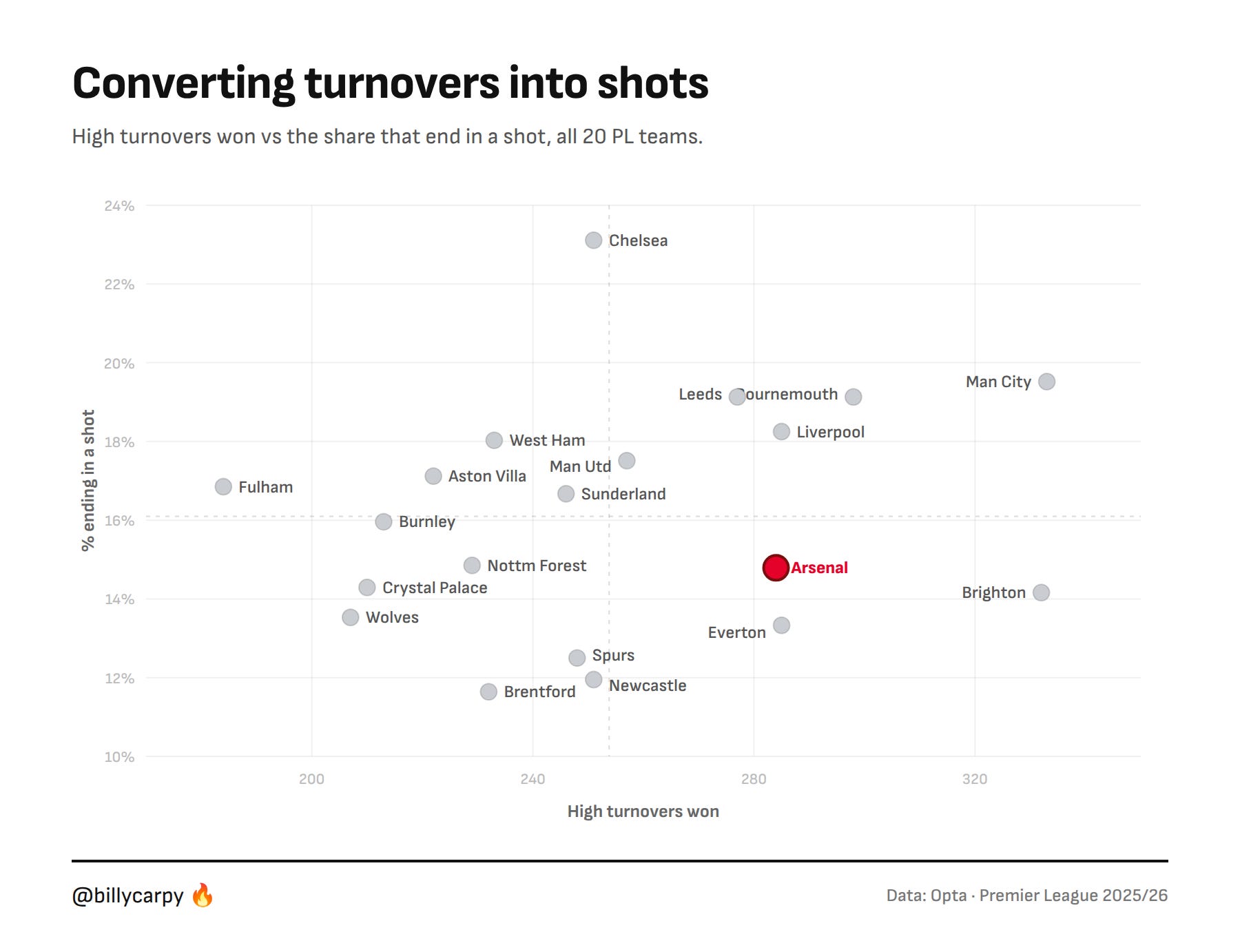
The results are mediocre. Arsenal didn’t necessarily lack for turnovers, but turned them into shots at the 13th-highest rate in the league, behind everyone from City to Burnley.
This was true of general “fast breaks” as well, which Opta defines as:
an attempt created after a team quickly turns defence into attack, winning the ball in their own half (counter-attack)
Arsenal created these counters at a mid-pack level, and turned them into goals at a mid-pack level, as well.
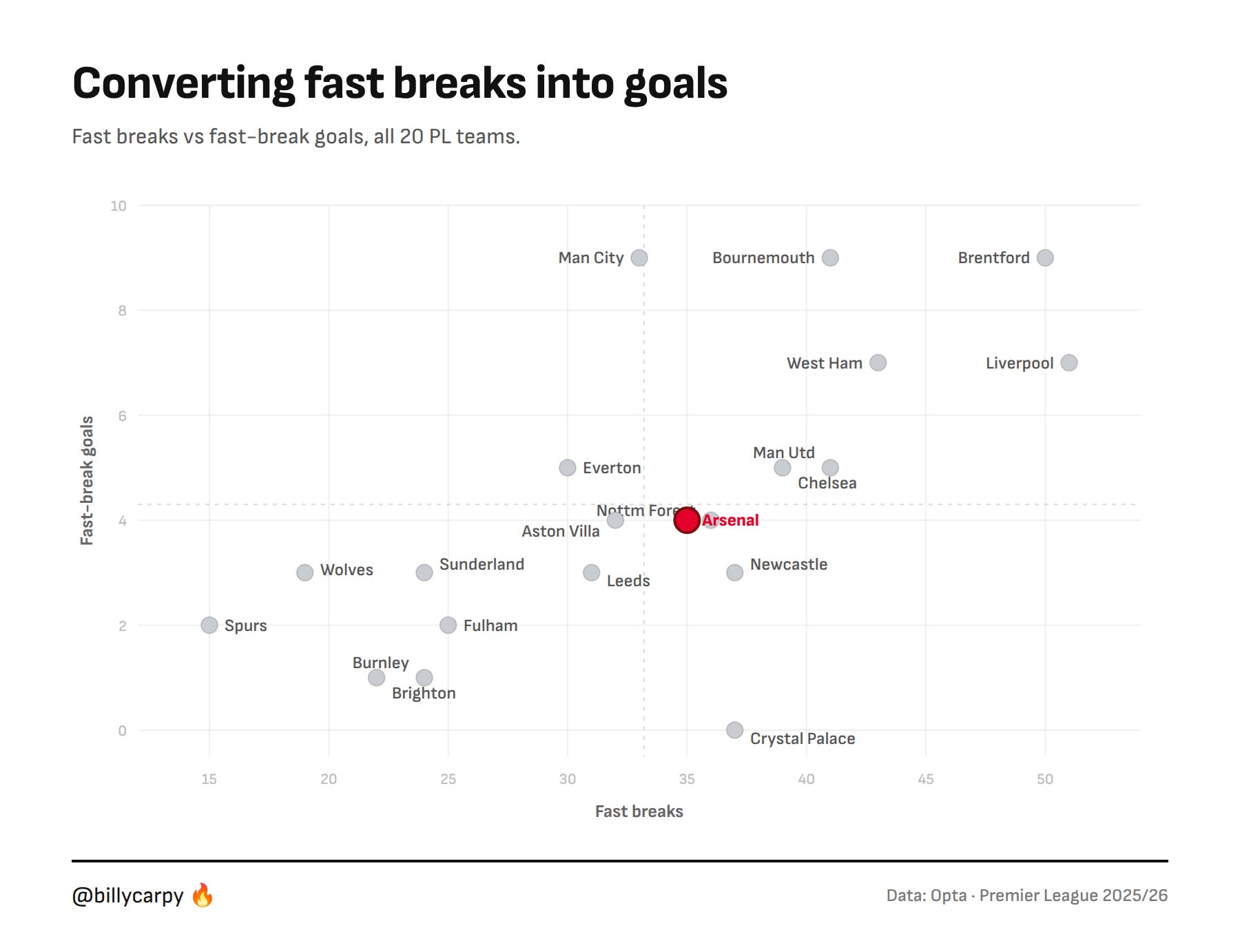
This is a difficult topic to deconstruct from an analytics perspective. The sample sizes are so small, and the situations are so variable, that it’s hard to credit the best transitional players. We have to, gasp!, use our eyes.
If I were to hazard a guess behind Arsenal’s relative struggles here, I’d say: Saka and Trossard weren’t at their fastest; Gyökeres, Merino, and Havertz were inefficient carriers; it’s true, Ødegaard’s release timings were off; wingers like Martinelli typically transition from too deep and too wide, and Eze never felt like he was lined up in his best spots. I would also say that there is a tactical intent to essentially count the players in transition, and if the numbers aren’t there, to hold the ball and regroup.
All of this can improve with: Martinelli more central (if he stays), quicker transitions, and simple improvement from the #10 (new signings, Ødegaard, and Eze).
🔥 In conclusion
I know you’re probably anxious for transfer target lists and scouting reports. I am too, and have been working toward all that in the typical, hypomaniacal ways. But the reason I wanted to take this step is to make sure I had a grip on the squad in a more clear-eyed way, with the benefit of a little distance.
First, we must keep doubling down on advantages. When you start from a good place, it’s harder for people to catch up: I can get a good haircut, but I’ll never look like Giroud. For Arsenal, that means fortifying set pieces, positional discipline, ball security, shot-stopping, box entries, depth, and late-game pressure.
👉 Ways to improve
I know I already said all this, but I wanted to end with a summary so I could more easily refer to it later:
Increase efficiency long and over-the-top: generate and contest aerial duels more efficiently (Kai, Merino, someone else?), add more physical second-ball collectors in the high areas, less long-balls in general via better build-up, add a player who is sharper at over-the-toppers from deep, more runs from the half-space.
Balance the lineups: balance the frontline (runners and passers), balance the wide triangles (orchestrators, runners, dribblers), balance the midfield (have a midfielder behind the gate who will be inventive in the middle), match the #10 to the frontline (less Kai+Gyökeres pairing please), and make sure the backline has a serious amount of ball progression.
Upgrade the passing bag: More receiving back-to-goal, higher volume of linebreakers of the first and second lines of pressure. Seriously backfill the wide playmaking of Trossard.
Stop easing off: Let’s get more (and earlier) second goals with better starting lineups, fewer long-balls after goal #1, and more aggressive attacking play when the game opens up.
Cash in on transitions: Turn more ball-wins and fast-breaks into shots and goals through better transitions, quicker releases, and higher positioning.
👉 The shopping list
That, then, turns into a summer shopping list, which will inform the articles to come. This will all depend so much on outgoings, and there’s probably nothing too surprising here:
A line-breaking hybrid midfielder. I was originally thinking a younger, flexible option who can get time at RB here, but there are two problems. First, those are proving exorbitant. Second, Declan Rice sure needs a rest. So … I guess we may have to settle for one of the best midfielders in the world (wink, wink). Regardless, it really comes down to passing quality and ground-eating. I’d like the passing bag to have some real verve and personality.
A (potentially world-class) younger, right-footed left-winger who runs, dribbles, and combines. I’d certainly go biggest here, if the player is right. We need a younger attack, and need to add threat to the left side so that the source of attacking gravity is not always so clearly on the right. This is the clearest role to upgrade and the most open spot in the starting XI. It’s a compelling offer.
A flexible, clinical hybrid forward. Ideally this is someone who can win both first and second balls, significantly help transitions, gallop in behind, and score goals. A quick, both-footed trigger is a big plus. Trossard was so helpful for his ability to balance other profiles, and we’ll need that moving forward; whatever profile you consider him to be, the trickiest part will be replacing his passing from wide areas. And regardless of the specifics of #2 and #3 here, the objective should be to sign the best attacker with the rarest attributes.
A progressive, physical full-back. I really just want an orchestrator here, somebody who feels like a midfielder, like White usually does, and has qualities and physical traits to defend 1v1. If a hybrid MF/RB is signed for #1, this can be a younger option. But if White leaves, and a midfielder like Guimarães is signed who is unlikely to feature much at RB, this has to be a serious, starter-quality option (which feels like a catch-22: the better midfielder you sign, the better right-back you have to sign). Options are limited, and a full conversion of a midfielder is a real alternative here.
[edit three weeks later: we’ve gotten more clarity on Saliba’s fitness, as he went off during the World Cup, and this may change the calculus here toward an RCB, or possibly require both profiles. More to come.]
A build-up, cross-claiming GK2 upgrade. While acknowledging how hard it is, I’ve been hoping to upgrade the #2 spot fairly forcefully here, with a longer-term focus, as Raya is a load-bearing pillar and one of the real risks of the entire team. The Turner, Neto, and Kepa signings have felt understandable but inefficient. In the meantime, Illan Meslier has been signed. Gunnerblog reports his understanding that this is a GK3 signing that allows Tommy Setford to go out on loan, and if Kepa is headed out, he will be replaced in all likelihood. If that’s all the case, then Meslier is about as good a signing as could be hoped for: he makes for a risky GK2 and an ideal GK3. I’d personally be surprised if Meslier, a 26-year-old with plenty of interesting characteristics but who really struggled, would spend a year as a GK3, survey the market options, and sign as a GK3 again, but I’ve been surprised before. If Kepa returns, I hope there are no handshake guarantees of starts in later cup games.
What is true is that Arsenal had some good fortune last year (disciplinary record, Champions League draw, struggles of rivals), but also some rotten injury luck. The attack never came together, and I don’t think I would have ever imagined Arsenal winning the title in a year in which no player had 12+ open-play goals. If that can be properly improved upon, anything is possible. But rivals are not static, and yesterday’s price is not today’s price. Time to pay up.
The cover story of The Atlantic was called “The End of Reading Is Here.” Thank you for being a member of the resistance.
We go again.
A big thank you to Bastian (@austriangooner1) for talking this through and looking it over.
🐐
I really think so many of Arsenal’s problems will be fixed by having Havertz + Odegaard playing together again (please please please)
Yea yea yea but whatt about Yann Gboho?