
Scouting PSG
I called in reinforcements to help me write a massive opposition report. Here are tactics, analytics, set pieces, selections, and how Arsenal can win the Champions League

I hope you’ve had the time of your life celebrating. In due time, I’ll share some reflections on the season writ large, as others already have so well. For the moment, there is still some minor business to handle.
Over the last week or so, I’ve been watching as much PSG as I can, poring over Newcastle, Bayern, Lens, Monaco, Chelsea, Liverpool, our tie last year, and Athletic Club, oh my. This was done with the hope of writing something interesting from an opposition analysis perspective, the kind of article I’ve done before.
But this time, I got by with a little help from my friends. I am first overjoyed to be joined by Jake, the Set Piece Sicko himself, of Pot Shot Podcast fame, who contributes a full set piece analysis below. His insights are detailed and invaluable. I have also been working alongside Bastian (@austriangooner1), one of the brightest analysts in the sphere, to try and spot vulnerabilities in PSG’s play. While Jake’s contributions are clearly demarcated in a specific section, Bastian’s and my work will blend. As a rule of thumb, if you like an insight, it was his, and if you thought Who is this moron?, it’s the moron you subscribed to.
Let’s see how we can win the fucking Champions League.
🔵 Matchup overview
Let’s get to work, starting with a basic comparison.
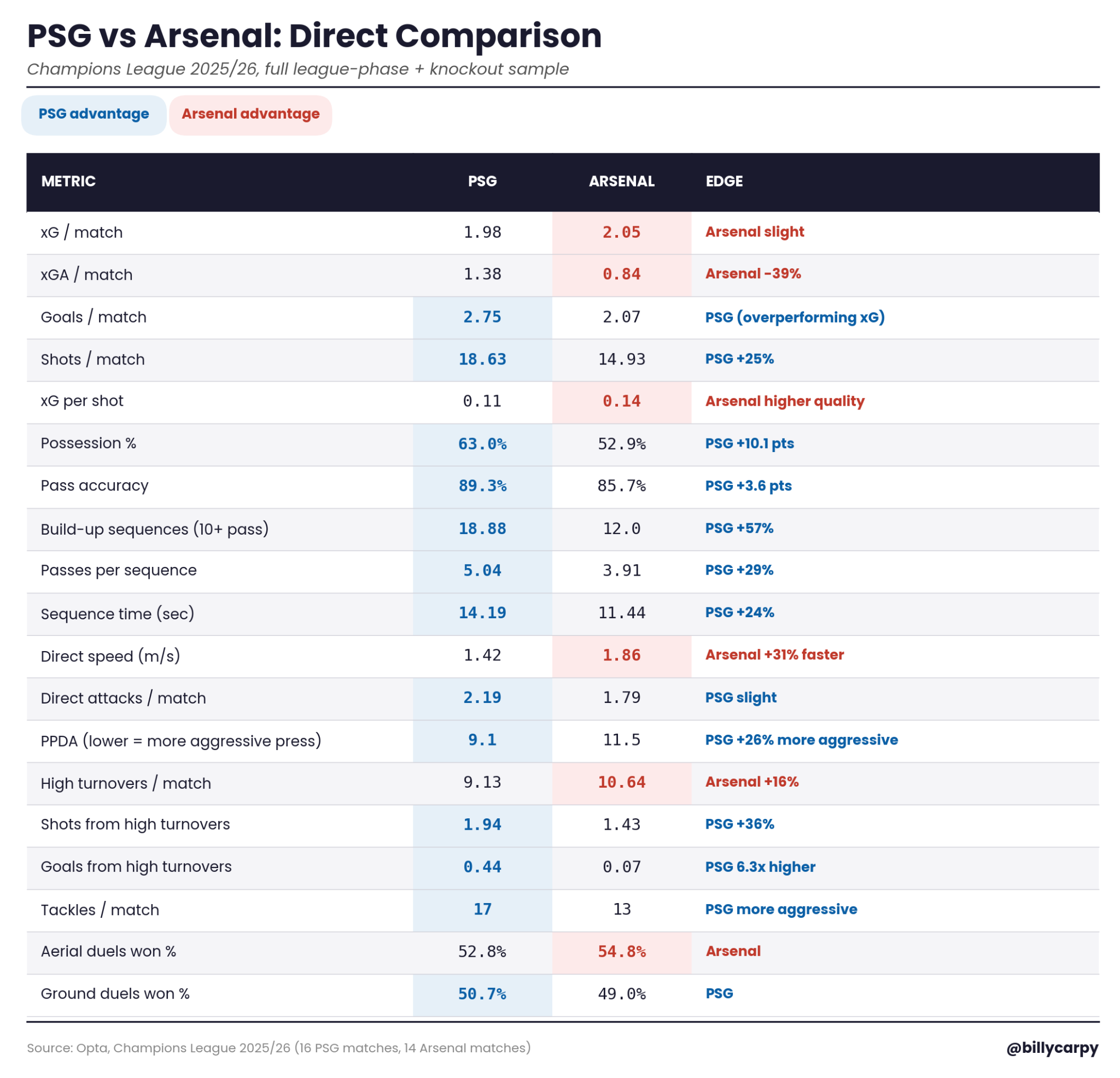
Some notes from that:
Here’s a narrative violation: PSG play the slowest Champions League football (1.42 m/s direct speed), while Arsenal play the 6th-fastest (1.86). In terms of their relative passing sequences, Arsenal’s tempo is 31% faster than PSG’s.
On that note, PSG rank second in a lot of territorial-domination, positional-play type stats, after either Bayern, Man City, or Barcelona. They log the second-highest possession (63%), the second-most build-up sequences of 10+ passes (18.88 per match), the second-most passes per sequence (5.04), the second-longest sequence time (14.19 seconds), and the second-most final-third passes per match (174.63).
Arsenal concede 50% lower xG/match than PSG (0.84 vs 1.38).
PSG overperform their xG by +0.78, which is the highest in the Champions League. They’ve been out-xG’d in their last three Champions League ties (Chelsea, Liverpool, Bayern). Defensively, Arsenal overperform xG against by 0.41, which is the best defensive “overperformance” in the Champions League. Both teams are operating in tails of their distributions.
Their xG per shot (0.11), which is usually a great indicator of the overall quality of attacking play (and one of the best predictors of victory period), actually isn’t super high.
In the Champions League, they send crosses in at below the median rate. That isn’t necessarily bad, as it’s more of a play-style choice.
While Arsenal force more high turnovers, PSG convert high turnovers into goals at the highest rate in the Champions League (0.44 per 90).
Meanwhile, in Ligue 1, there’s what you’d expect: PSG have the highest line, they have the most possession, they face the lowest blocks, they limit opponents to the lowest build-up success in the league.
Let’s move on to the players.
🔵 The players
Here’s a look at how things may shape up.
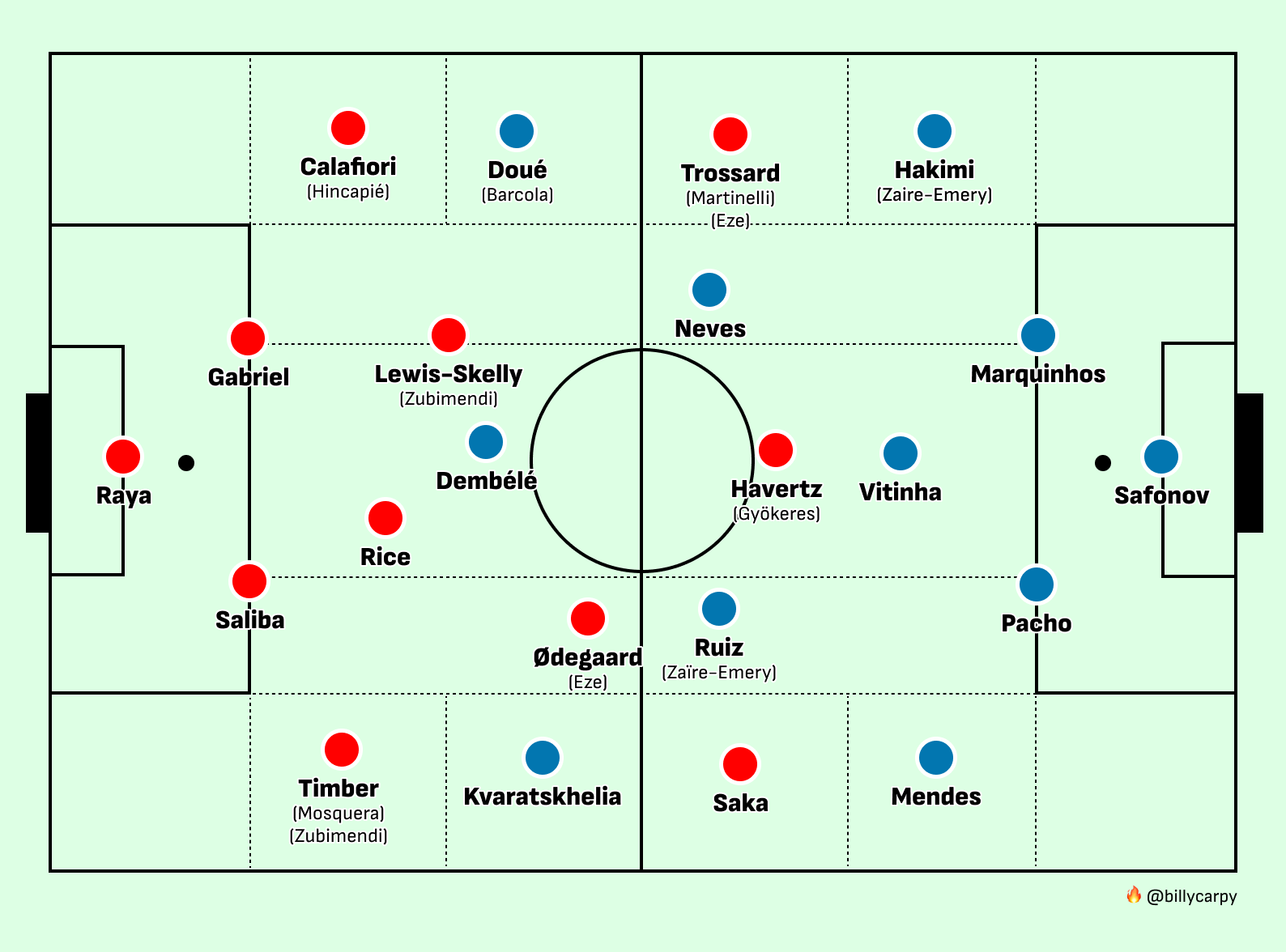
We’ll get back into Arsenal selections later. But there are primarily two big questions for PSG, both surrounding their wonderkid (or, rather, one of them):
Zaïre-Emery or Hakimi at right-back. This comes down to whether Hakimi is fit enough to start, and if so, how long he can go. He’s been out since Bayern with a thigh issue.
Zaïre-Emery or Ruiz in midfield. Ruiz suffered a knee injury in January and was out for several months, while Zaïre-Emery has played the most minutes on the squad. This will be influenced by sharpness. Ruiz just played a full-90 on the 17th; if all else is held constant, then it’s a choice between the carrying and ridiculous engine of Zaïre-Emery versus some of the passing and savvy combination work of Ruiz. They look a little more vulnerable defensively with Ruiz right now, to my eyes.
This view from Transfermarkt will give us a sense of availability and selections in the league campaign:
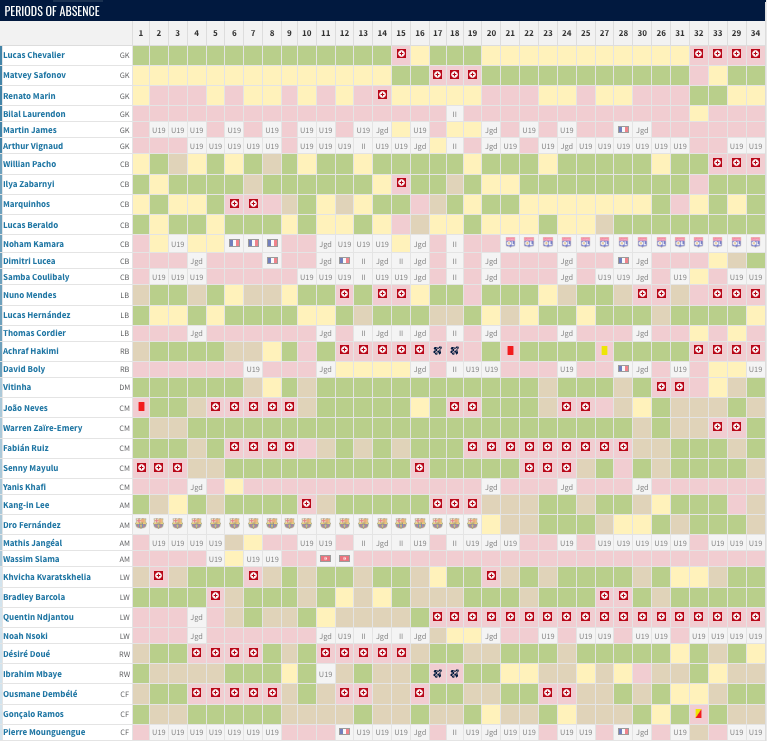
That said, it’s only so trustworthy for our task. PSG rotate massively and hilariously. They don’t have a single attacker in the top 1,000 players in Europe for league minutes. As an example, Mohammed Kudus hasn’t played in five months … and has more league minutes than any PSG attacker. I saw Marquinhos make a European Team of the Season, which seemingly included domestic performances. He had 11 league starts.
(It is clearly the smart and advantageous thing for them to do. All I ask is that commentators mention it when they guffaw about their energy levels. And I also think it must be taken into account when giving out end-of-year awards.)
Even more, Ligue 1 rescheduled two league fixtures to give them more rest ahead of Champions League ties. One of the postponements was against their primary title rivals, who were only a point behind at the time.
My shameless hopium barges in to feebly ask: have they overdone it? They haven’t played in weeks, and there was plenty of rotation even then. In the meantime, they hosted a short friendly to try and maintain match sharpness. Could they play looser as a result?
Ah, probably not. But Arsenal have now rested, as well.
[edit: In the pre-match presser, our Starman has chimed in with some perspective.]
“A game like this is not going to be decided on minutes, it’s going to be decided on moments.”
Next, let’s look at the statistical profiles of key players (through Gradient’s advanced analytics and grades) and some notes I’ve taken on each.
I. The attack
👉 Ousmane Dembélé, forward
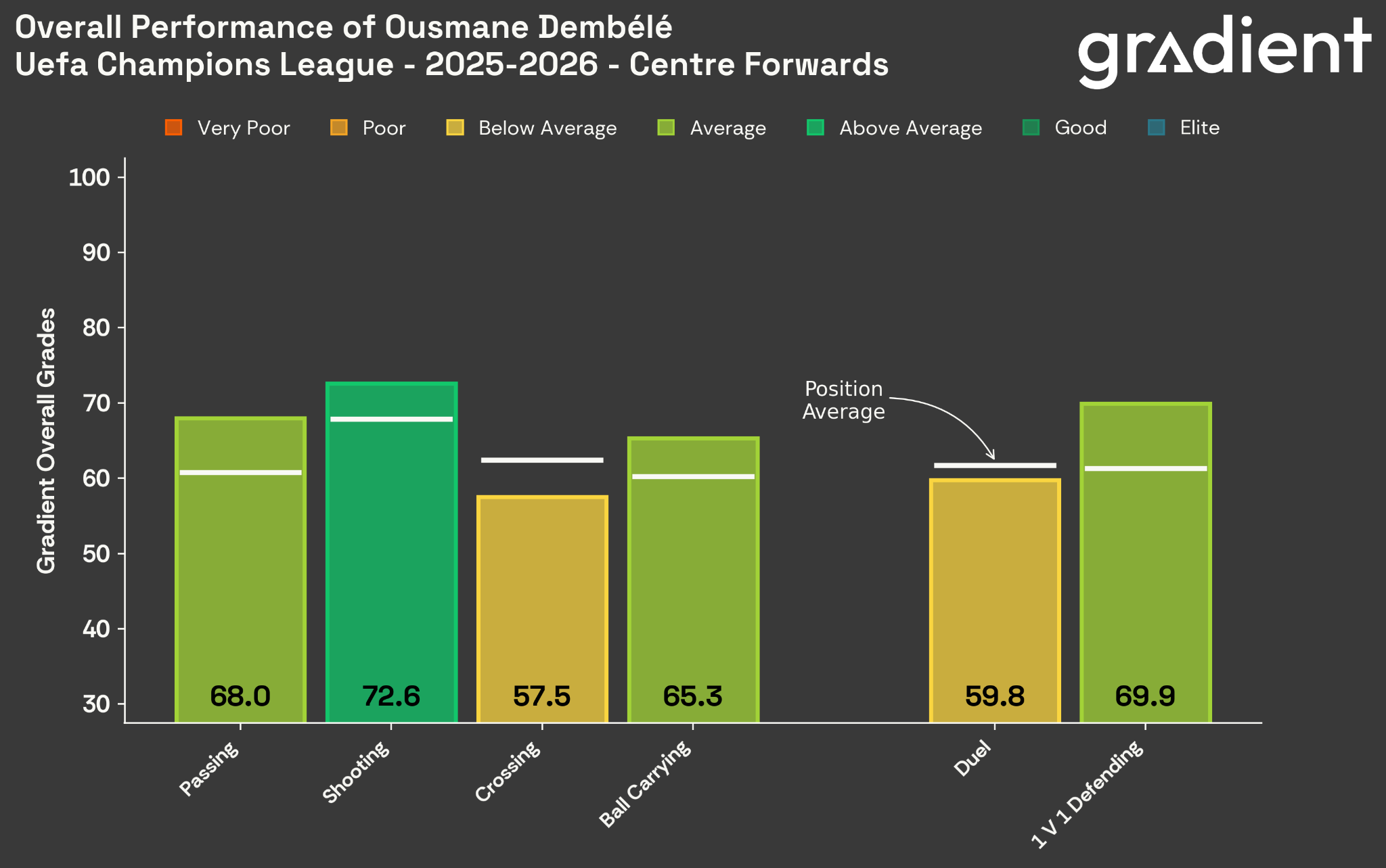
For each player, I’ll include some of their rankings in the advanced analytics, as well as some notes I’ve taken on approaching them. This is an opposition report, after all, so full priority should be given to nullifying opponent strengths: for each player, ask yourself, if I’m them, what kind of game do I want least?
We’ll start with the reigning Ballon d'Or winner.
Analytic strengths (via Gradient): finishing across types (pressured, off either foot, even his headed finishing rates well), through-ball passing, link play, defensive contribution from the front (dribble defending, 1v1 defending, tackle resistance), ball-carrying.
Vulnerabilities (via Gradient): more isolated dribbling, aerial duels, crossing under pressure, over-the-top passing. He likes getting touches and being involved, and can look to do it from outside the block in settled possession, in places where he isn’t nearly as dangerous.
Coaching points (our notes): don’t dive in, as his finishing beats you more than his dribble; track and communicate the runner who fills in when he vacates the nine. Track him everywhere in build-up, though you don’t necessarily have to deny him touches in wider or crowded areas in settled, advanced play.
👉 Khvicha Kvaratskhelia, winger
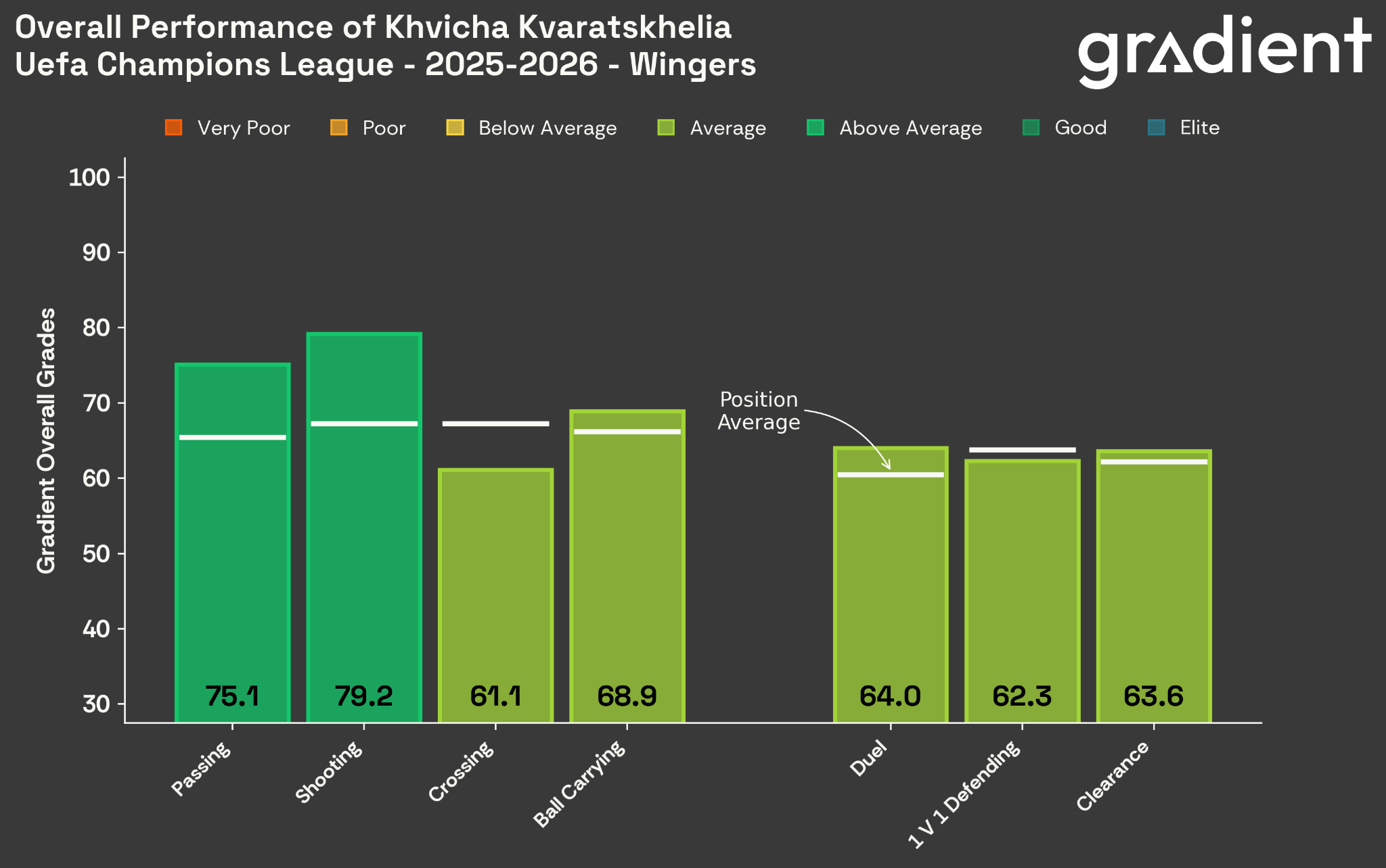
And here are some of his deeper on-ball grades as well:
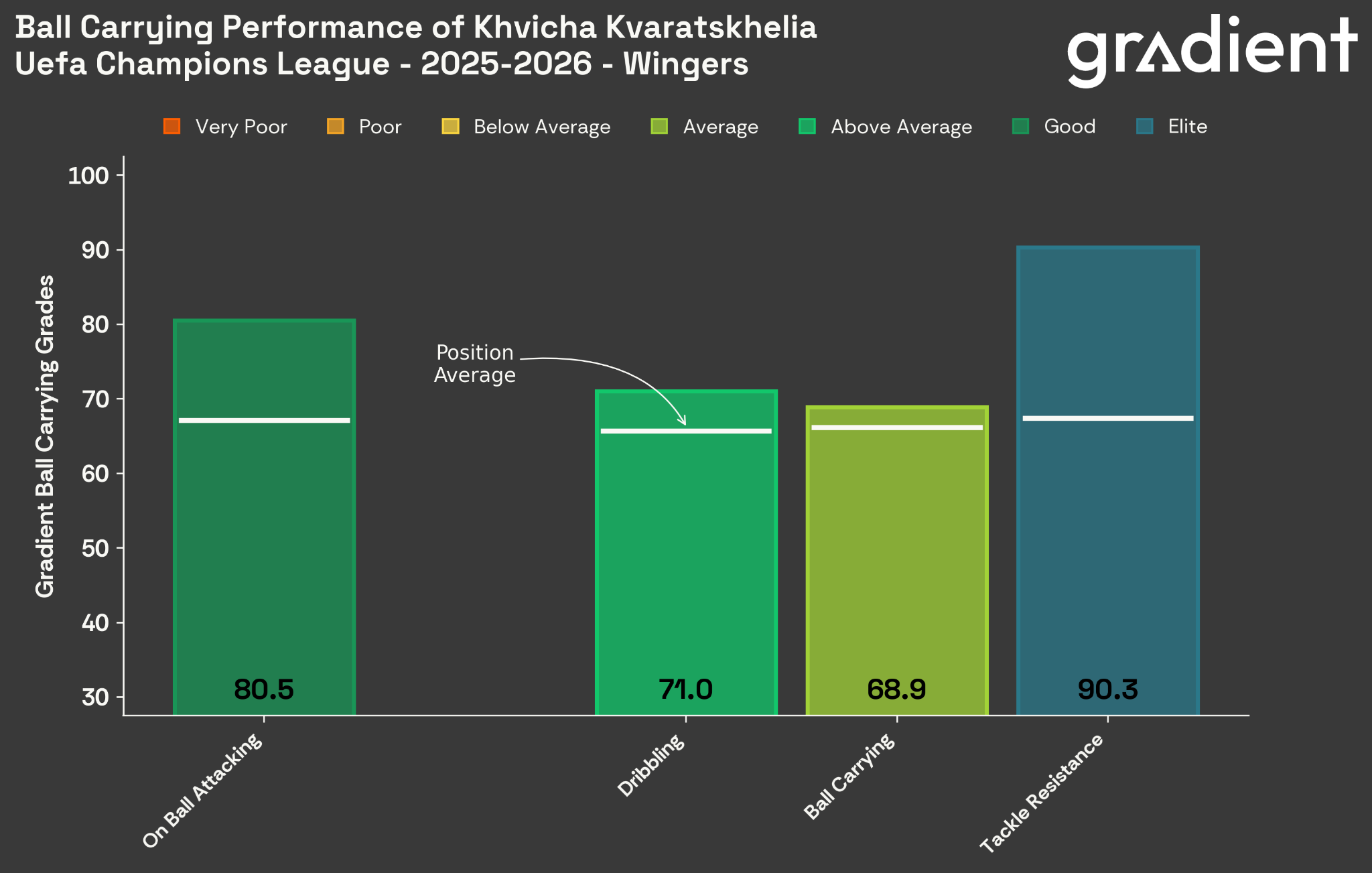
Analytic strengths: tackle resistance, ball-carrying, on-ball attacking, open-play shooting off his right, shooting under pressure, inswinger crossing, ball distribution.
Vulnerabilities: positioning off the ball, 50/50 duels, headed shooting, left-footed crossing/delivery, weaker pressured crossing in the CL sample.
Coaching points: deny the cutback-and-shoot at all costs; show him down the line, never inside onto his right; don’t lunge, be patient in duels; double the touchline when he carries to force him wide; force him to defend, crash his post, and constantly have the full-back sprinting on his blindside.
👉 Bradley Barcola, winger
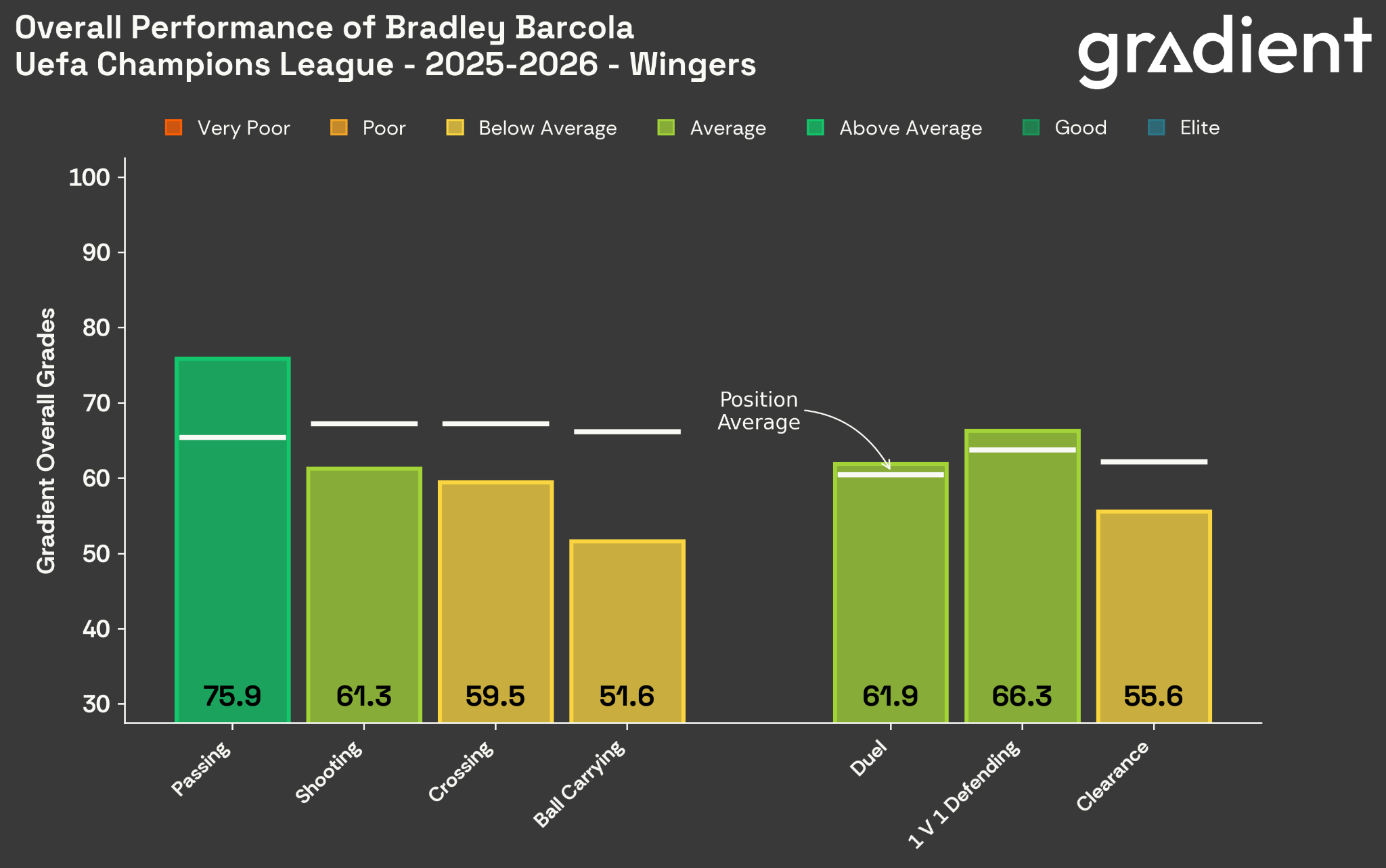
I’d currently expect Barcola to be the first name off the bench.
Analytic strengths: His numbers are a lot higher in the league. Numbers-wise, his strengths include: shooting and ball-carrying in the league sample, one-touch and pressured passing, over-the-top passing, defensive work-rate (blocking, tackling, dribble defending, 1v1 defending), ball distribution.
Vulnerabilities: tackle resistance, aerial duels, pressured shooting, headed shooting; his carrying and shooting have dropped sharply against CL-level opposition this year.
Coaching points: get tight and physical; he can be dispossessed. He is hell to face when you have a high-line, so you have to keep him as wide as possible, and engage as early as possible. He’s prone to looking caged when squeezed to the touchline and can have loose touches in those situations. He’s one of the reasons it’s worth staying low in a winning game-state.
👉 Désiré Doué, winger
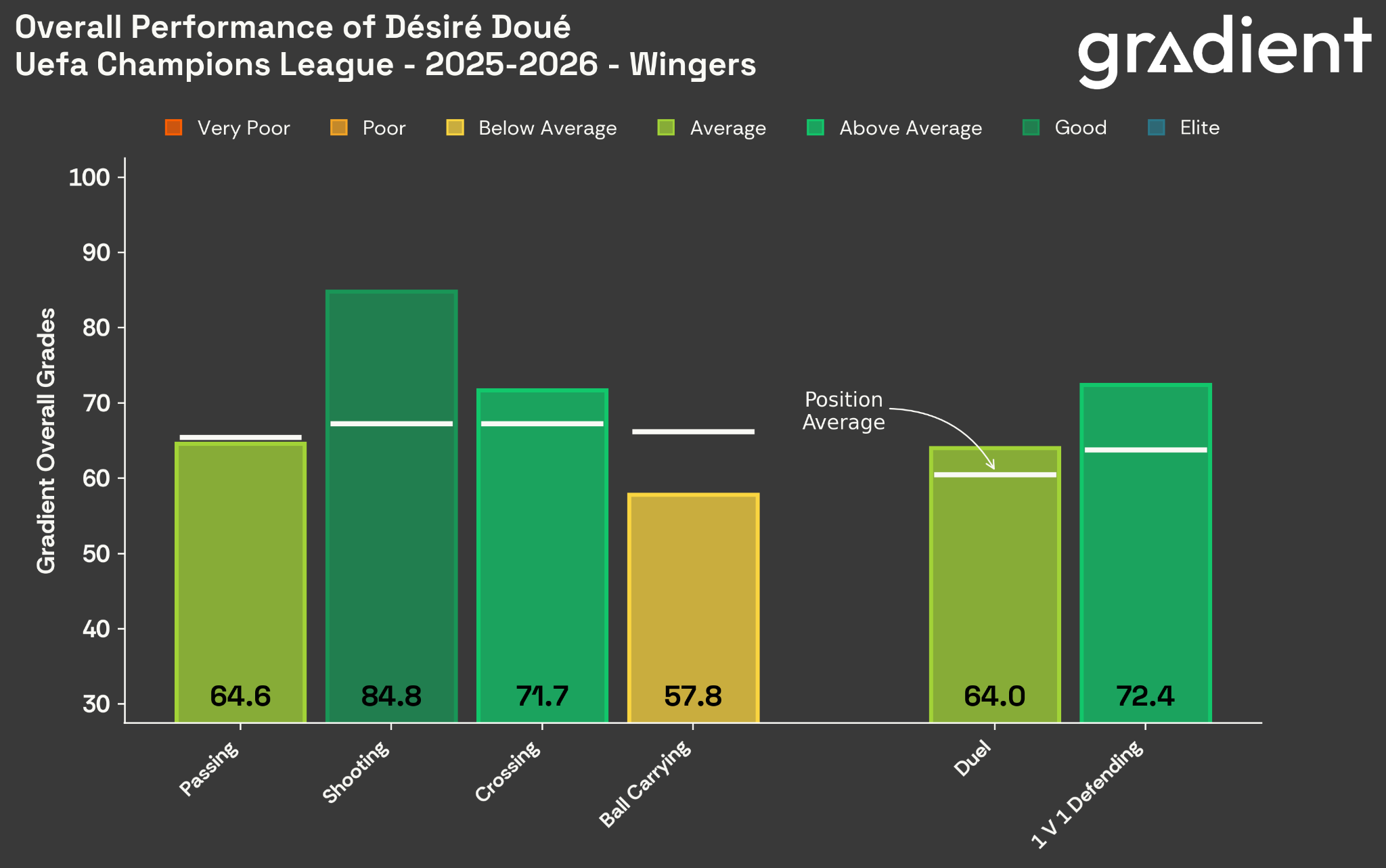
Analytic strengths: he scores high in finishing under pressure off either foot, tackle resistance, defensive work-rate (dribble defending, blocking, 1v1), ball distribution. For a tekky wingfielder, he covers a lot of distance (second-most distance per 90 by wingers in the Champions League).
Vulnerabilities: aerial duels, over-the-top passing, left-footed crossing.
Coaching points: push him to the touchline, and out of central areas, however possible; deny the shot and dribble: like most good dribblers, he wants to provoke a reaction and a heavy step, so if you hang off a bit, he has fewer ideas; stay aware of his positioning at all times, as he’s an incredible finisher; you can surrender the pass if it means he doesn’t dribble you; attack the flank he vacates when PSG lose the ball.
II. The midfield
👉 Vitinha, central midfielder
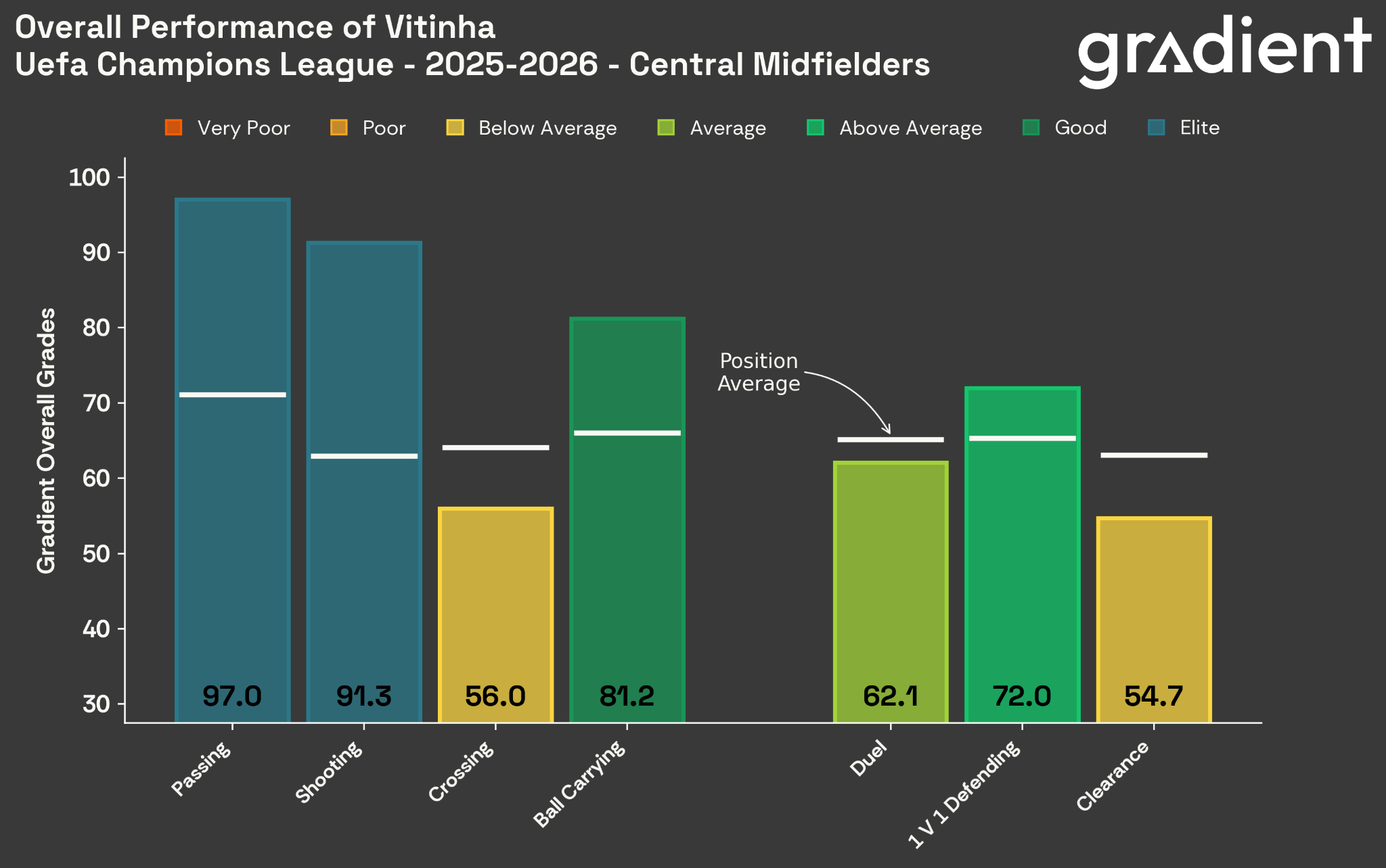
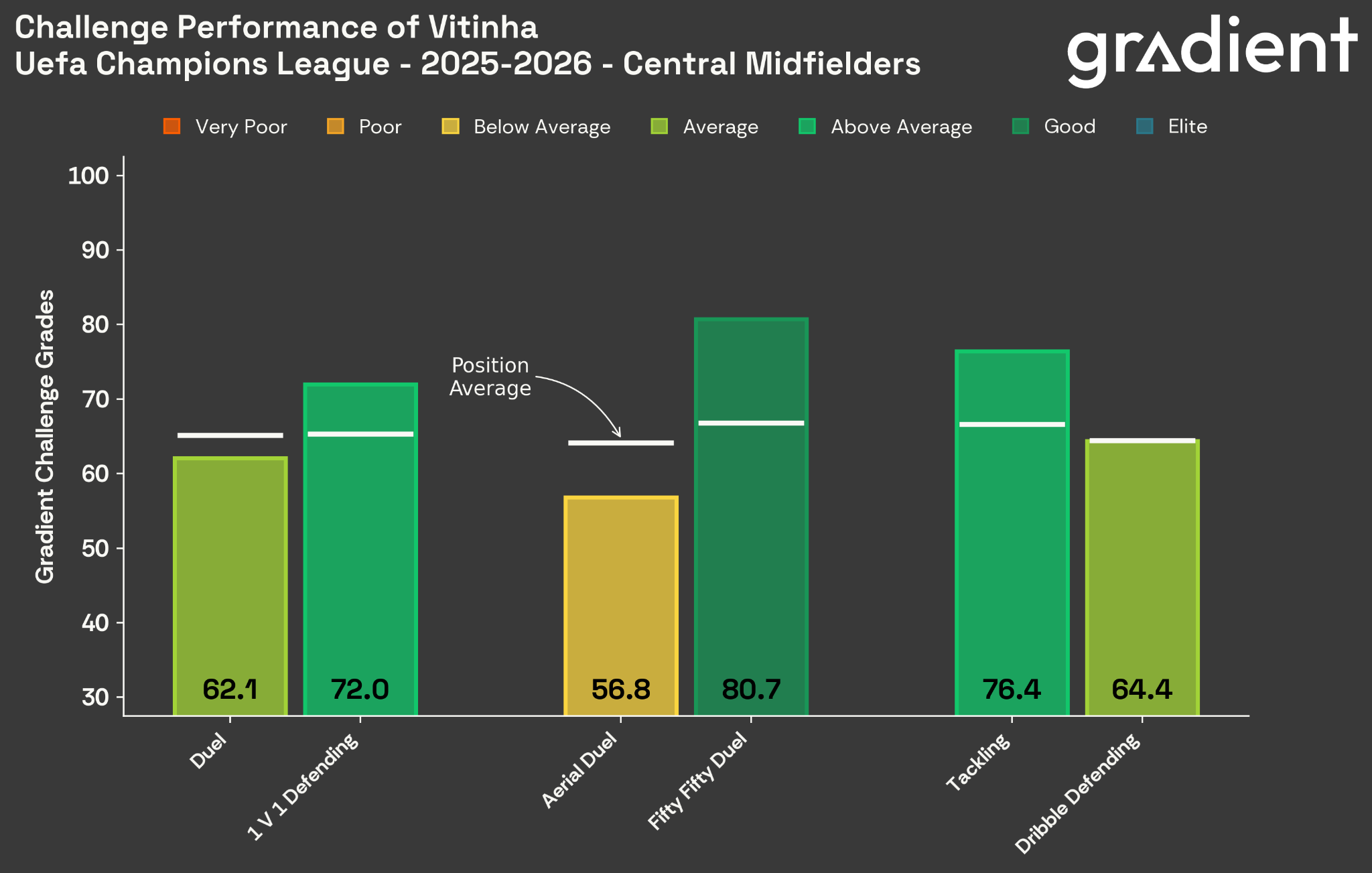
For the midfielders, I thought I’d pull the wider challenge/duel stats as well:
…and finally, his deeper passing grades. 😳
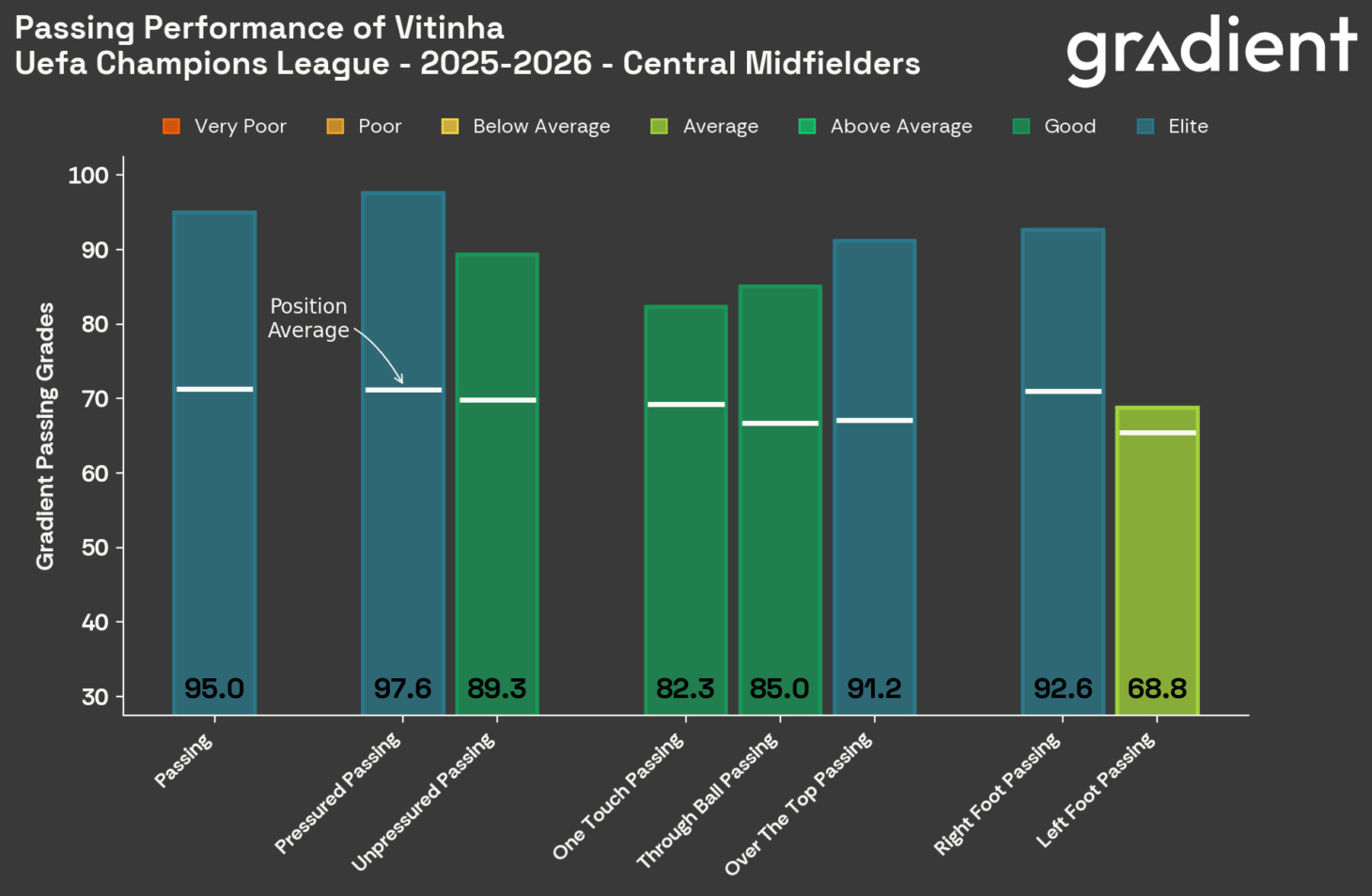
I’ll throw my hand up and say I had underrated him before watching all the footage for this. I knew he was quite good, but sheepishly thought he hadn’t faced physical enough players and could be shoved off the ball. But it’s really almost impossible to get the ball off him. Agent Thomas Frank was categorical: “Vitinha is the best midfielder in the world. He will be the next Ballon d'Or winner. Wow, what a player.” Anyway. Here’s what the stats show:
Analytic strengths: press-resistant passing, ball distribution, long-range passing, through balls, ball-carrying, shooting from range. Passing, passing, passing.
Vulnerabilities: left foot, aerial duels, crossing, set-piece delivery. Not as dynamic a passer when unpressured. In possession, he constantly picks up positions that will be vulnerable on a ball loss.
Coaching points: Is it possible to mid-block one player and press the rest? I say let’s try. Lay off and deny the forward pass, then jump the receiver; beat him up in the air however possible, and bully him especially on second balls; close out his shots on top of the box; drive at him in transition, especially if he’s dropped down to the wide-CB role and they’ve lost the ball.
👉 João Neves, central midfielder
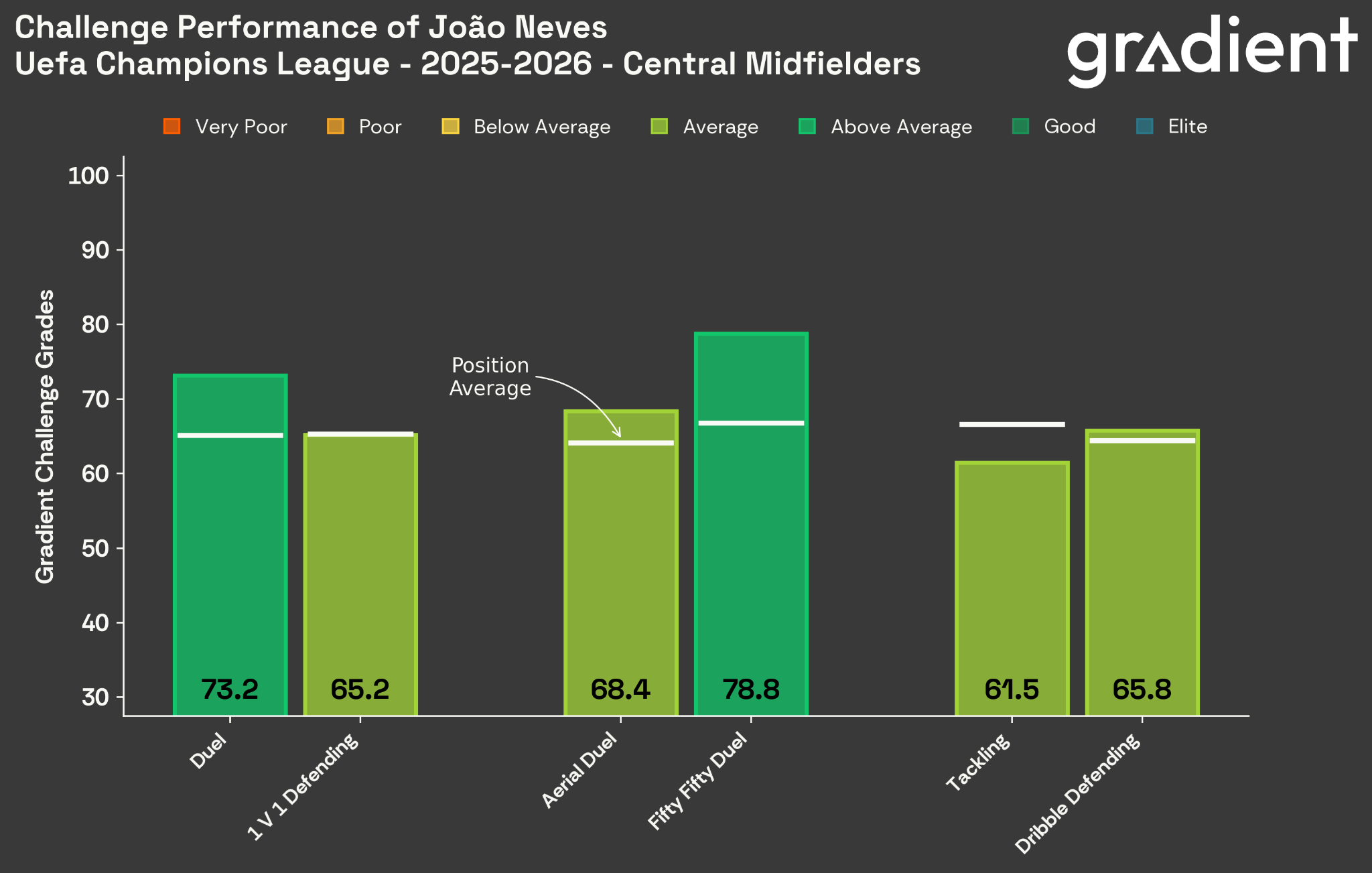
His challenges and duels:
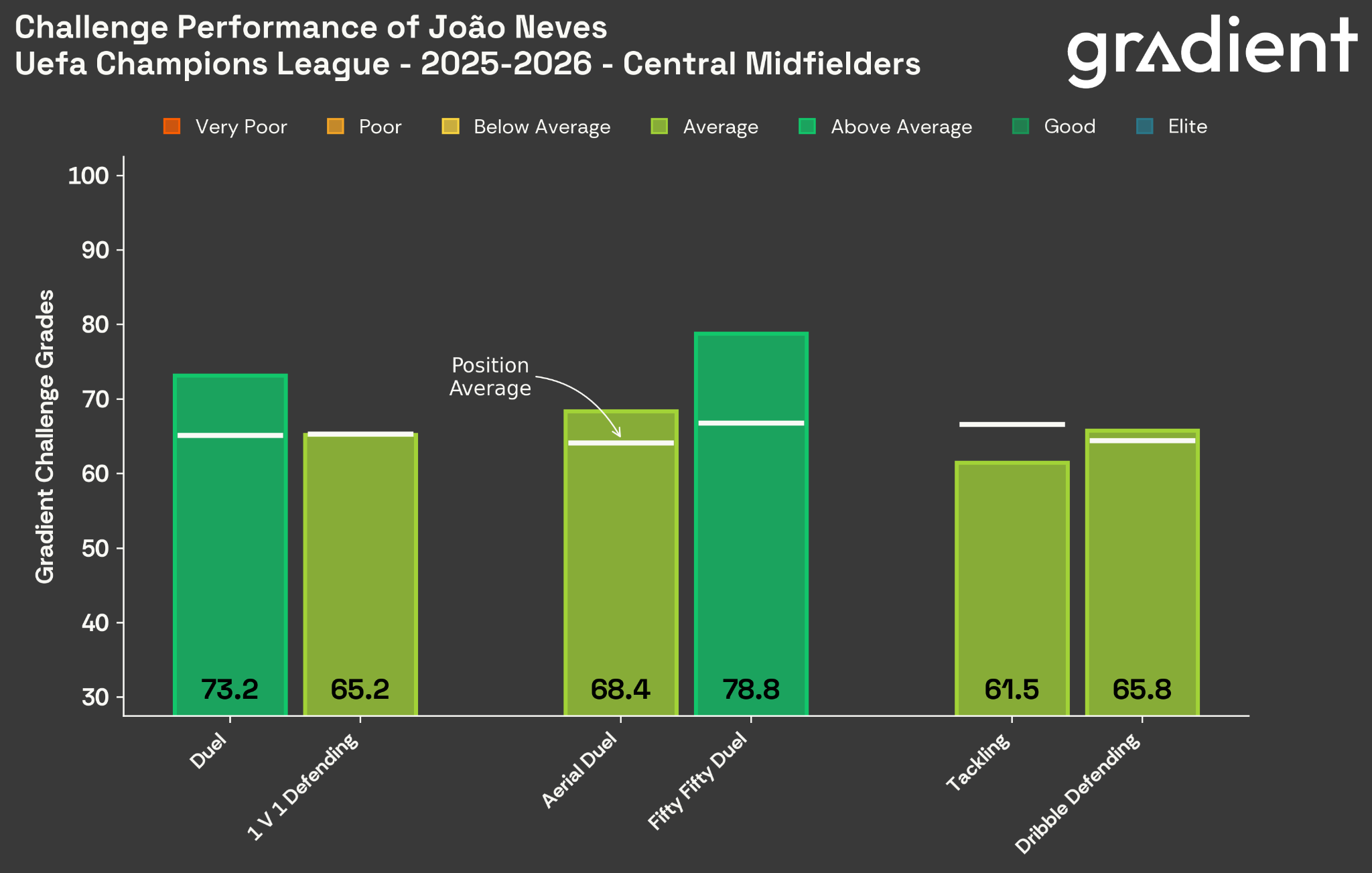
Analytic strengths: He’s good at everything, is my scouting report. Specifically, his one-touch and pressured passing, ball control, tackle resistance, 50/50 duels, aerial threat for his size (headed shooting on set pieces). If anything, I think Enrique underuses him.
Vulnerabilities: He doesn’t grade quite as well on dribbling, ball-carrying, pressured shooting, over-the-top passing, and crossing.
Coaching points: He’s extremely busy, overhelpful, and occasionally over-amped (got a silly red in the Club World Cup final). He’s often cleaning up others’ messes in the middle, so I’d want to use dribblers and runners to drag him away from zone-14, get them to cover his spot, then attack the middle. I’d also a) want to bait his aggression with some shit-housing, and b) potentially target him aerially, which sounds wrong because he’s their best aerial midfielder. The reason is that it’d leave Vitinha+Ruiz (or Vitinha+WZE) as the midfield “second ball net,” which is much preferable to having Neves there.
👉 Fabián Ruiz, central midfielder
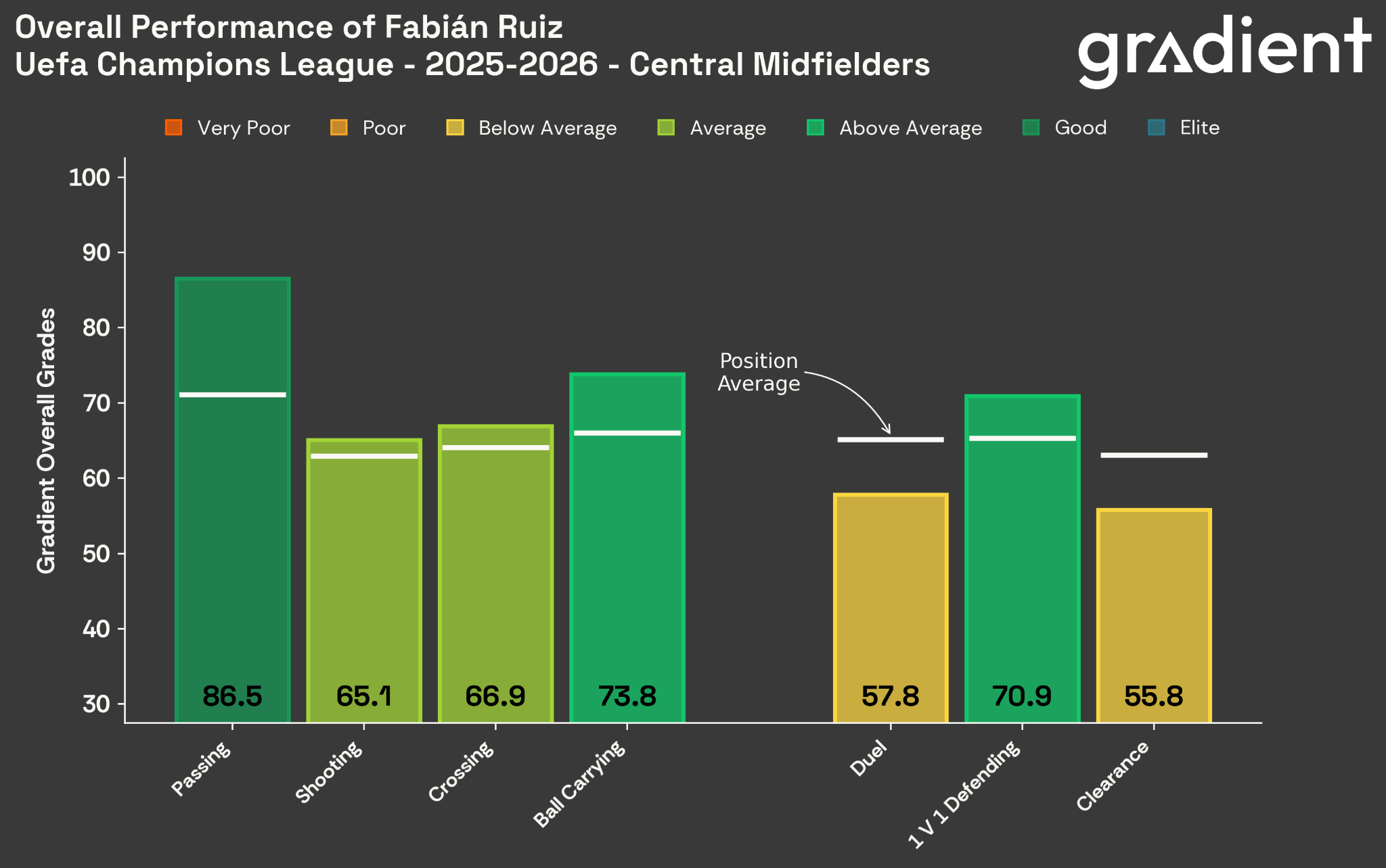
Challenges and duels:
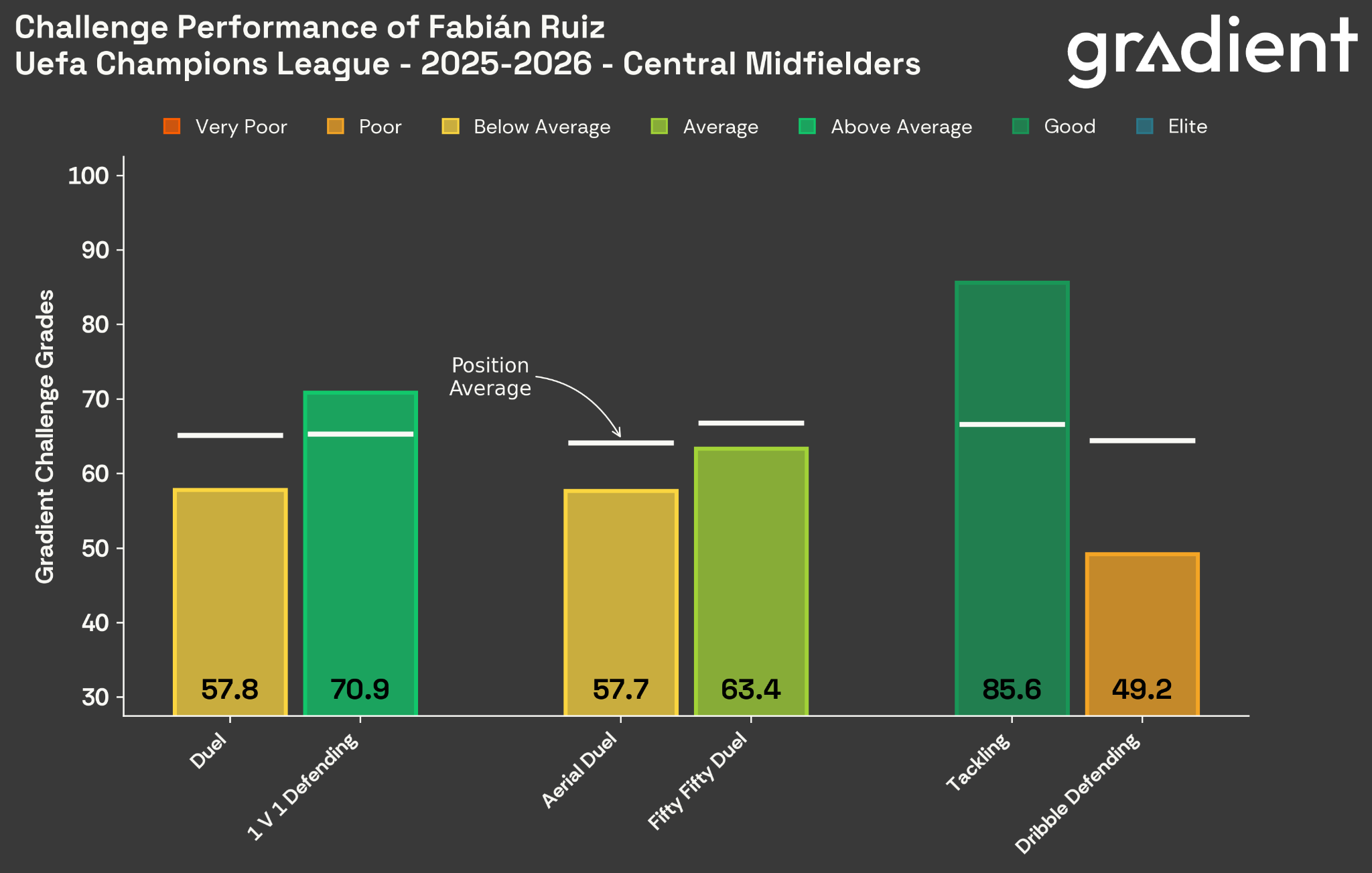
Analytic strengths: left-footed passing, distribution under pressure, over-the-top and through balls, tackling, ball-carrying out of midfield. He’s their best big-space passer.
Vulnerabilities: tighter-agility dribble defending, tackle resistance, aerial duels, positioning, shooting (he’s graded out poorly this year, but we know he can hit a ball). He can feel more lethargic than others on this team.
Coaching Points: run at him as a defender; he’s usually press-resistant as a passer/shielder but not as a carrier/dribbler, so he’s less of a threat to drive into open space, and I still want to test him with shoves and tackles; once he already has the ball, I’d personally lay off him a bit.
👉 Warren Zaïre-Emery, central midfielder / right-back
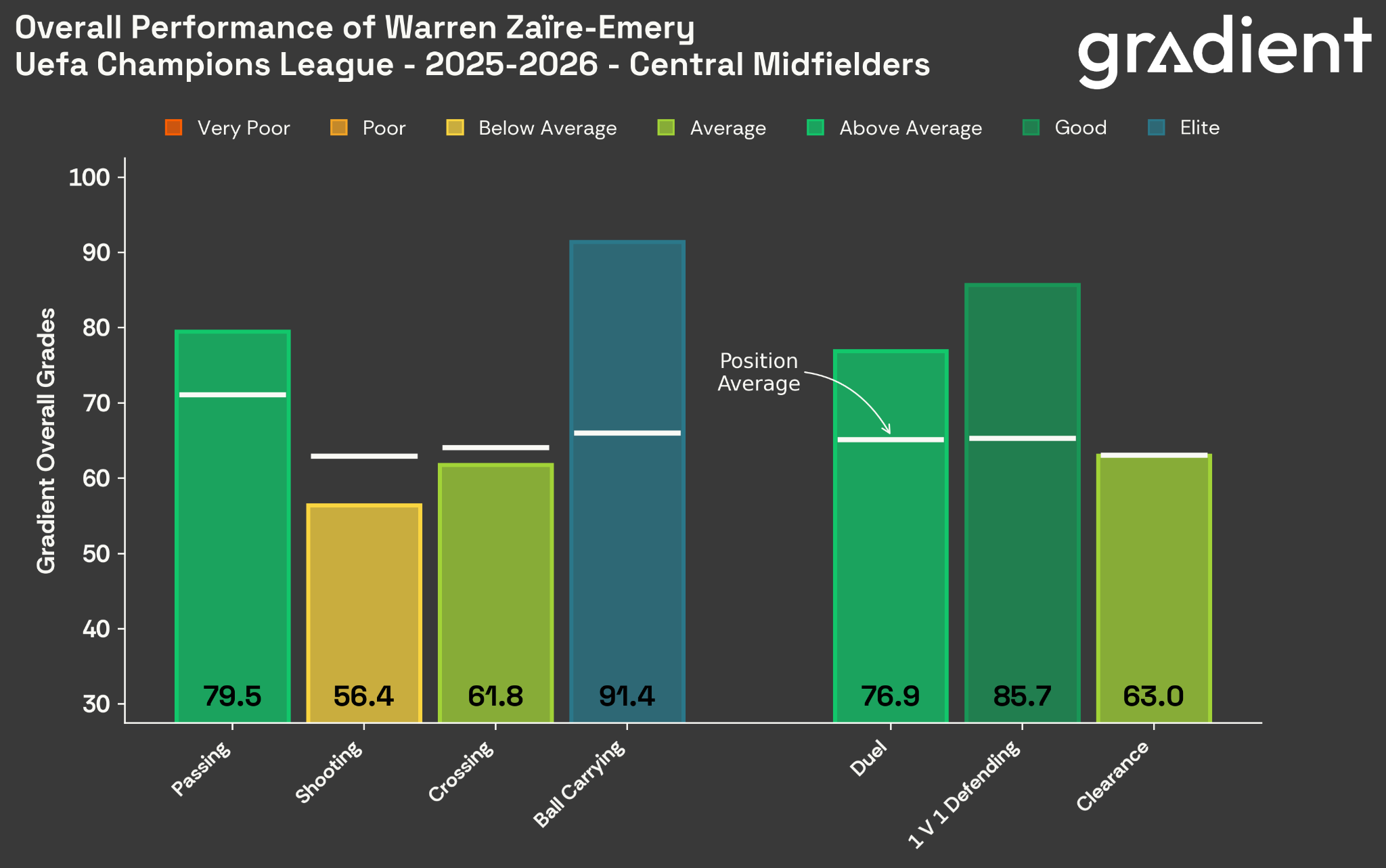
He might start at right-back (if Hakimi is out), at midfield (in place of Ruiz), or arrive off the bench.
Analytic strengths: ball-carrying into space, pressured passing, defensive work-rate (tackling, blocking, dribble defending, 1v1), aerial/headed threat, plus an elite engine (8th-most distance covered per 90 in the Champions League).
Vulnerabilities: shooting, tackle resistance and isolated dribbling against top opposition, over-the-top passing, crossing, wide pacy defensive 1v1s.
Coaching points: press and harry him on the ball, he’s potentially dispossessable; block his carrying lane to force the pass; he’s fairly shot-shy; track his late forward runs, because he doesn’t get tired. If he’s right-back, play it in behind and test his long pace.
III. The backline
👉 Achraf Hakimi, right-back
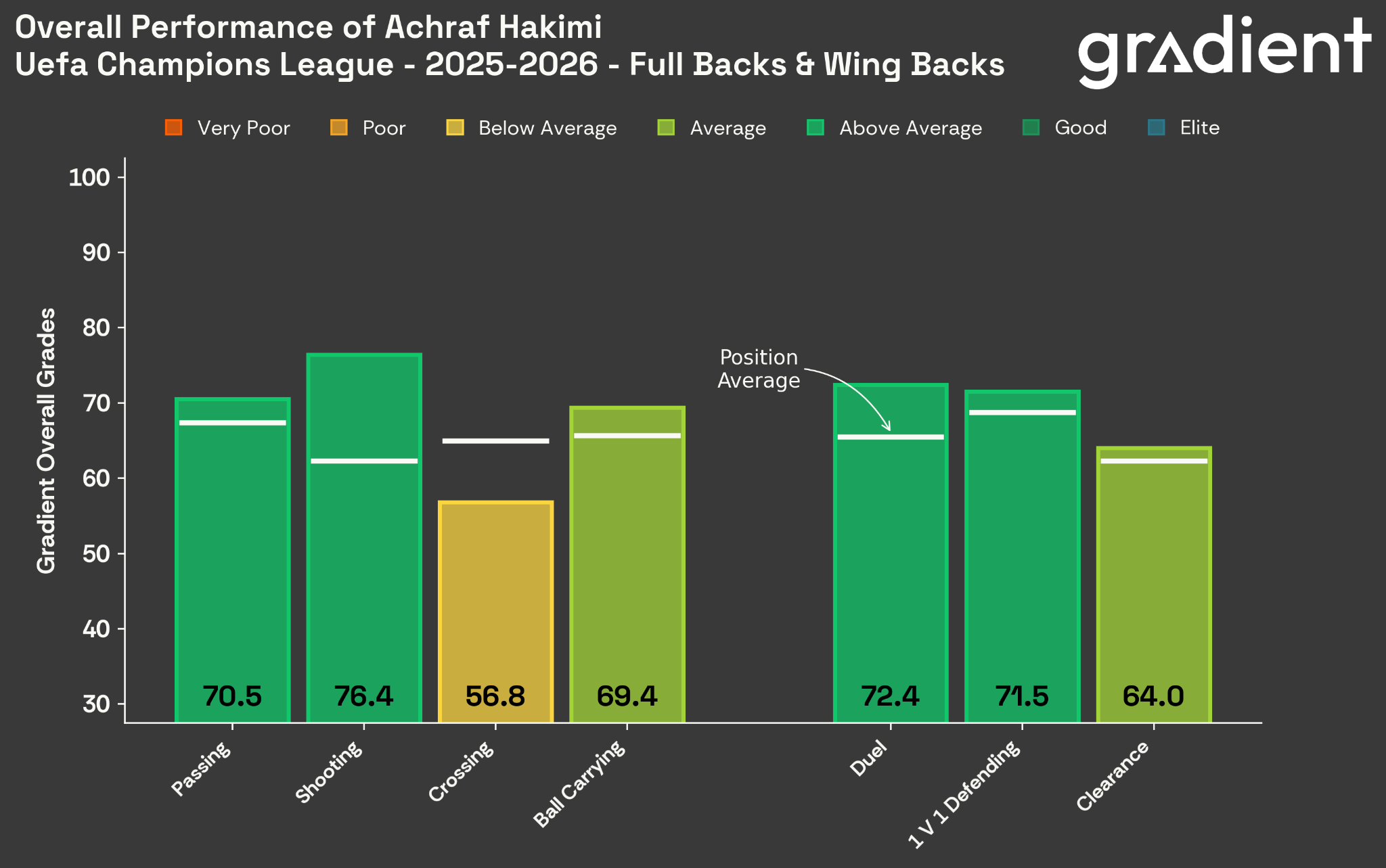
Analytic strengths: shooting under pressure (especially high for a fullback, as we know too well), ball distribution, right-footed and pressured passing, ball-carrying forward, tackling, 50/50 duels.
Vulnerabilities: overall deep tackle resistance, dribble defending, crossing (especially under pressure in the CL); constantly leaves space behind.
Coaching points: attack the space in behind when he pushes up; he’s dispossessable in deeper areas, you can go hard; close out his shots hard, with sound blocking technique.
👉 Marquinhos, right CB
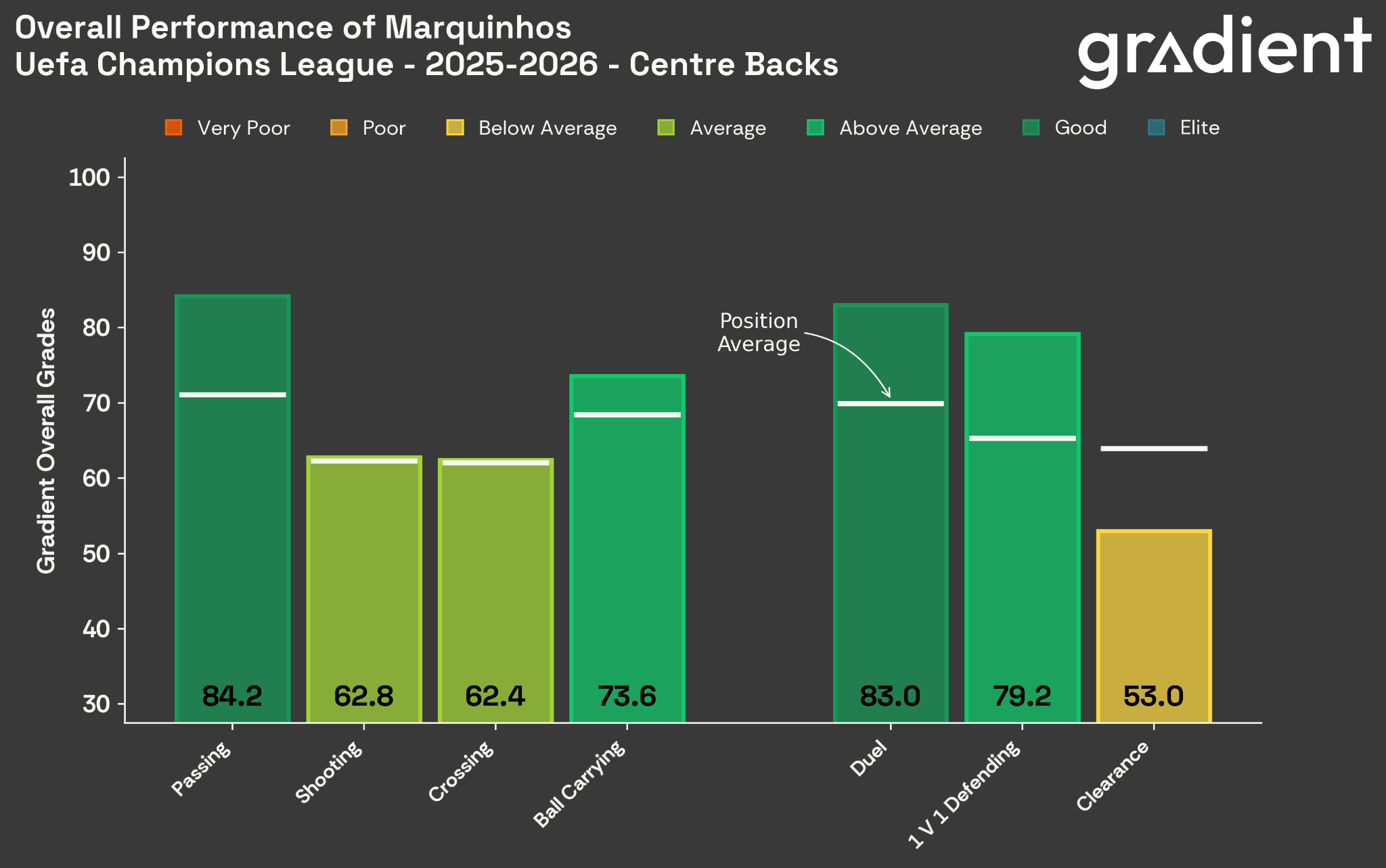
Analytic strengths: range of passing (including over-the-top), reading of the game, aerial and ground duels (good, not elite).
Vulnerabilities: tackle resistance, passing accuracy under pressure (big drop from unpressured), clearances, speed.
Coaching points: press him on the ball, his distribution falls off when hurried; attack him at pace, especially when Hakimi has stepped up (one of the team’s biggest vulnerabilities); deny him the unpressured first phase, push him to play long.
👉 Willian Pacho, left CB
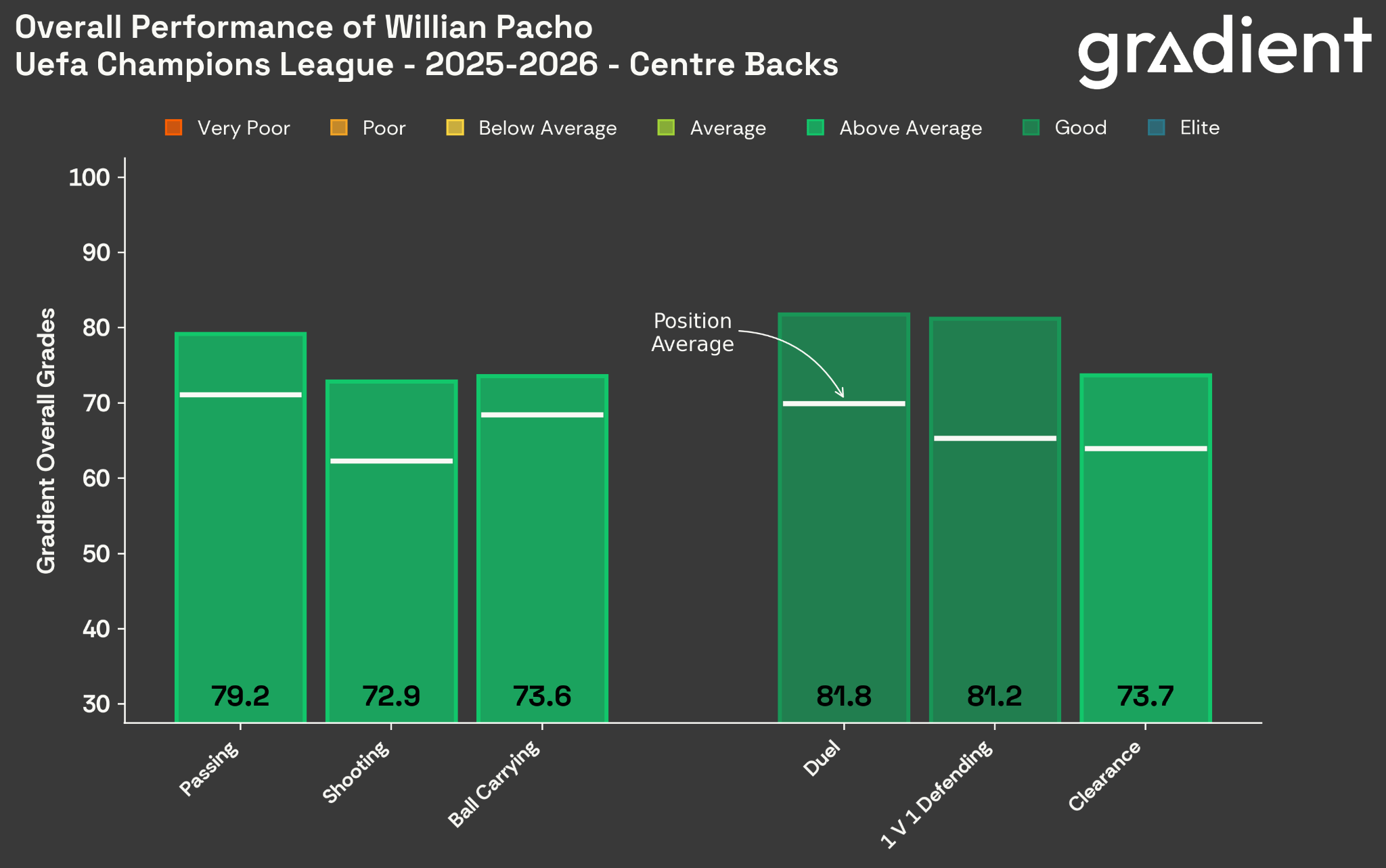
He’s quite good. I’ve loved him since his early days at Eintracht Frankfurt.
Analytic strengths: aerial duels, dribble defending, 1v1 defending, positioning, tackling and blocking, left-footed pressured passing.
Vulnerabilities: dribbling/carrying out of pressure, ball distribution and progressive passing, over-the-top passing.
Coaching points: press him hard; cut his short passing options so he has to play long where he’s weaker; avoid lumping it onto him, as he’s an outlier for them in aerial duels, amidst plenty of weakness; like Neves, he cleans up a lot of messes, and follows the ball, so get him out of position and then attack the spot he vacates. A lot of their players can get too close to the ball and lose runners.
👉 Nuno Mendes, left-back
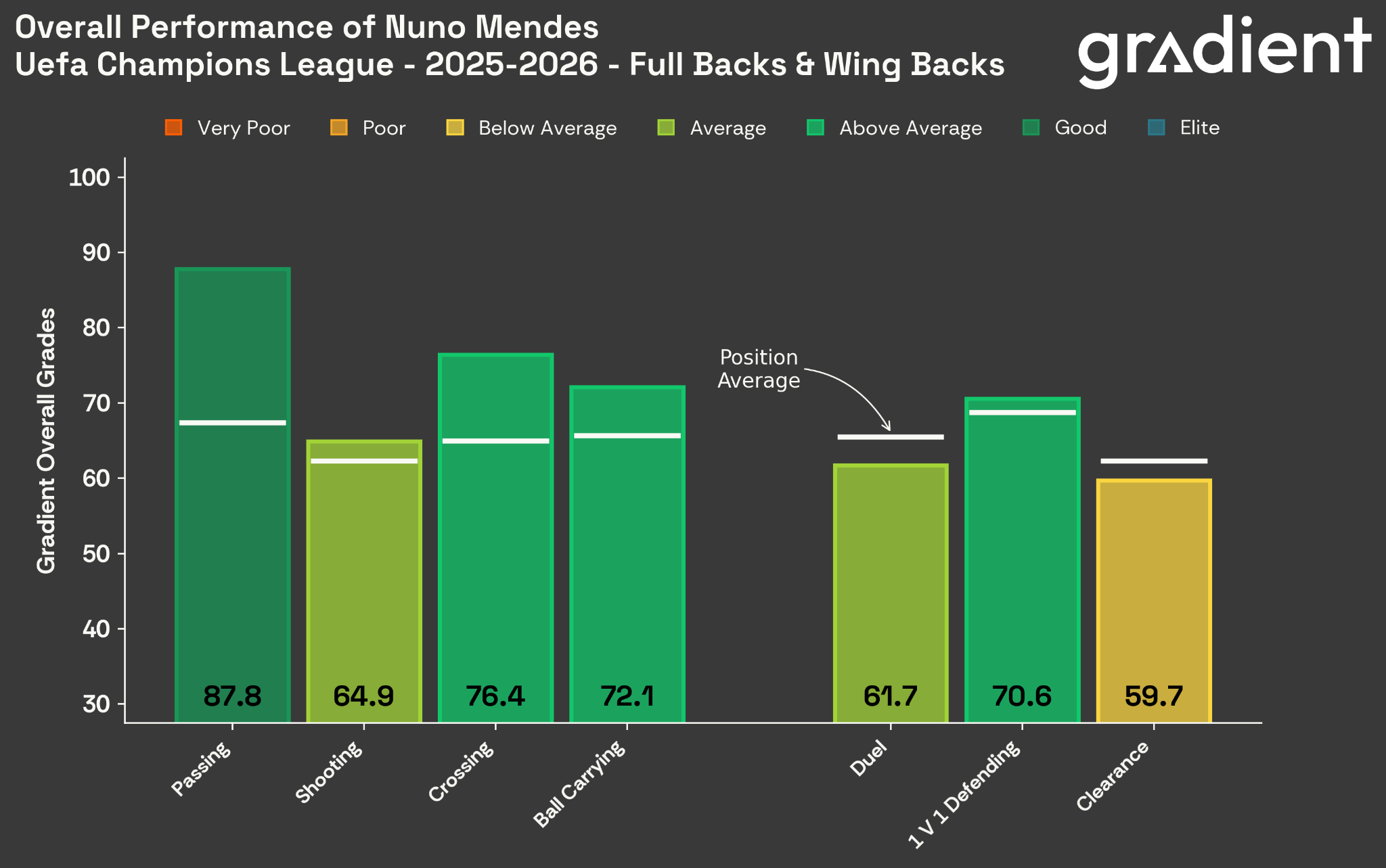
A joke of a player, whose only real flaw is his ability to stay fit. PSG have a solution for that: injuries and all, he’s played 40% of the minutes in Ligue 1 across 5 seasons, which magically jumps up to 75.4% in the Champions League. He’s started-and-finished (i.e. played all 90 mins) 44 total games in Ligue 1 in his career, or 8.8 times per season.
Analytic strengths: passing under pressure off both feet, over-the-top balls, dribbling and ball-carrying forward, dribble defending and positioning, inswinger crossing threat. He’s won possession more than any player in the Champions League.
Vulnerabilities: aerial duels (moderate weakness), finishing (though he can strike it, just inconsistently), raw tackling/50-50s in the CL; high attacking positioning leaves space. He can sometimes hit ill-advised switches that open PSG up to the counter.
Coaching points: his advances are when PSG are most vulnerable: they don’t usually make Hakimi drop back on the other side to compensate, so it means there is a front-6 of committed attackers, and Vitinha is covering the wide-LCB spot in build-up. Vitinha is really savvy with his positioning, but still: go, go, go. I also have stubborn faith that Saka can beat him; he turned his back on Olise once or twice.
👉 Matvei Safonov, keeper
After last season’s elimination, Arteta’s thoughts drifted to the goal.
“When you look at the two games, who has been their best player on the pitch has been the goalkeeper. He's made a difference for them in the tie.”
Donnarumma can’t hurt us anymore.
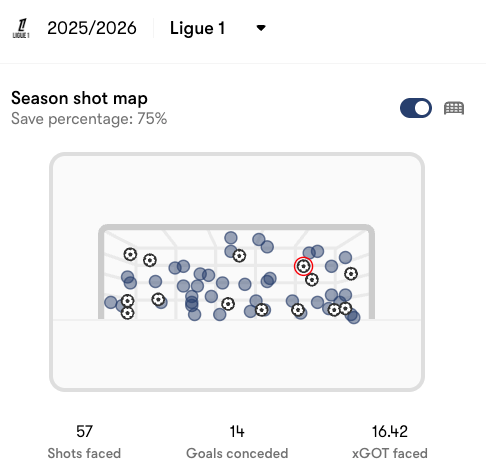
Here’s Safonov in the league, since taking the job from Lucas Chevalier:
And here it is in the Champions League, a smaller sample:
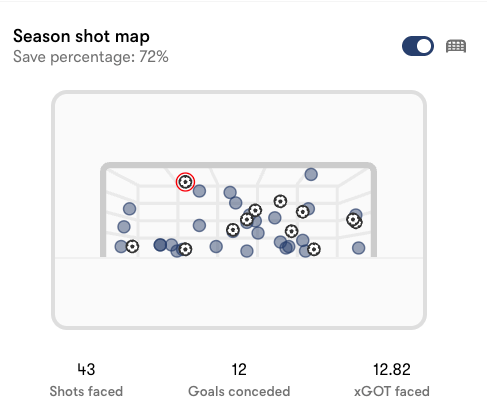
In the Champions League, he’s faced three set-piece shots and surrendered two of them.
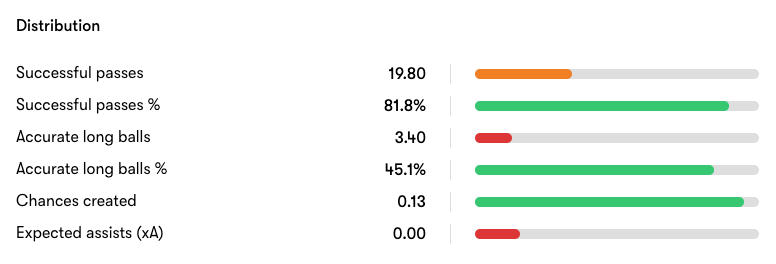
He is not highly involved in build-up:
…and that is especially the case in the Champions League, where Enrique has him regularly booting it out on purpose, forcing opponent throw-ins in suboptimal locations:
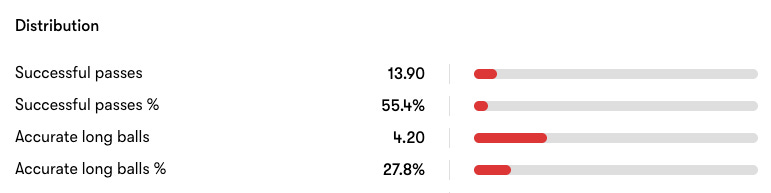
Through Gradient’s numbers, he fares quite well in shot positioning across the board, but is more mid-grade during the actual save. His pressured passing is also meaningfully lower than his unpressured passing.
Coaching points: Press him hard, push him to his left foot. They have outlets, but not aerial outlets.
👉 Substitutions
If Ruiz or Zaïre-Emery don’t make the eleven, they are highly likely to come on. Aside from that, the four players with 5+ substitute appearances in the Champions League are:
Lee Kang-In: 10 appearances as a substitute, 27 minutes per substitution.
Lucas Hernández: 10 appearances as a substitute, 24 minutes per substitution.
Gonçalo Ramos: 10 appearances as a substitute, 18 minutes per substitute. This feels fairly likely, as Dembélé may not be fully fit.
Senny Mayulu: 6 appearances as a substitute, 20 minutes per substitution. So impressed with his footage, by the way.
Other possible appearances are Illia Zabarnyi, Ibrahim Mbaye, and Lucas Beraldo.
Next, onto the play-style.
👉 Referee
The final will be refereed by Daniel Siebert, a 42-year-old German who has officiated two of our games this year: the first leg v Sporting, and the second leg v Atleti. He presided over one game for PSG, which I also watched (against Athletic Club). He’s been around the median with fouls (22 a game), slightly above-average with yellows (4.44 a game), and has given one penalty and two reds across nine games. Over a longer time frame, his stats (fouls per game, yellows per game, reds per game, penalties per game) all look pretty normal.
🔵 In-possession
👉 First phase
As we established, Safonov isn’t terribly involved in early build-up. Against Bayern, he purposely hit it out to generate conditions that would squeeze the Bayern attack.
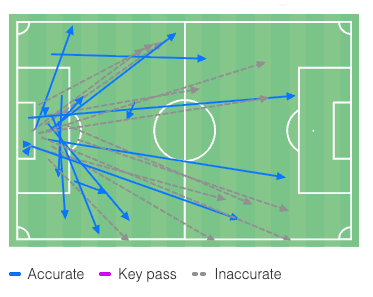
In the Champions League, he has largely gone long, hitting 46 long goal-kicks, compared to 9 short ones. He hasn’t hit a single short goal-kick in the last five Champions League games. In the second leg against Bayern, he took no risks and hit it long 14 out of 18 times total. Almost all of them were hoofs that had very little chance of a PSG ball-win.
Other players pick up the slack, particularly Vitinha. Below, you’ll see a more standard look.
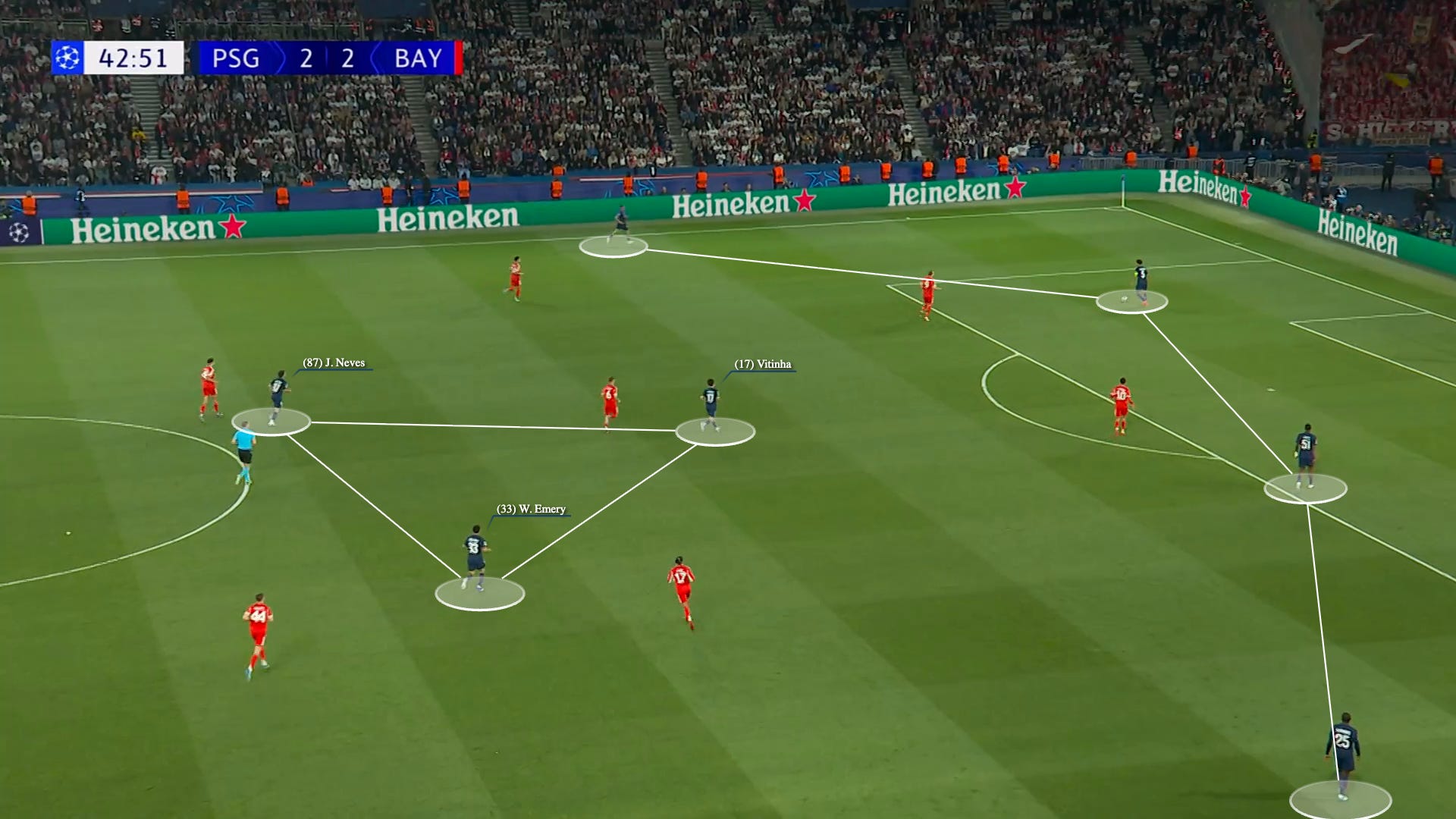
All three midfielders are all-purpose and can be expected to float anywhere in the central areas. While Vitinha can look to back up and disappear up to the frontline, he is primarily the deepest one, constantly getting on the ball, picking it right up from the centre-backs as he sees fit. Would you like to know how many successful passes he has in a typical PSG league game, per Opta? It’s 109.
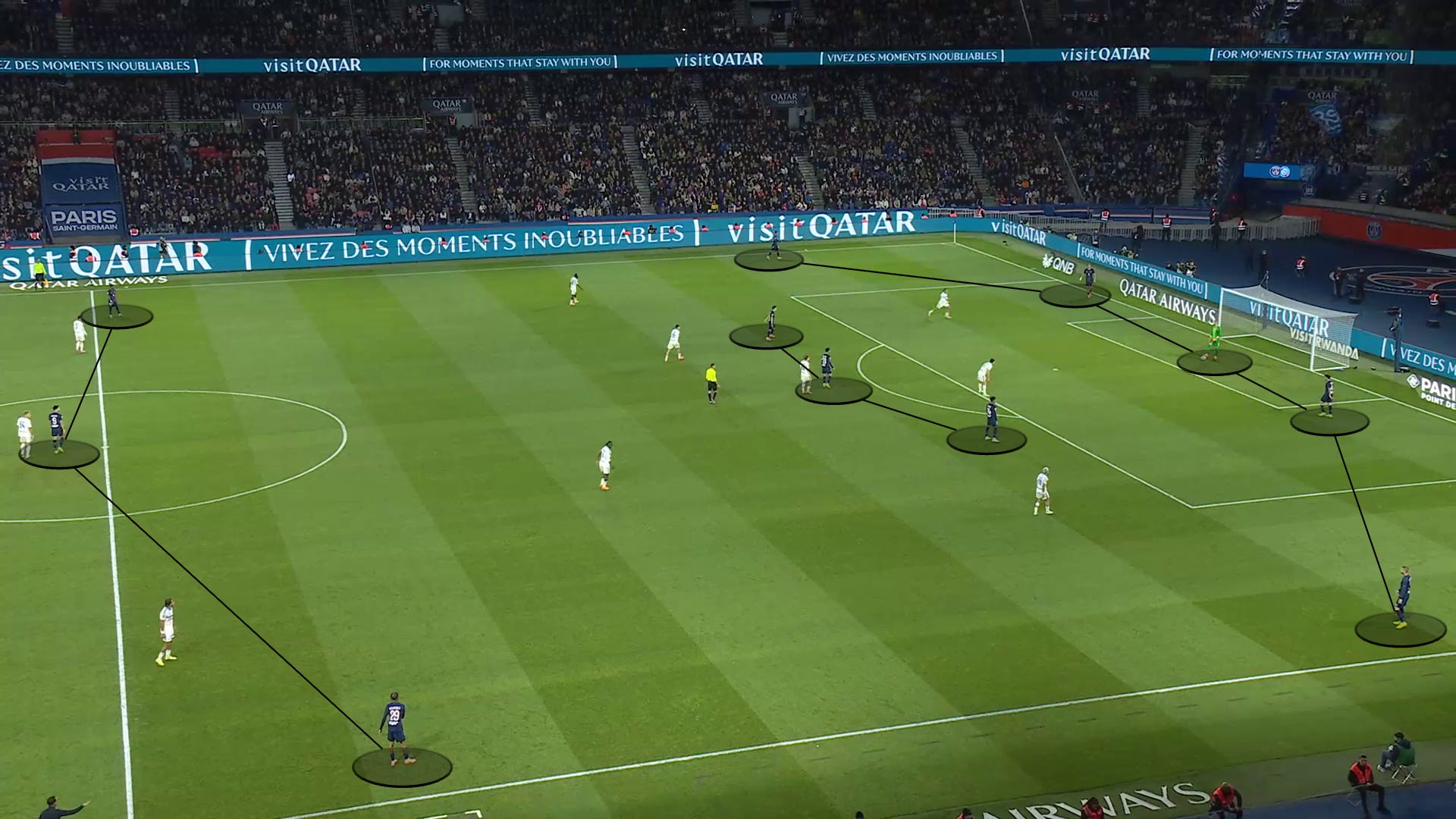
During goal-kicks, the shape can be tremendously flat to try and generate 1v1s on the backline. I’d largely expect Arsenal to go man-to-man for this one.
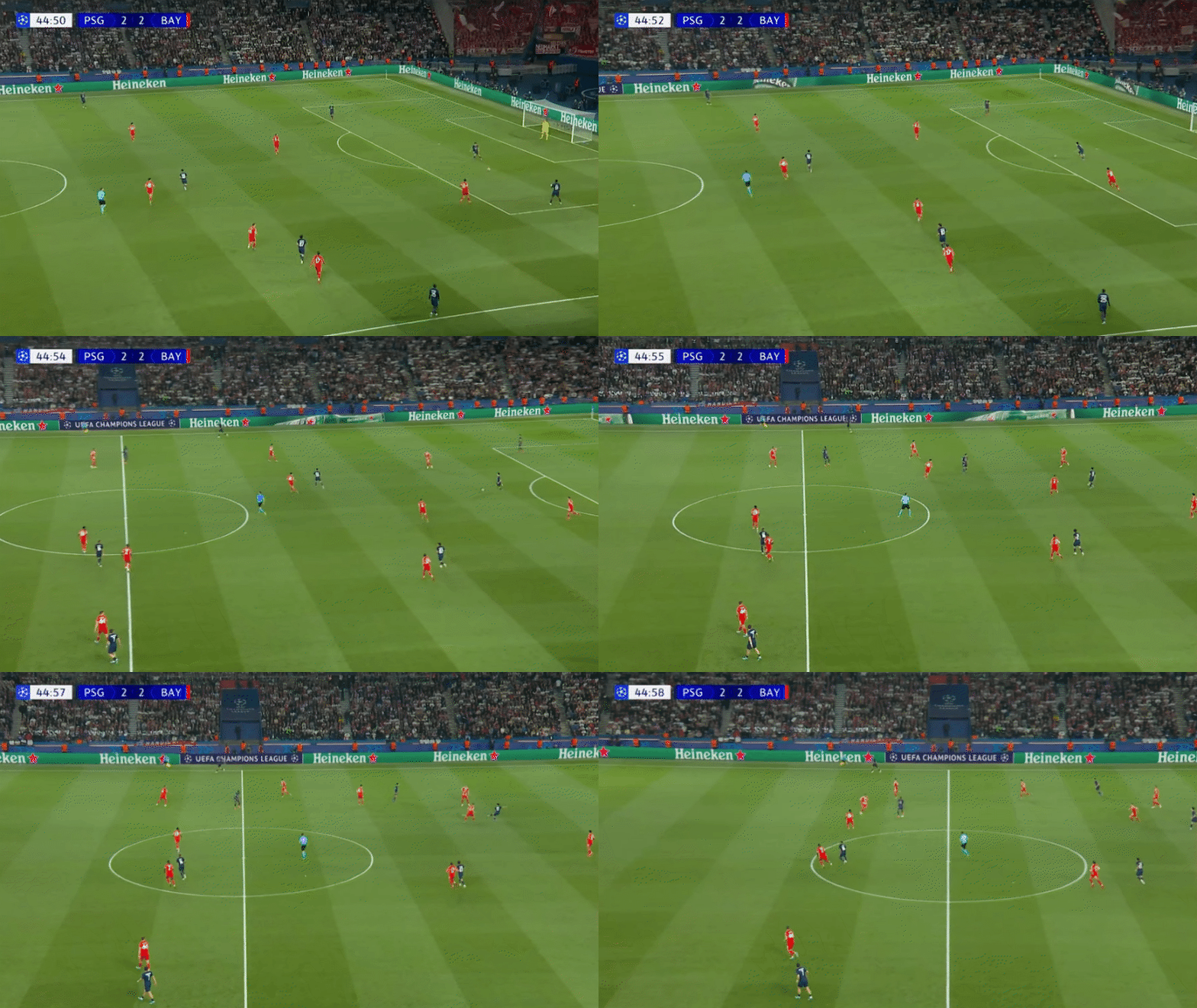
And here’s what I’m talking about with Vitinha. He picks it up off the keeper, and does the job of Raya and a defensive midfielder in one fell swoop. At the end, he disguises his body to open a lane, and hits it up into the pocket.
When there are fewer numbers forward in the opponent press, that’s when things get interesting. You’ll see Mendes stay heavily involved as an auxiliary CB, while Hakimi pushes up as the de facto right-winger. This then gets the right-winger inside, swapping and changing with others.
The PSG midfielders are required to be comfortable all over the pitch. As I warned, here’s Vitinha dissolving into a striker-type position, Zaïre-Emery dropping as the #6, and Neves going out to the left-wing. Those wide duos (usually high midfielder + winger, or even winger + winger, or winger + striker) are the heart of the PSG attack.
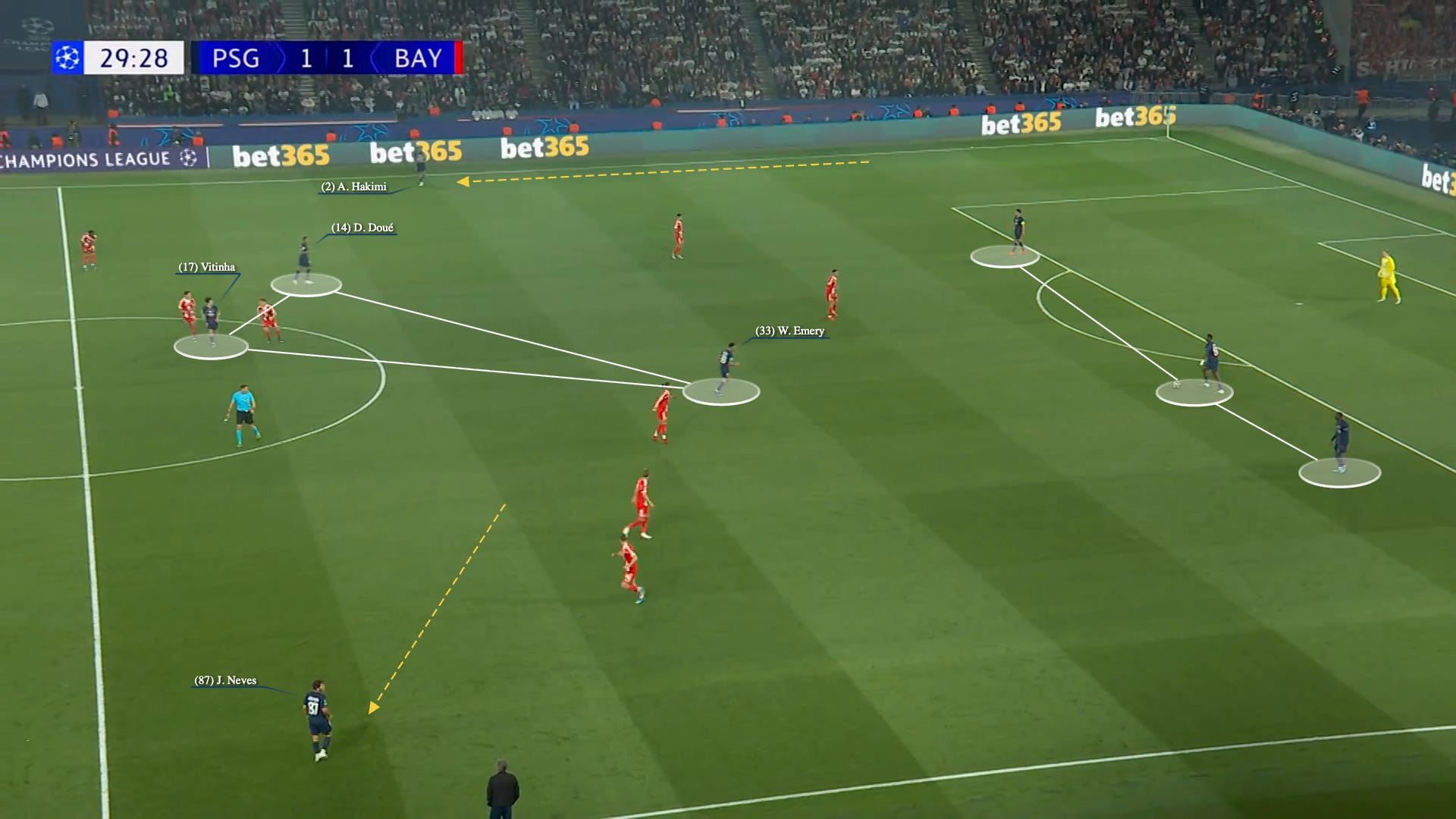
And here’s why their mobility is so hard to defend. They test you horizontally and vertically, asking: OK, big dog, are you really ready to go man-to-man?
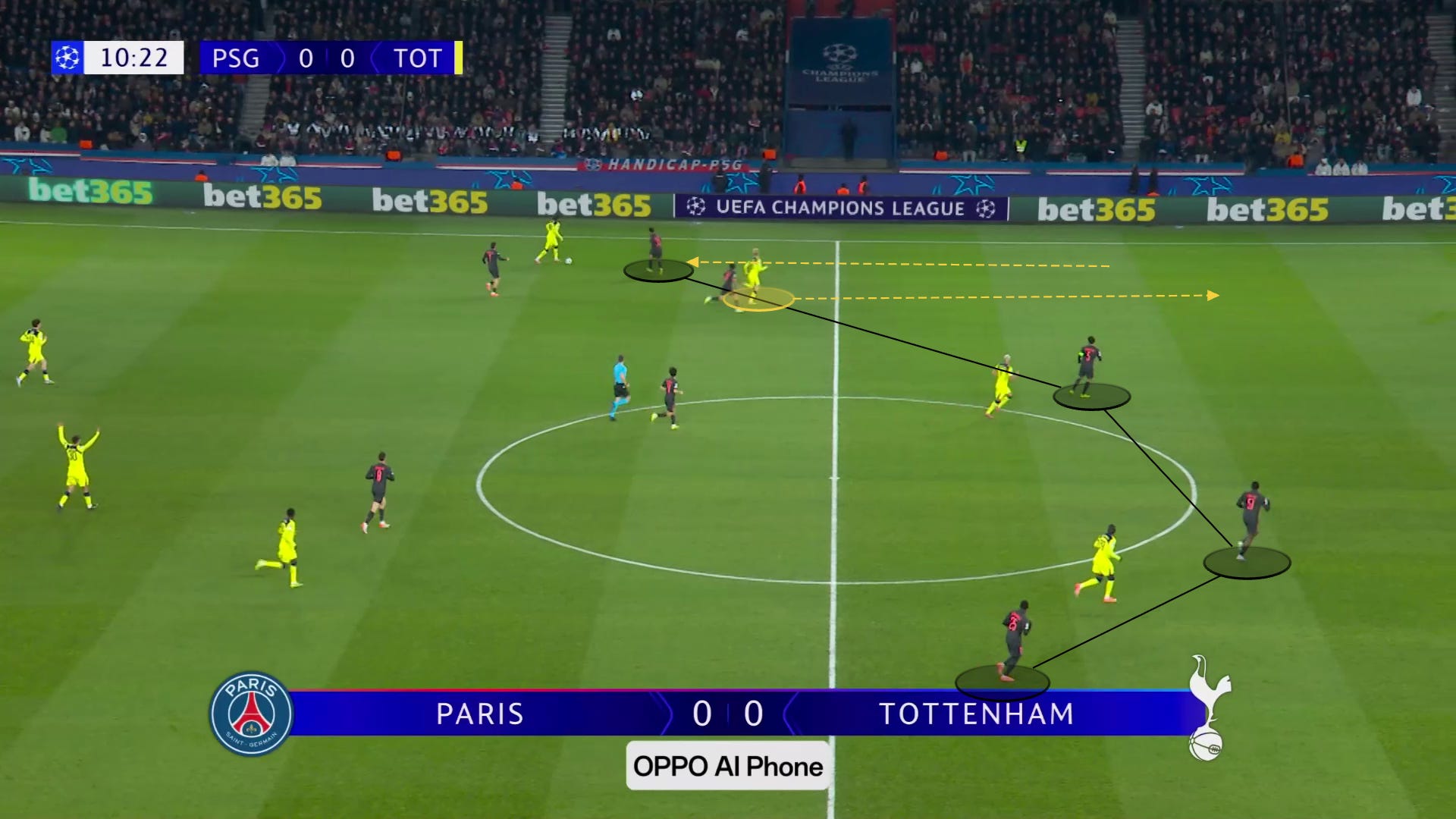
Below, Davies is following Doué, but he’s a left-back. Is he willing to follow him completely across the pitch? No, that’s too risky. So he hands him off to the middle and keeps his spot.
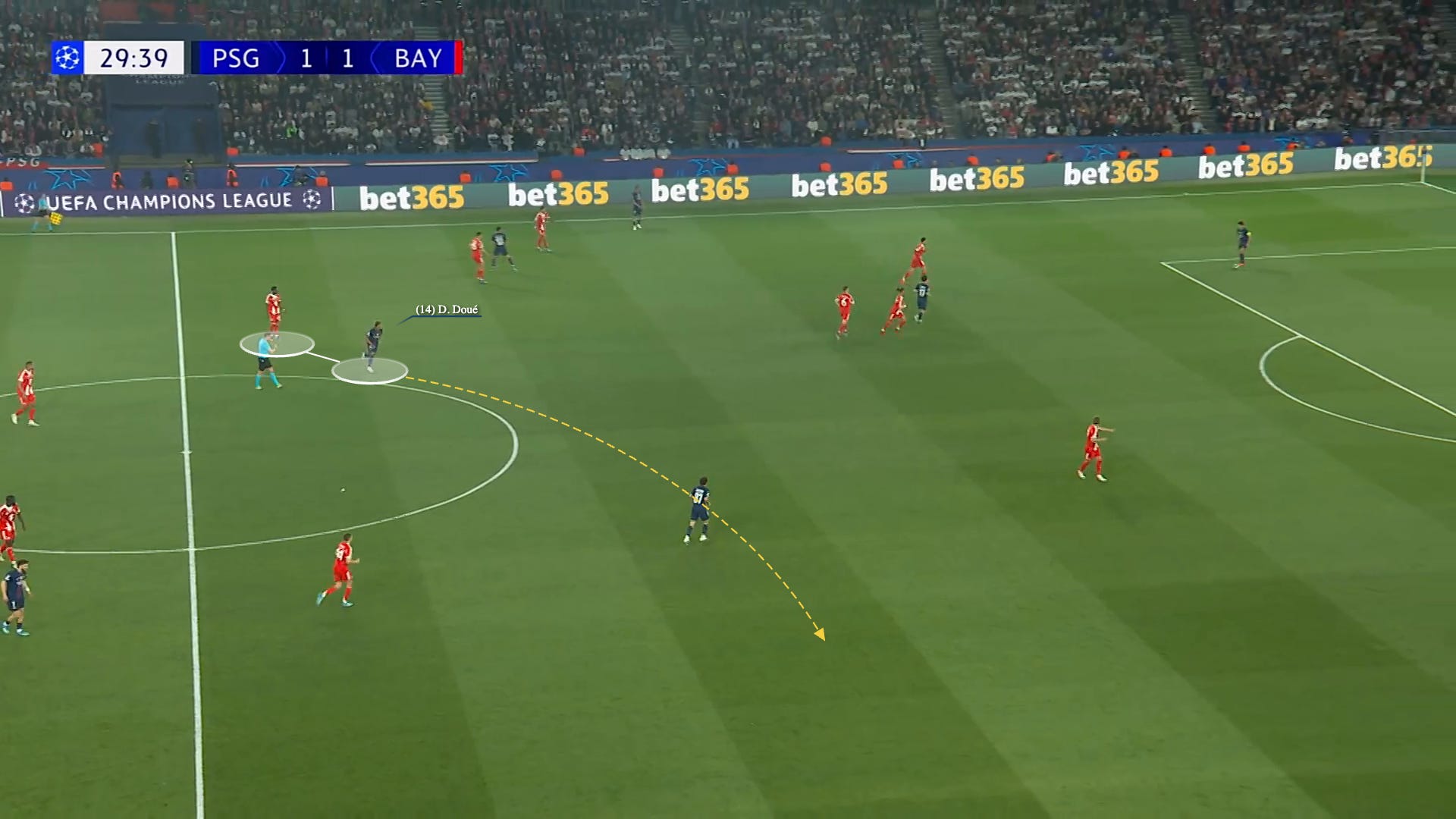
But that creates a moment when Pavlović can either leave Doué free or leave Neves free. Pavlović pushes up, Doué is free, and the press is broken.
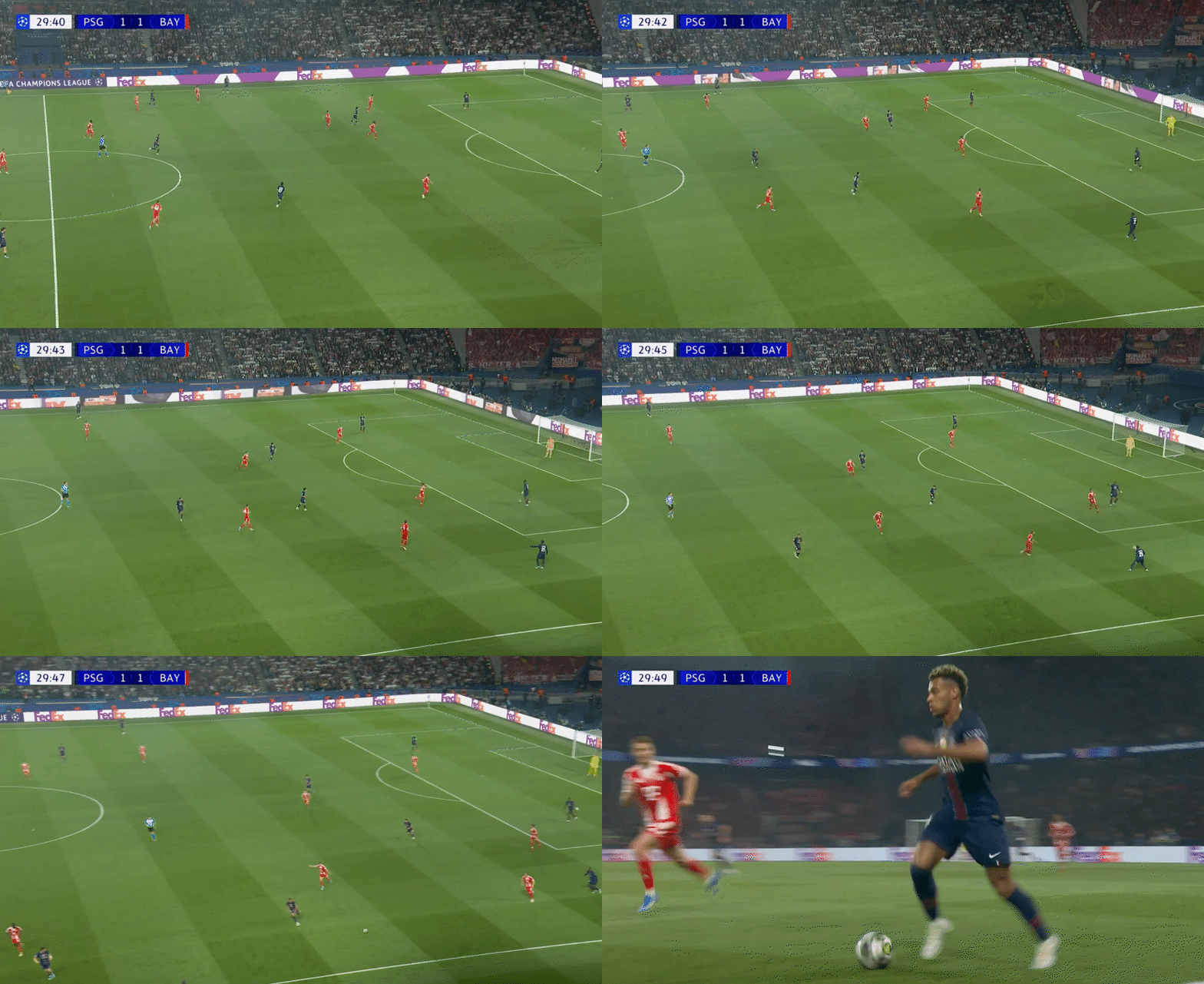
As high-pressing-slash-bold as Arsenal will look to be, you can’t get caught in the middle: you either have to commit to going truly man-to-man in a situation like that, or, if not, give priority to the player behind the backs of the midfield. The backline and the double-pivot can’t allow Dembélé and Doué to roam in these spots. Either follow them, or tighten up your pressing distances so you’re closer.
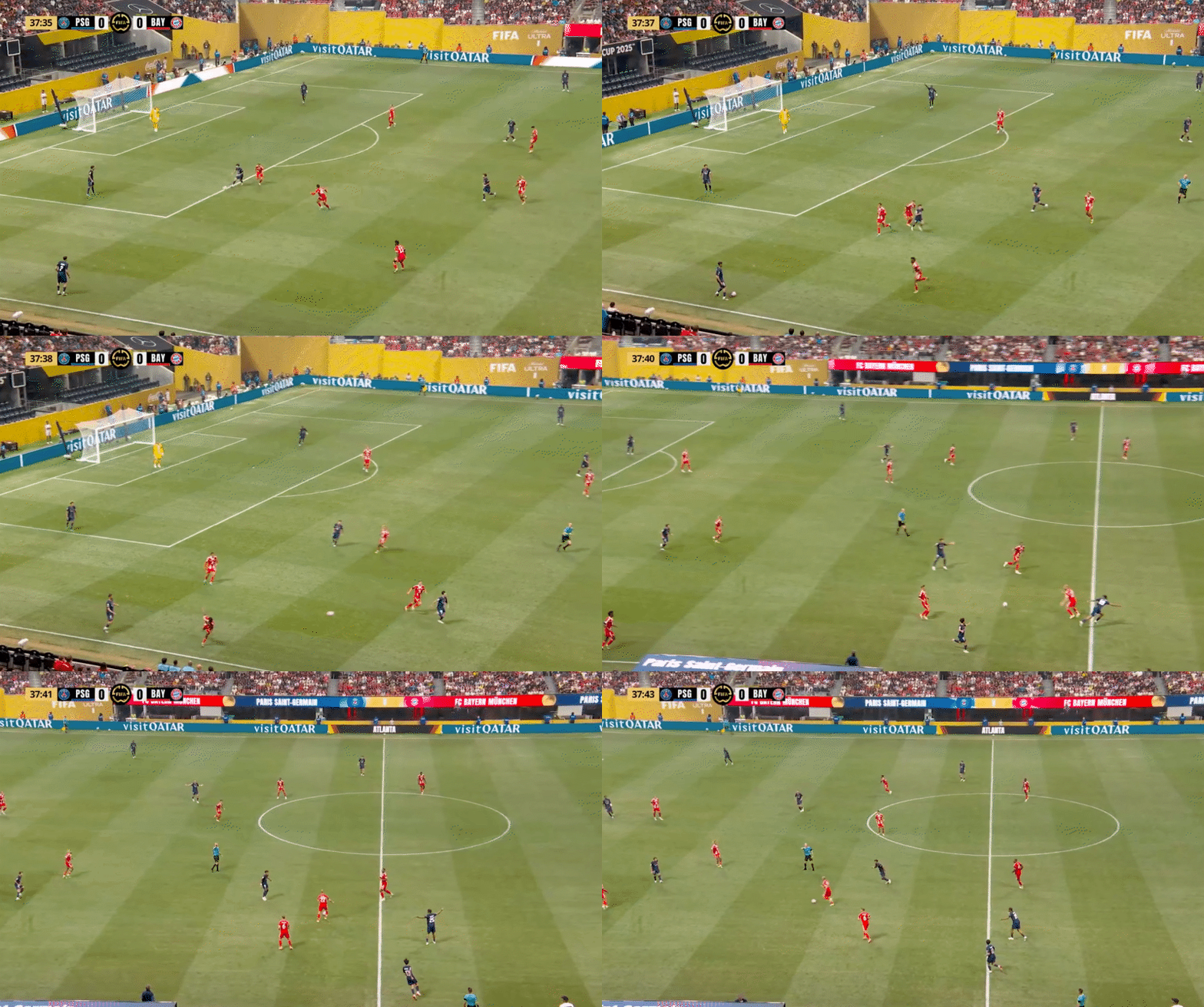
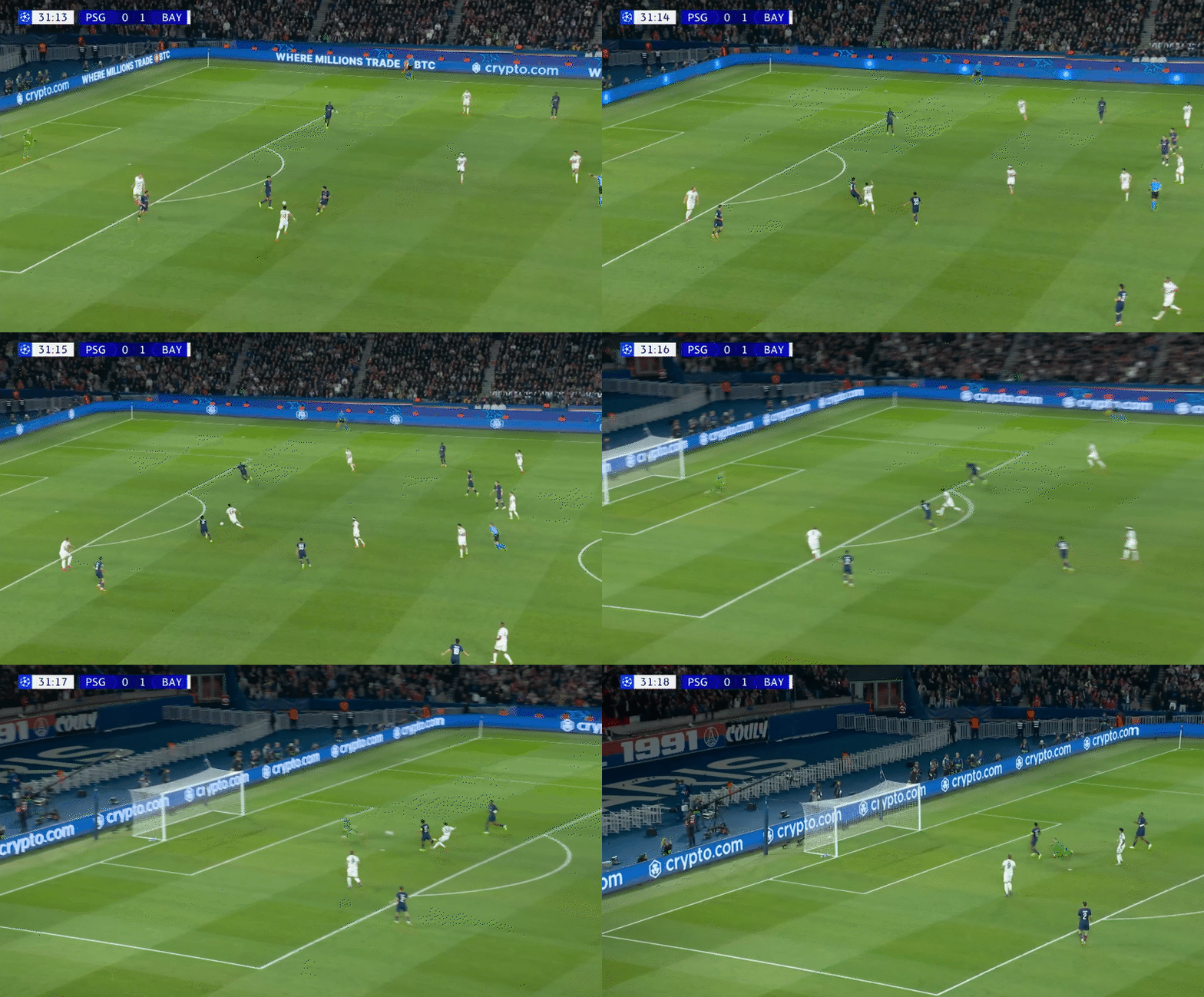
So that’s the challenge. The nice thing is that PSG are not impervious to deep build-up mistakes. This is because they have a few players who are simply pressable. On a raw counting basis, they’ve given up the most chances and goals from errors. To my eyes, it’s often when they build up on the left, and then look to switch the angle of attack to the right.
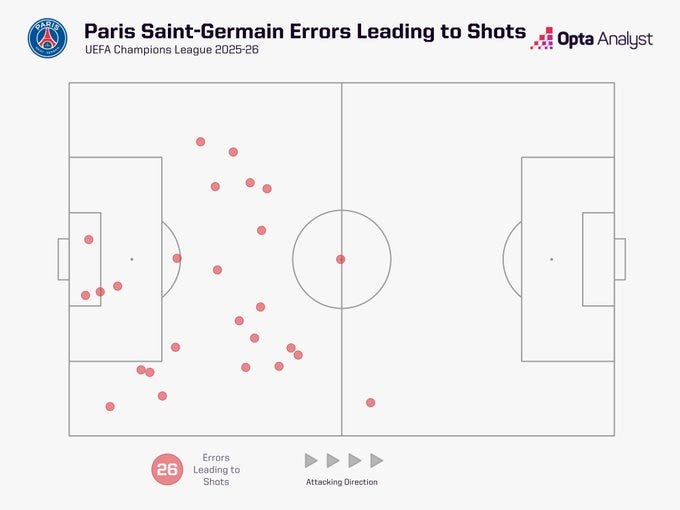
One of the best ways to generate a ball-win is to jump these sprinting underlaps. It is just a constant move by them, as we’ll cover later, and it’s always worth anticipating.
The right (from Safonov to Marquinhos to Hakimi) can also be pressured deep.
👉 Consolidation phase
As things progress into the middle third, here is the most typical look of their build-up shape against a 4-4-2 zonal block. The front-four are completely interchangeable, and they’ll also swap with the midfielders. Because the opponent’s central CB is often left lonely, the free man is usually the far-side winger, by design.
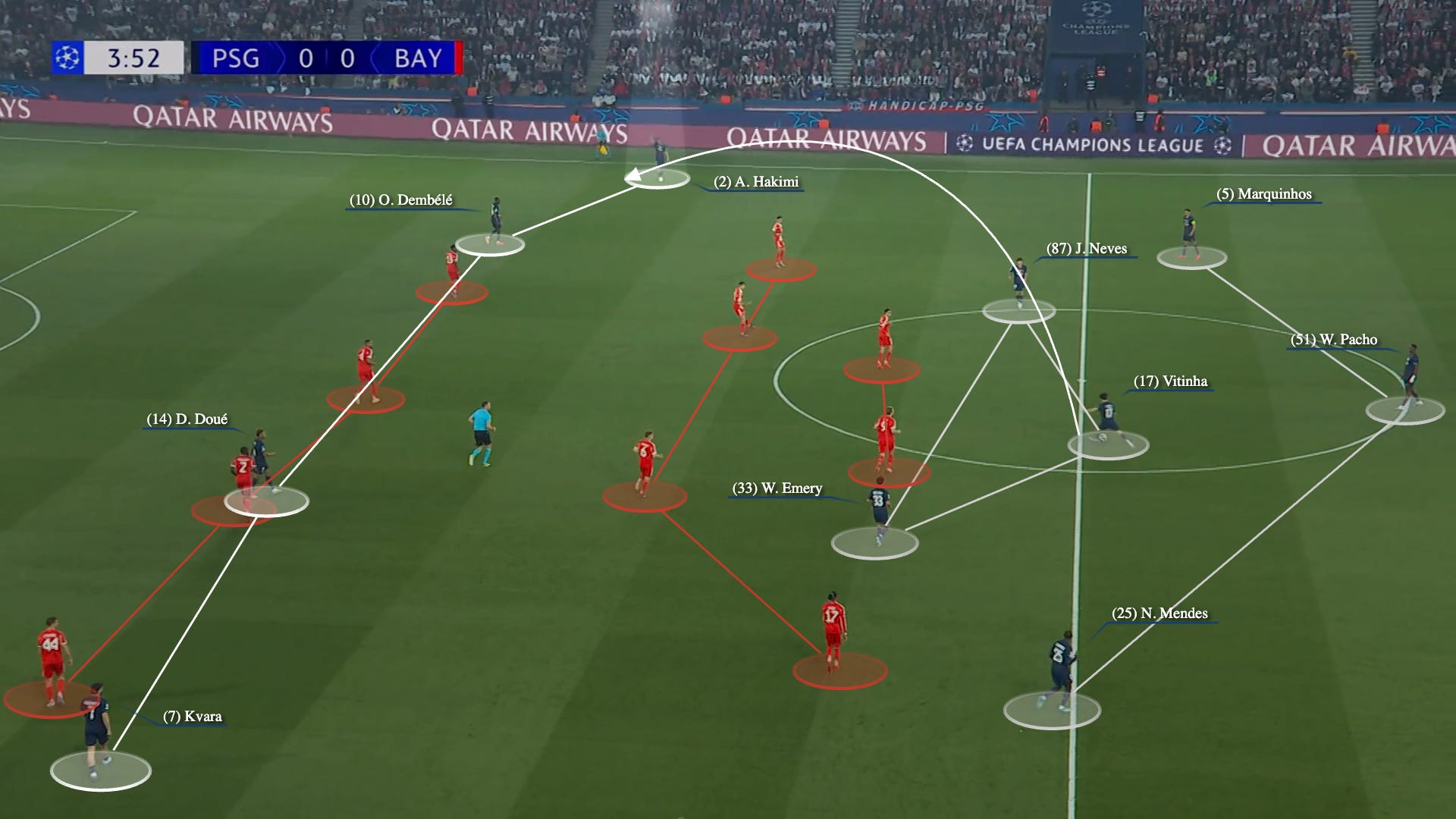
Hakimi is almost always high in those situations.
But Mendes can join the frontline as well. In those cases (more often than you think, even against good competition), Vitinha backfills the role of wide-CB and the shape continues. Vitinha drives a lot of tempo from back here.
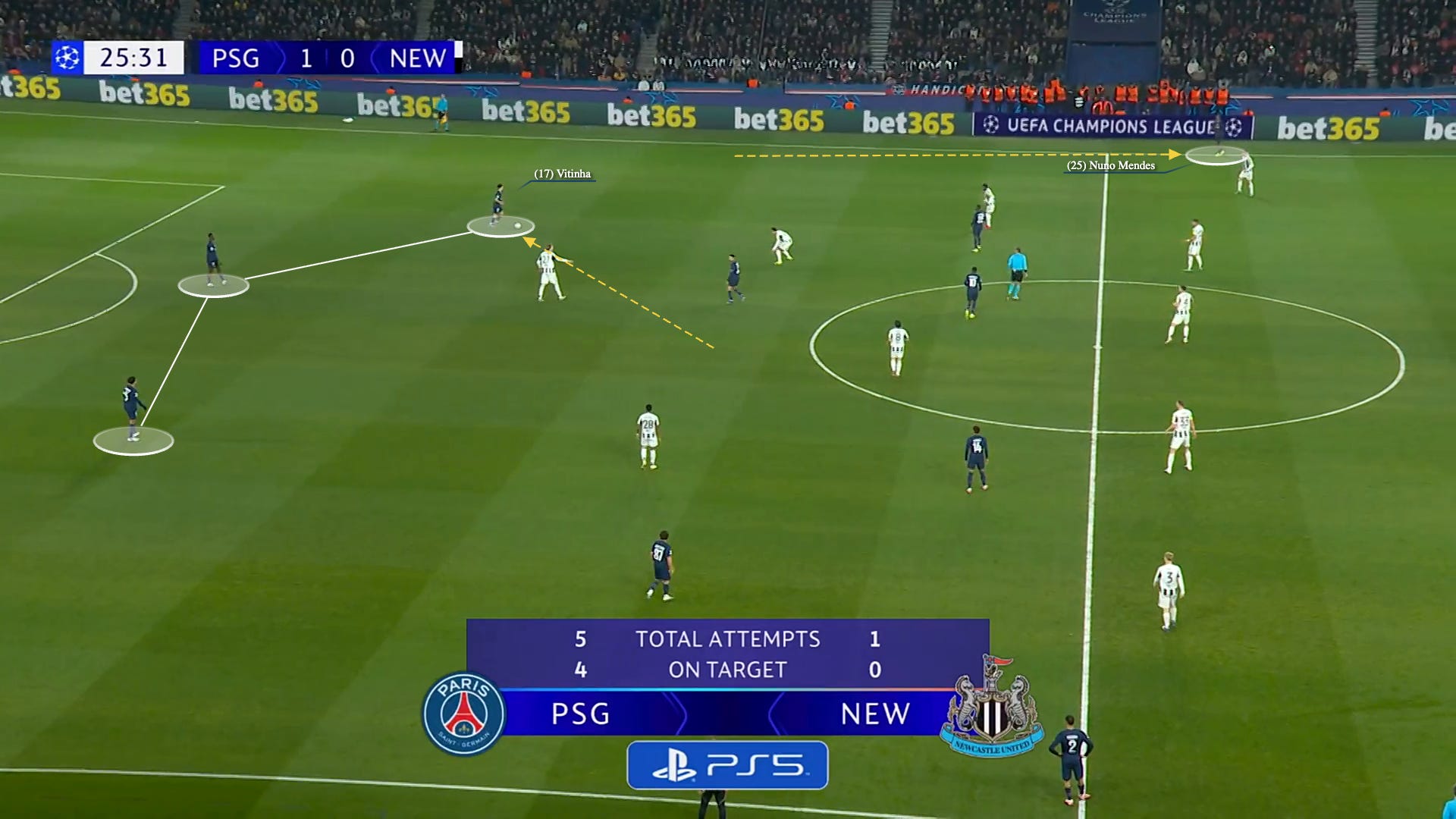
You’ll also see it here, in which PSG seek “double-width” outside.
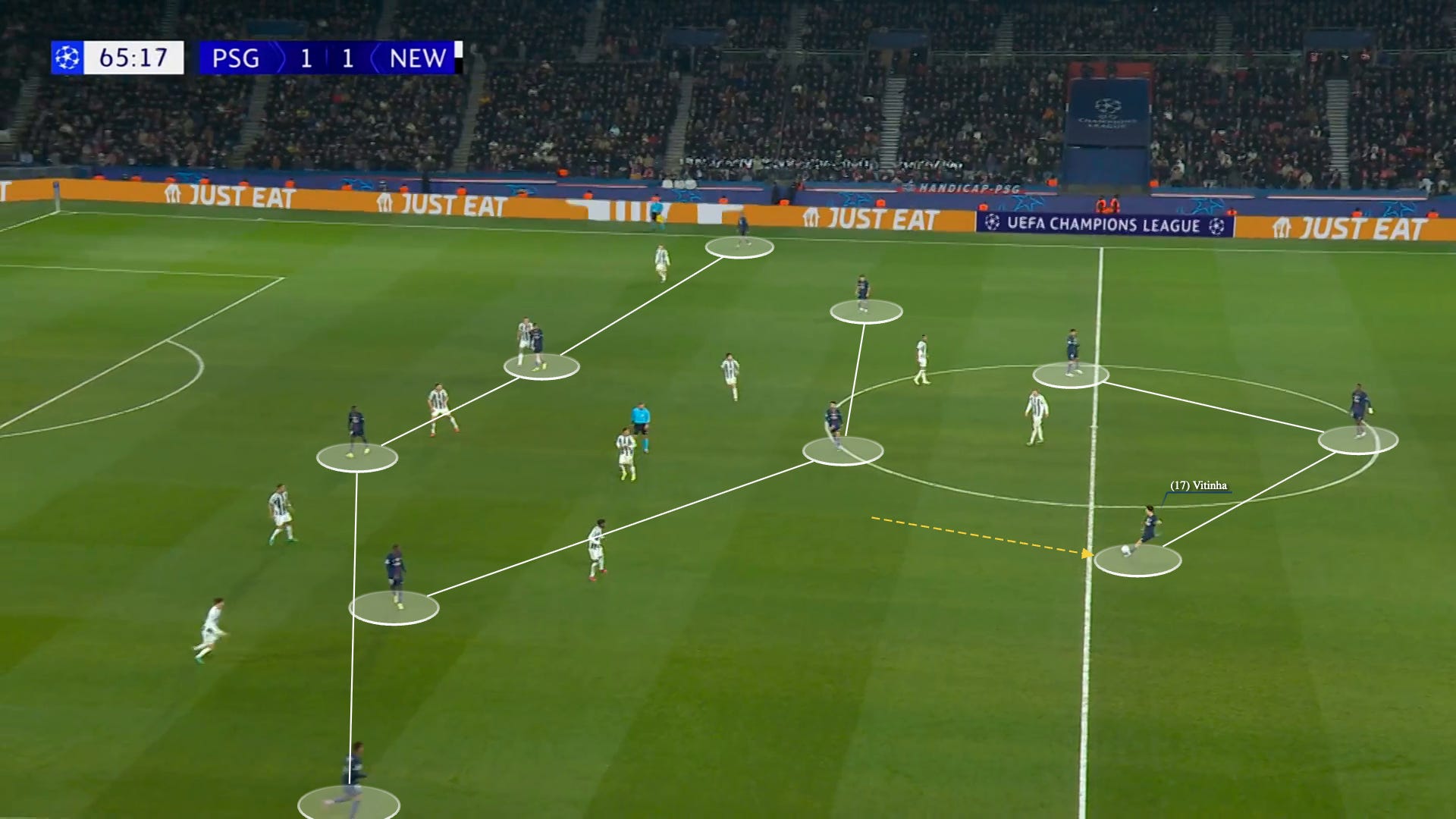
That brings huge, vibrant strengths, but also vulnerabilities on a ball-loss.
👉 The wide double-moves and underlaps
For all the rotations and fluidity, I was surprised by how much the PSG attack seems to be built on a relatively small number of automatisms. So many attacks carry similar characteristics: Vitinha picks up the ball deep, and probes left and right. Two incredible attackers are in close proximity and make opposite movements: one goes behind, while one drops deep. You see it here:
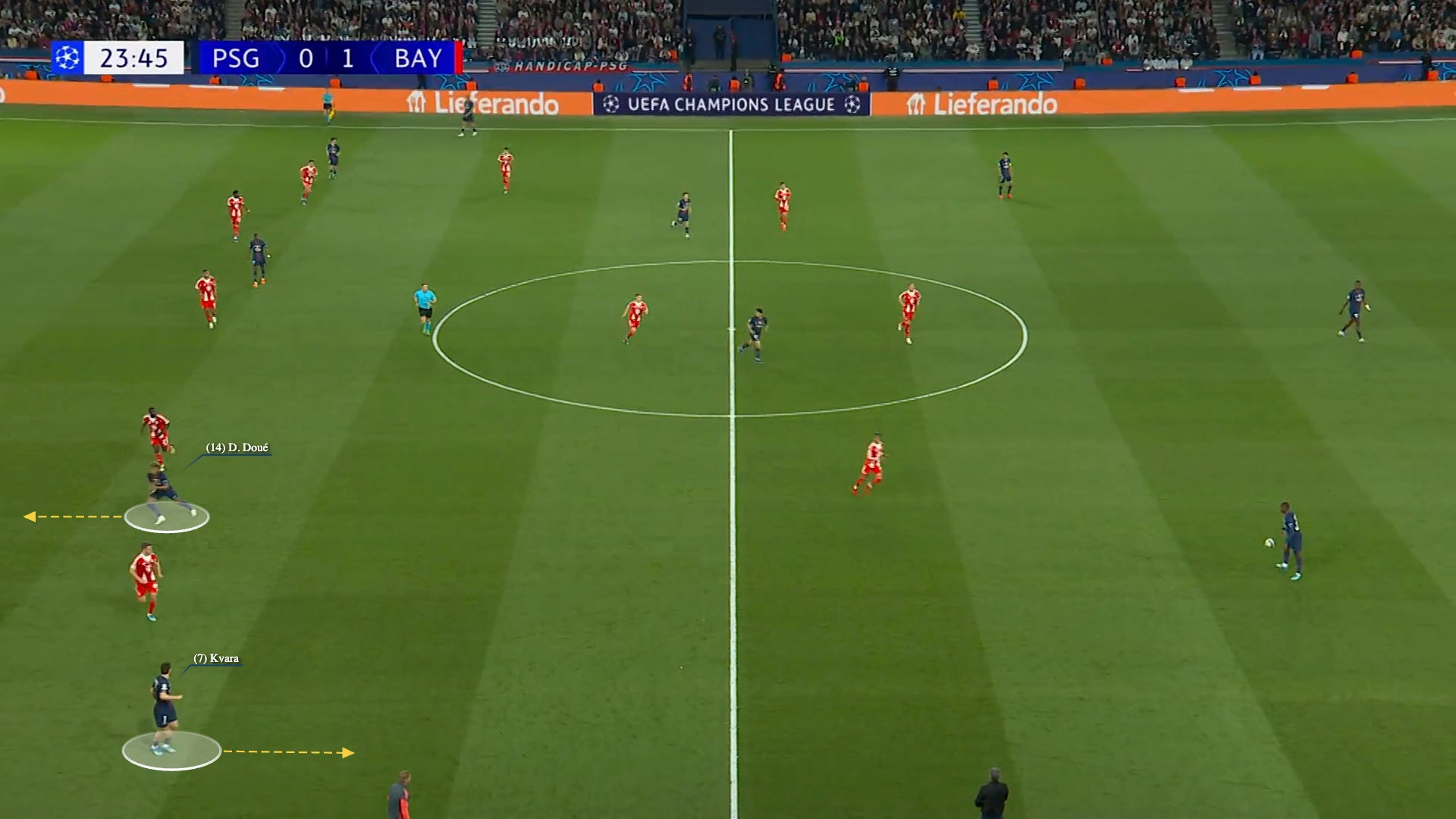
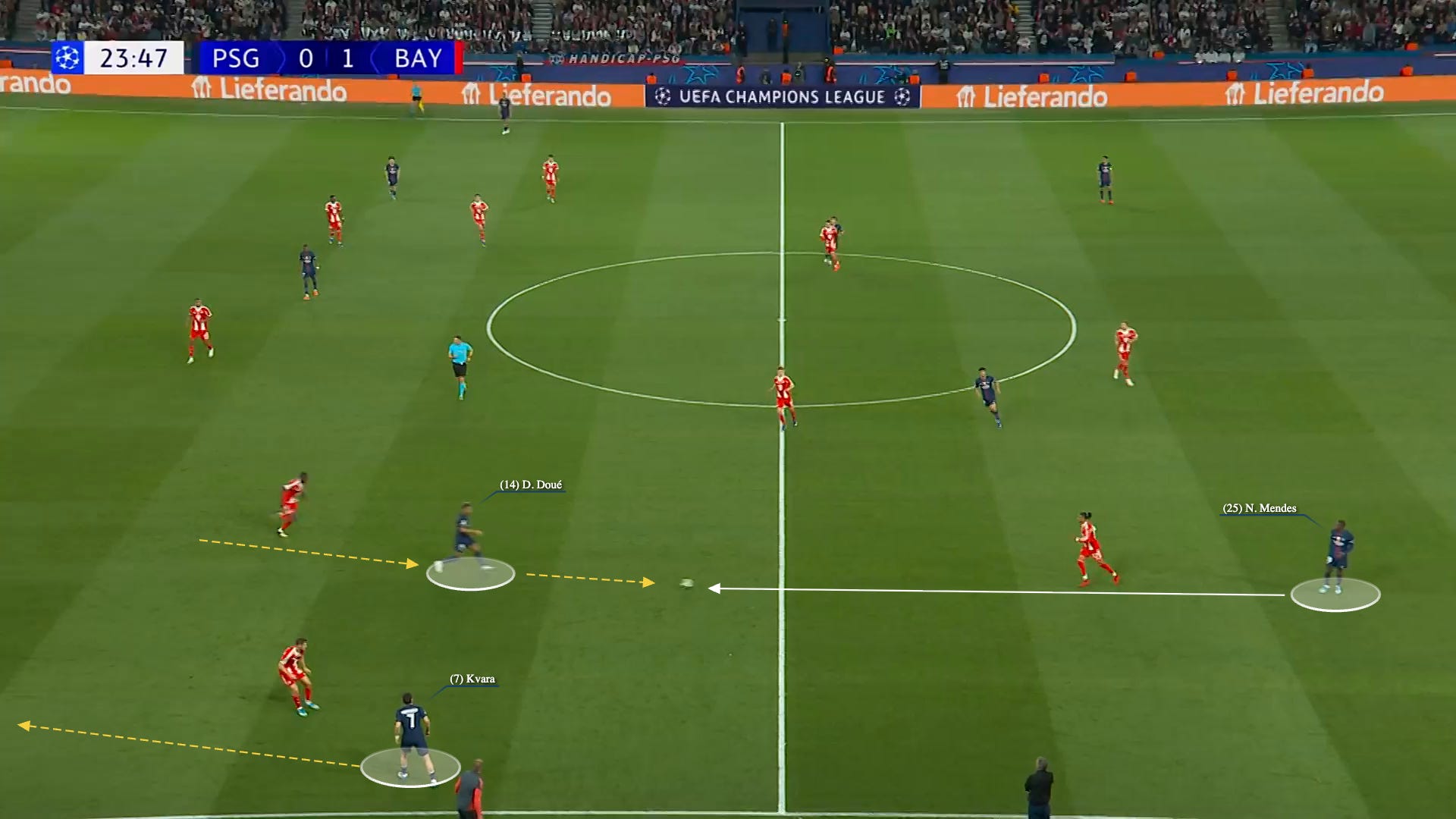
But because the timing wasn’t right, they just switch. Mendes delivers it to a dropping Doué, which means it’s now Kvara’s turn to run in behind.
…and he does, starting the movement for his goal.
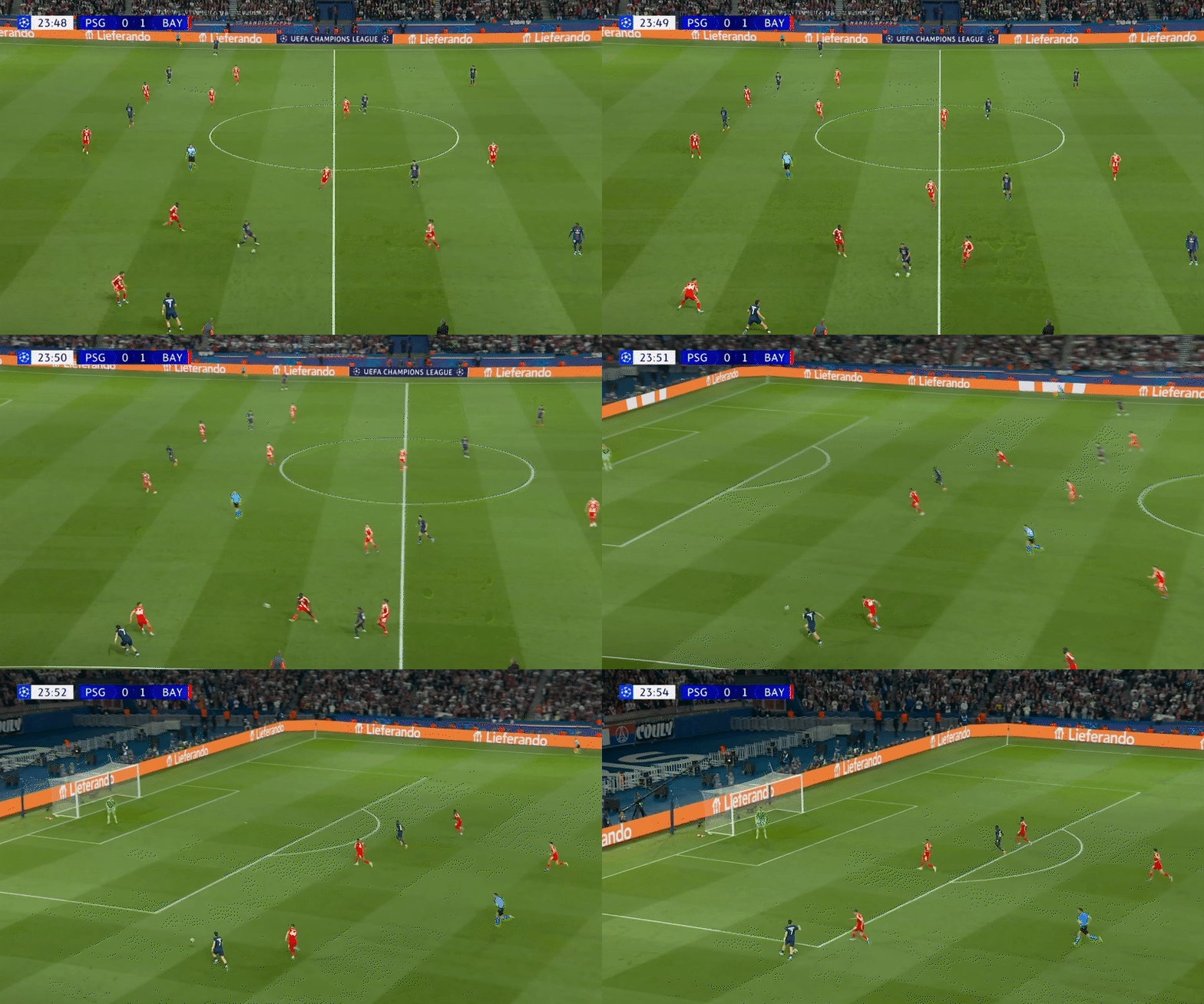
In more advanced areas, we see it even more.
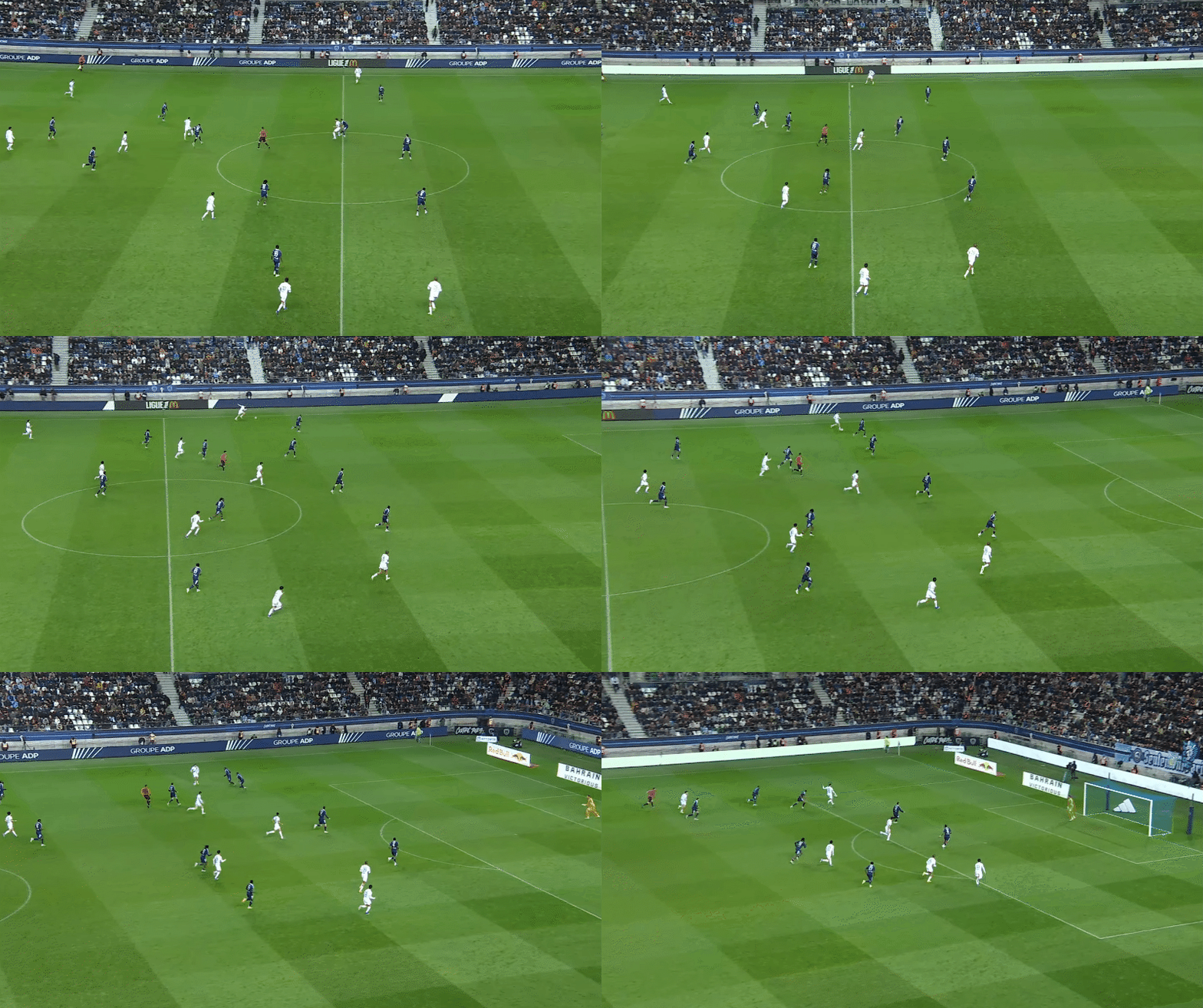
It feels like the entire heart of the PSG attack is based on this: one wide attacker drops, one wide attacker sprints in-behind (often after a give-and-go), and the ball is delivered into space.
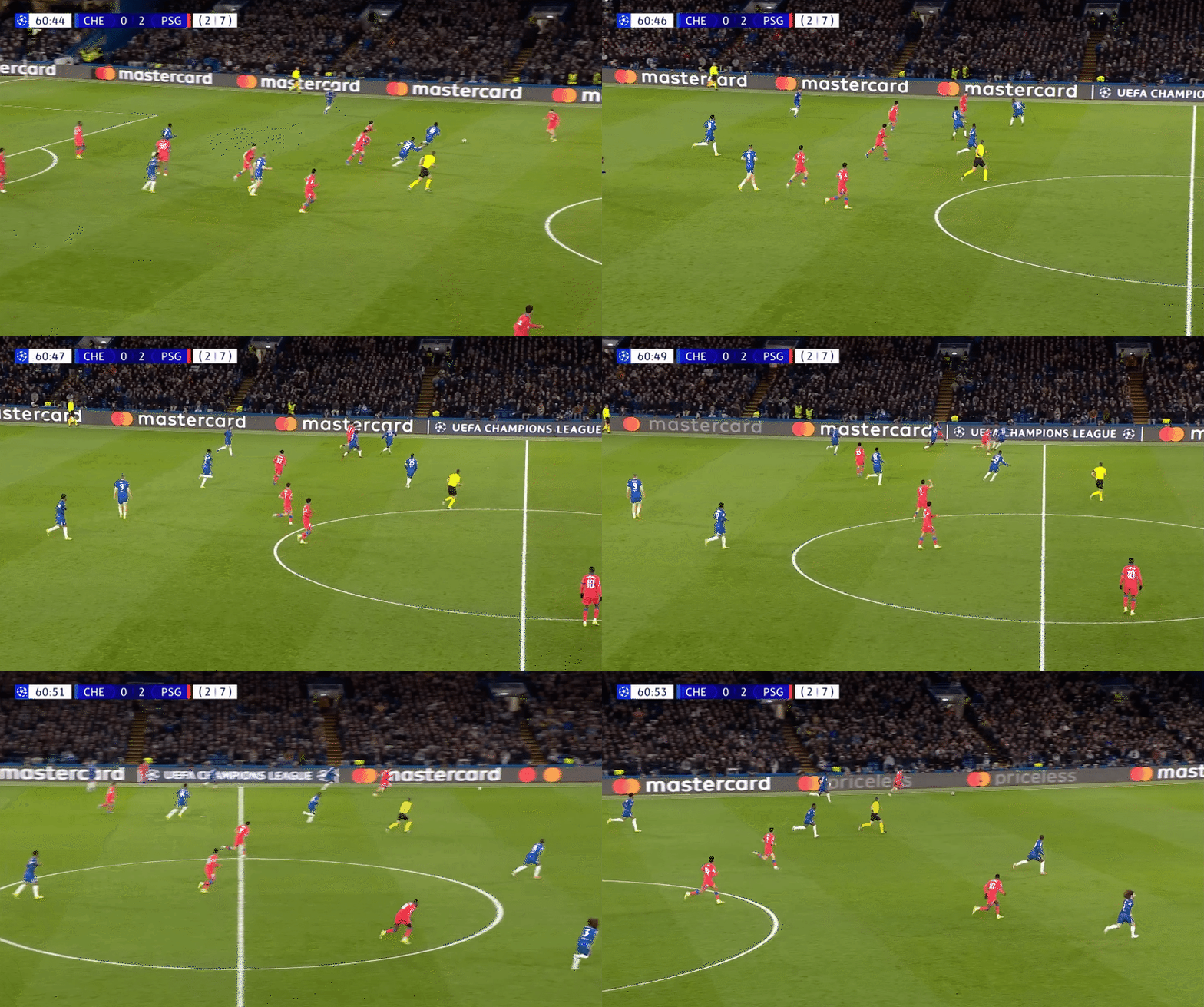
Ahem. One wide attacker drops, one sprints in behind, ball is delivered into space.
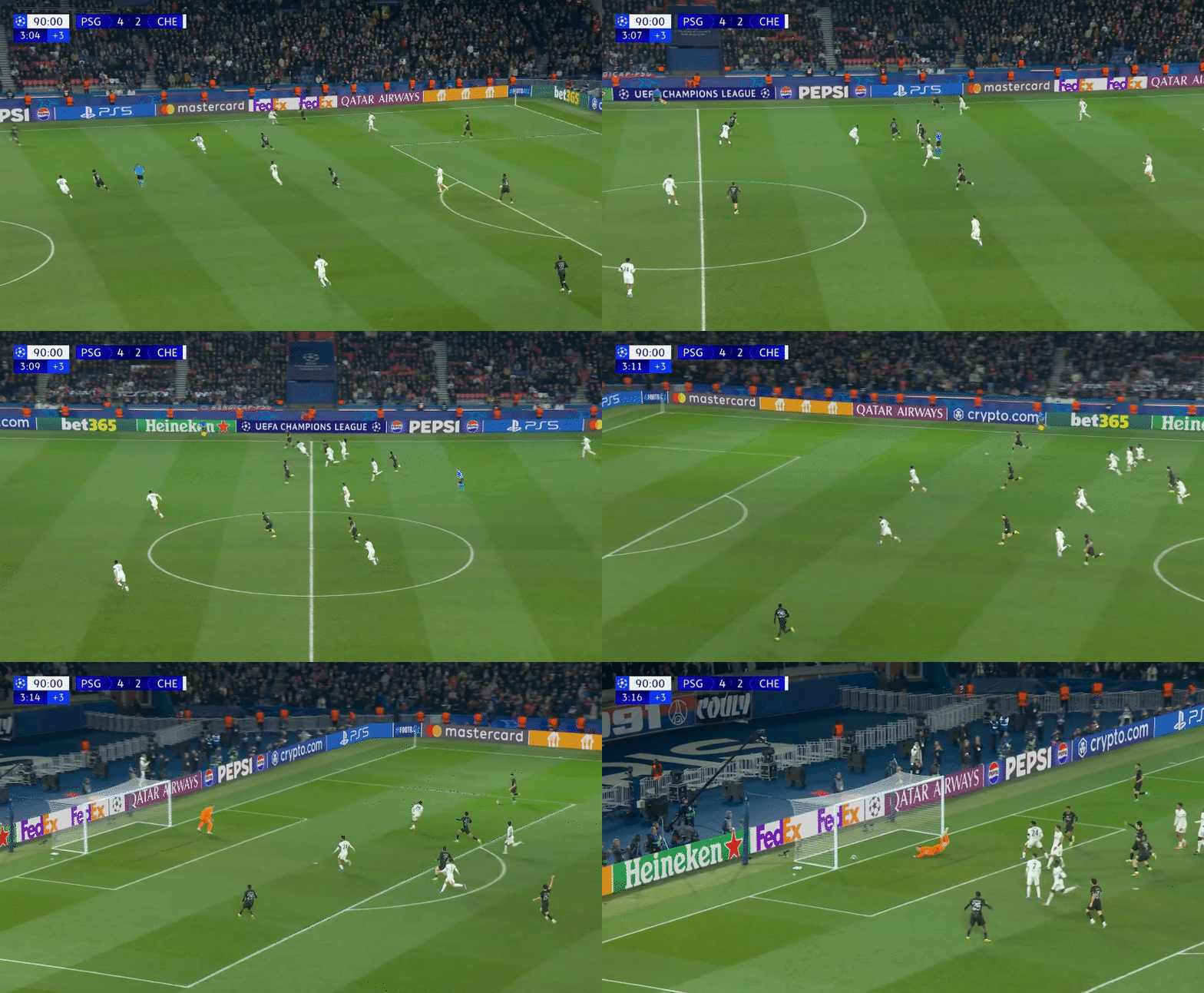
This feels predictable, and that’s because it is. For one, this is just about incredible quality and physical characteristics. For the other, this is about defenders who aren’t anticipating this enough, and are doing a poor job of staying goalside of their marks.
👉 Final third and chance creation
In the Champions League, PSG have had a lot of the ball, but aren’t always in a rush to push it forward. All their possession doesn’t culminate in an excess number of touches in the box: they have the fifth-most, after Liverpool, Bayern, City, and Inter.
They are often keeping it around here, then recycling the ball, and then rotating endlessly.
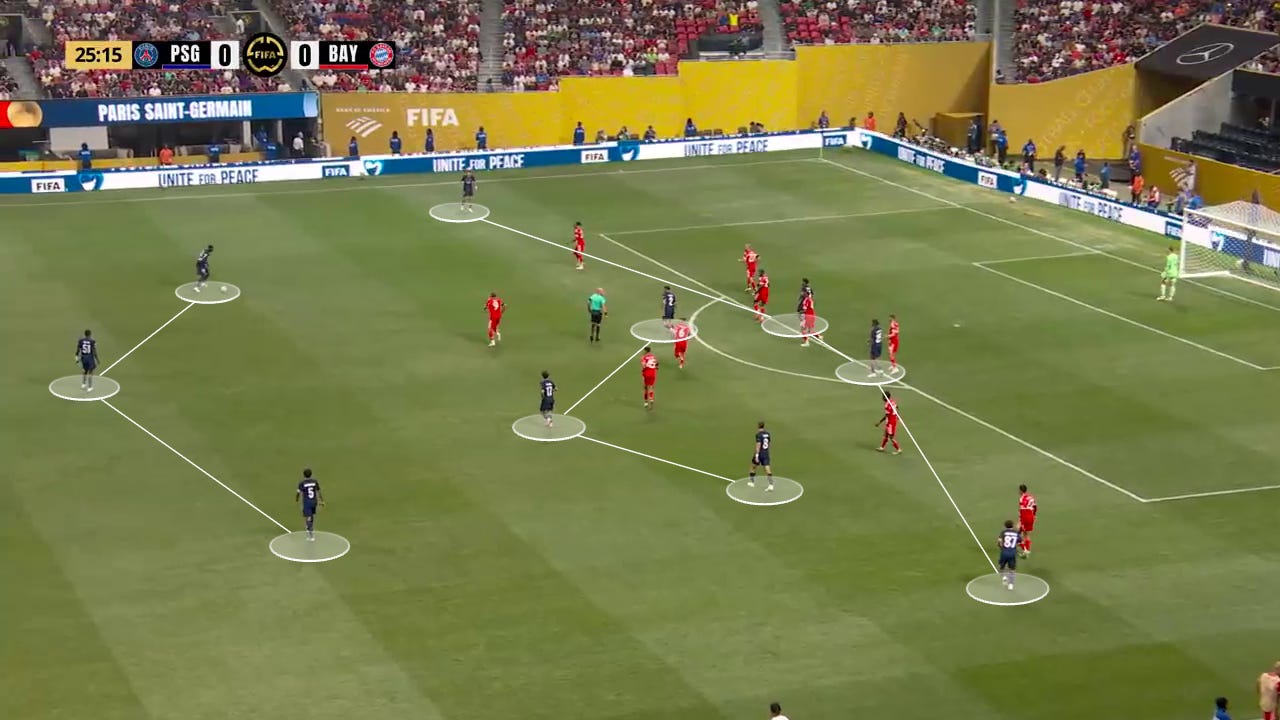
To my eyes, they are better at generating threat when it originates in the middle-third, because they aren’t the most dangerous (or voluminous) crossing team, they don’t have a classic aerial threat in the six-yard box, and they have such dynamic runners and dribblers. They have benefited from a lot of worldies on the edge of the box. I think the backline can step up a little bit to compress space in these situations. An aerial goal could happen, but it’s less likely than a great strike after Kvara, Doué, or Dembelé made somebody lunge.
👉 Shot profile
On that note. According to Understat, in Ligue 1:
PSG underperform in the penalty area (50.14 xG, 46 goals)
PSG overperform outside the penalty area (8.48 xG, 14 goals)
…and especially underperform close to goal (-4.68 on xG in the six-yard box)
Defending this final third play will come down to patience, sound blocking technique, and closing out each attacker in a way that suits their shooting style.
🔵 Out-of-possession vulnerabilities
For this section, I haven’t set out to give an exhaustive or fair synopsis of their shape and philosophy. Instead, I went probing for vulnerabilities. They weren’t impossible to find. In the Champions League to date, Arsenal have given up 6 goals, while PSG have given up 22.
👉 Press
PSG are about as man-to-man as one could possibly fathom, and it works: they score the most goals off high turnovers in the Champions League.
This is a typical look for them, with each player doggedly following their mark wherever they go.
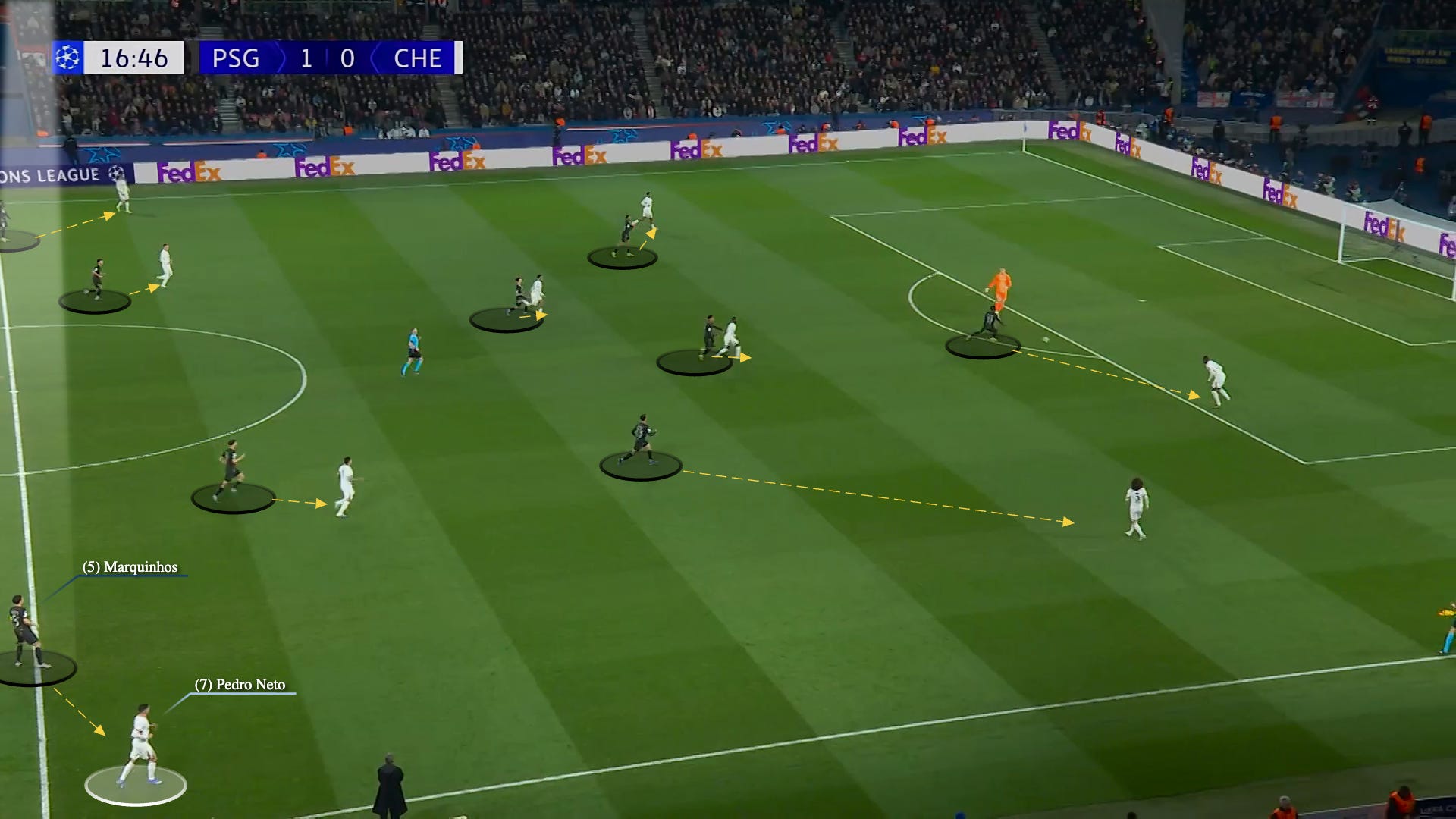
You will also see susceptibility in that shape. With Cucurella further down, and somebody occupying both Vitinha and Pacho, Marquinhos has to swing out to mark Pedro Neto.
What happens next is fairly expected.
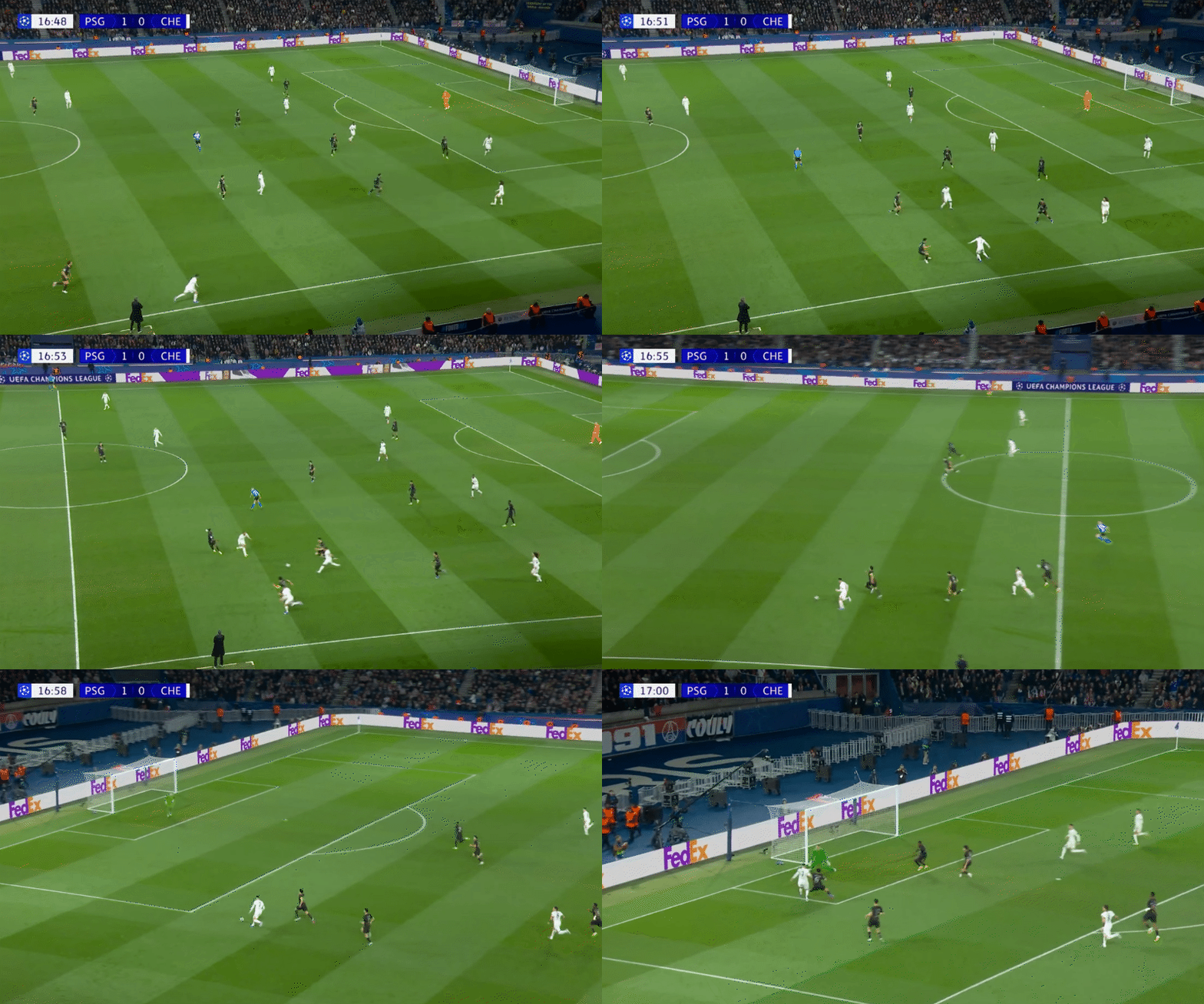
Some version of this image (the 32-year-old Marquinhos pushing up, forced to track a snappy winger on the halfway line) happens in almost every game he plays.
👉 Defending in the middle and defensive thirds
Even in their own third, PSG usually turn to a high-octane style of defending, which basically resembles pressing. This is another area to exploit. They did a solid job against Bayern in the second leg, but they simply don’t look as settled or comfortable in these moments. They don’t have a lot of joint experience in that kind of defending.
João Neves is perhaps their best defensive player. And he runs around fixing a lot of things. This can also be used against him: if you’re able to gain his attention, you can create those high-effort moments where he gets dragged around, out of the middle.
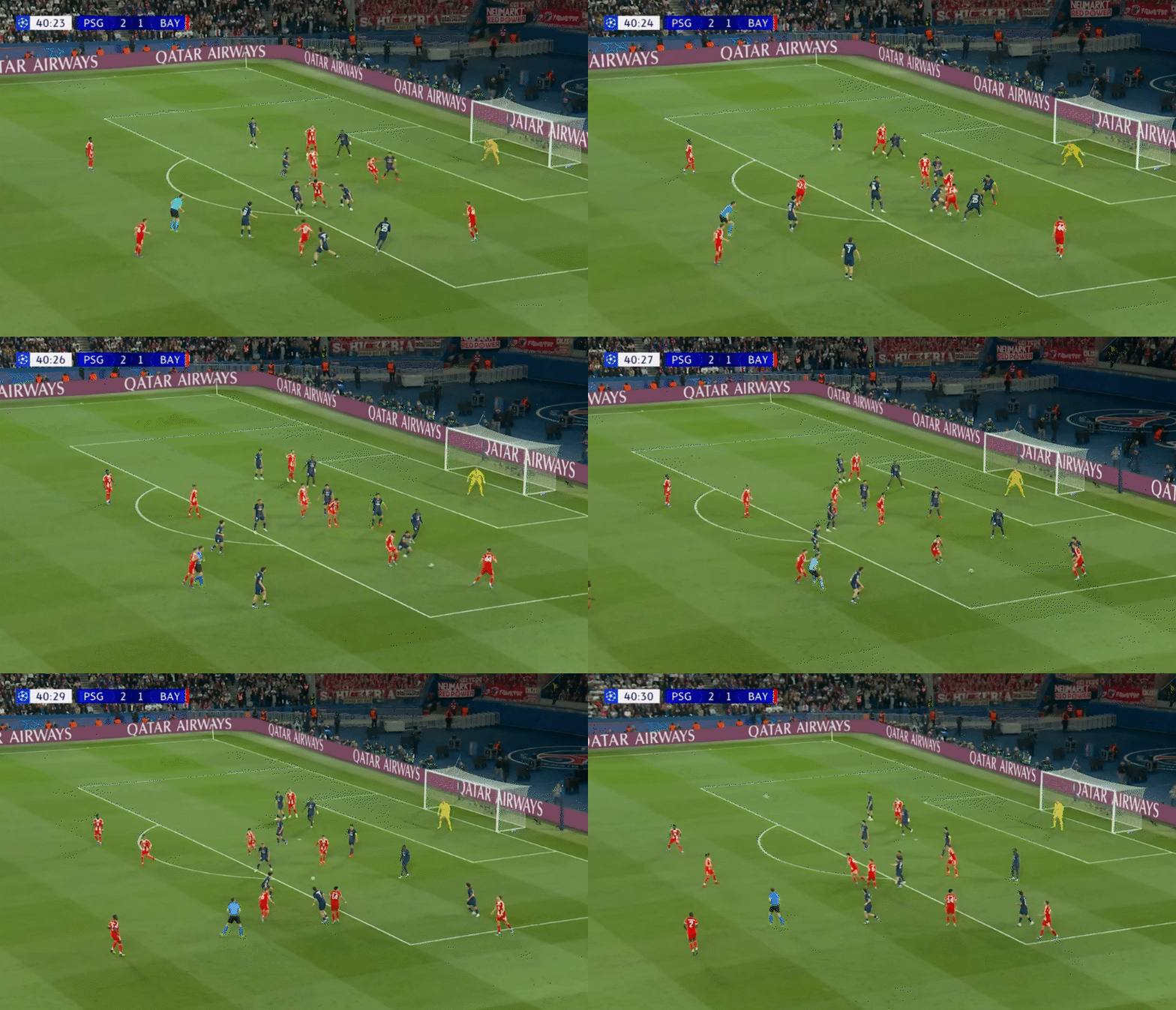
Now, with play reset, the rest of the PSG shape is starting to funnel out toward their marks, and Neves is left deep. Because they all track the ball (and their man) so much, spaces can open up centrally, like this.
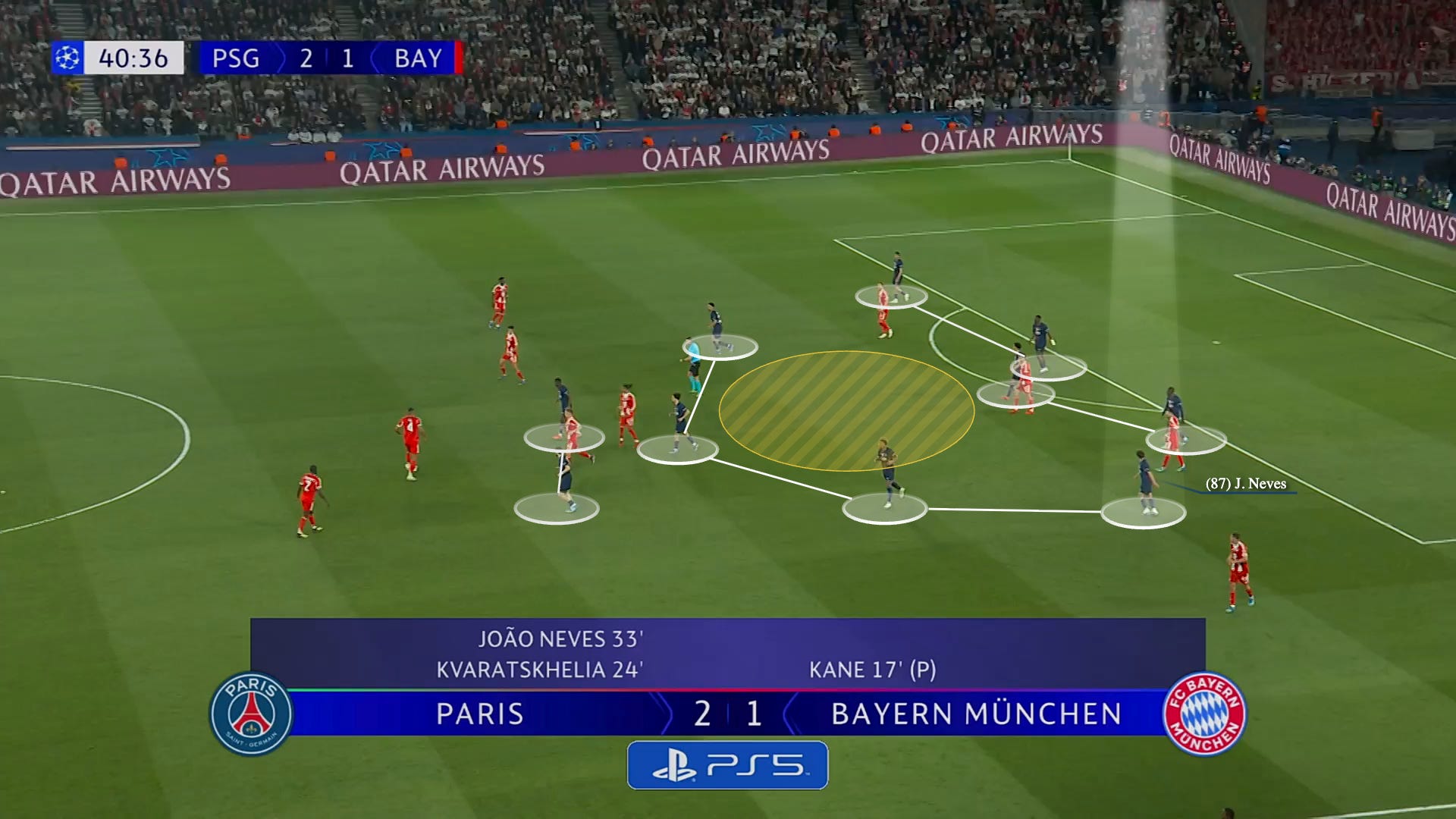
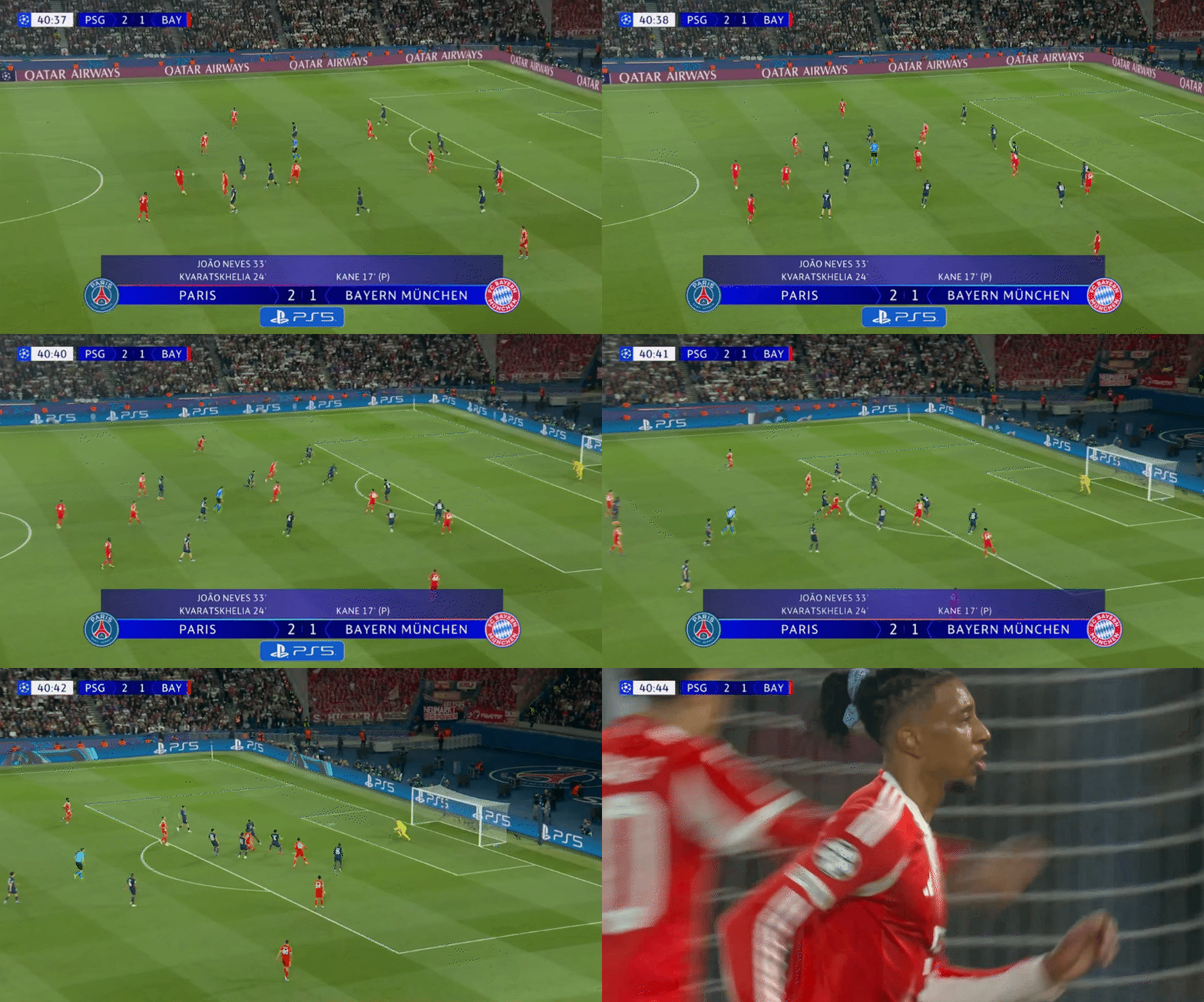
Especially when Neves is out of there, those spots are soft, indeed. The likes of Vitinha and Zaïre-Emery don’t make for the most imposing zone-14 defenders. Here, Olise notices and drifts behind.
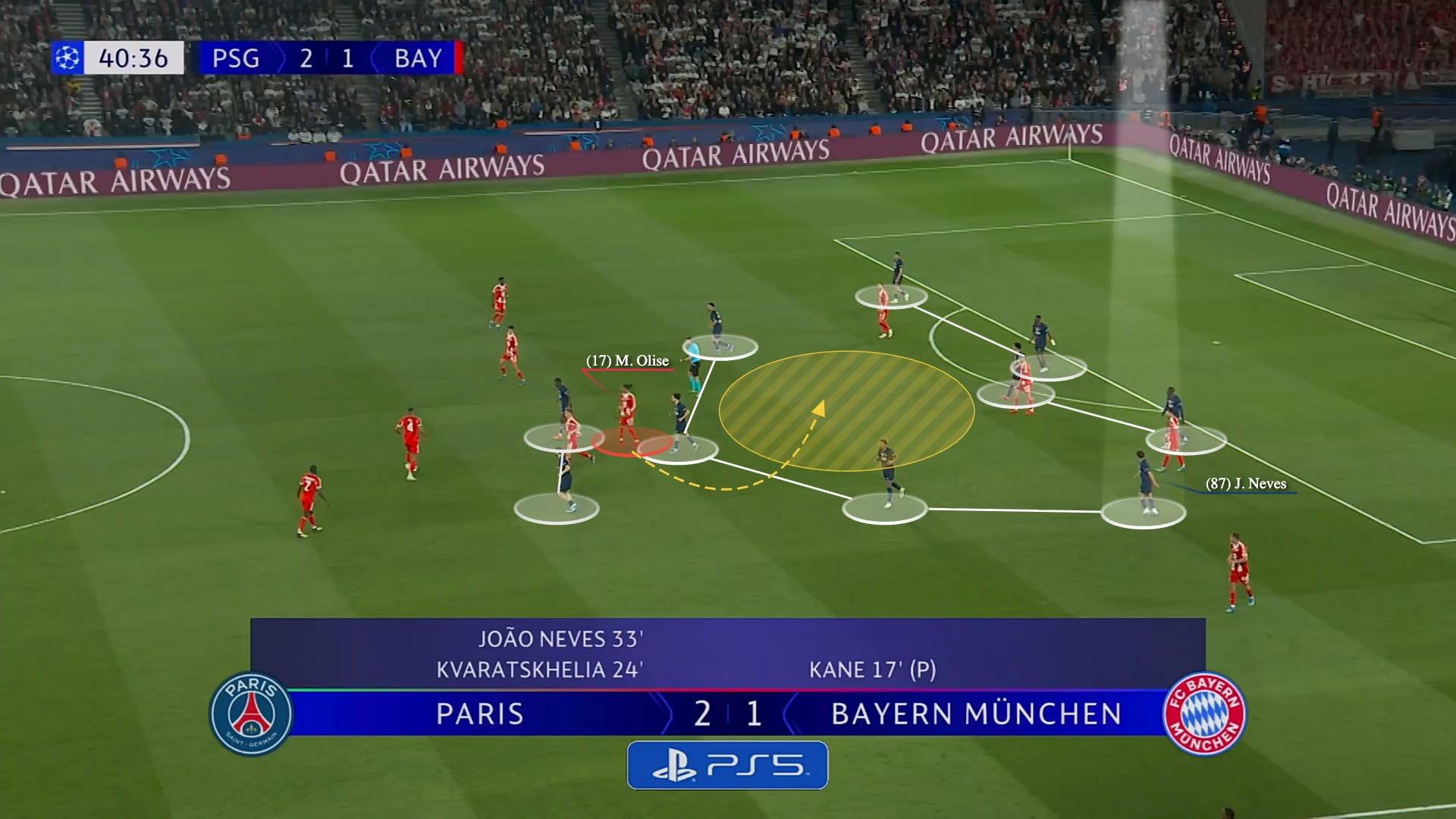
With that space open, and Neves too far to disrupt the play, Olise scores.
They are also susceptible to the same attacking moves they’ve perfected. One of the best ways to get past them is through timed underlaps, dragging a midfielder (who is usually playing high anyway) all the way through the channel. If nothing else, this again clears out the middle.
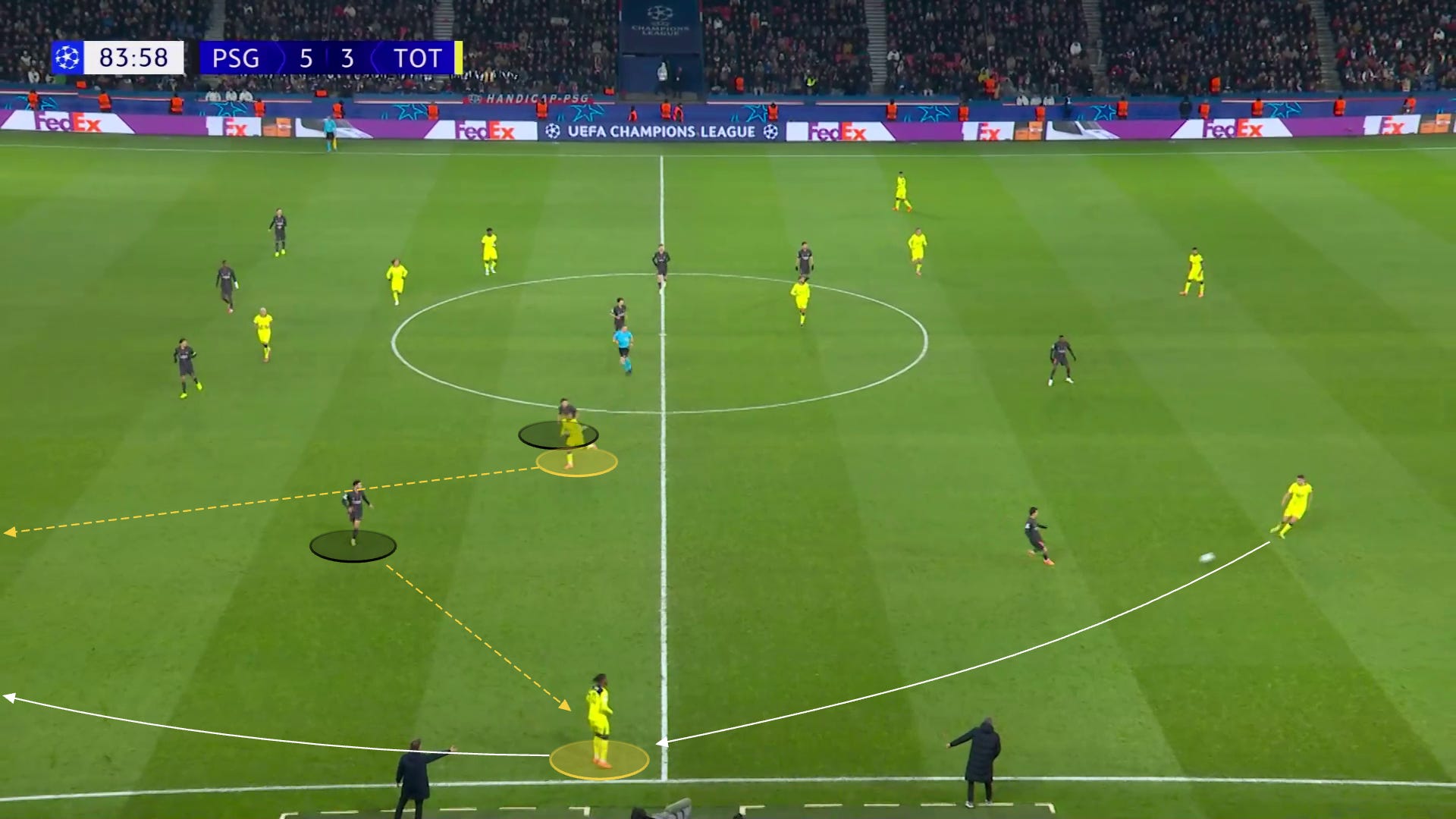
Bah gawd, that’s Calafiori’s music.
👉 Central carries and duels
PSG do a good job with energy and bumps, so they aren’t always open for business in the middle. But the secret to beating any man-to-man press is to have your … man … beat their … man. This starts a domino effect where others have to cover, and somebody is inevitably found open. Rice found that last season.
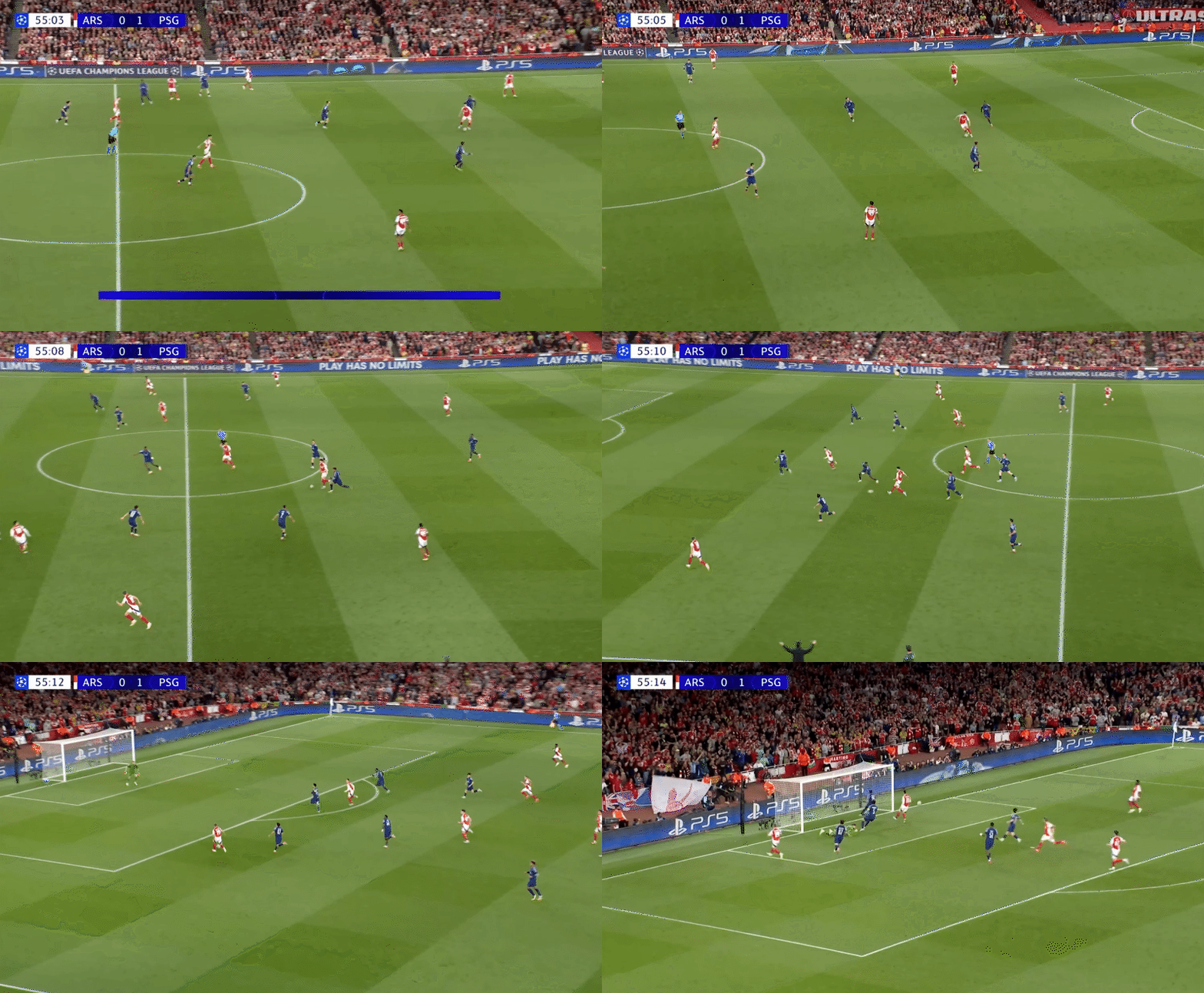
…and Lewis-Skelly did, too.
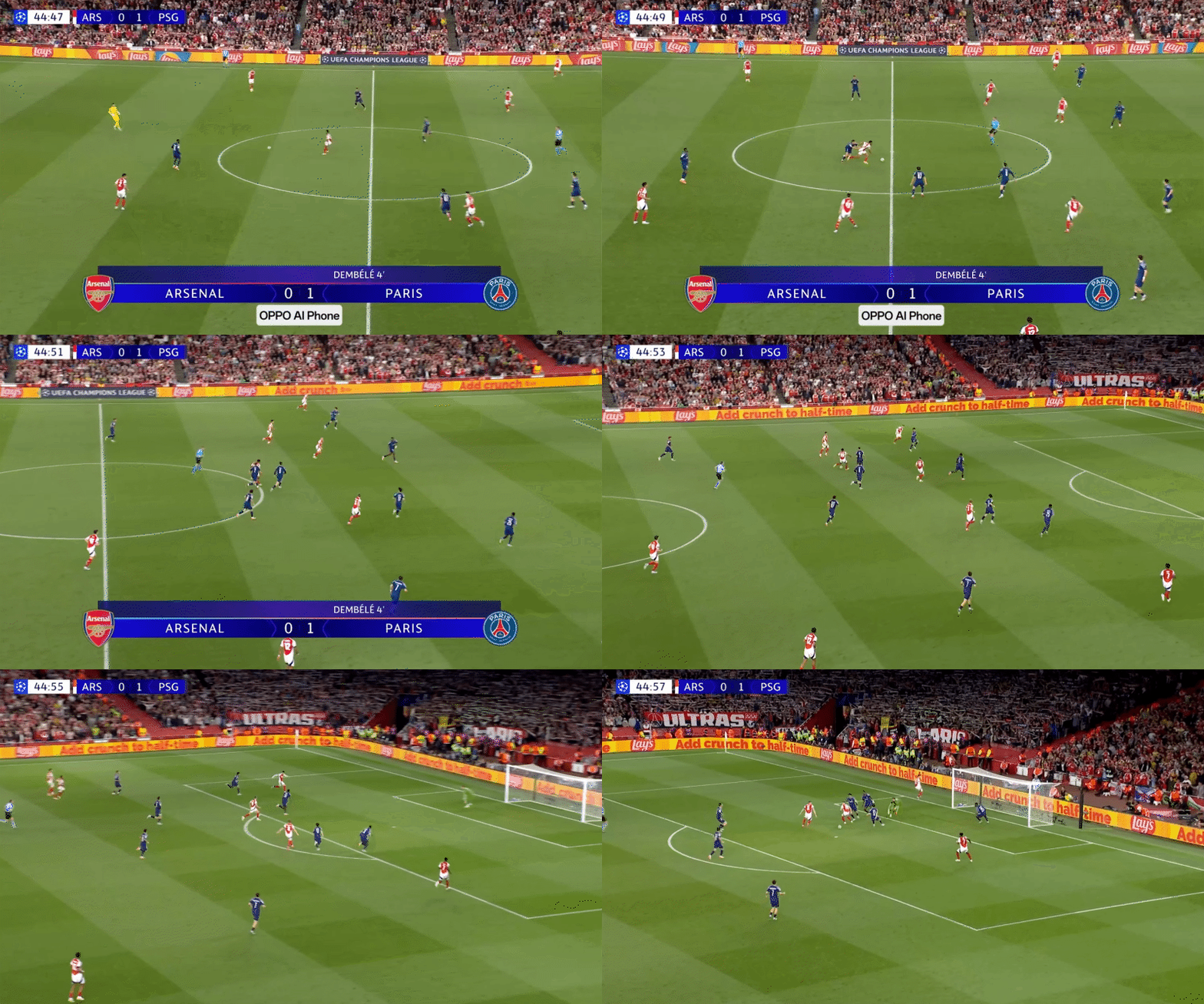
👉 Rest shape, defensive transition and counterpress
But their biggest vulnerability, by far, by far, by far, is how they attack. The positioning of the midfielders is usually quite high, and Mendes and Hakimi are often out wide, unconcerned with squeezing the middle in case of a ball loss. They don’t lose the ball often, but when they do, they look wide open.
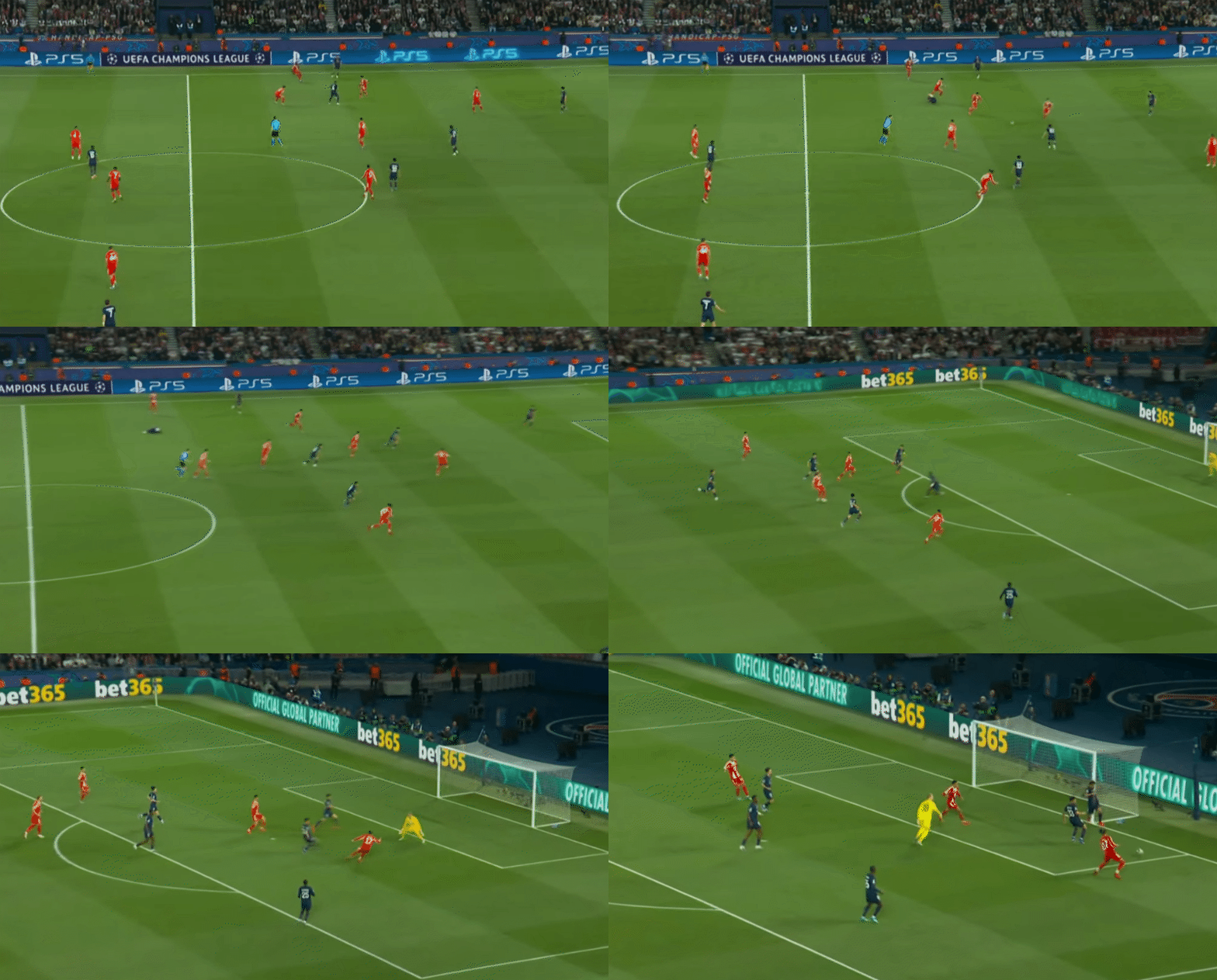
One of the most hopeful moments is when Mendes is overambitious and dispossessed. Because the other full-back, Hakimi, is always flying on the touchline, the transitional coverage is Vitinha (often wide) and the two CBs, with midfielders far ahead of the play. On a tackle, a good first glance for a pass is always the spot that the opponent just vacated.
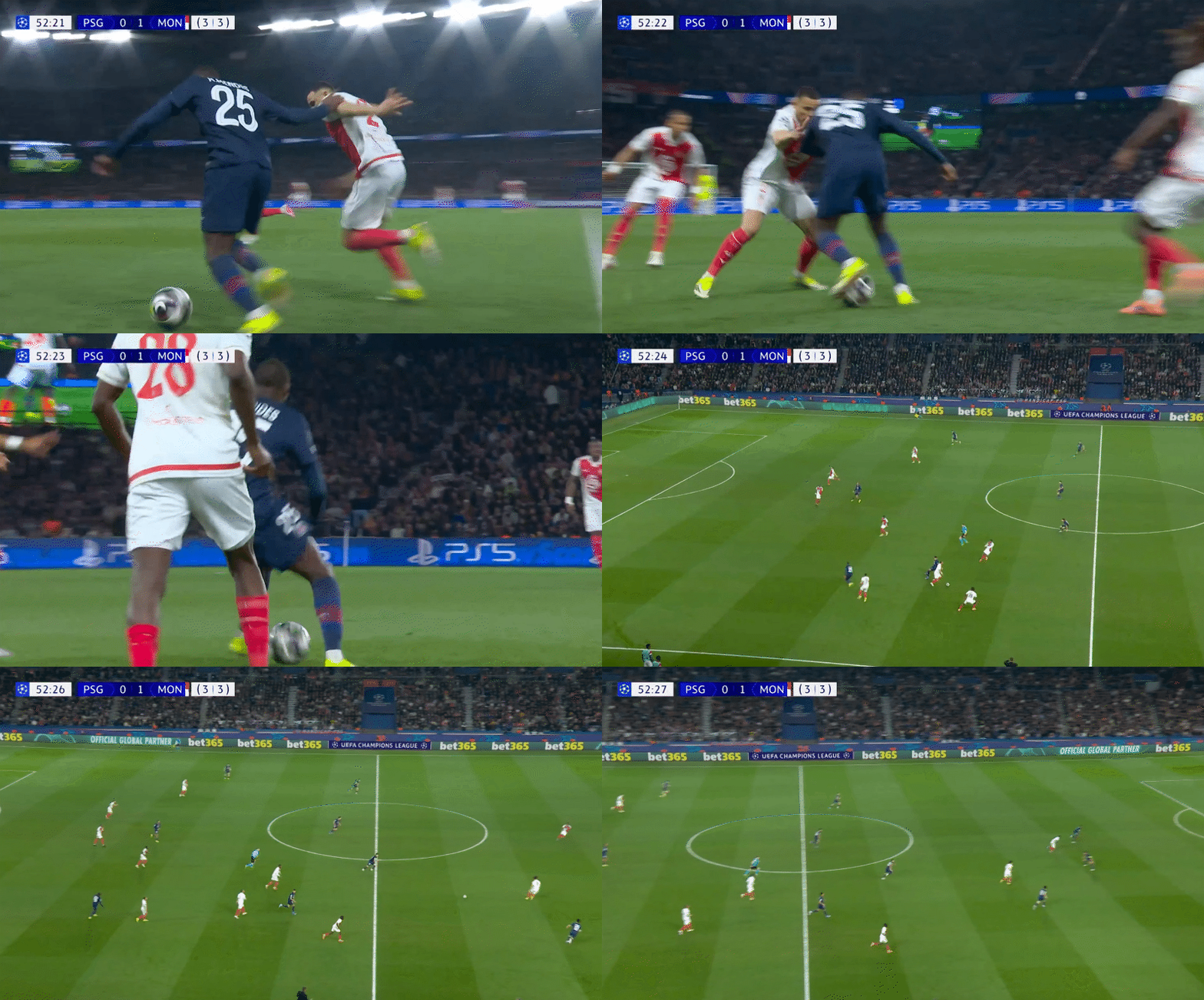
If Mendes hasn’t pushed too high, that space is almost always at their right-back. The imperative is to counter that way and send multiple runners if you can.
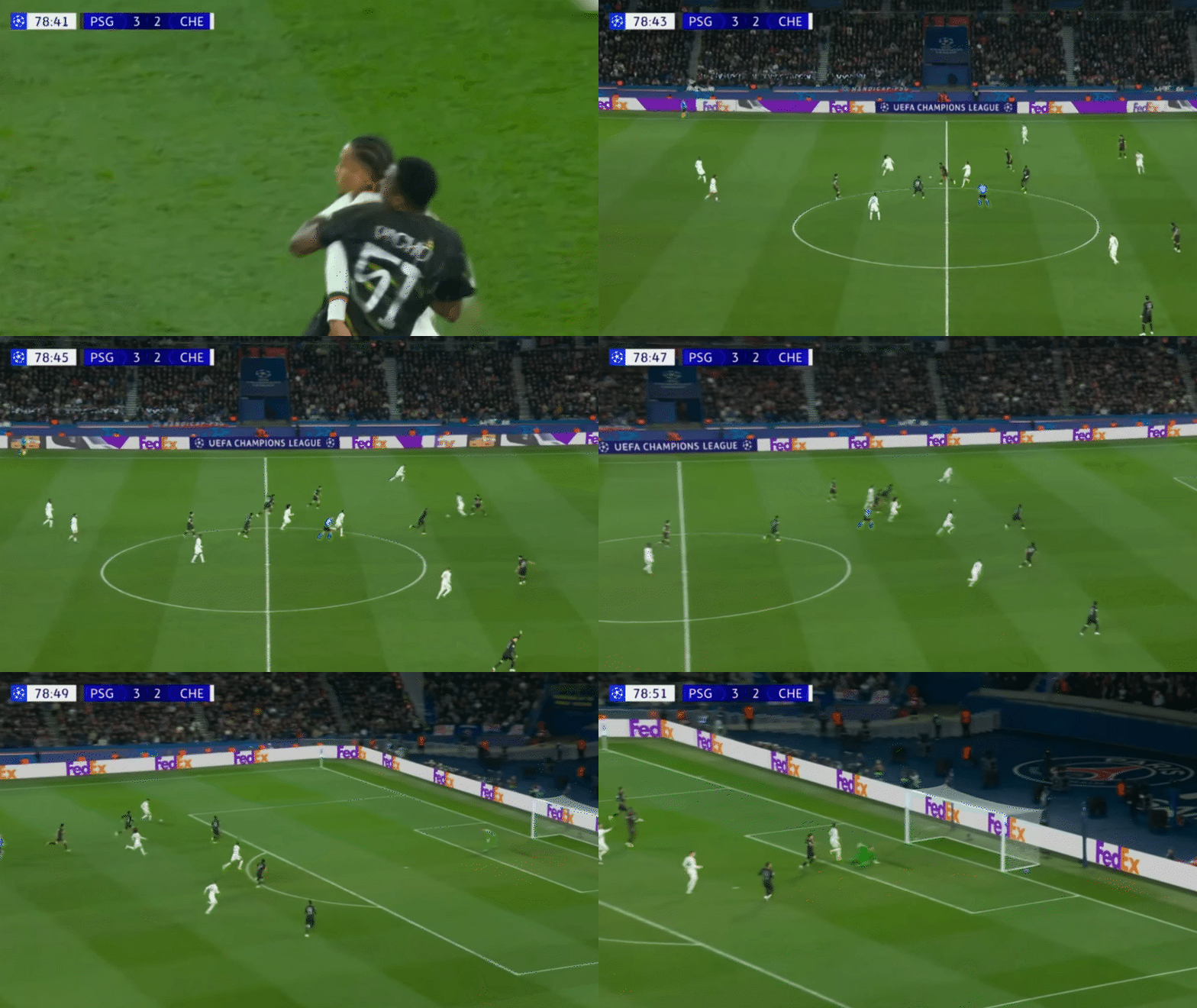
After a ball-win here, we see how easy that space is to access.
Bergvall made it all the way to the box.
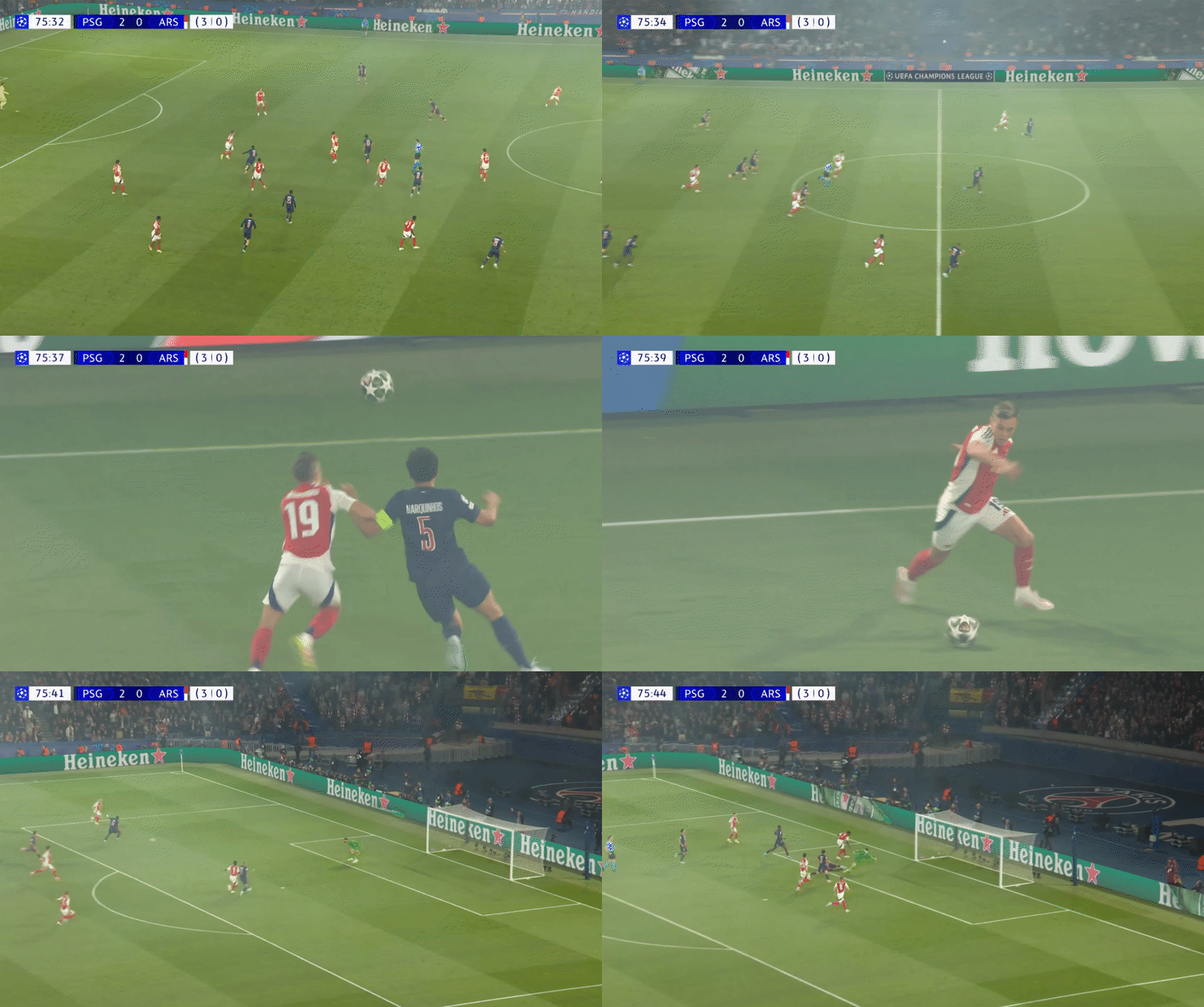
That’s how Saka’s goal last season started: ball-win, immediate ping to the vacated right-back position, and Trossard bullied Marquinhos for it.
👉 Restarts
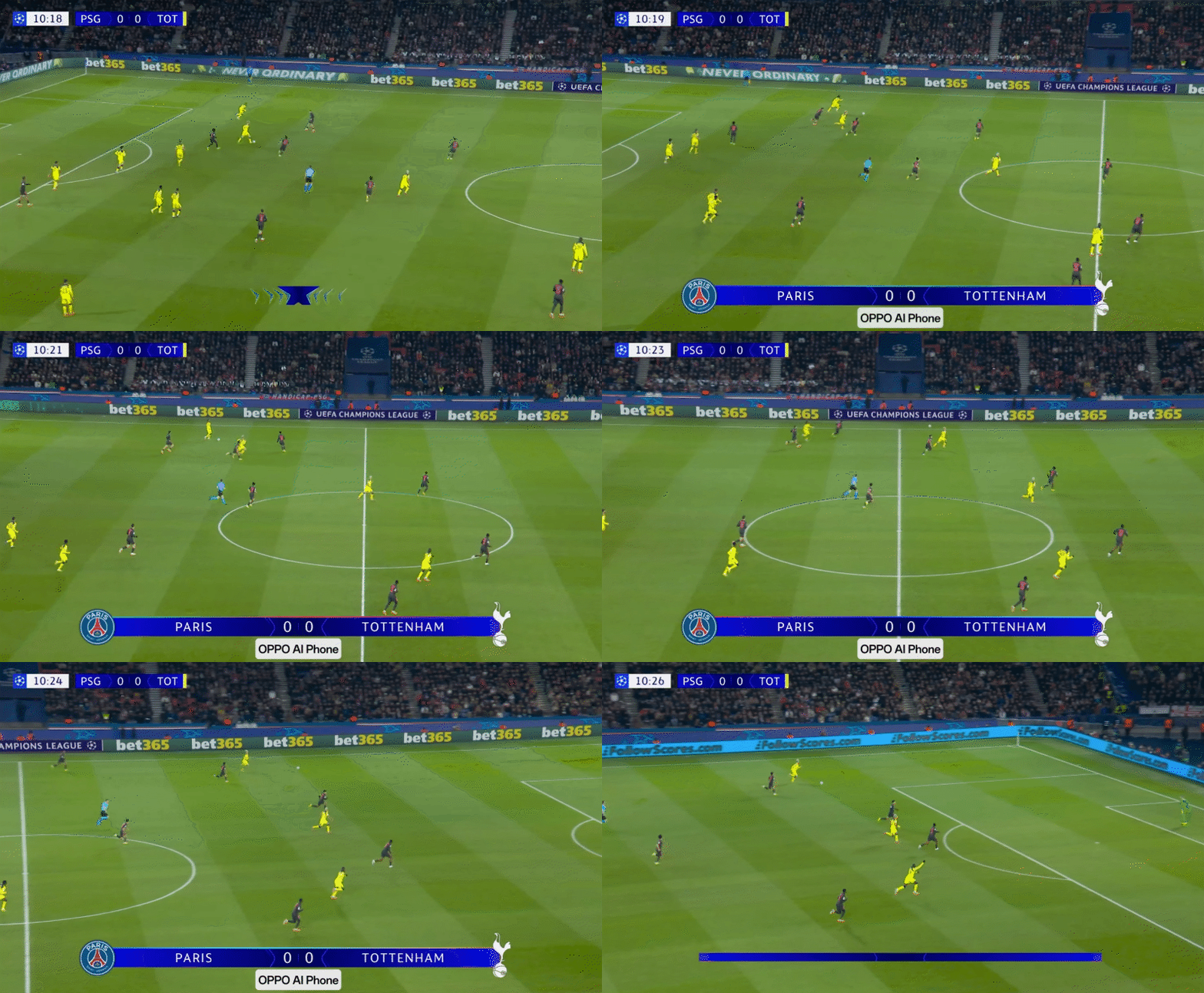
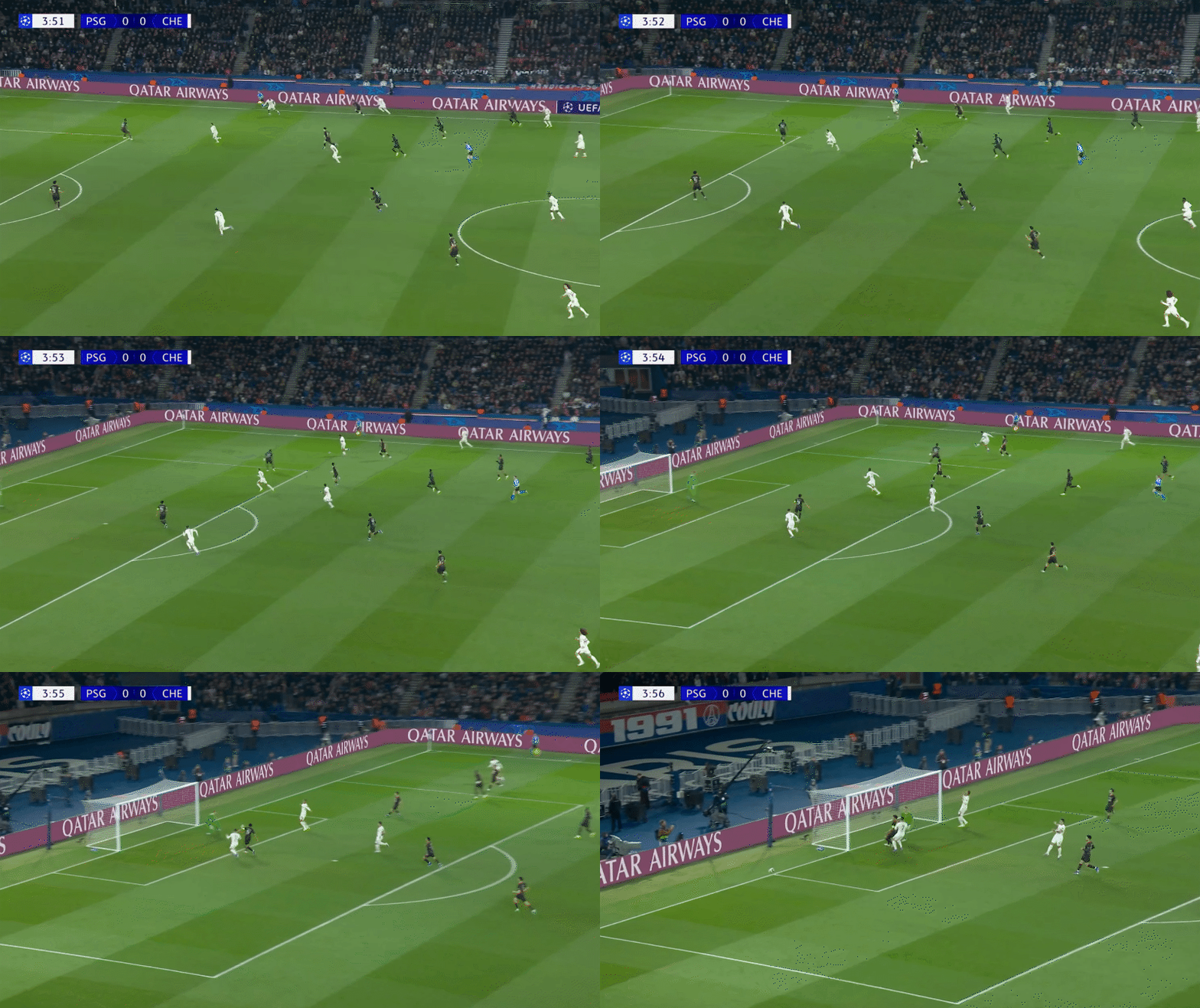
That fluidity can be used against them when possession changes hands. Here, Neves lost it, and Chelsea has acres to play with on a quick throw-in. Every Arsenal player should be ready to throw.
That turned into a 3v1 in the box.
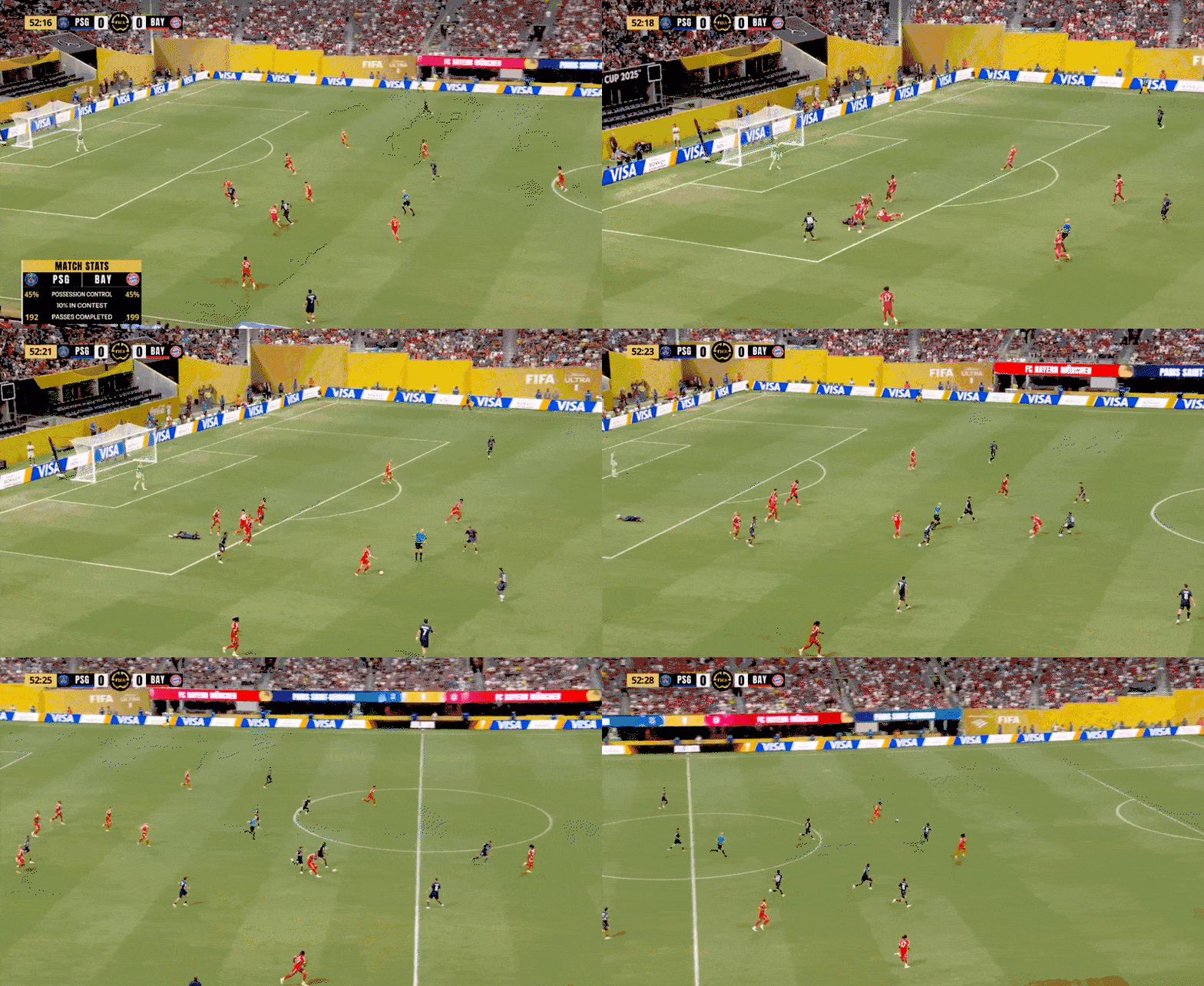
In the Club World Cup, that same trigger (a failed Nuno Mendes carry) led to this Bayern counter, reinforcing two things: the importance of a dropping striker against a man-to-man scheme, and just how open PSG can be in these situations.
👉 Wide defending
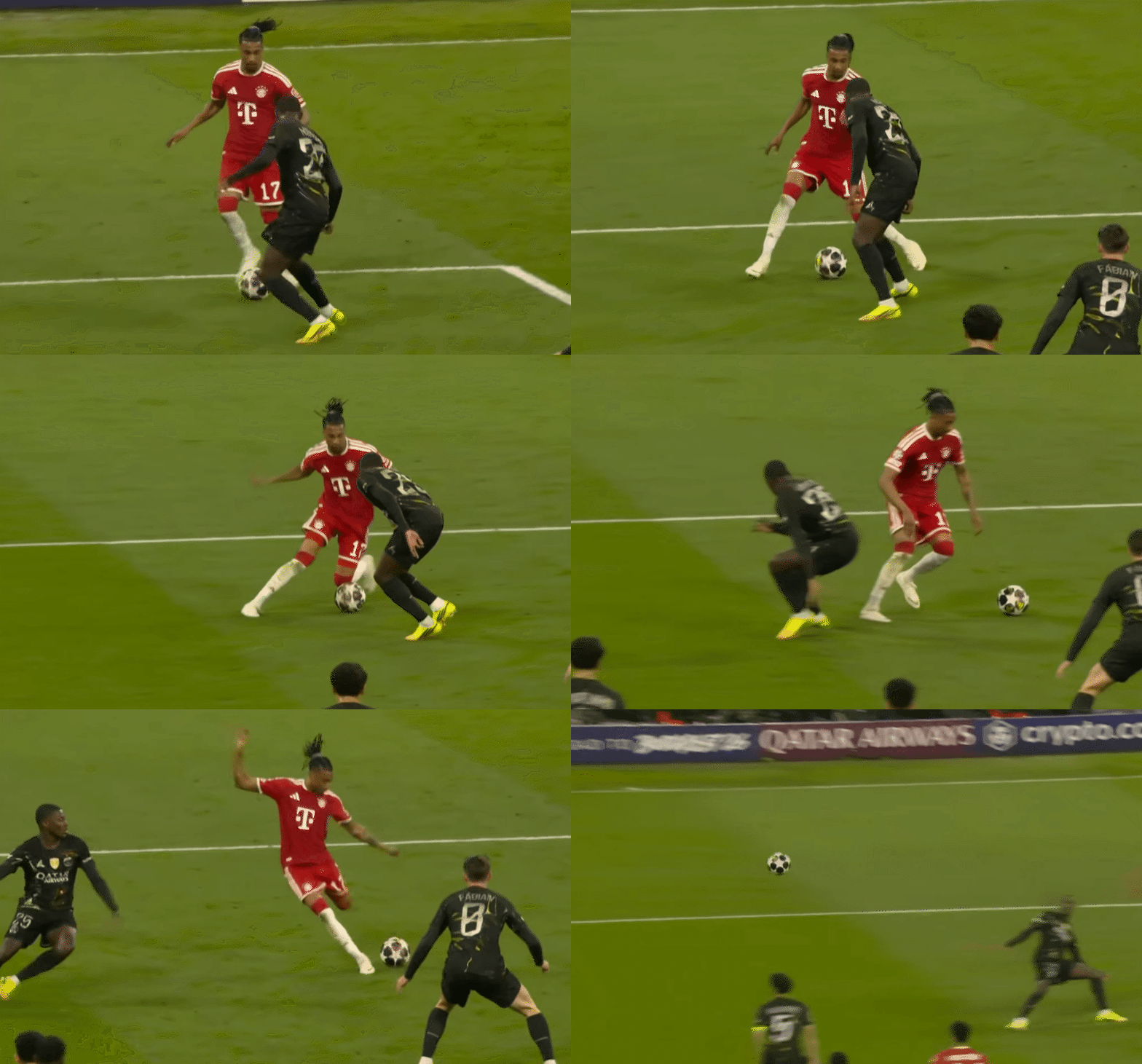
Nuno Mendes is tremendous (tremendes?). But looking back at last year’s footage against Saka, I don’t think this is an unwinnable battle.
He may be rusty, and I’ve seen a few of these this year.
👉 Trailers
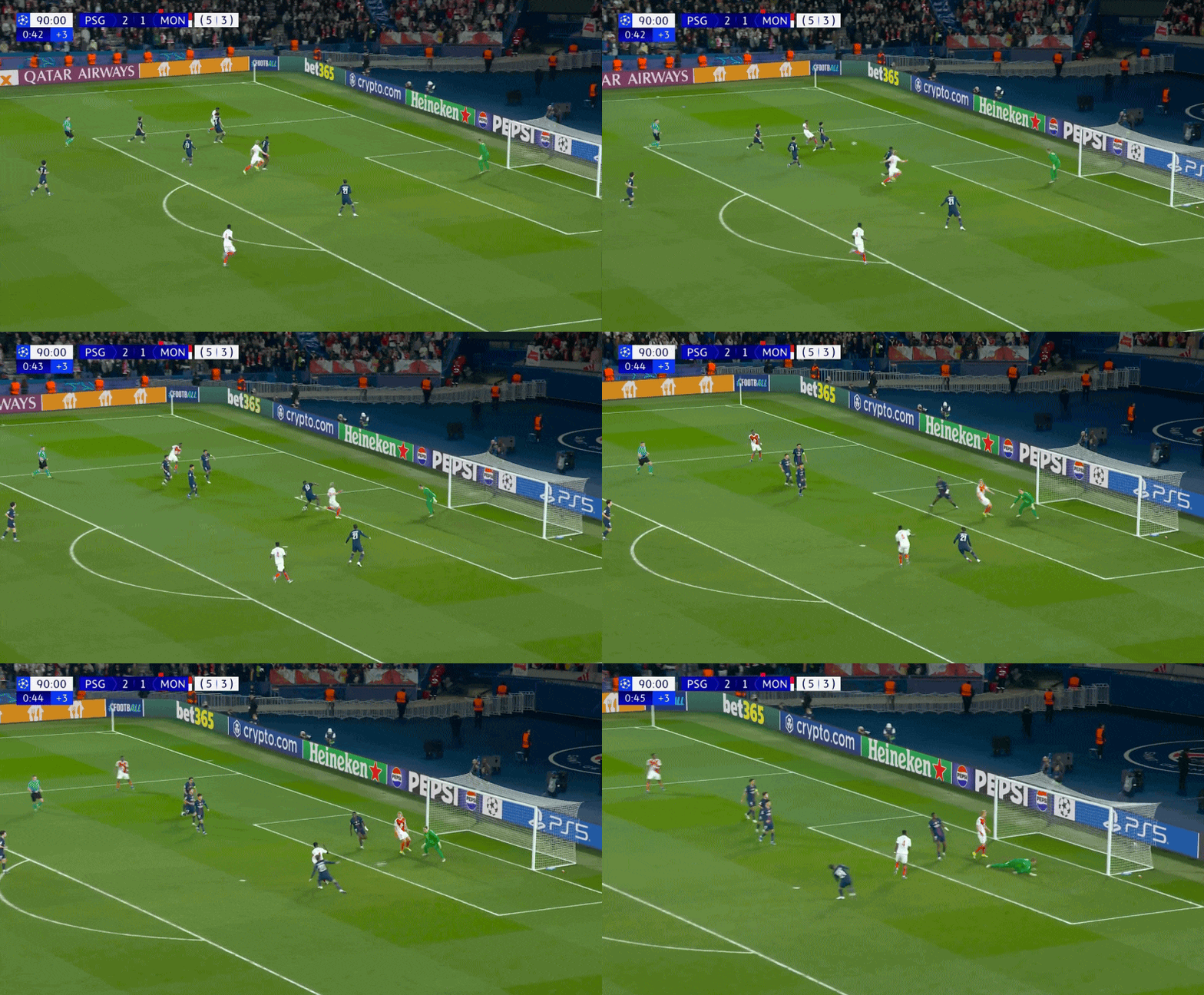
Aside from Neves, PSG can lack physical ground-eaters in the middle. They can also congregate around the ball a lot. That means that these rebounds by late-arrivers can seem more “on” than usual. Look how many players are out wide near the crosser, versus blocking the “second-six-yard-box,” where most goals are scored.
👉 Aerials and duels
Finally, PSG are extremely light on aerial duellers. They can be beaten in a situation like this.
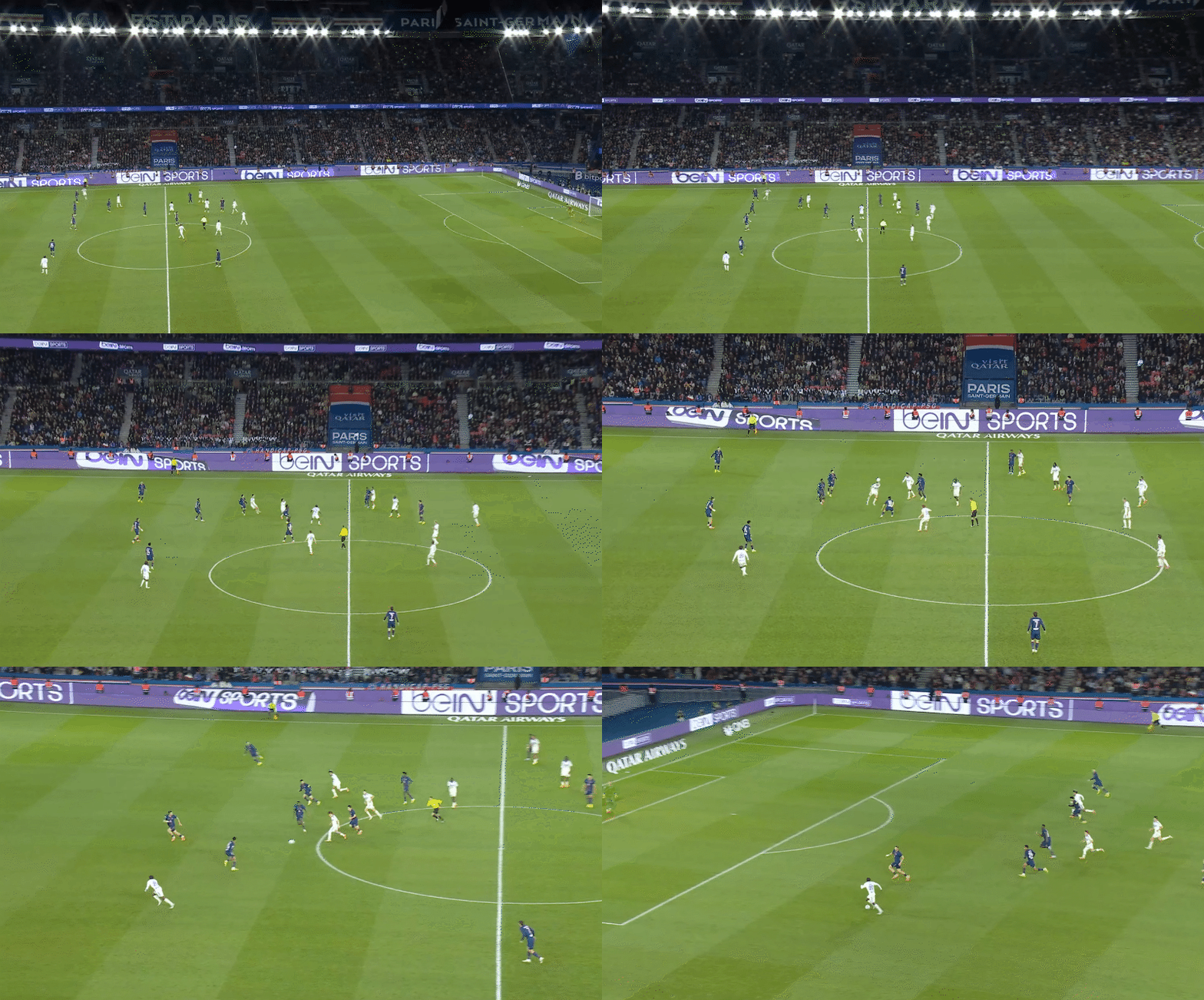
Or this.
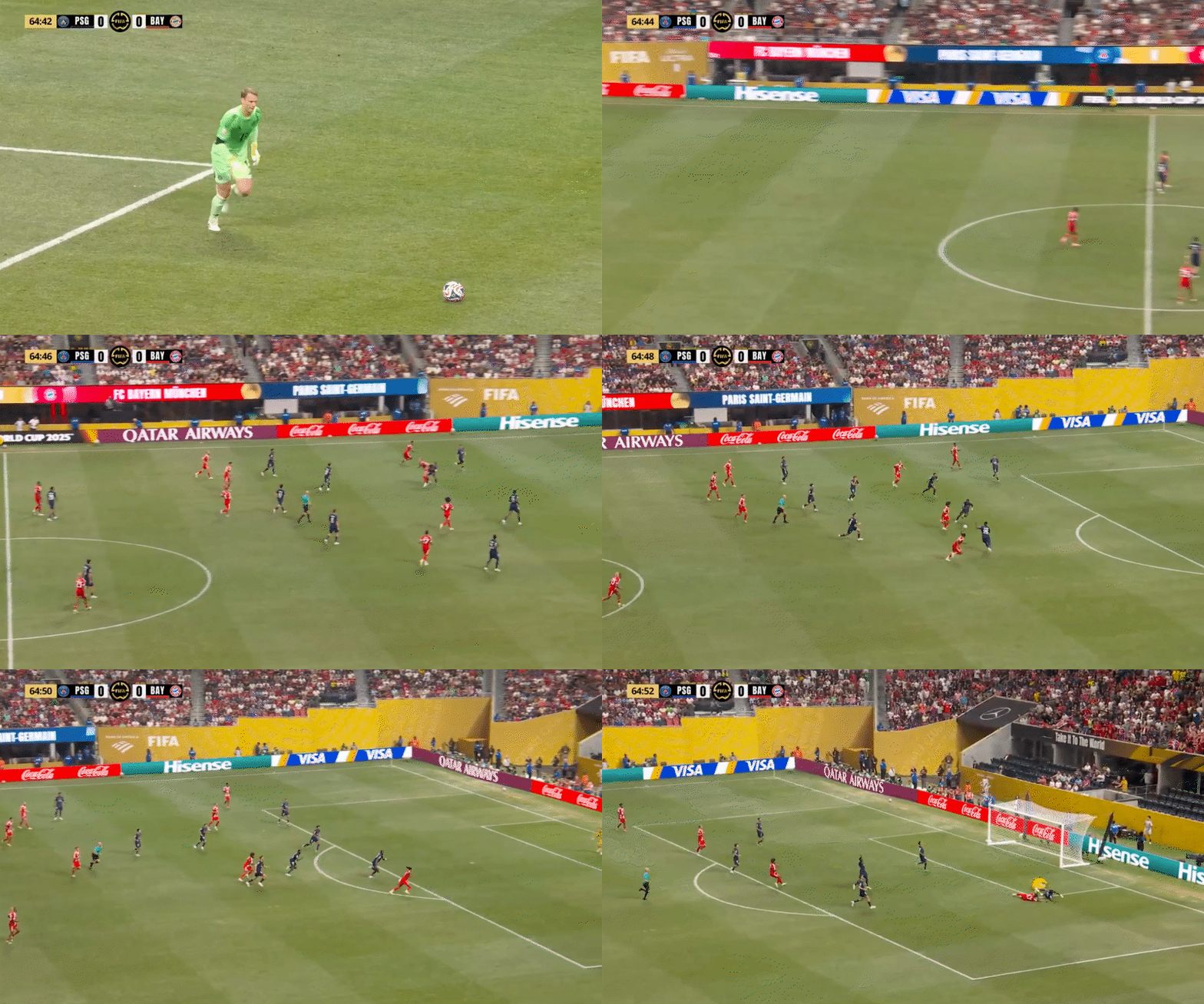
While Pacho (good), Neves (good), and Marquinhos/Mendes (fine, not great) can hold their own, the rest of the team is filled with liabilities.
Here are some positional ranks on aerial duels in the Champions League:
Vitinha: 153/161 (CM)
Fabián Ruiz: 138/161 (CM)
Dembélé: 75/110 (CF)
Barcola: 129/149 (W)
Ironically, we may want to target one of their stronger aerial performers (Neves) for reasons we’ve covered earlier, and will cover again later.
🔵 Set pieces
For our next section, I’m again so grateful to be able to turn to the words and brain of Jake, commonly known as the Set Piece Sicko, revered for his work on the intrepid Pot Shot Podcast as well as his insights at @setpiecesicko. I’ve admired and devoured his work on set pieces for years, and I’m so happy he was willing to share his thoughts ahead of this one. Go follow him and listen to that brilliant podcast, please. This entire section is by him. Thank you.
For your common football social account, set-pieces seem to nicely encapsulate the harsh vibes contrast of these two sides.
PSG the romantics: turning their nose up at the brutish meat-walls and dead-balls of the criminally English Arsenal, who wouldn’t dream of trying to pass the ball in beautiful triangles, preferring the quarter-circle wrapped around the corner flag. Boo Arsenal! Boo corners! Long live teams who entirely exist within the boundaries of play!
After watching a tonne, I do agree that you can fundamentally distil these two sides into their differences at set-pieces, but it is primarily the way they integrate them within their ethos, rather than one just not using them. You know enough about Arsenal, so the emphasis will be on PSG, with sprinklings of “how we can get up and at ‘em”.
I. PSG’s offensive set pieces
The best encapsulation of this idea of PSG being embodied within their set-piece strategy is on offense. This will come in three key prongs: corners, free-kicks, and throw-ins.
👉 Corners
This is thankfully easiest to do due to the sheer volume PSG create (due to the sheer volume of their bank statements compared to most teams they play, but anyway).
PSG use their corners in a weird way for PL eyes, in that their emphasis is not to launch it on the keeper’s head, but instead to manufacture better situations for their star qualities to shine outside of the box.
To do this, often PSG will go short, with a midfielder joining a winger who takes. From there, we can get a few branching pathways, which I’ve tried to make feel like a choose-your-own-adventure book below:
Option A: You spy the opposition short defender is not a gifted 1v1 specialist. You choose to isolate him and run towards the goal, along the line.
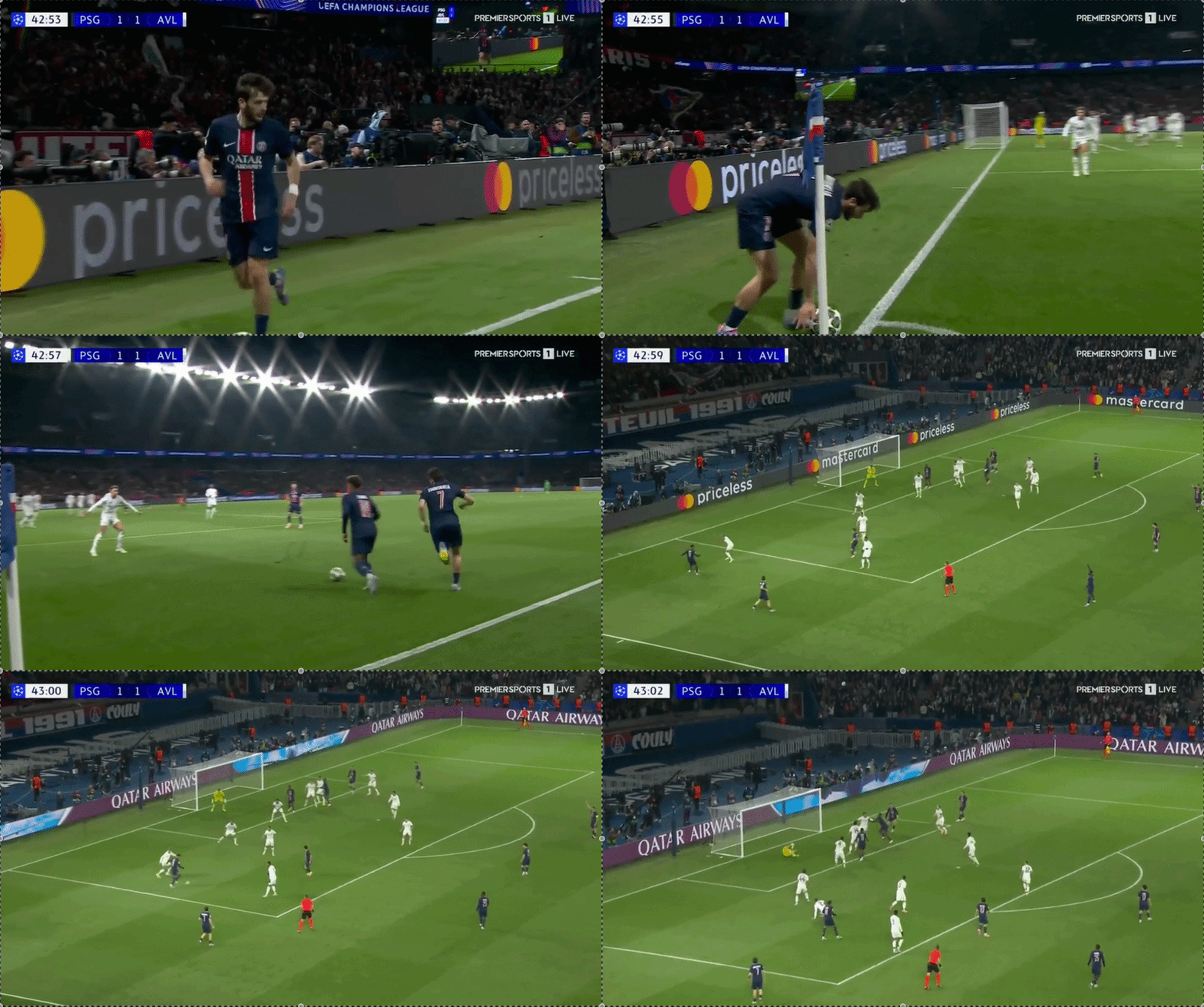
Option B: You notice the opposition are being dragged towards you, leaving a large amount of room for either your burly CF or even burlier CB to dart into the space far post. You hit it first time, catching a sweet inswinger behind an advancing defence.
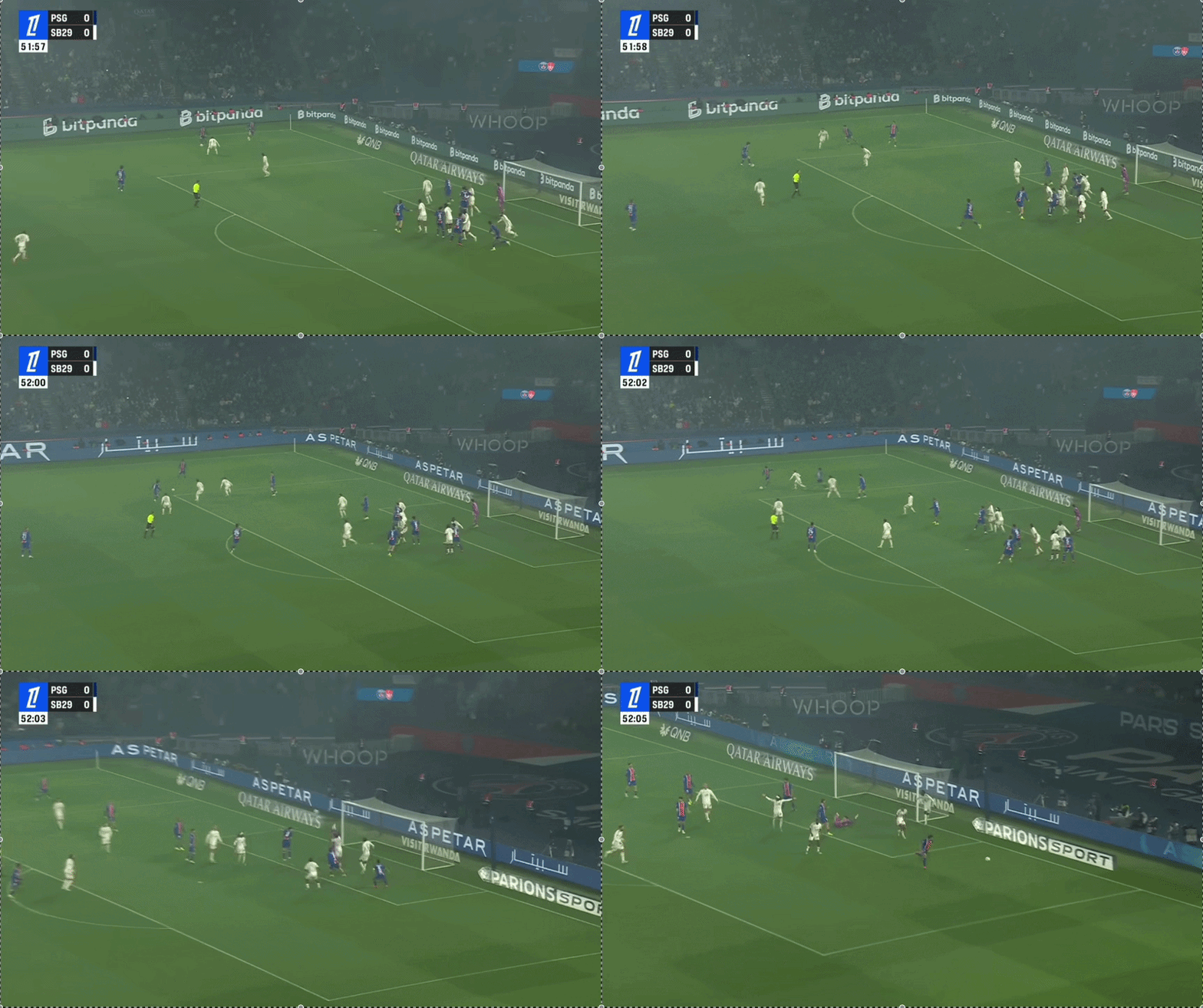
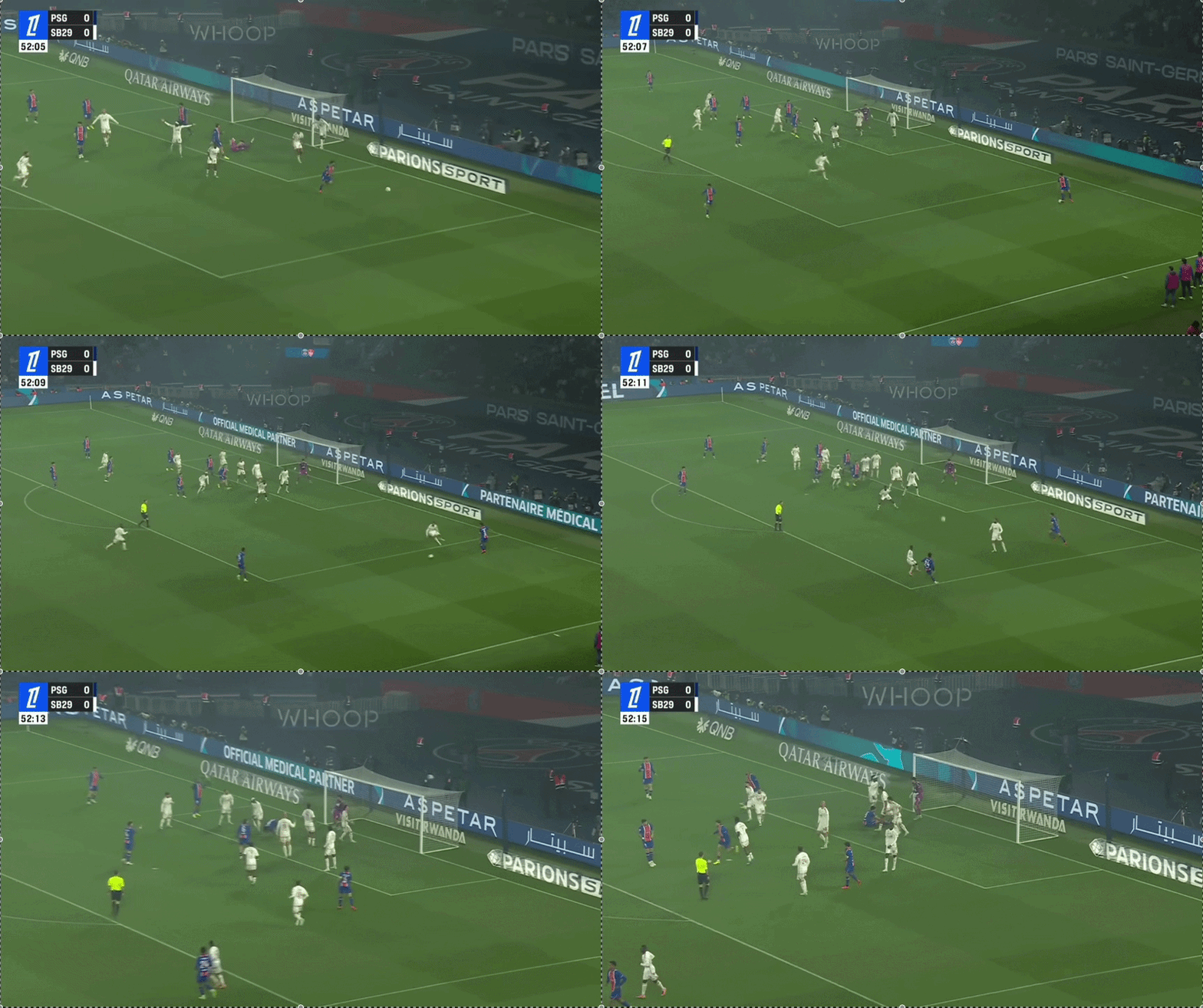
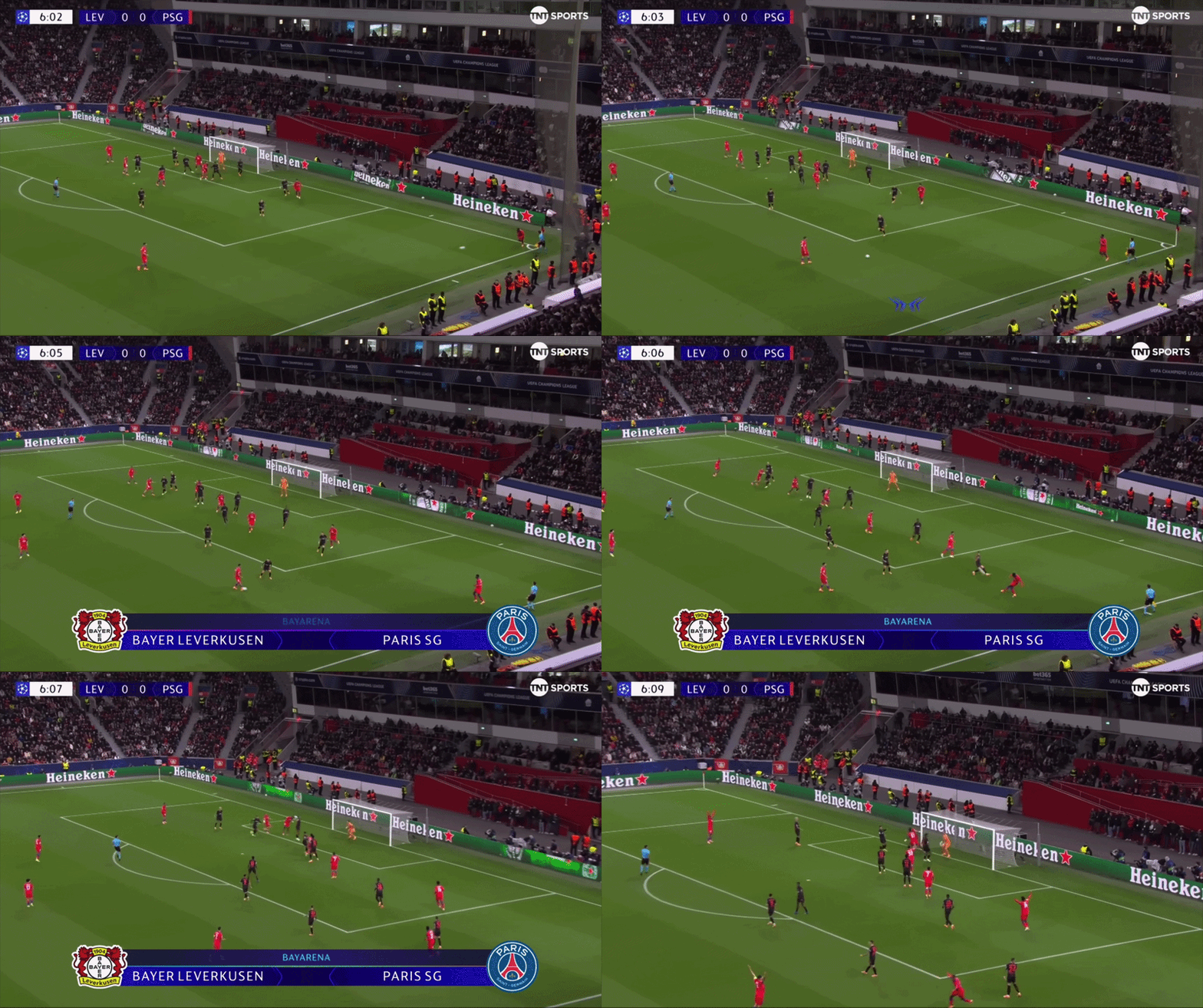
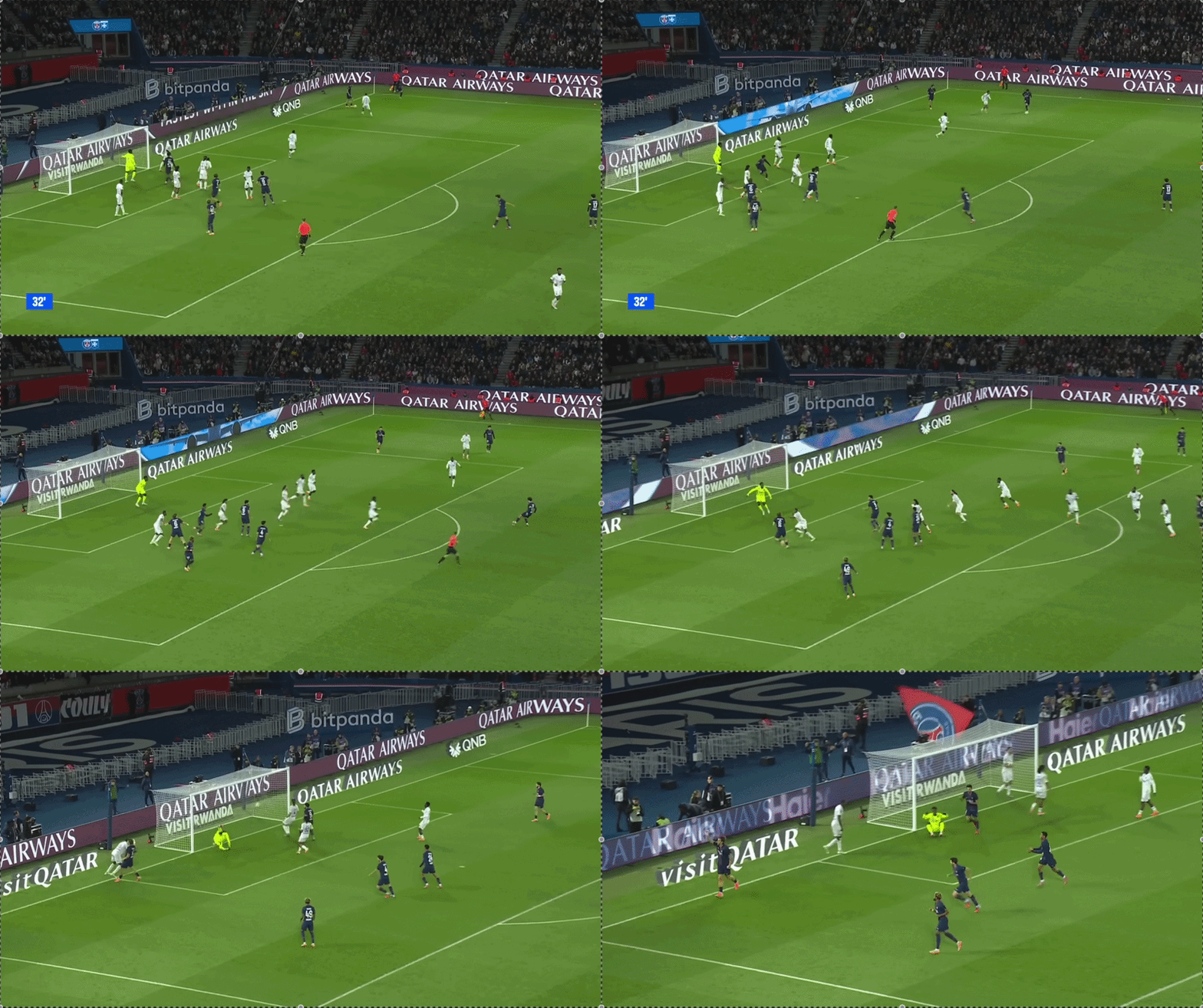
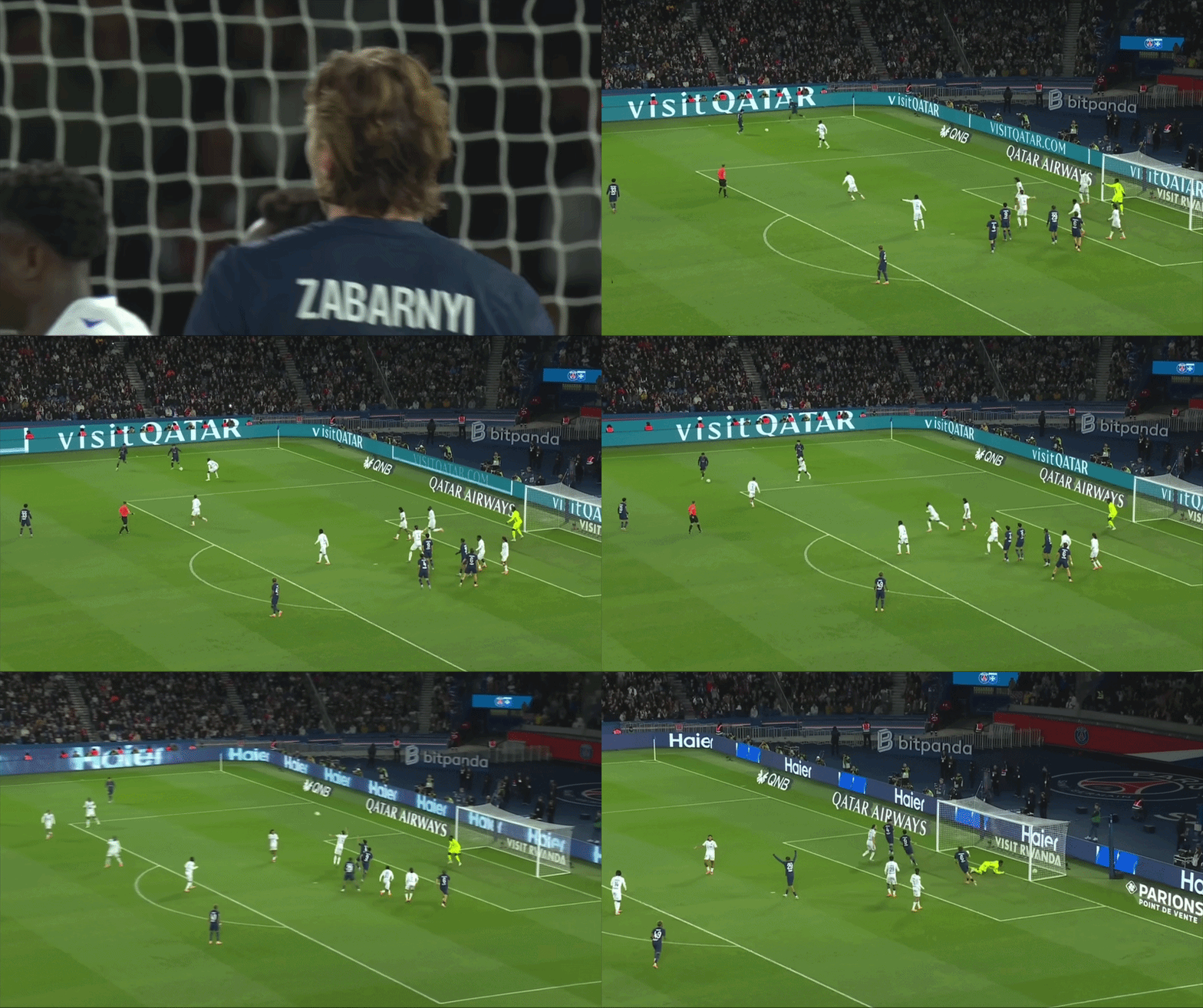
Option C: Your physically diminutive but technically mint midfielder is screaming for it on the edge of the area. You roll the ball towards him to hit within two touches, relying on blockers in the box and fear of Options A and B to keep the shot unblocked.
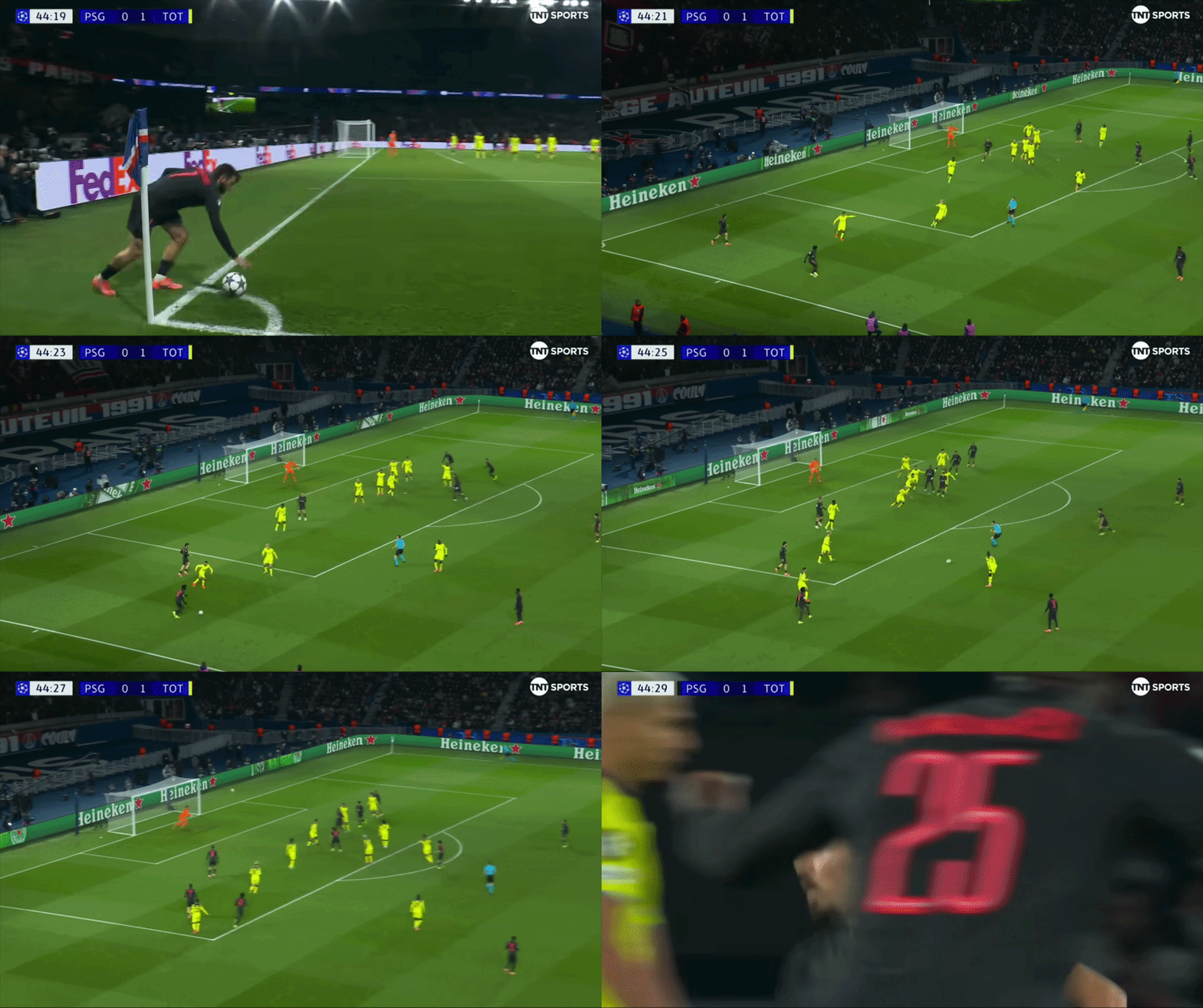
Options A and C are primarily where PSG hang their hat, making use of the snapshot ability of Vitinha alongside the individualistic brilliance of Dembélé, Kvaratskhelia, and Doué to transform a situation which fundamentally shouldn’t suit PSG into one that resembles the freedom of open play. I’ve rarely seen a team that prefers a punt from 25 yards to a chance of a close-range bundle, but it feels like a smart stylistic choice from PSG to not engage themselves in duels where lower teams may actually have the upper hand. By enabling the battle to stay wholly technical, they don’t enter this weird control-less aether that they may be used to.
For those interested in corner lore (lore-ner?), this feels very 2017-2022 Guardiola, with corners being used to complement in-play ideology, to the extent of a team only seeing it as a method for getting back to the comfort of high technical possession.
The solution teams adopt is to simply go tight and press out quickly, removing PSG’s ability to ‘reset’ from these moments and gain dangerous territory comfortably. The natural caveat of this then brings about Option B – now perhaps you’re starting to see the dangers PSG pose here. Due to the quickness with which PSG players can change direction, teams often allow huge spaces due to the inconsistency of structures as they move outwardly – like 2000s Hulk Hogan ripping his t-shirt, slowly there are gaps, which become huge tears, revealing a weirdly soft underbelly. All it takes is one well-timed run for one of the 2/3 targets on the side, and it’s a far easier chance than any initial delivery can hope for.
What is a positive for Arsenal is that you rarely see this tactic employed vs an equal-strength side (Most of these looped crosses are aimed to Gonçalo Ramos, which says enough to this point), and Arsenal’s added height and reputation mean I would be expecting an emphasis on Options A and C, especially given PSG’s success from range in last season’s fixtures.
This isn’t the only way PSG roll their dice, even if it is the one I’d be banking on. Much like last season, their aerial targets are few and far between, but that doesn’t stop João Neves being a 5ft 9 Gabriel. If PSG ever do fancy launching it, Neves will 90% of the time be the target; he has an incredible leap for a man with his shirt tucked in, and a timing of run that would make another tucker (Frank Lampard) blush.
For some reason, the deliveries will never exceed the front post, but Neves will consistently hit the spot just out of the zonal coverage – even easier to do on PSG’s favoured outswingers. This is exactly what we see vs Bayern in the 5-4 win, and he nearly did the exact same to Arsenal in the group phase of last season’s competition.
I don’t often recommend adjusting systems for one player, but given PSG’s preference for edge-of-area plays and Neves’ desperation for CTE, I would be moving the standard outswinger zonal setup a couple of yards forward to make things difficult.
👉 Free kicks
Only a small note here after the novella on corners, and that is two core features of play I’ve noticed.
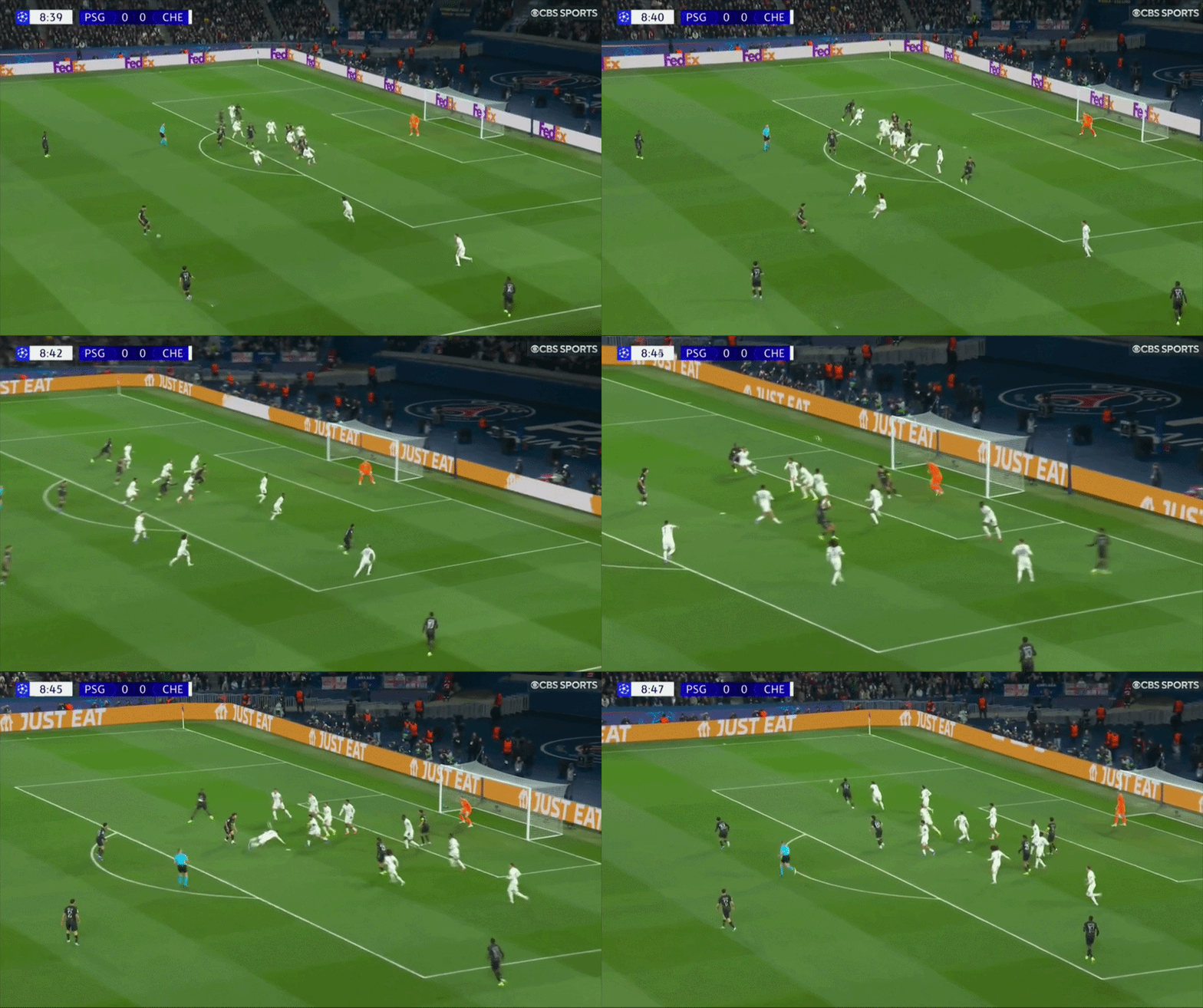
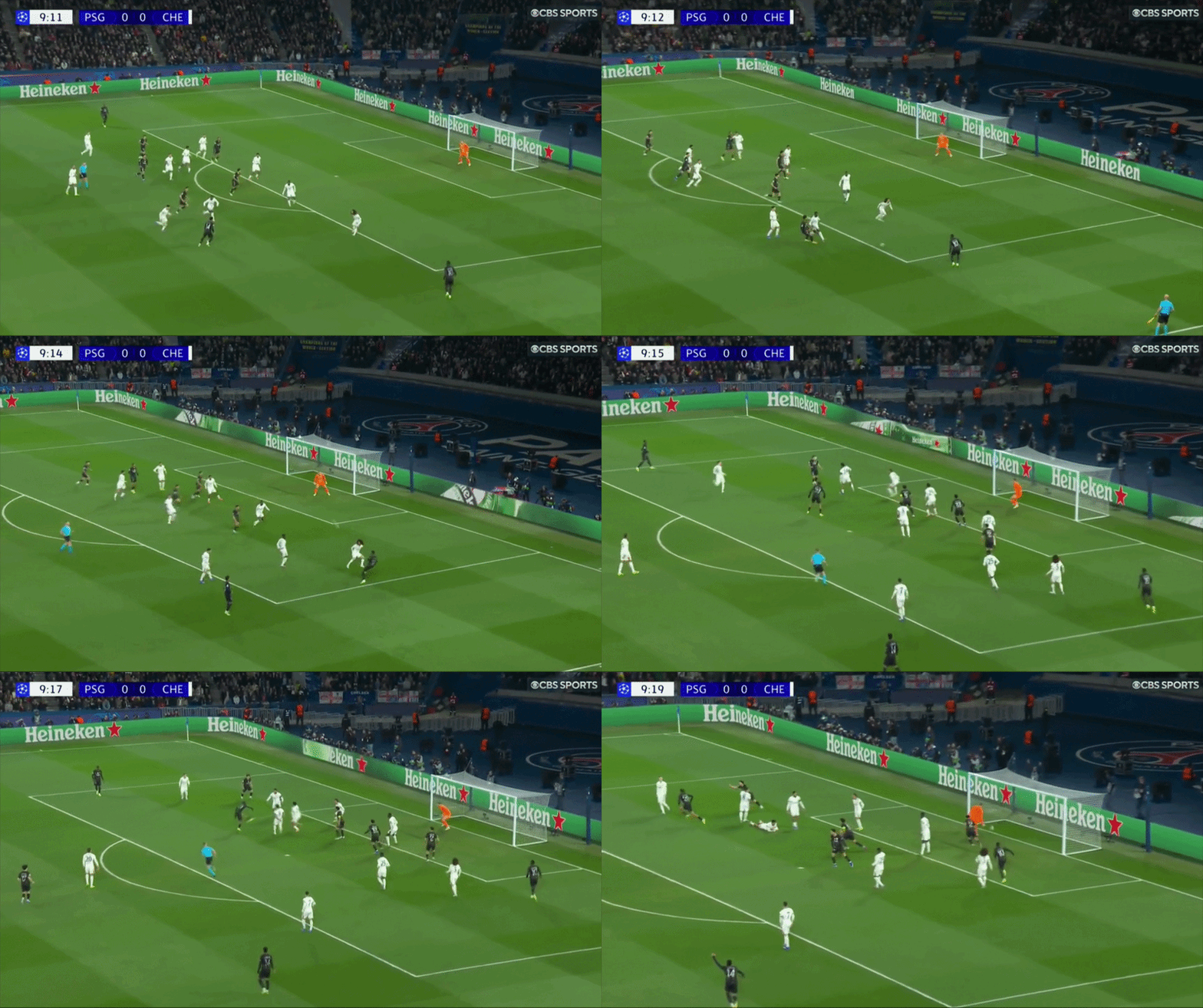
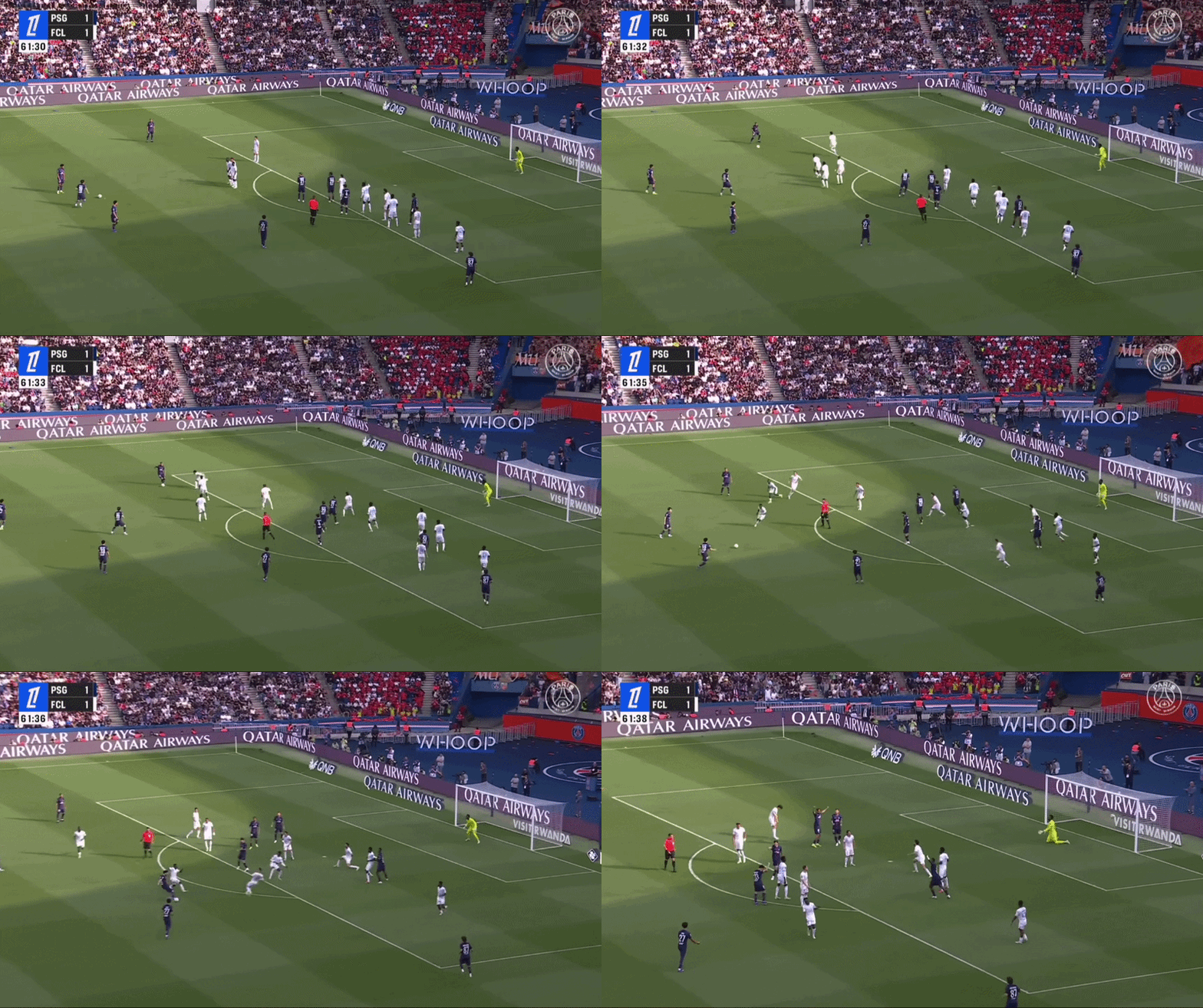
The first comes from PSG’s domination of the second phase, which is perhaps expected given their focus on intensity and pinging it from 30 yards. PSG’s set-piece strength tends to be in these ‘overspill’ moments, rather than singular routines of absolute quality, but the heart of how these moments occur is actually a clever inversion: rather than be intense, PSG players earn space by switching off.
Looking at this scuffle vs Chelsea before a Bradley Barcola Banger, what screams out to me is how PSG earn positions by ghosting behind automatic defensive movements. It’s how the first run is earned, it’s how the shooting zones are earned at the top of the box, and how movements for second balls after that are earned. Weirdly, this will require more active thinking, as the typical runs are likely to be ignored in favour of waiting until Arsenal have made the space via the expectation of those runs.
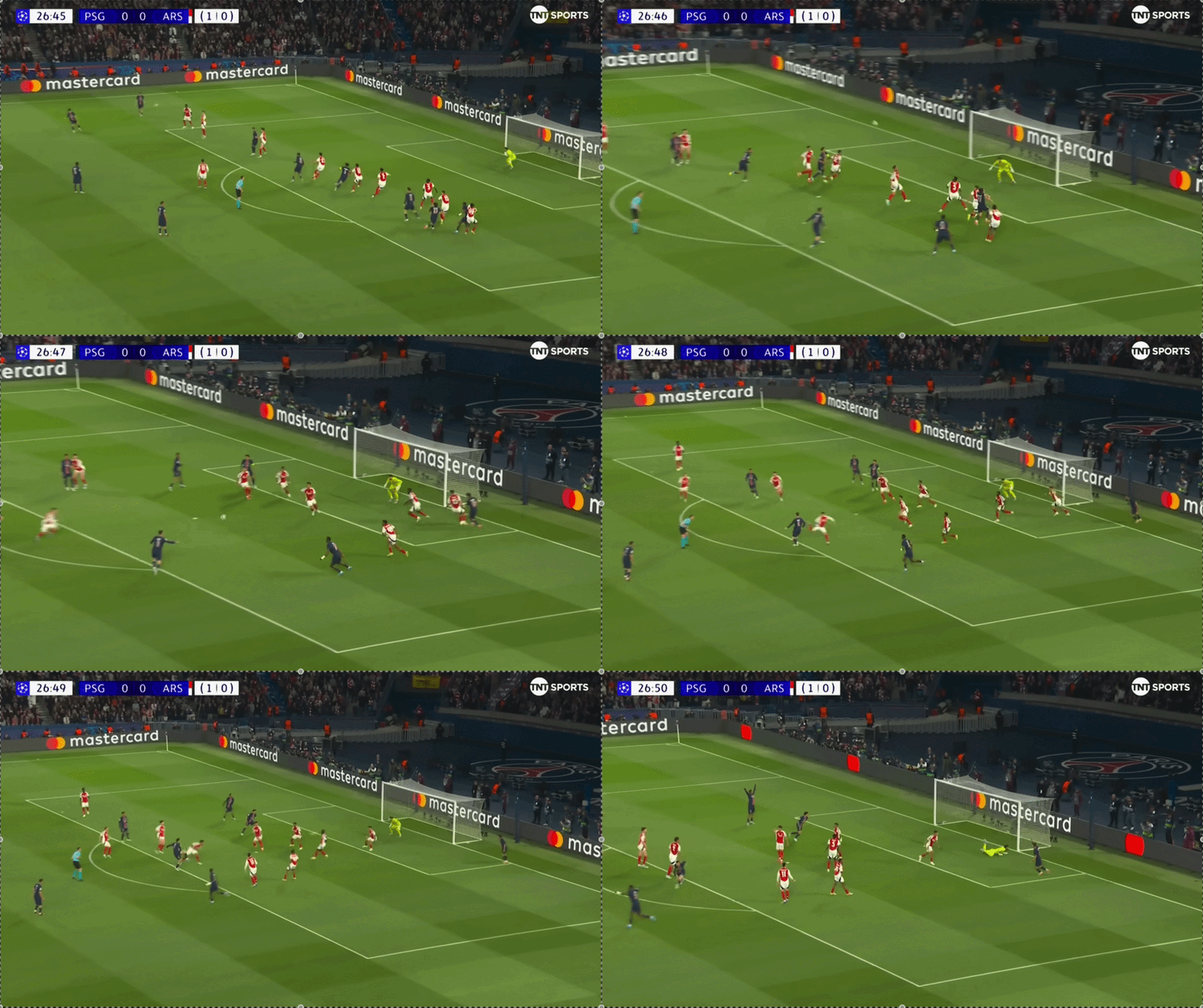
Very similar to Fabian Ruiz’s goal last term, drifting away from a backline in autopilot:
The second note here is a more ideological one. Versus Chelsea, in the second leg specifically, PSG suddenly went from the tippy-tappiest side around to absolutely launching it. Safonov got an assist. A lot of this was in reaction to the aggression Chelsea suddenly showed in their high line: rather than deal with congested space where the opposition were specifically set up, PSG went right over, isolating an uncomfortable CB playing RB against Kvaratskhelia. Glad that isn’t going to be a situation Arsenal have to deal with, eh?
This general openness to direct play, knowing when physical battles aren’t worth the hassle, is a hallmark of PSG on set-pieces this year, and it feeds perfectly into their ethos of hitting sides early then opening the space up for fast, brutal counters. If Arsenal get behind, it’ll be a key battle to ensure aggression doesn’t dominate thinking – PSG love a quick set-piece, and if it can earn them an extra 30 yards doing so, they’ll eat it up.
Aside, absolute twats from the edge are still an option here too.
👉 Throw-ins
The last point on offense maintains this line of thinking. Whilst most throw-in patterns are centred around passive-aggressive possession quality at the top end of the field (see: Doué’s goal vs Liverpool, after 27 passes), some are more overtly aggressive.
A lot of this is covered by the ever-brilliant Liam Tharme, but it’s worth repeating with a little extra sauce.
Much like in their game vs Chelsea, when faced with Liverpool’s out-of-possession-aggression, PSG utilised set-pieces to give themselves situations to isolate a stretched backline. From his own third, Nuno Mendes yeeted flat but perfectly intended deliveries to isolated players in the middle (often Vitinha) who could then drive forward in ideal 4-on-4 scenarios. Often, players aim down-line or short in these scenarios, which is why Liverpool felt so comfortable ‘boxing em in’, but PSG used their half-baked enclosure to move forward very quickly. The speed of these moments is startling, and again leads into the idea that PSG’s main quality in set-piece play is quickness of surprise, not simply the surprise itself (much like in open-play again, wow!)
This strategy of launching far and flat is even more effective towards the half-way line, where Kvara can escape backlines to generate these quasi-counters. Barcola is also a big beneficiary of these.
My two cents on throw-ins is: pick your battles. It may be worth sacrificing a final third pressure to ensure you don’t need a 50-yard recovery run. Limiting direct options quickly is a huge part of this.
II. PSG’s defensive set pieces
Now we move to the juicier bit, where you can get at PSG. The sections won’t match the previous, due to the limitation of ‘not as much tape defending when you’re good’, but a lot of the focus will be on how they’ve set up in the UCL, as this is I think where we can get most purchase in terms of squad use.
👉 Corners
A fair while ago, I wrote about the notion of goalkeepers, and how a team’s defensive structure on corners tends to betray their feelings about the goalkeeper within it.
With that in mind, here is PSG’s defensive structure on inswingers (Arsenal’s bread and butter):
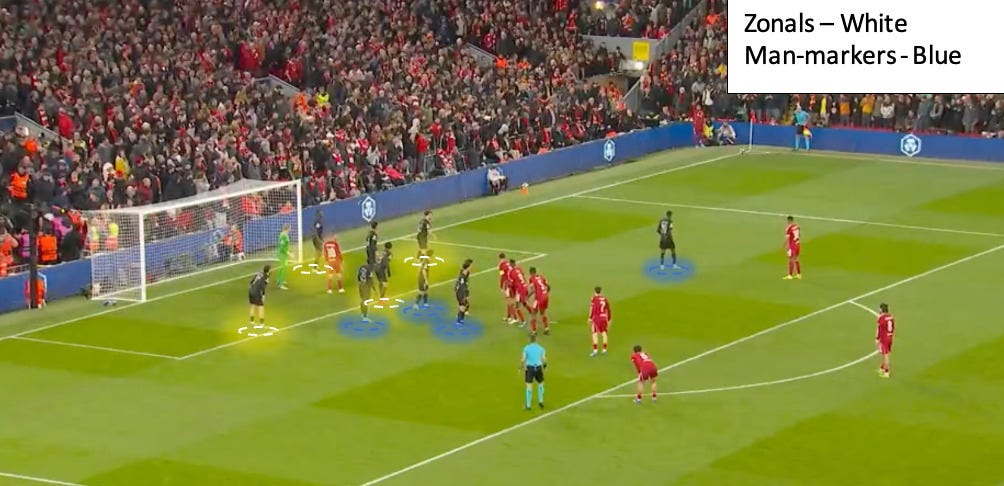
This is not to say that Safonov is a De-Gean level goalline goalkeeper, but it’s more a respect of opposition strengths, and particularly opposition targeting of the Russian. Much like any PL goalkeeper, focus is often placed upon dislodging Safonov from his space and trying to secure the front post zone in particular. Part of this is due to the PSG setup favouring this space too, meaning attacking teams get some blockers for free.
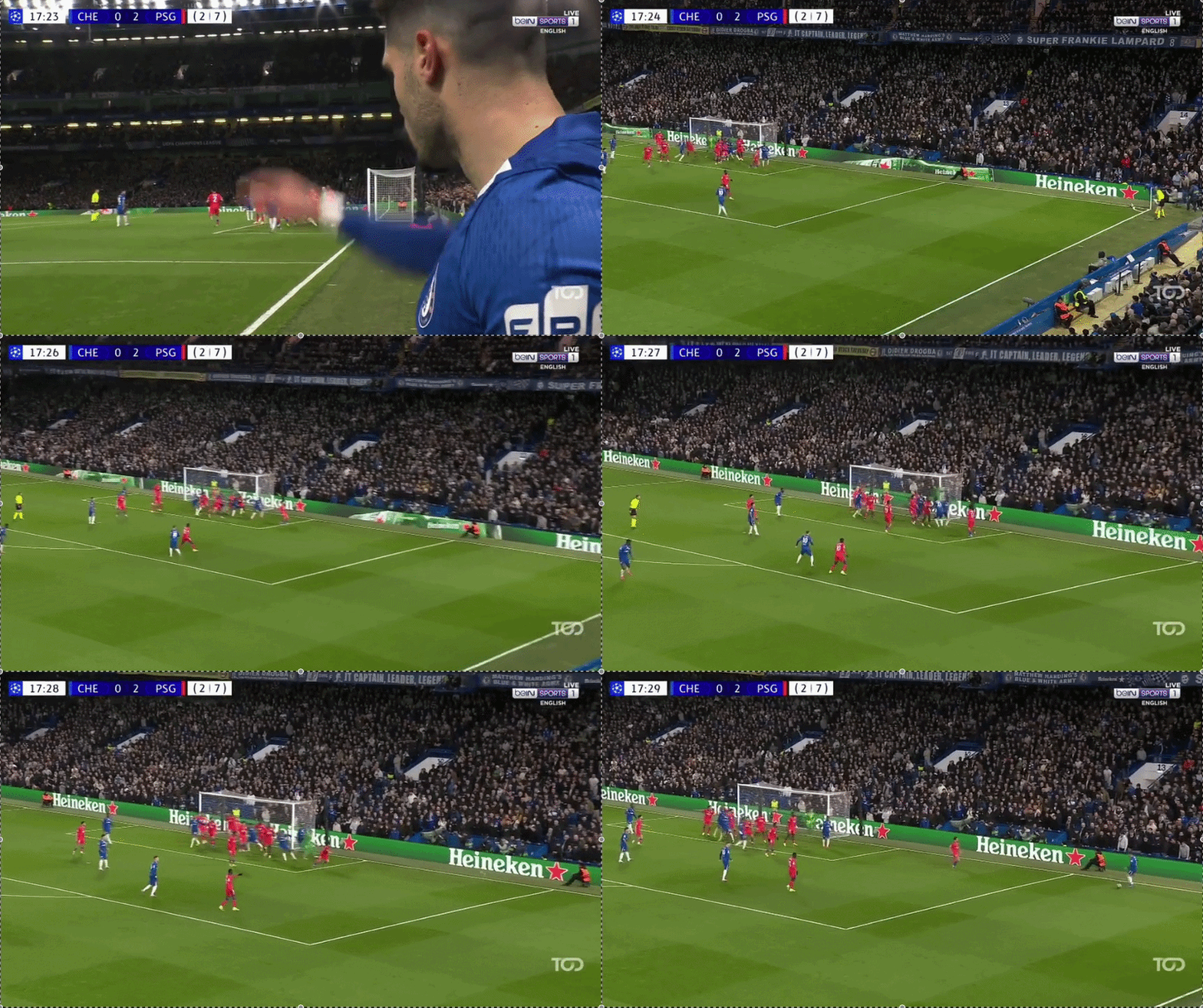
Safonov is not a particularly commanding goalkeeper, hence the… everyone around him, but he is a weirdly aggressive one. He will consistently challenge crosses in the area but never claim them, opting for a punch in all situations – likely making him slightly harder to totally limit, but it means there is some optimism for weak skims provided the momentum he can build up is limited (I miss you every day, Ben White).
Chelsea and Liverpool have both had real joy in hitting the front post and probably should have had a goal for their troubles, and the fear with which PSG set up is a general limitation in how they can prevent runners. The only positive of the structure is the presence of João Neves in the Kai Havertz role, leaping high to stop this zone being rife with flick-ons a la Gianni Vio’s Spurs a few years ago. Of course, the way around this is to get even further forward, as Aston Villa focused on a year ago (this was in the first minute vs an equally uncomfortable GK in Donnarumma, admittedly with Vitinha in a front post role instead).
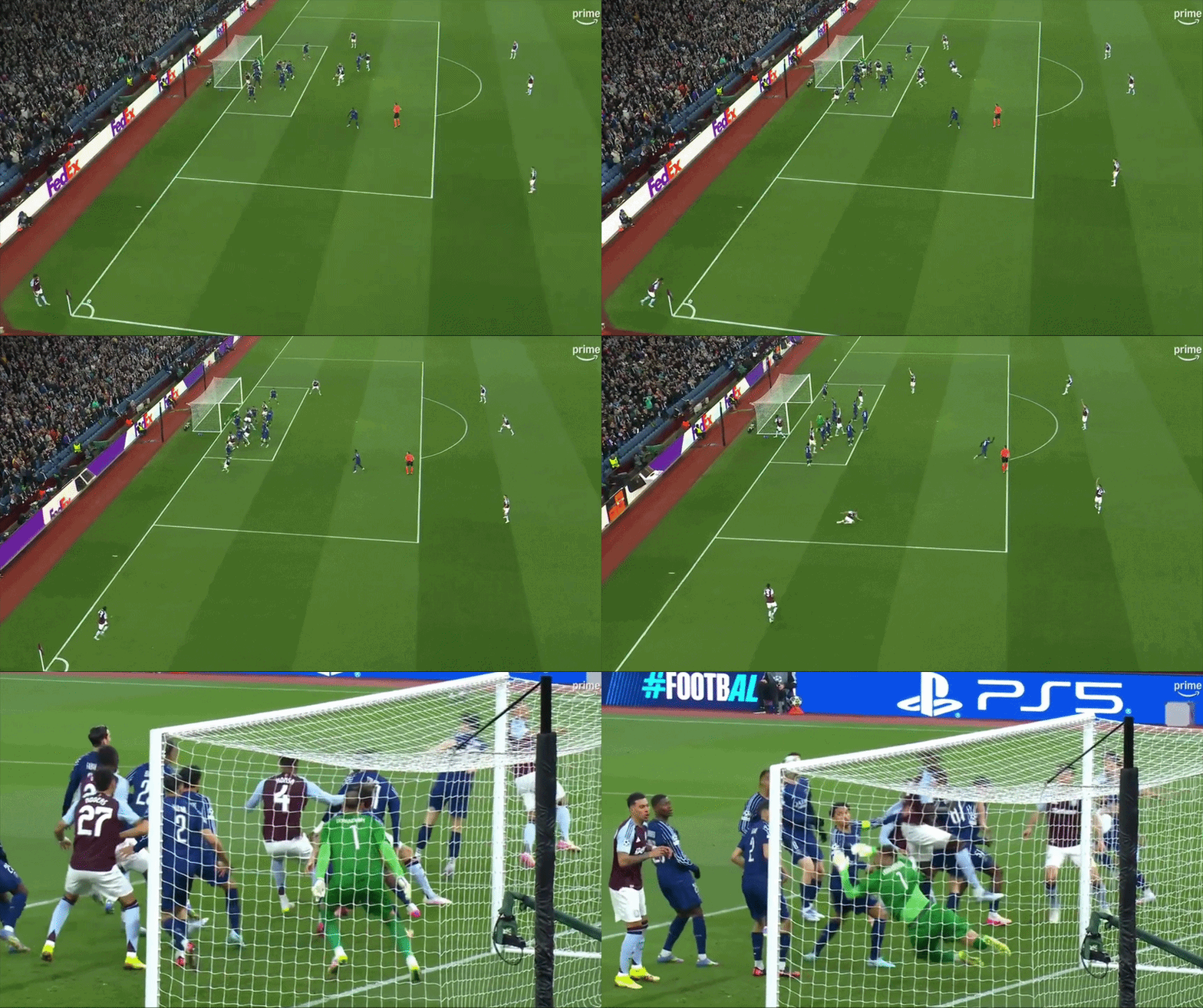
The aggressive-but-not-commanding problem also leads to ‘second wave’ deliveries being a nice option: mirroring the PSG ‘go short and whip it later’ method to create a cavernous space between an advancing back-line and an unsure goalkeeper (see vs Monaco below).
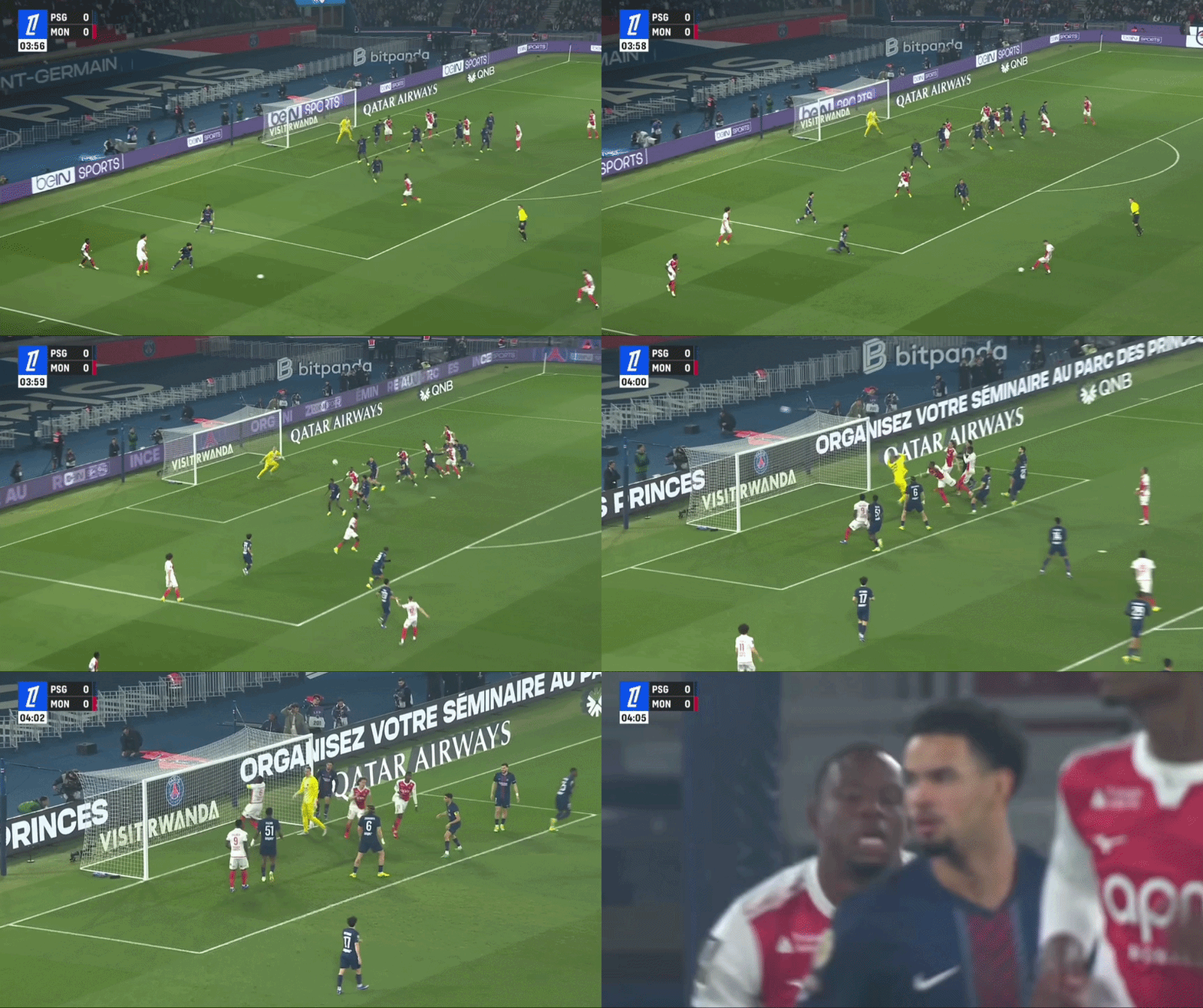
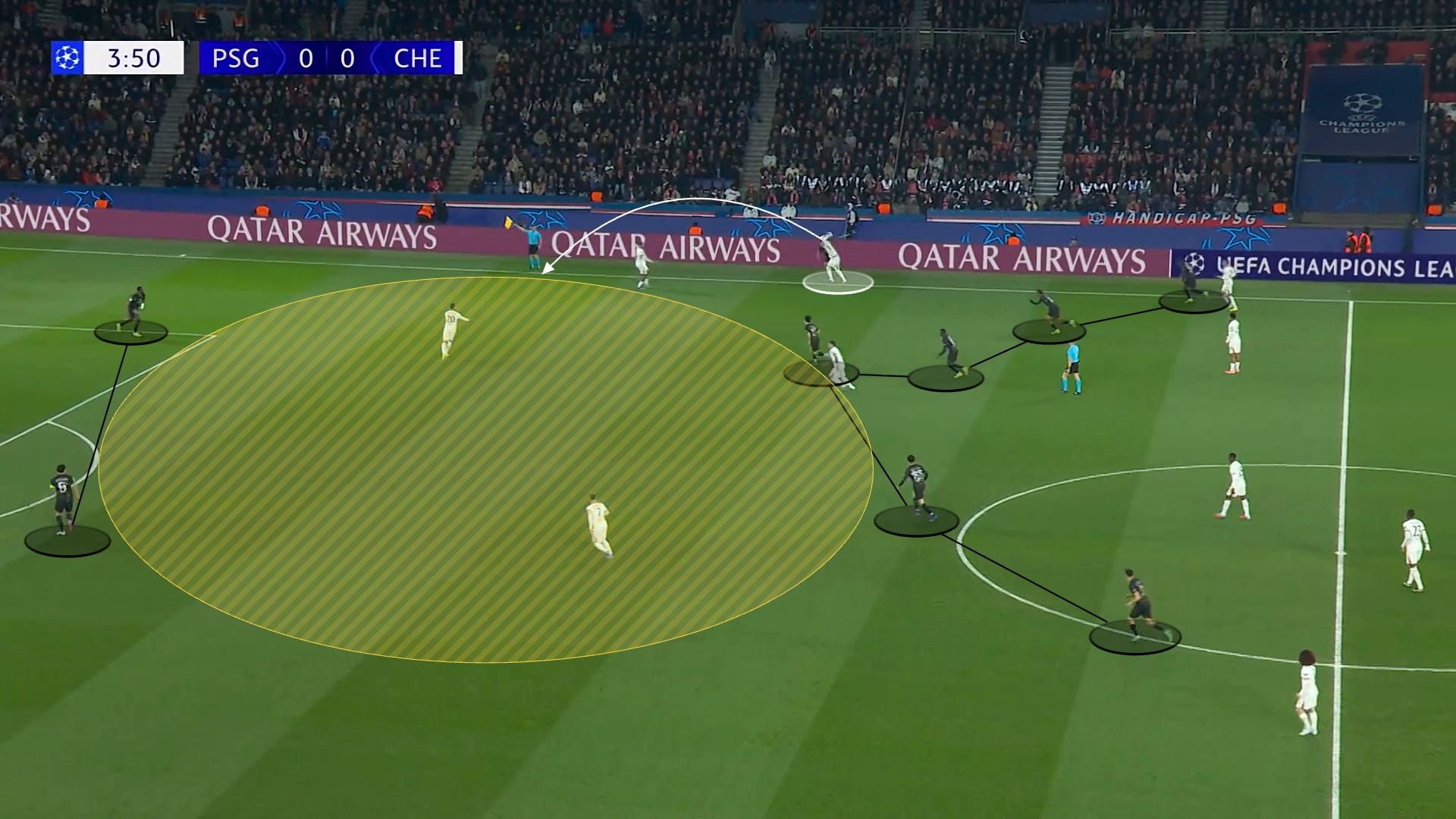
Another sign of this fear is a retreating Kvara at the back post, tucking in behind Safonov. This is perhaps the most important point for what I think is the way to get at PSG, because look at the image of the box as he does so:
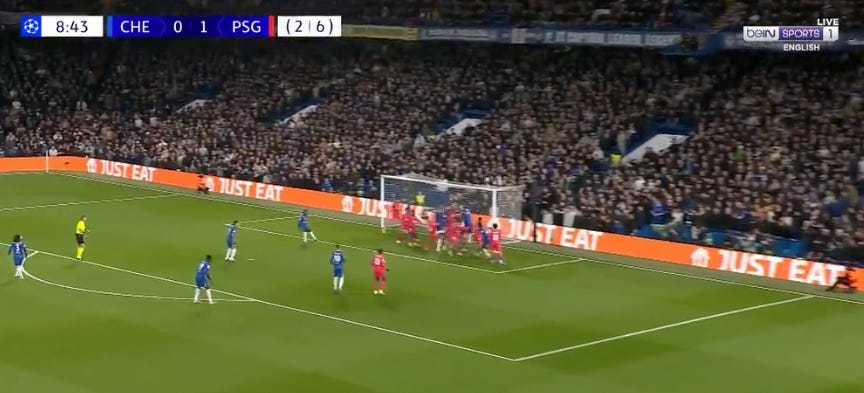
This also works for free-kicks.
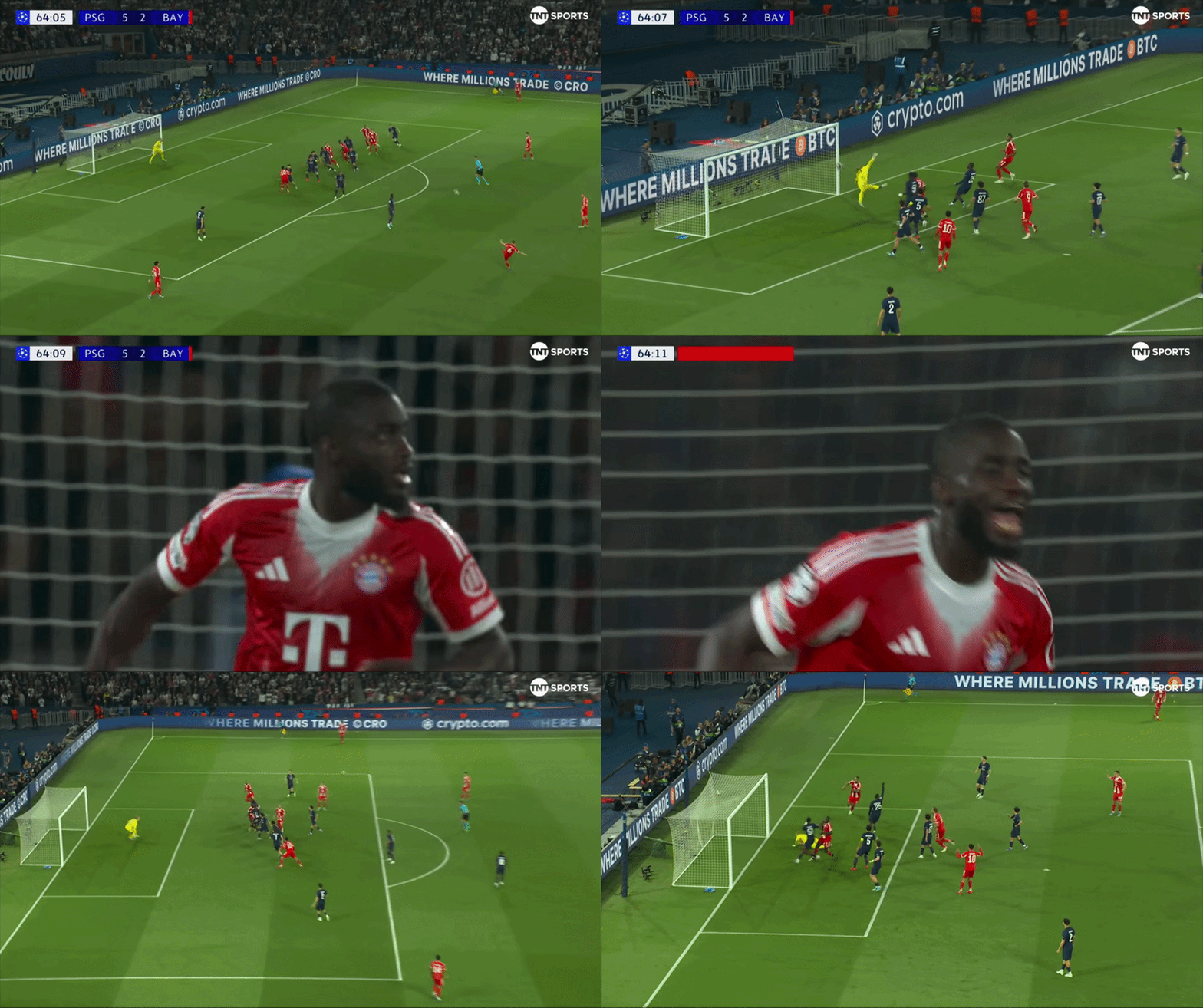
There are chasms of space at the back post, and in the zone around it for scraps. Not many teams have utilised this space, or perhaps have tried to access it through front-post flicks, but with Arsenal’s deep delivery quality from Rice and Saka, it could prove a wonderful pool for Gabriel to dive headfirst into, or Trossard to hang out at.
Baiting the keeper into overextending and throwing his arm at it also extends to long throw-ins, which Joe Gomez recently found by aiming at the front post.
I think aiming to bait the front zone and exposing the under-staffed back would be a real play here, and one Arsenal are very accustomed to (this is basically the same idea as how Kai Havertz got his free header vs Burnley).
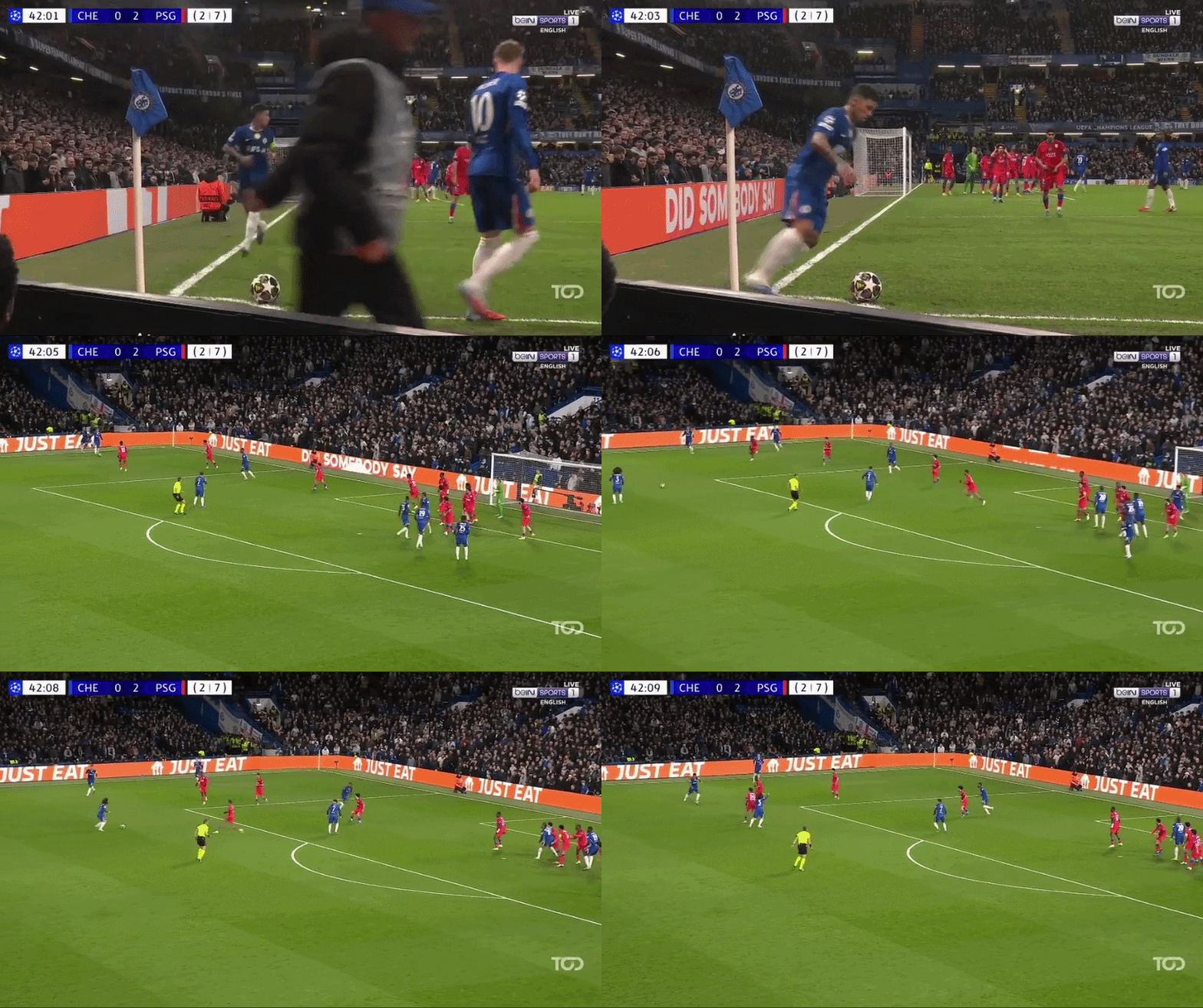
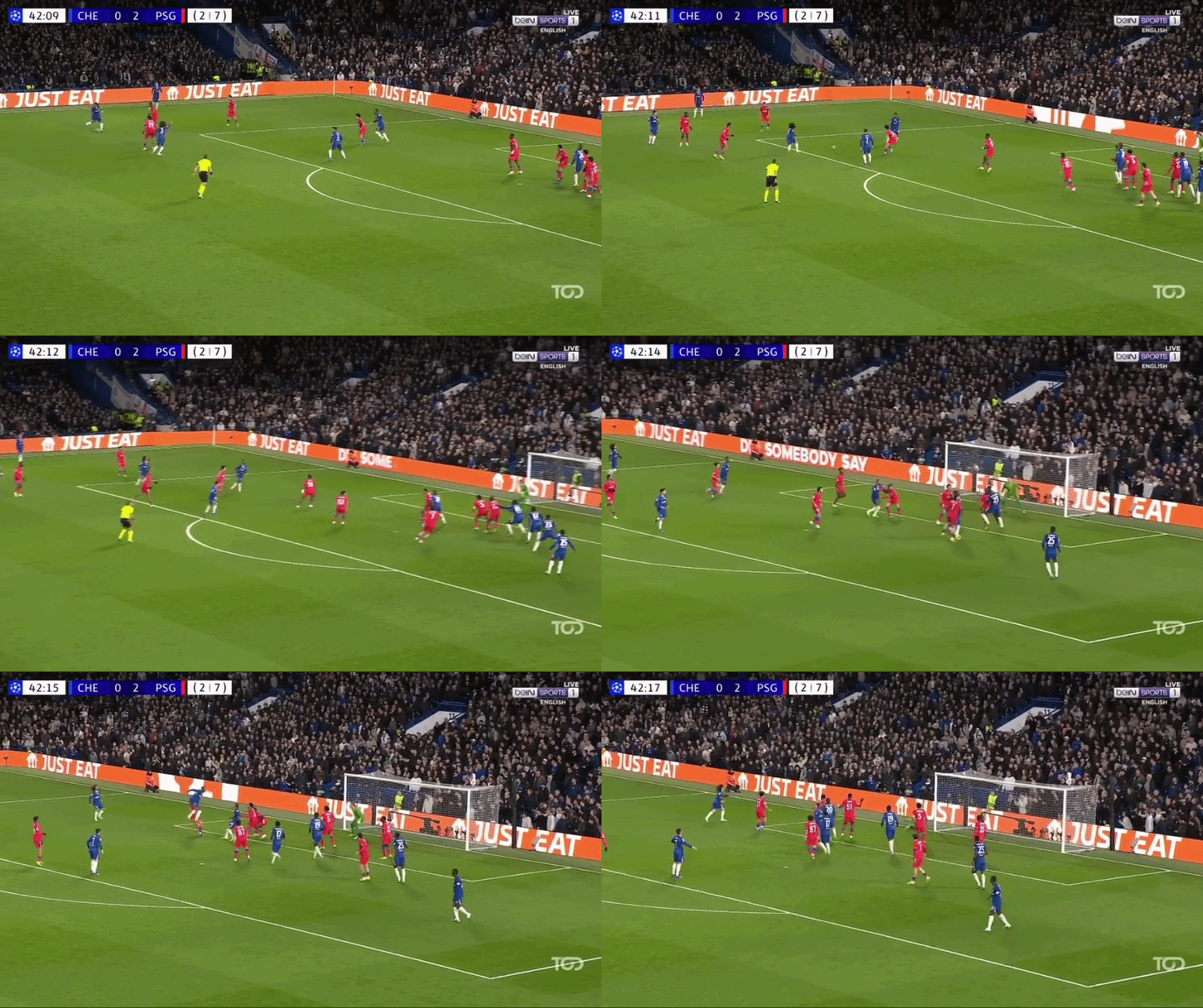
What Arsenal should be very fearful of is the short corner. PSG, again, much like in open play, have a very snappy front-line pressure in these moments, and will force a team back very quickly given the chance.
Take, for instance, this corner Chelsea earned in the 43rd minute of the return leg:
This, however, leads us into a nice amalgamated section of set-piece analysis, which I can subtitle for you.
👉 Counter strategies
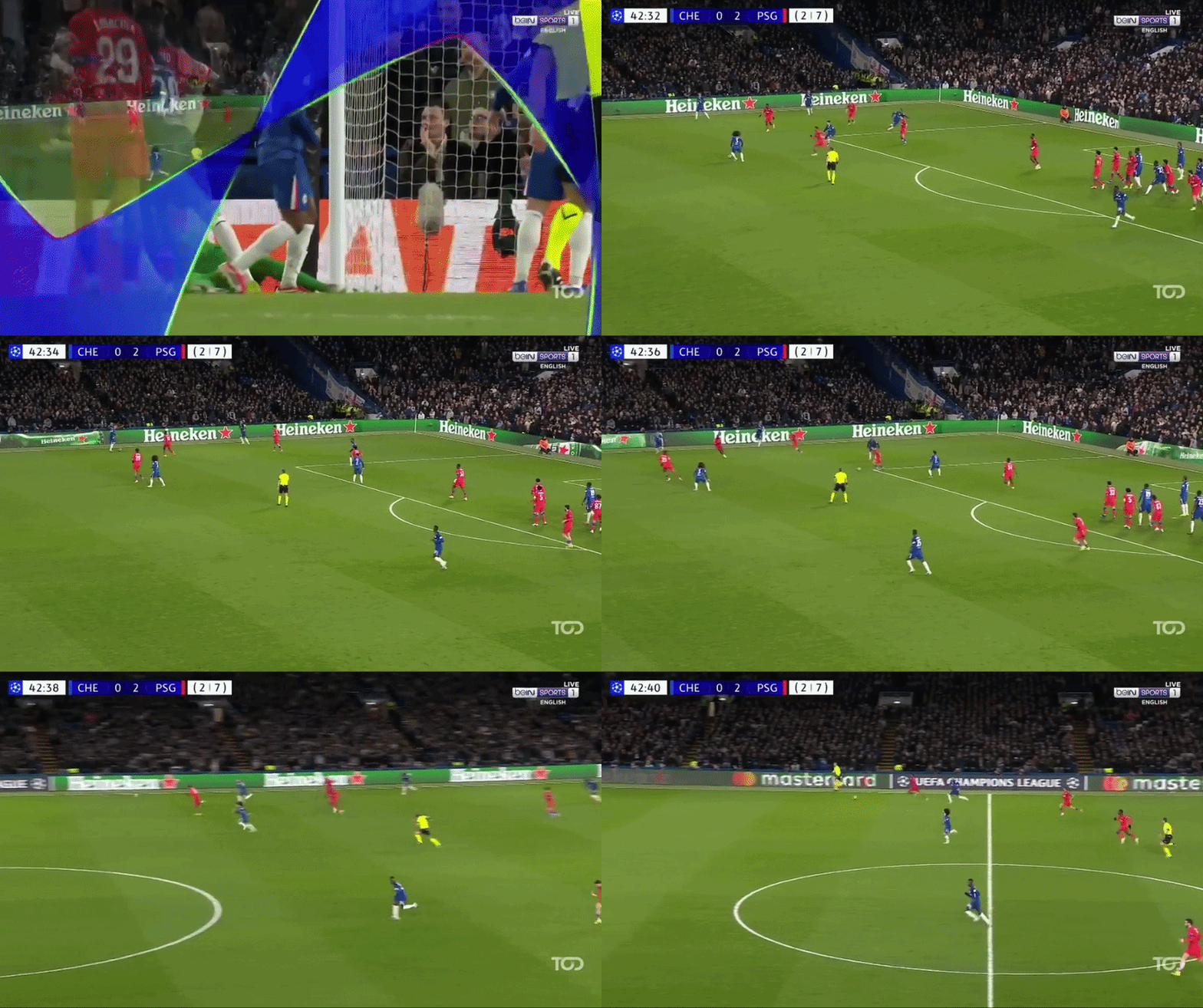
This outward pressure is consistent with PSG in basically any forward zone, with the aim to move the opposition away from their box as soon as possible and ideally get a nice counter from it, like above.
However, sometimes this is overzealous, and this presents a real strategy to beat PSG at their own game.
As the pressure builds and front-line runners move out to hit CBs hard and fast, what happens is that gaps naturally emerge – Dembélé is especially at fault for becoming a press leader with no understanding of how fast his teammates actually are. Much like with Arsenal’s second-phase issues last term, the reshuffling of parts following the re-emergence of open play presents opportunities (also known as Massive Gaps) which can be exploited. This clip specifically reminds me of something Calafiori is capable of – I know it’s Chelsea again, but there’s a reason they paid millions for Bernardo Cueva:
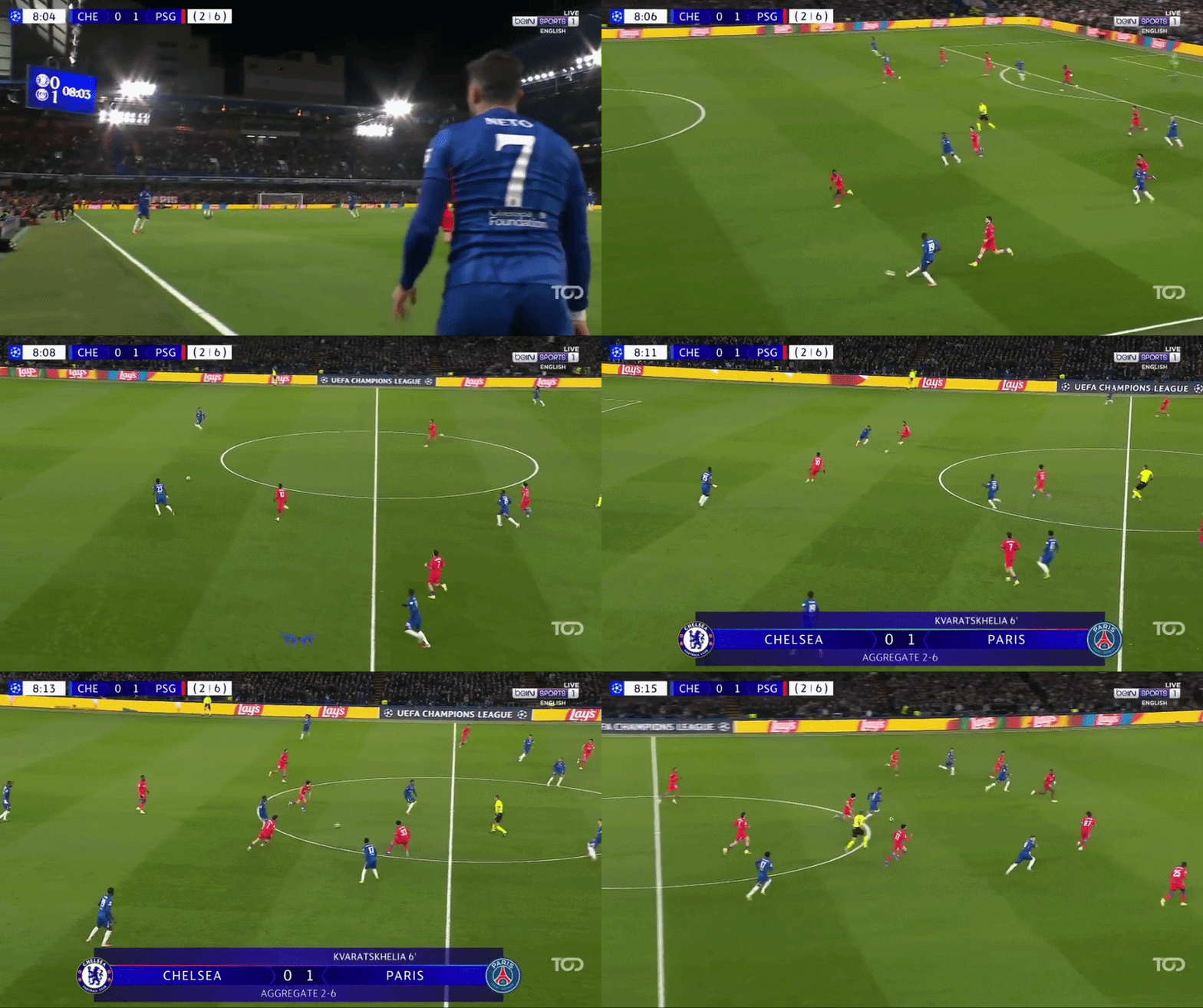
Recycling moments can produce quasi-transitions through some powerful running, hitting PSG at their own game, which is something they aren’t particularly suited to, frankly. Even if you want to limit how often you get into a running race, you can utilise this to earn positive wide overloads. The issue will be how much this strategy would involve Mosquera, but it enables you to vary strategy without playing into PSG’s hands.
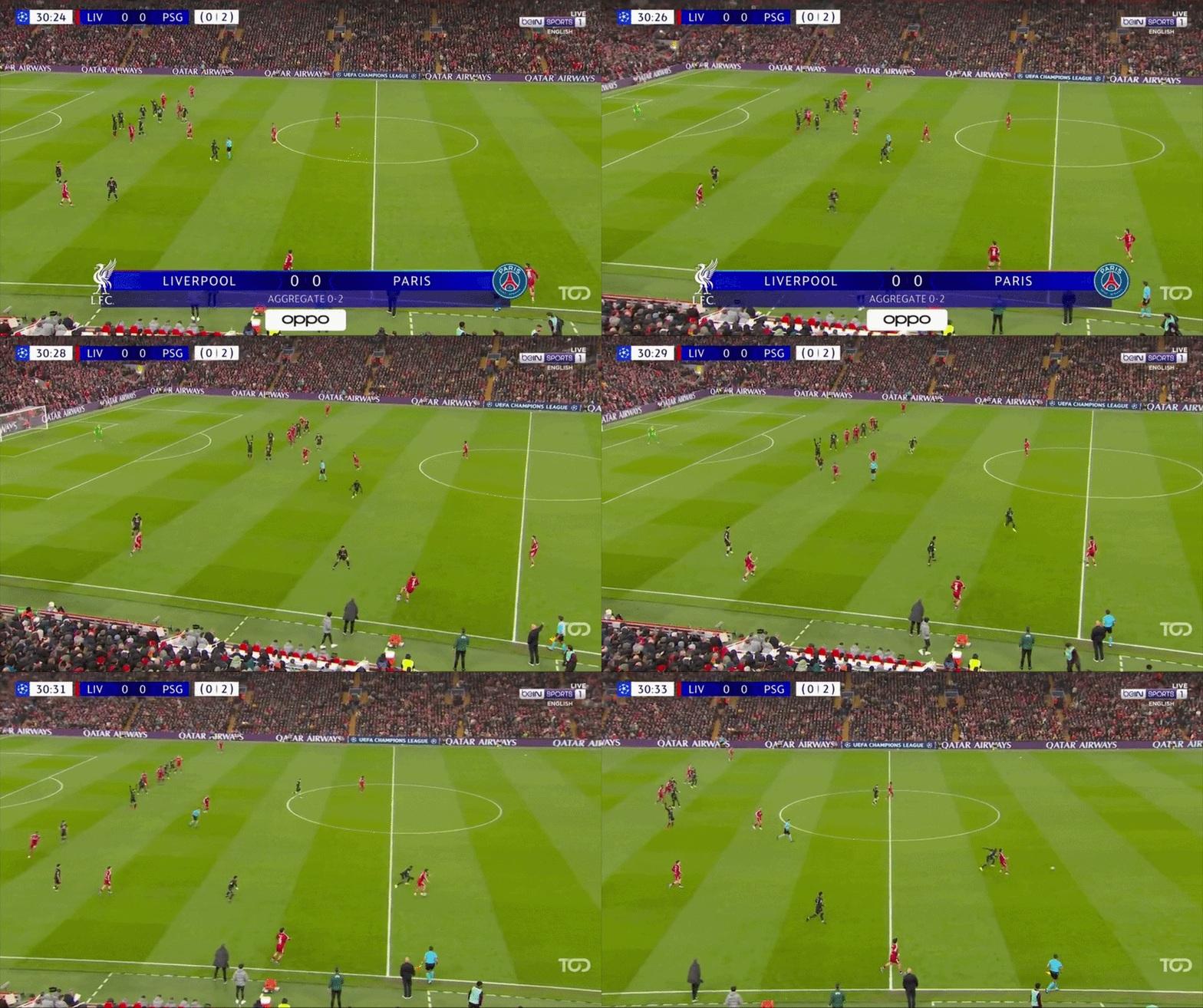
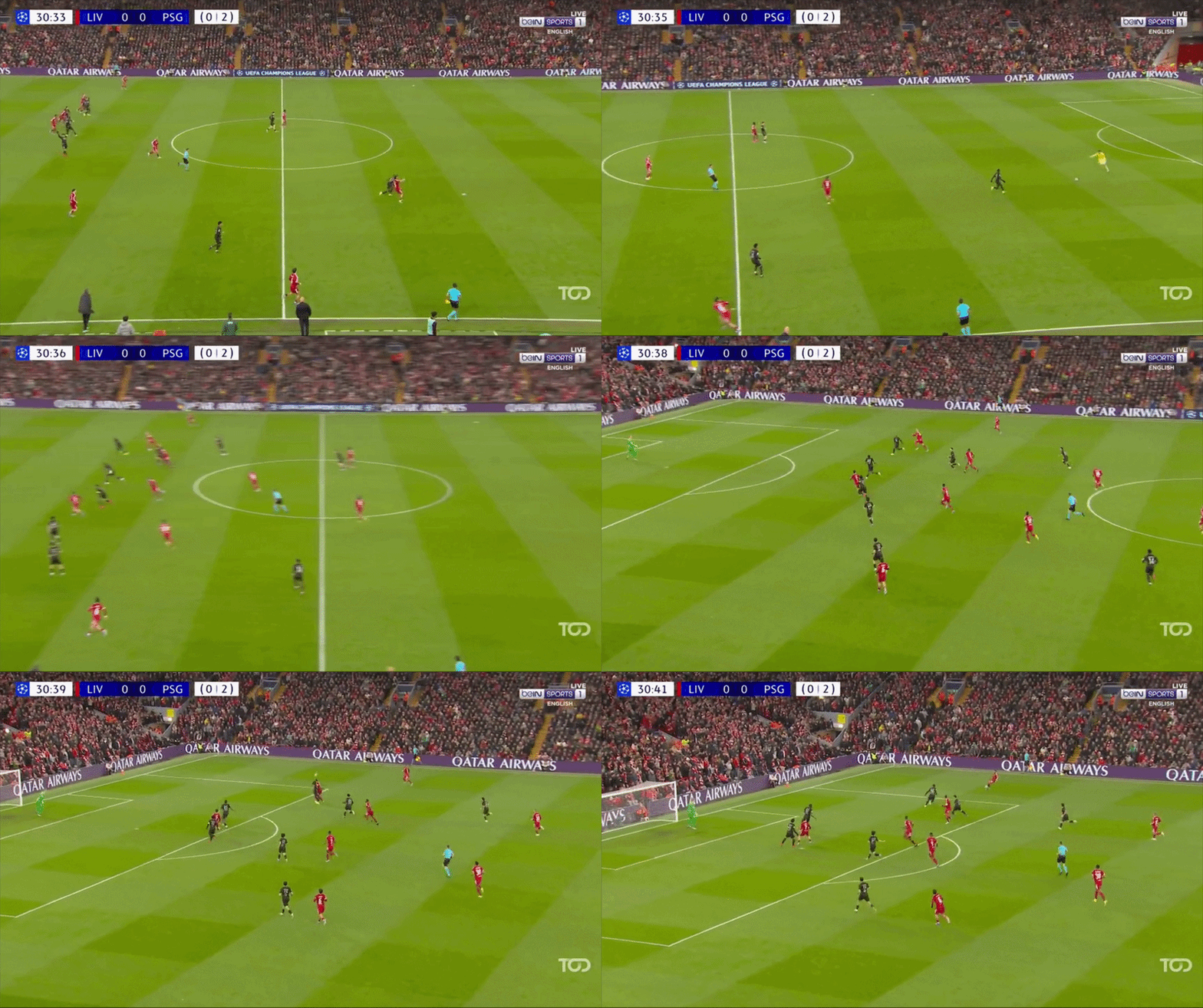
All of these tactics are best served focusing on the far post of PSG, or at least the part of the set-up furthest away. This is typically the weakest/emptiest part of the structure (see: at corners), and it’s no surprise this is where Tottenham found joy all the way back in August. With an unsure keeper and a structure that is rarely fully tested domestically, there are weak points to poke and prod at if you can avoid their stronger areas.
The final point I’ll make here is that this will need courage. Both offensively and defensively, to avoid PSG allowing set-pieces to become another part of their game domination, you need to ensure that tactical space remains yours: not falling for baits outward, resisting the urge to defend automatically and remain active, reduce space for top-of-the-box shots, pushing up and out to limit João Neves’ running starts, pulling PSG out of shape by trusting your build-up, and giving yourself as much space as possible at the far post for a charging header. A cohesive game-plan to ensure PSG remain uncomfortable can fundamentally change the fear and pressure in these moments: some oversized cojones could go very far.
OK, thank you, Jake. Required reading, all that. Now, back to my voice.
🔵 Game-state
When I pulled game-state data across competitions, I found a few things:
PSG look the least potent, and have lowest xG difference, when losing. In those situations, they have the most possession, shoot more from outside the penalty area, log fewer counterattacks, have the highest press, log the fewest passes per possession, and, perhaps most notably, log a lot more crosses (twice as many as when they are drawing). It’s easy to understand causes and effects there.
They are incredible at tacking on to leads, logging the most goals and shots and goal difference in that situation. They are happy to defend a little and then play explosive counterball, which makes sense.
In attack, they log the lowest xG when the score is even.
Now, using Understat data, we can look at how they fare per timing of the game in Ligue 1:
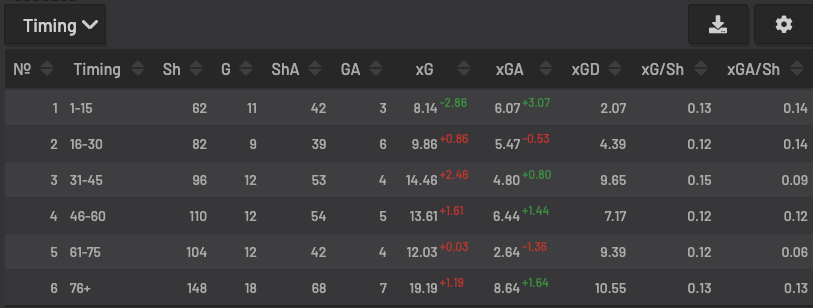
It’s clear they are most potent late in games, which is usually the case (there are more tired legs and the most minutes available), but it is especially the case if you have the kind of attacking quality that PSG offer. Most interestingly, their performance is lowest in the period after things settle in, between 16-30’. After watching, I’d suggest that it has something to do with PSG starting to go for it, having a sloppy moment, and being caught with a bad rest shape: in that period, the goal differential is only +3. Arsenal, often more conservative in first halves, may want to go for it early.
Also in the league, here’s what it looks like based on game-state.
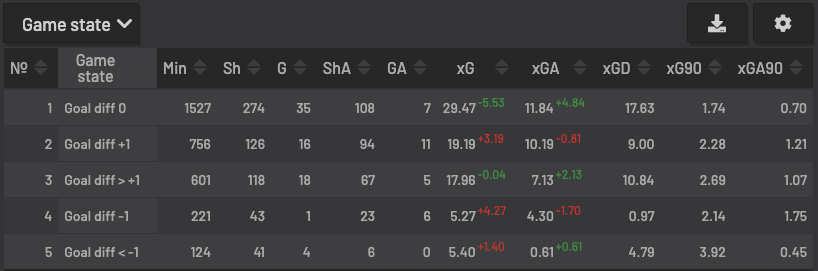
They have the lowest xG/90 in even state, and the second-lowest when they are down by 1. It’s a small sample, but when down by a goal in the league, they only scored once and conceded 6 times. In other words, leads and losses can both compound for PSG.
🔵 Selections
Here’s where I’d lean.
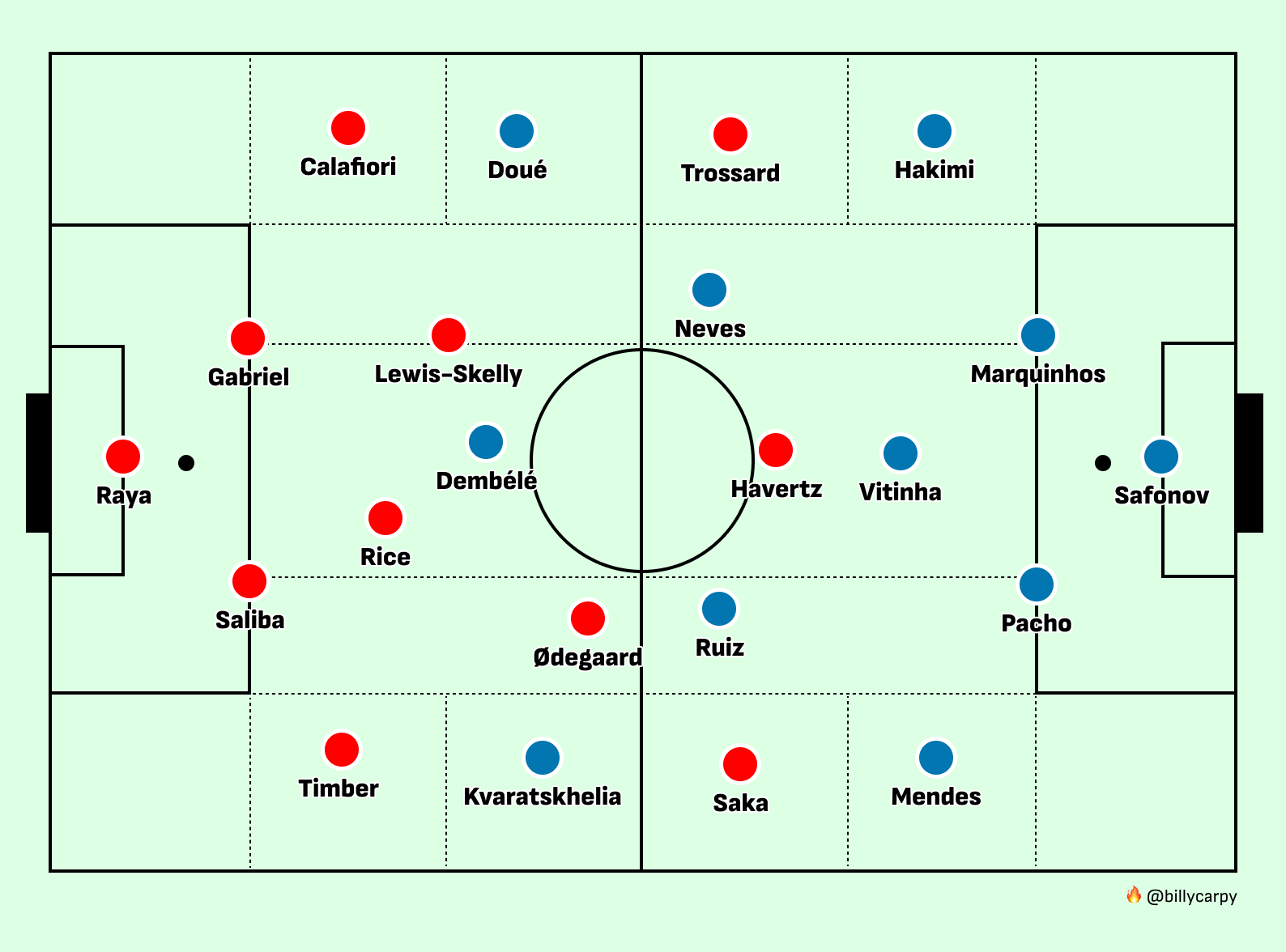
My thoughts:
Havertz wins out for his ability to go over-the-top and win aerially, as well as his ability to drag a CB and play total football. Gyökeres can come on as a finisher, where he’s been looking great. I’d like him to do shoulder runs on Marquinhos in the last twenty minutes.
Timber is the obvious start if he’s free to do so. If not, I would go with Mosquera. While I suggested Zubimendi at right-back the last time we spoke, and then we saw it at Crystal Palace, I think that looks most dangerous when we’re facing a pinned opponent and need another dynamic player in the pockets. For this, I’d prefer Mosquera to face play and defend, enabling the left-back to roam at will. There is still an argument for Zubimendi, as the full-back gets such valuable free touches in this system, and he can come on as a sub, but I’d ultimately lean the other way.
On the other side, Calafiori is a clear choice for me. His underlaps and ability to provide an option above the pivot will be huge for exploiting the spaces that PSG can leave open. Hincapié can come on at 65-70’ and do well in whatever game-state that requires (defending, or chasing a goal + running + crossing).
Trossard is the likely choice for me (and Arteta). That move where he pulls back on the touchline and hits it into the half-space should be on, and he’s been playing great of late. Martinelli can arrive as a closer at either right- or left-wing, though I’m a little tempted to have him sprint behind Hakimi. I suppose that can wait.
I’d go with Ødegaard in the RCM spot. Not only does he offer some control, pressing sharpness, and combination quality with Saka, but Eze offers more optionality off the bench. He can come on as RCM, LCM, or LW.
The most difficult decision is Lewis-Skelly or Zubimendi. It’s very 55/45 to me. It ultimately comes down to a deep, personal understanding of the players involved. If Zubimendi were at his early-season finest, it’s an easy call, as he’s superior defensively and so good at dragging around man-to-man schemes like that of PSG. But right now, there is a swaggering sense of Hale End belief that Lewis-Skelly is instilling in the team, and he’s shown how many complementary characteristics he offers to Rice and Calafiori in particular.
Regardless, I’d play Rice in the deeper role of the double-pivot. If Zubimendi starts in midfield, I’d want him to reprise the role he played in the first leg against Atleti, higher and more to the left, playing in the pockets.
The subs, then, are fun to think about: Eze, Martinelli, Merino, Gyökeres, Hincapié, Zubimendi, Madueke, Jesus, Dowman, Nørgaard.
🔵 Final thoughts, gameplan, and levers
This section, in particular, was done in coordination with Bastian (@austriangooner1).
PSG are the best attacking team in Europe. This is because of some savvy tactics by Luis Enrique, sure, but it really comes down to their outrageous attacking quality and depth, their shared identity, and their ability to rest and rotate. These factors have hidden a structural cost. Their fluidity and man-orientation leave exploitable windows, but they require a team with defensive qualities to force turnovers, and then the speed of action to punish before they can regroup.
In the Champions League, their attacks are a little slower and more foreseeable than may be commonly thought, but that doesn’t make them any less devastating. Those fuckers can strike at any time. This, then, shakes hands with their outlandish defensive intensity, which is aggressive and high-octane in every third.
The idea is to show them the cost of their rotations. We can take advantage in the moment we win possession, target the space behind the full-backs, use quick restarts to unsettle them, and transition faster than they can regroup (or interrupt). These windows are short but potentially exploitable.
To sum things up, here are a few levers to pull.
👉 Defensive levers (how we nullify):
Commit a brave, lopsided, high man-to-man press. Ferry them to their left. Our CBs can follow their central hubs to deny the connection between deeper build-up and the attack. Arsenal can take a slightly different tack with Vitinha, with more conservative positioning, cutting off his right-side access, pushing Ruiz into some back-to-play receptions, and forcing clearances onto Safonov’s left foot. This all requires full commitment. They’ll happily remind you of the cost of getting a trigger wrong even once.
Force ‘em long. Safonov would rather hit it out than play through. Raya’s sweeping, plus Arsenal’s aerial advantage, means a long-ball is close to a guaranteed turnover.
Keep the play in front. This is mostly about distances between our backline and midfield. The false-nine coverage and handoffs will require constant communication. We can’t allow the likes of Dembelé or Doué the room to carry it out. We’ll have to drag them down if we’re caught out (respectfully). And the likes of Lewis-Skelly have to be careful of early yellows.
Beware double moves and switches. In settled play, PSG’s best attacks have a familiar chorus. Their top chance-creation move is the wide double-action (where one drops and one gallops into the half-space). The other big move is the hit out to the opposite-side winger.
👉 Attacking levers (how we score):
Counter behind the fullbacks. Hakimi is seemingly always high; Mendes is often high. When we win the ball off Mendes’s side, the transition coverage is Vitinha (who is often wide) and the two CBs. The other midfielders are usually ahead of the play. The first look on every turnover should be to the spot the full-back just vacated.
Manipulate the man-marking. When Pacho follows Havertz into midfield, Marquinhos will then be isolated. Likewise, if the left-back (Calafiori) can drag Hakimi away, Marquinhos is on an island versus the Arsenal left-wing.
Calafiori underlaps. That thing where Trossard hits it from the wing into the half-space definitely feels on.
Go long, strategically. Havertz time. One idea is to avoid Pacho and have someone target Neves in the air on purpose, even though he’s their best aerial midfielder. The point is to leave Vitinha + Ruiz (or WZE) as the second-ball net, which is much preferable to battling it out with Neves.
Sustained pressure. Not for lack of effort, their entire frontline can get caught far up, as we saw against Bayern. Forcing them to defend their own fullbacks pulls them out of attacking shape and can tire them out. Let’s back-post overload at almost all times to compound it. In general (Bayern notwithstanding), they aren’t used to conceding territory for longer spells, and can look chaotic when doing so.
Saka vs Mendes is winnable, one hopes.
Late arrivers on rebounds. PSG congregate around the ball and leave the second six-yard box thin. Only Neves and Pacho can really fight there.
👉 Game-state / energy levers:
Du-el. Somebody asked for my ideas for beating PSG. I said, “My strategy is mostly around nerd-bashing. You find the little nerds and then you bash them.” I have not changed my stance. This involves tackling on the right triggers, Rice and Lewis-Skelly driving through on carries, and scrapping for every second ball. Throw in Havertz dropping around their midfield, and a Merino sub late.
Restarts as weapons. Quick free-kicks, throw-ins, and Raya pick-ups can hit the disjointed or rotated press before it sets. This is Fluid Team Kryptonite. There isn’t a better way of changing game-state and gaining momentum than throw-ins into the box. Take something out of Brentford’s book. Aerial superiority should allow us to create high-pressure moments and take advantage of the fact that you can’t clear throw-ins off first contact like you can with corners.
Clearances must be passes. We can’t volunteer territory back.
Manage the score-state. When we went through the numbers, we saw PSG’s per-90 xG climbs through the match, which is fairly normal, but especially prominent. They’re at their most efficient when up one, and most fragile when down by one. The ideal game would be to get to a one-goal lead, then make them break down a settled block, then get our finishers on.
Acknowledge momentum windows. Something we had been doing very well in the first half of the season, and at our peak, is knowing those moments where the momentum is there for the taking. To fall back into shape, conserve energy and retreat when the press starts to lose control. To get on the front-foot and push the issue when the opposition starts to make mistakes on the ball. To control tempo in possession and sustain possession in the final third when it’s needed instead of being overly aggressive and turning the ball over. In recent months, and past seasons, the pressure of being nearly-men has seemingly weighed heavily. We should play free of those old handcuffs.
I won’t try to TL;DR Jake’s section, which had so many good set-piece takeaways. But that battle looms large.
The broadstrokes are all true. PSG boast an incredible team. They can score at any time, even against compact shapes. Their talent is overwhelming. But they also have some clear structural vulnerabilities. And though nothing is guaranteed, I believe Arsenal fans can feel pretty good going into this. I am grateful to you, and I am grateful to this team, and after going through this exercise, I do feel more positive about our chances.
With one dragon vanquished, the team can show up with a mix of joy, drive, pragmatism, and physicality.
One more tunnel to walk through.
I’m scared
I would like to see Martinelli on the left to take care of Hakimi's speed and also exploit the spaces because of his tenacity - he will outsprint Hakimi/whoever covers after a Hakimi run. Calafiori can find ways to get himself involved on his own.
Also Havertz needs to find the spaces, that's our biggest advantage i would say.
Saka beating Nuno won't really happen i think, but he should find joy if he crashes the middle. Let Havertz sometimes drift wide to occupy Nuno while Saka searches for space and combinations with Ødegaard.
I just hope we won't lose because we concede the first goal from them somehow exploiting Mosquera, since he is not very natural on the right, even if he is a really good player. That would be so anticlimactic.
We really need to press them high and nit get beaten by a long ball. But my eye test tells me that Kvara is not that bad in the air, especially if he is defended by Mosquera, nit Timber.