
The tunnel
On the moment, Saka's winner, Arteta's gut, the lineup du jour, the daisy-chain of Rice and Lewis-Skelly and Eze, West Ham lessons, the full-back question, and the walk into the roar
“Henceforth I ask not good-fortune, I myself am good-fortune,
Henceforth I whimper no more, postpone no more, need nothing,
Done with indoor complaints, libraries, querulous criticisms,
Strong and content I travel the open road.”
— Walt Whitman, Song of the Open Road, 1
The tunnel was uncovered, a change Mikel Arteta, in his mania for detail, was reported to have requested ahead of the 2025/26 season. It was the same uncovered tunnel that delivered Eberechi Eze into a frenzy upon his unveiling ahead of Leeds in August, the player turning with a giddy disbelief, still coping with the idea that this was, in fact, real life. On this occasion, the first Arsenal player through was Bukayo Saka, holding a mascot’s hand and wearing the captain’s armband. At 24, he’s lived a full career’s worth of moments compressed into seven seasons, many at this ground, and through all the successes, setbacks, and battlewear, the smiling eight-year-old who joined Hale End was somewhere underneath.
The Champions League anthem blared, and on rewatch, you appreciate the choreography of the camerawork, panning through the lineups from right to left. The shot of the Arsenal lineup started, again, with Saka. Then it surveyed the remaining players, of various heights, all with their own stories. The second-from-last was Myles Lewis-Skelly, the Hale Ender who has picked up Saka’s baton and was boldly chosen against expectation. Finally, it settled on Eze, who, released by Arsenal as a 13-year-old, had taken 14 years to come home, in no small part to play in nights like these. Saka first, Lewis-Skelly and Eze last. Hale Bookends.
As the horns and choir continued to swell, the camera zoomed out from Eze, revealing the sprawling tifo behind him. A fleet of boats, the words ‘Over Land and Sea,’ the vanquished foes in the background. A decidedly good tifo, unlike last year’s lonely cannon. Things change, and they can improve, but they don’t improve on their own. Tifos or tunnels, tactics or performances, they improve because humans made it so.
There was pandemonium in the stands. All that was left was to play.
👉 The goal
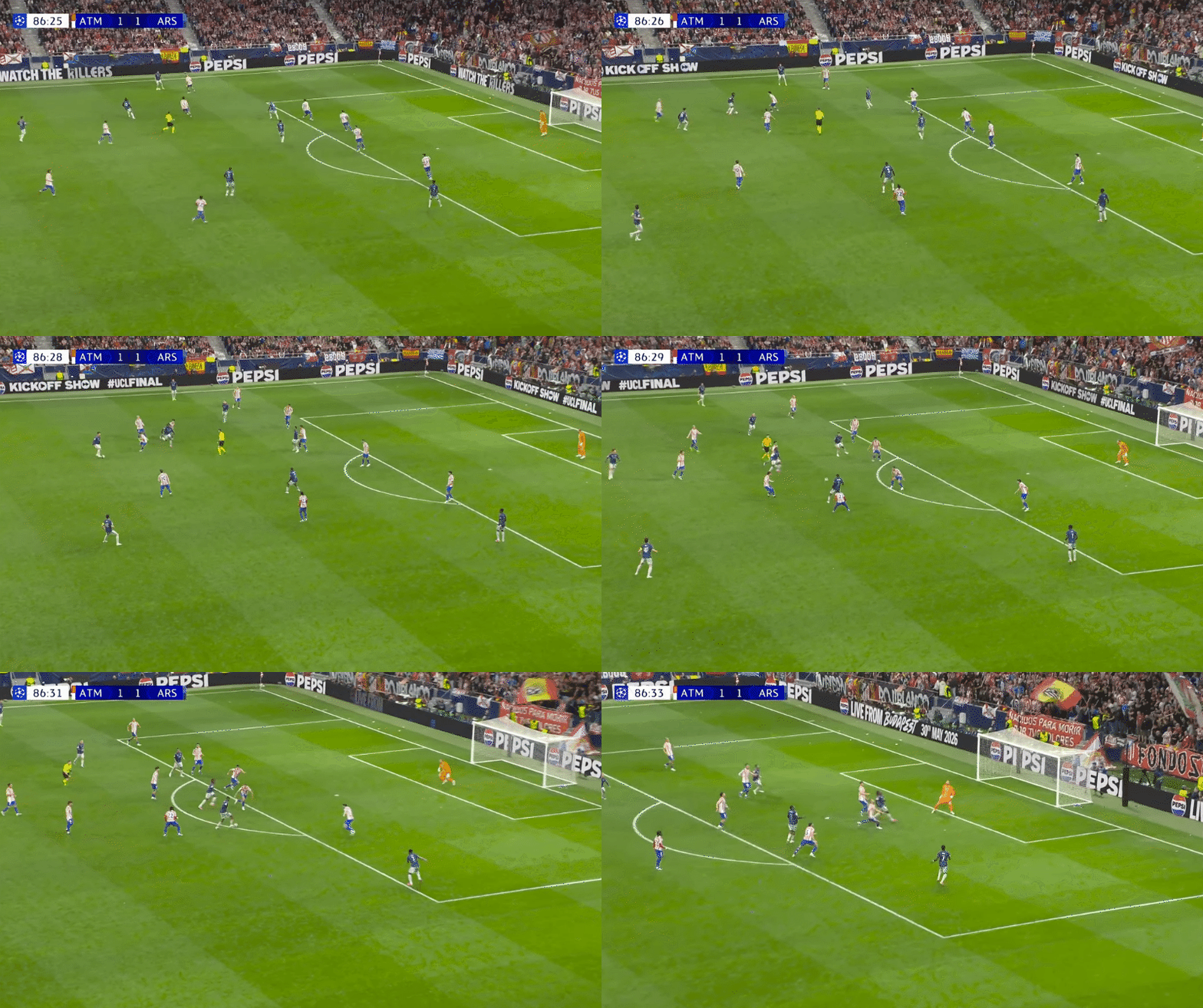
The goal that sent Arsenal to the Champions League final came from a slow accumulation of factors.
Interestingly, the initial period included a lot of work by Saka to float across zones and connect play.
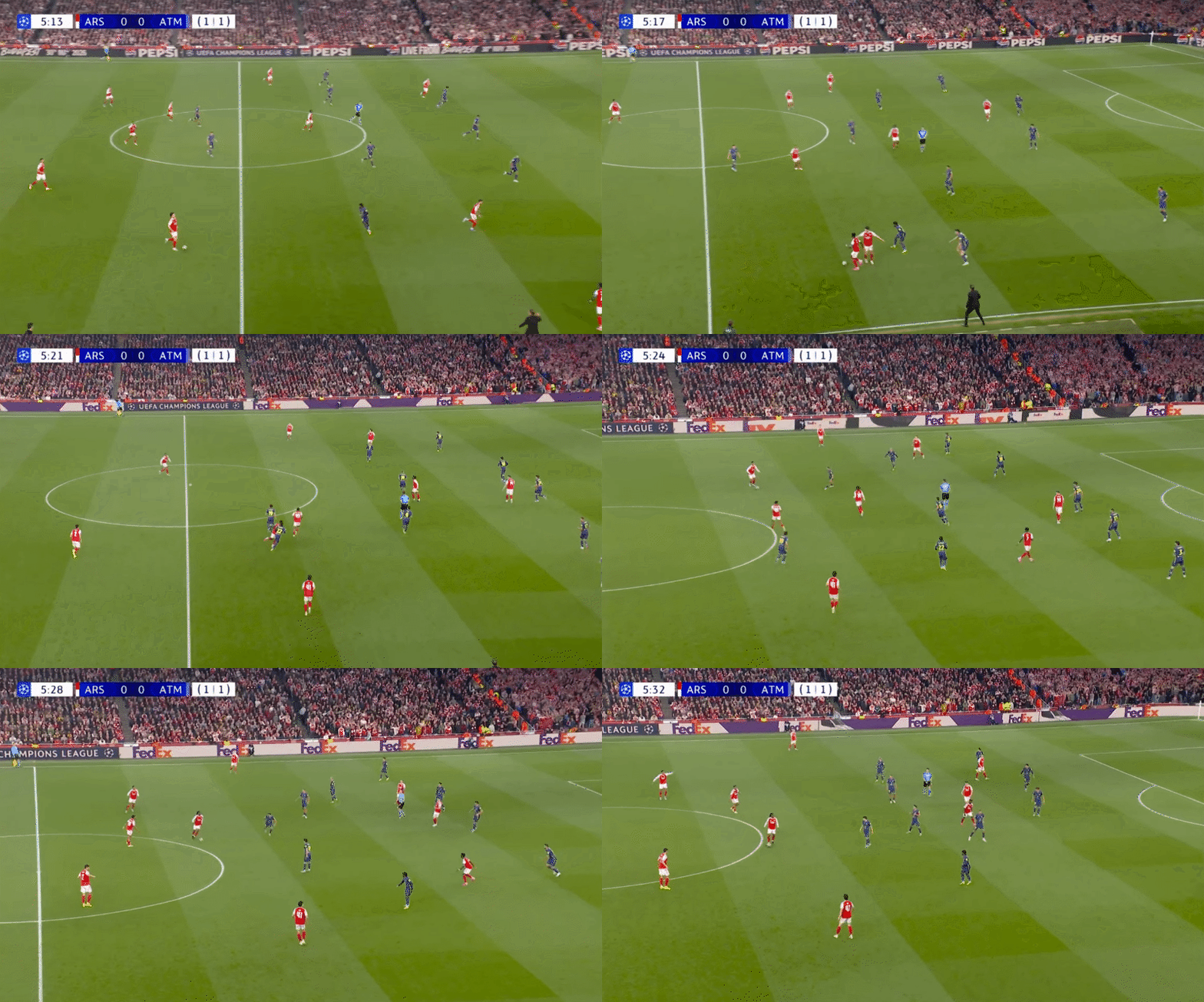
For an Arsenal-style attack, the spare man will swirl around the double-pivot, but with eyes on Eze, Saka would often drop in to overload the midfield and provoke pressure to squeeze in on him, hopefully opening up lanes for others. If anything, some of the responsibilities might remind you of a Jesus false-9 day.
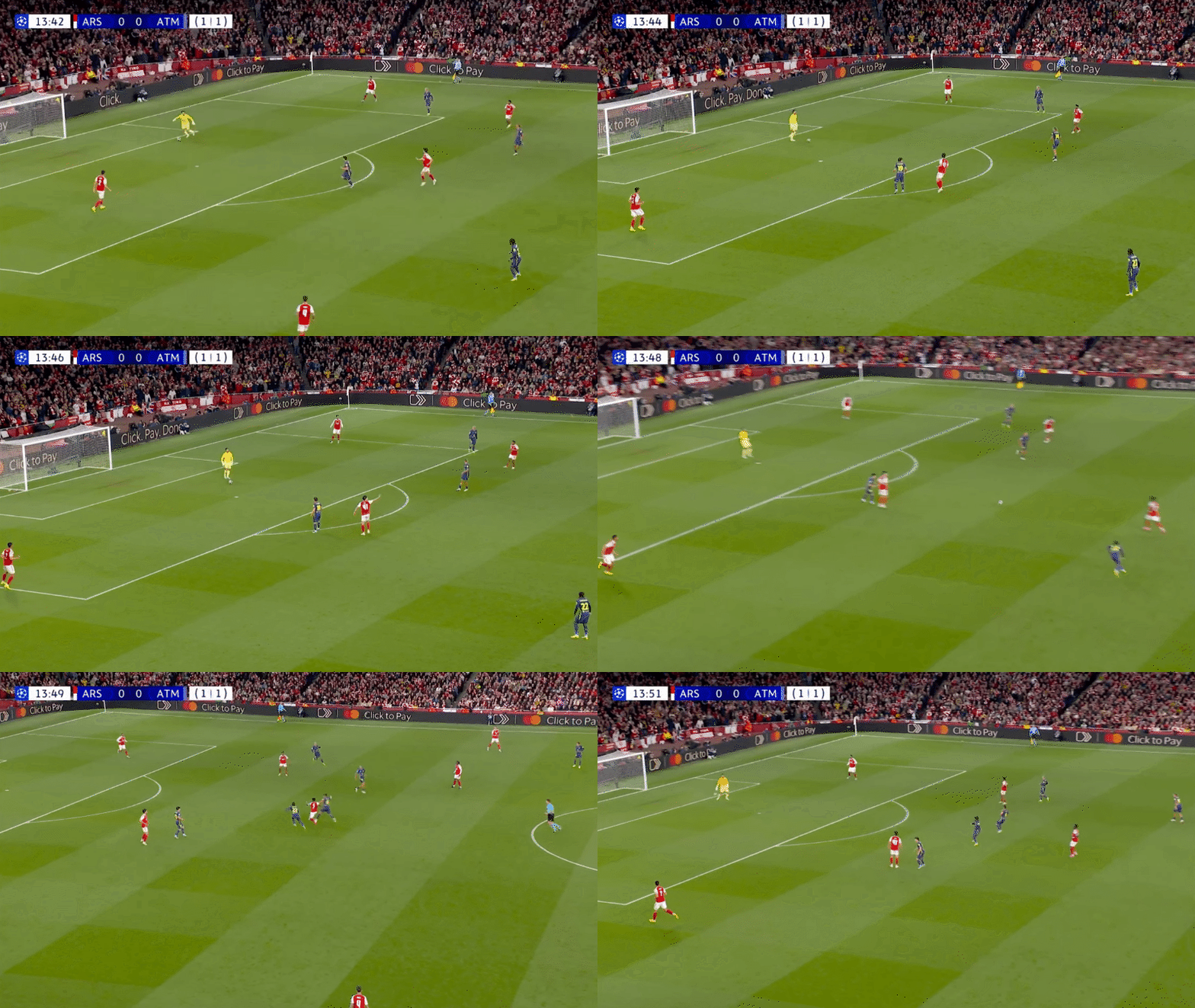
…and another one.
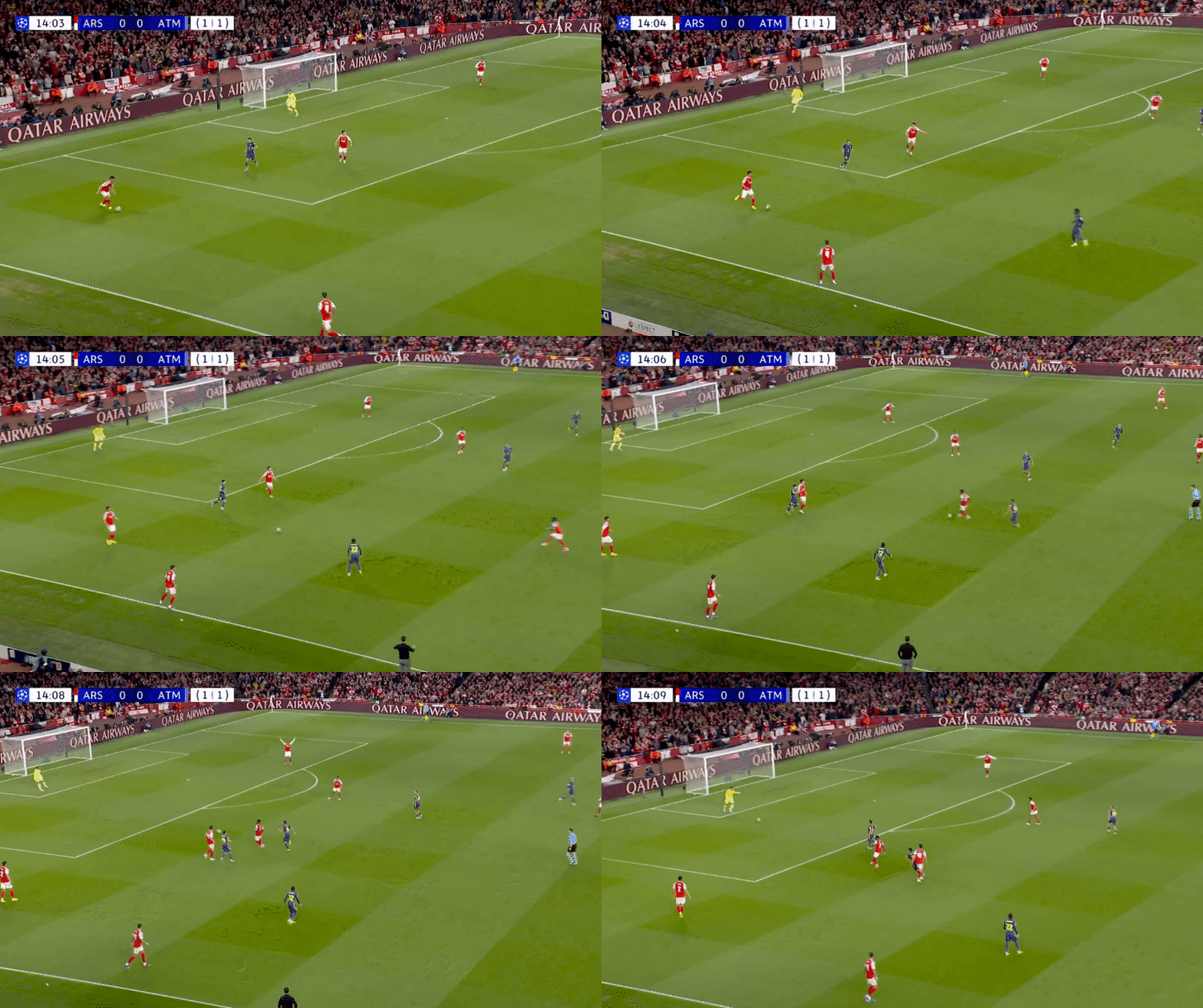
While this costs you a wide outlet threat on the right, it dovetails nicely with Gyökeres staying central and pinning, giving you the ability to execute a box midfield without the striker dropping by default. This also shows you why progression looks better with Saka. Even as a right-winger, he’s a half a midfielder, helping unstick things without losing the ball.
He also gives you the presence of mind that comes from playing with a teammate who can figure shit out on his own. The first half also featured plenty of the hallmarks of a prototypical Saka Shift, in which he accepts the ball on the touchline and attracts 3-4 defenders by himself.
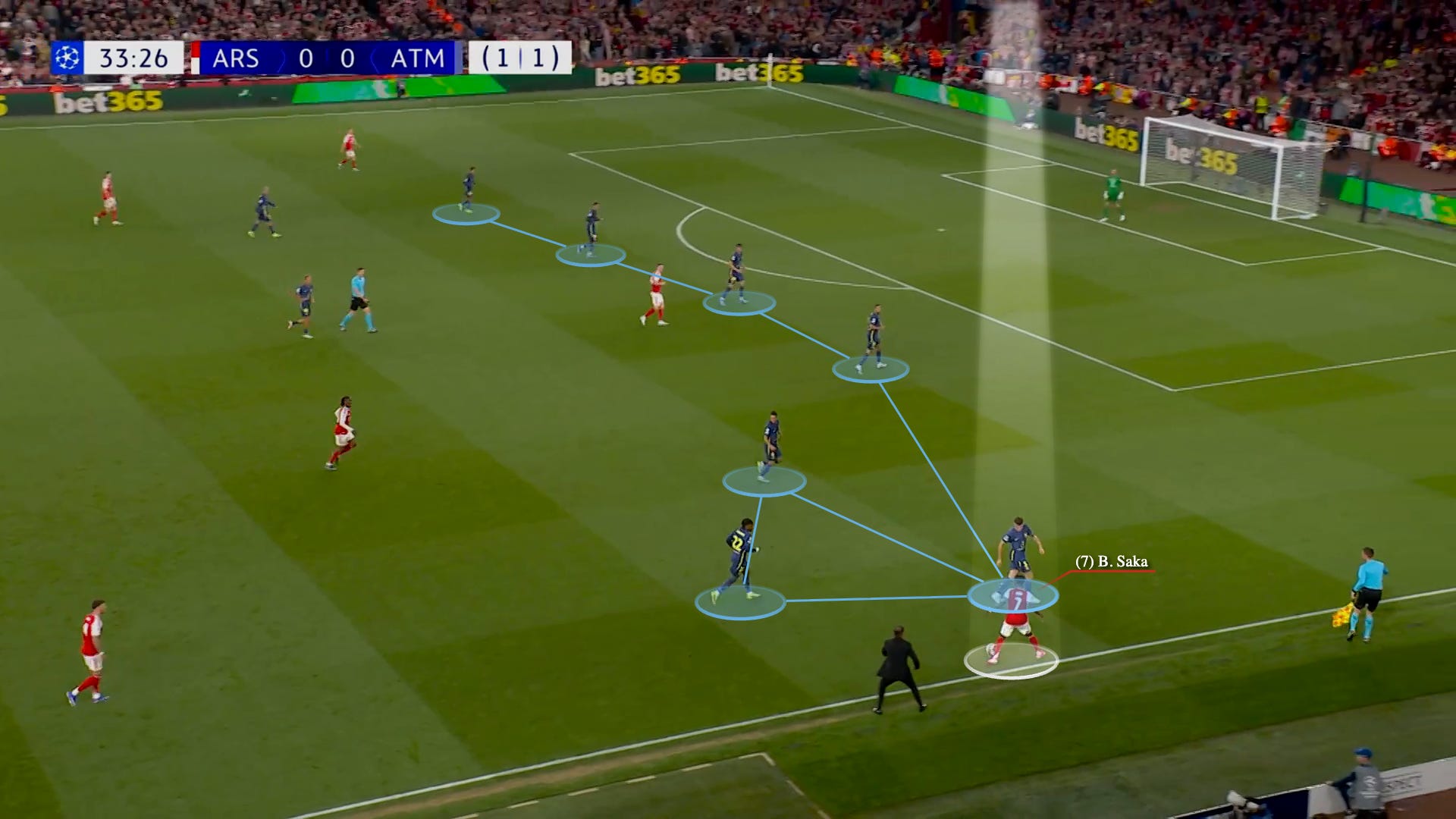
For the goal, he was more off-ball, and was rewarded for his travails.
In so many words, that decisive goal represented how I’d like Arsenal to attack.
Atleti finished the first half without a shot on target. And as the game progressed, Arsenal started turning up the temperature, pinning them back with more dominance, and throwing waves at the final third. The final fifteen minutes were all Arsenal.
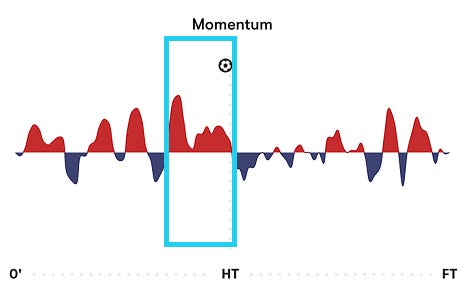
Pressure accumulates and eventually bursts pipes.
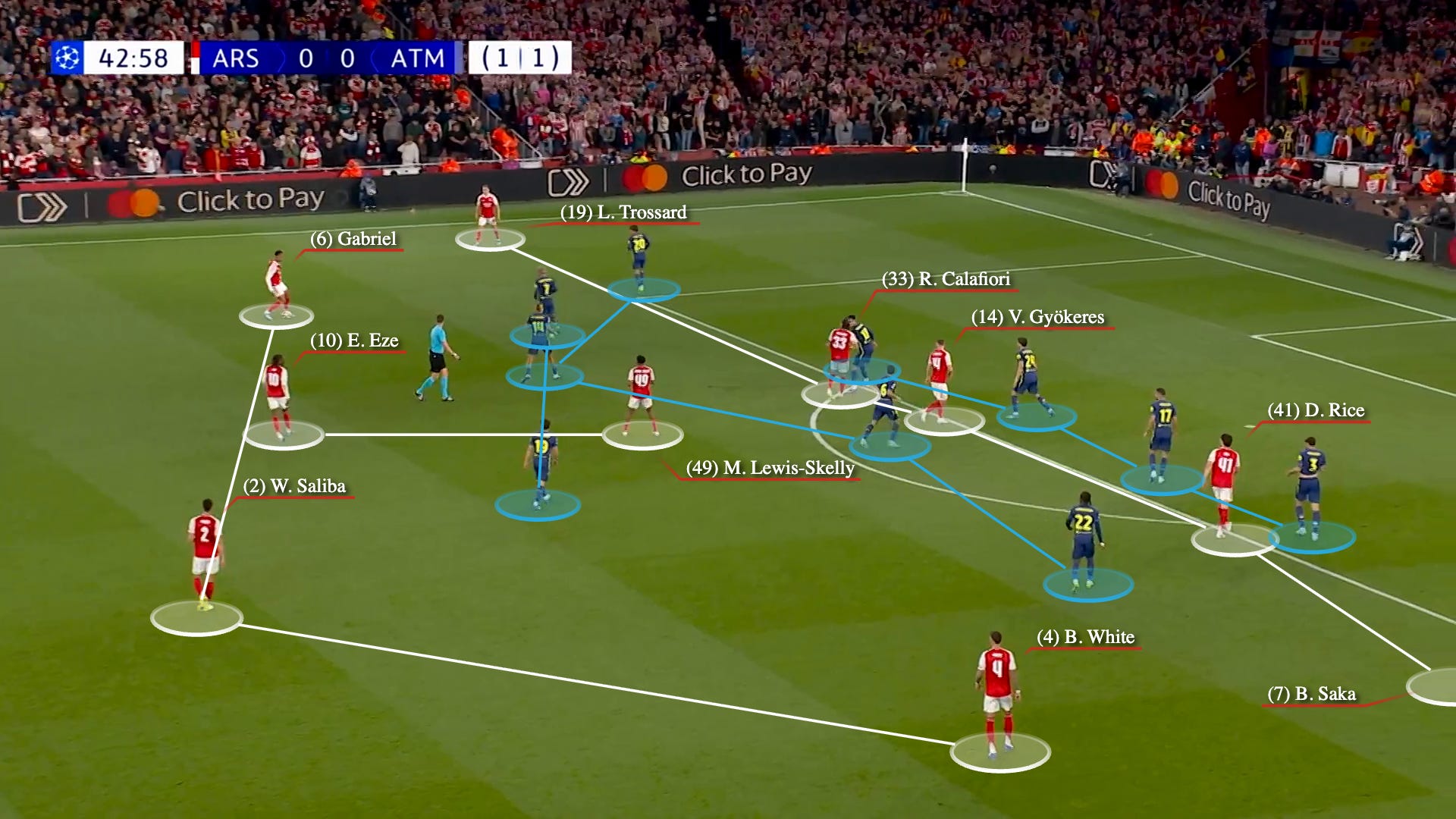
You can see the extent of the pinning here. All 20 outfield players are in frame, save Saka, who’s a little to the right. Gabriel has joined a wide diamond to help push the opponent back. This is not without risks, as the midfield counterpressing duo is Eze and Lewis-Skelly, but Atleti are so far back that they won’t be able to push forward quickly on a ball-win.
Eventually, Atleti were able to hassle Saka during an attempted attack, and Saliba and Gabriel sloppily regroup. But Atleti are just too deep to do anything about this, providing another demonstration of how the dominance of your attack affects your opponent’s ability to send players forward.
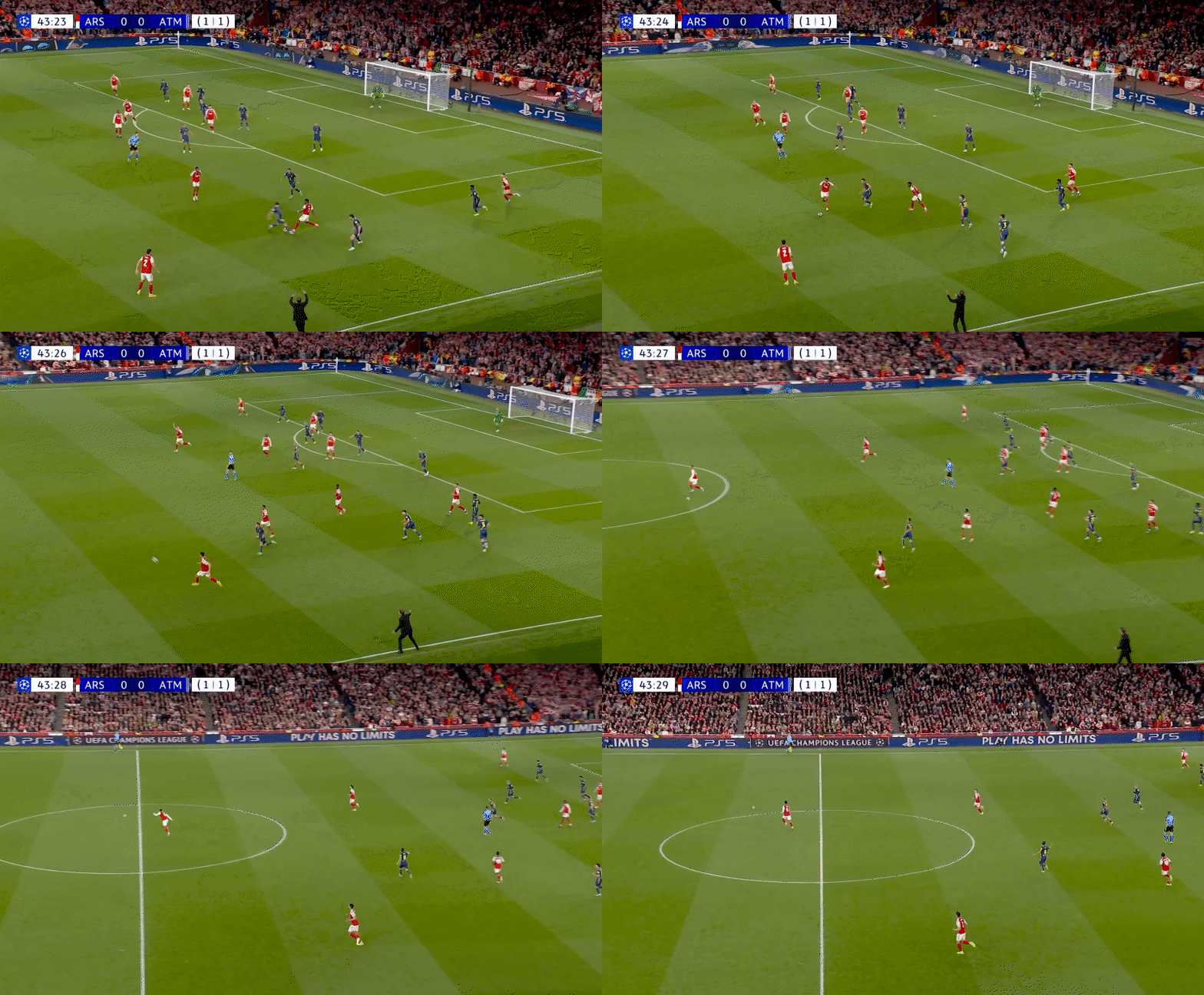
And this is the moment where Arsenal are different this year. Regrouping in the middle third, they are less likely to push forward until a genuine advantage has been gained.
For the last couple of years, some idiot has blabbed on about how Arsenal should try and keep it in the middle third a bit more.
Arsenal would often settle for “easy progression,” advancing the ball upfield on a midspeed carry without creating a genuine advantage. Once the opponent dropped in, the rhythm slowed, and possession turned into patient but predictable circulation: side to side, waiting for a crack that didn’t necessarily come against your Fulhams and Newcastles.
In What’s the Difference, we also probed for answers, looking for the ways Liverpool was more able to generate space than Arsenal. One of the takeaways:
I do believe that Arsenal can recycle back some more, and be a little more patient about advancing to the final third. Teams basically allow those advancements to happen anyway, so Arsenal should wait for more tangible advantages to accumulate to push it forward. This will help maintain the space to shoot when the final action is nigh.
Nice in theory, but this has caused problems when the available front-three don’t then win their 1v1s, or when the long-balls look like hoofs (hooves?). In this case, Calafiori splits the CBs to bring the ball up, and adequate numbers are pushed forward.
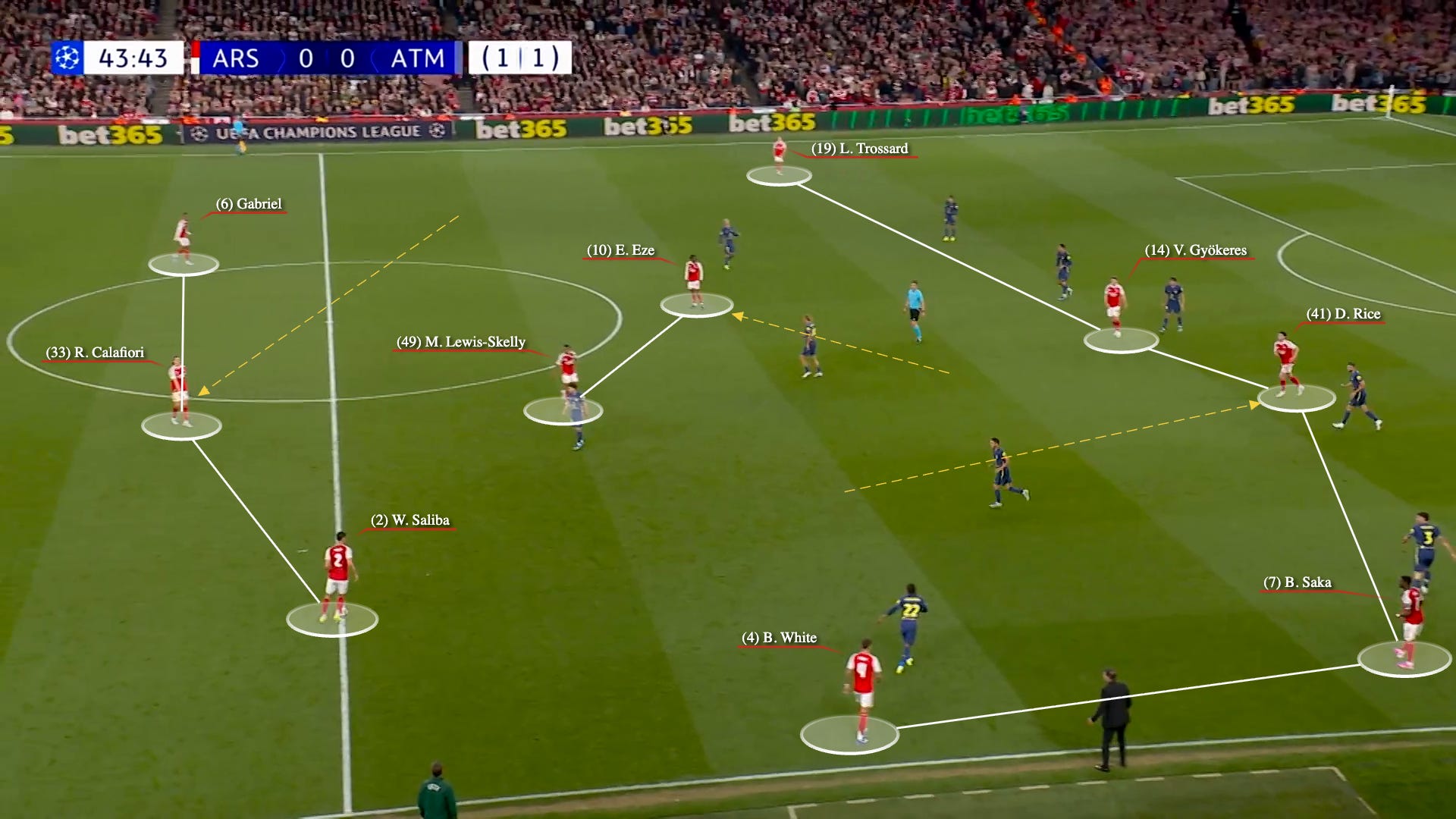
With space behind now created, Saliba hits a ball to Gyökeres, who has timed his run for the moment Rice drops lower, gaining the attention of his opponent. These factors, plus a good matchup for Gyökeres, plus a simply improved Gyökeres, turned the odds for Arsenal in this one.
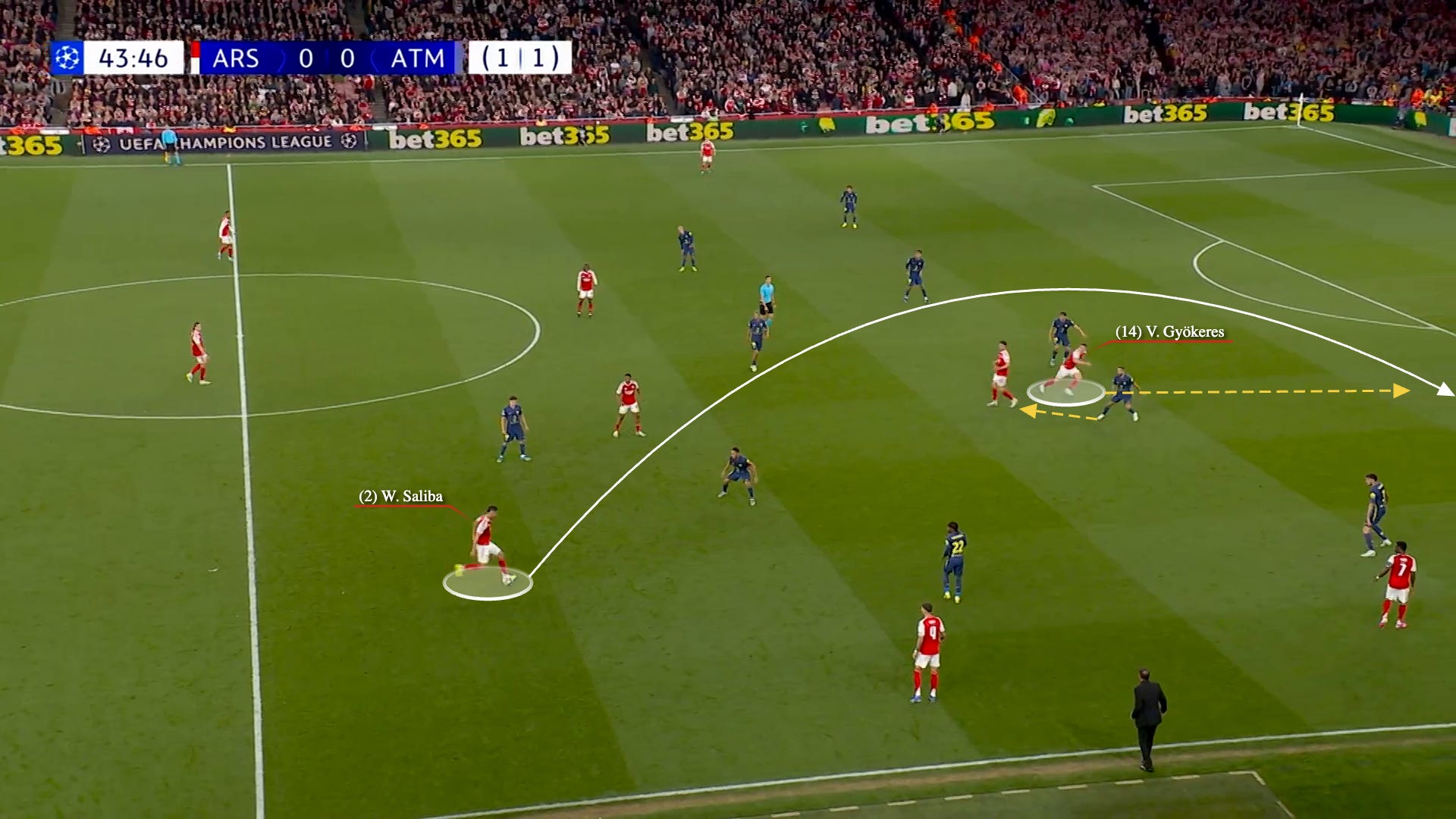
Gyökeres wins the sprint to the ball, as he often did against Atleti. But an opportunity doesn’t immediately present itself. And this is the key: by progressing dynamically from the middle third, and then immediately mounting waves of pressure from there, you are much more likely to catch your opponent in a moment of disorder.
We know what happened next: Trossard probed for a shot, then ripped it off Oblak. Because Arsenal arrived at speed, you do not see a perfectly-disciplined Simeone shape: you see a bunch of players rushing back to clog the middle, attempting to make an individual block. A bit of chaos from an opponent who gives you little.
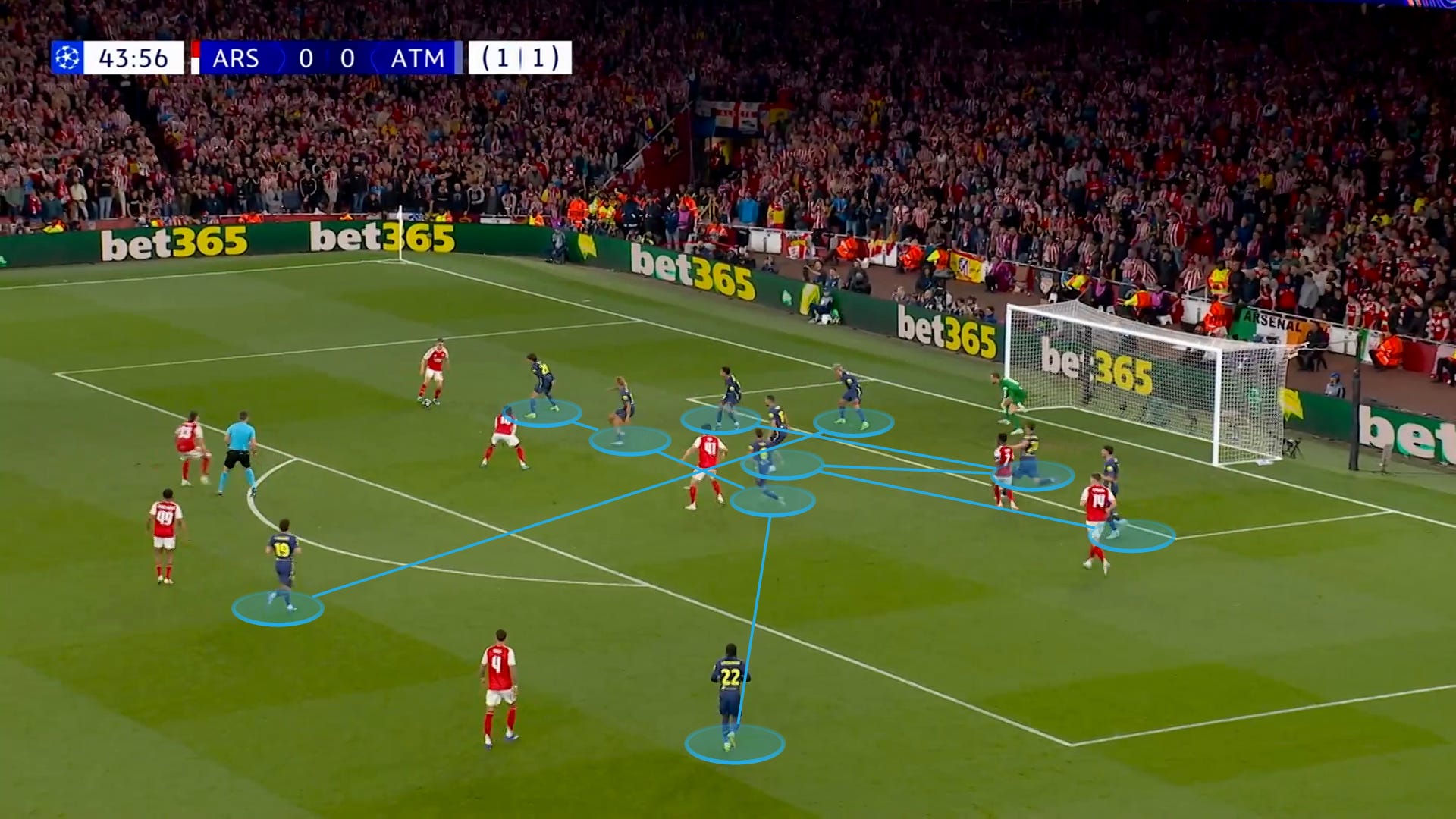
The key was the timing of our subject. Trossard’s two-footedness gives him the space to get a shot off, and Oblak parries it to his left. But Saka is already jostling for position before the ball is struck, winning position in case of a fortunate bounce.
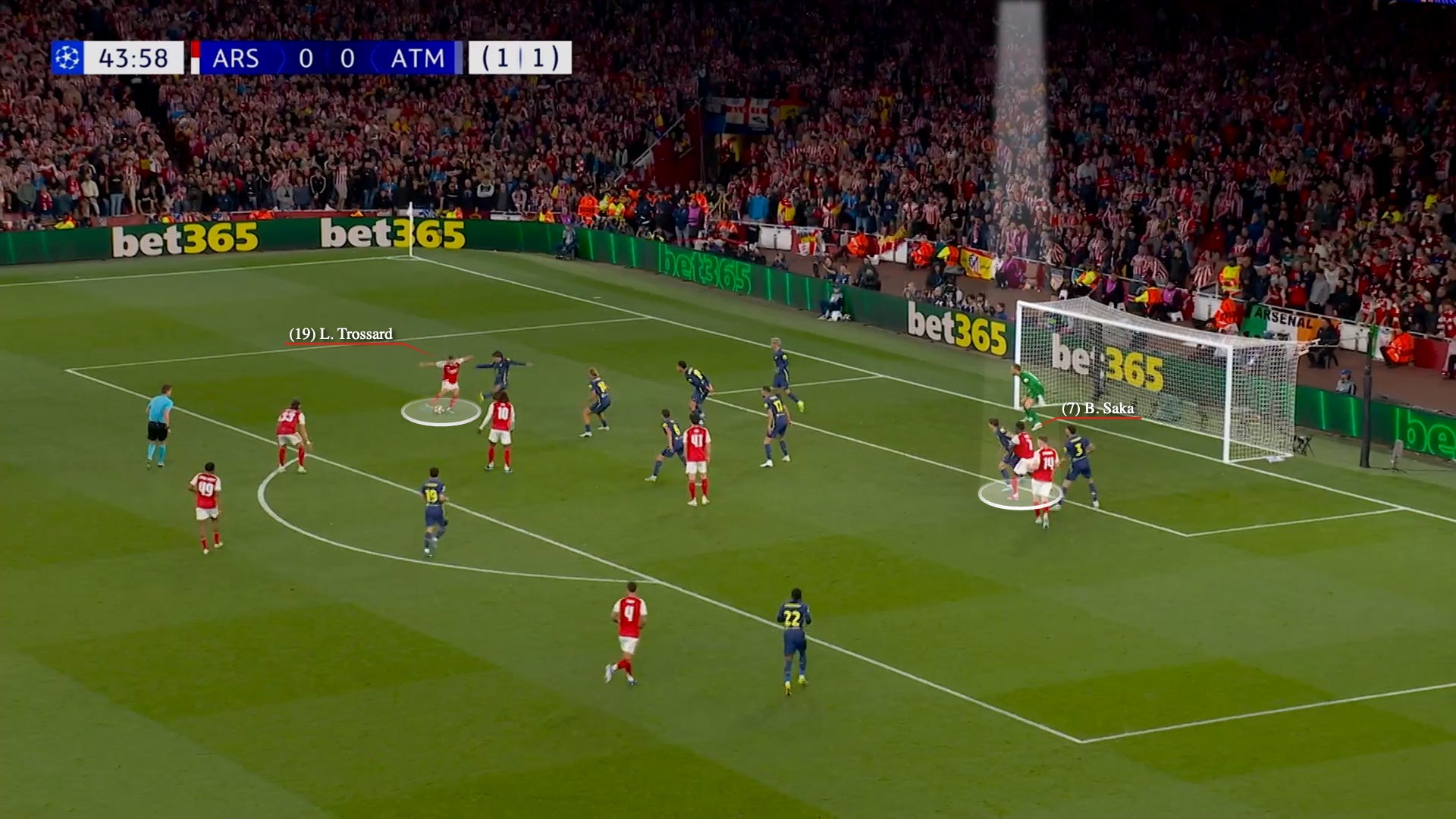
He didn’t seek good fortune. He was himself good fortune.
We can see it even better from the Spidercam.
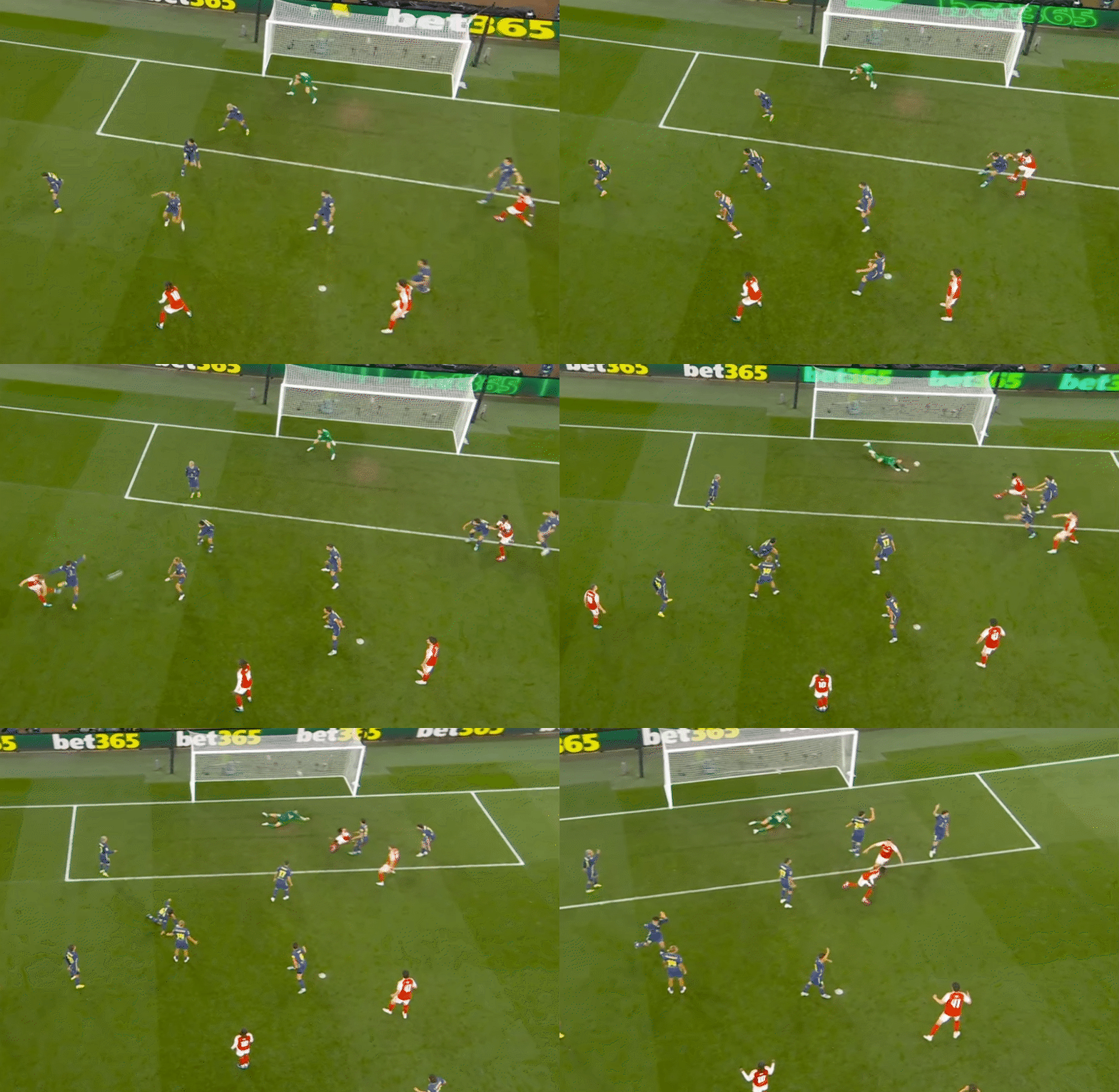
Those close to me will know that this is usually a bugbear of mine. Professionals are in their own stratosphere with so many skills, so I tend to complain about the areas in which they are still too close to we mortals: specifically, blocking shots (so much turning and ducking) and rebounding (so much standing and ball-watching). I think top players are often too flat-footed on parries and should essentially be boxing out for position on every shot. They shouldn’t be waiting to see where the ball goes; they should be winning the spot first, and then reacting to the trajectory.
Here’s Steven Adams, one of the best rebounders of the era in basketball, explaining the beautiful geometry of the skill.
Saka won the physical battle, but he also won the geometric battle. In the equivalent of 23.2 90s in the Champions League, he now has 21 goal contributions (or 0.91 per 90).
“In those situations, I just try and stay alive,” said Saka after the game. “Sometimes it bounces for you, sometimes it doesn’t, but you have to be there. And I was there.”
I often reach for symbolism, shamelessly tying individual actions to the wider narrative of the season, or, when that fails, quoting a spy novel or some shit. But sometimes a quote like that does my work for me.
In those situations, he said, I just try to stay alive. Sometimes it bounces for you, sometimes it doesn’t, but you have to be there. And I was there.
“It had to be someone very special,” said Arteta. “And certainly he is very special with me and the boys and everyone attached to this club. If it had to be someone scoring that goal, it probably had to be him.”
👉 Total footballers
Luis Enrique has a dream.
“Of course. It’s my dream. My dream is to have 20 players who can play everywhere. Nuno Mendes as a full-back, Nuno Mendes as a winger, Nuno Mendes as a No 9, Nuno Mendes as a midfielder. Everyone except the goalkeeper, that would be my dream.
“You can imagine the opposition manager when he sees the line-up saying, ‘But he plays everywhere…!’ It’s a dream. I know it will be difficult to achieve but I’ll try.”
He is not alone in dreaming it. Max Eberl, Bayern Munich’s director of sport, told Nick Wright something similar in a great piece: the diagrams on TV before kickoff bear less and less resemblance to what actually happens once the whistle blows.
“The defensive midfielder and the No 10 drift wide, the centre-backs and full-backs make runs into the centre... I believe true specialists who can only do one thing will become increasingly rare, simply because the game is becoming much more dynamic and variable.”
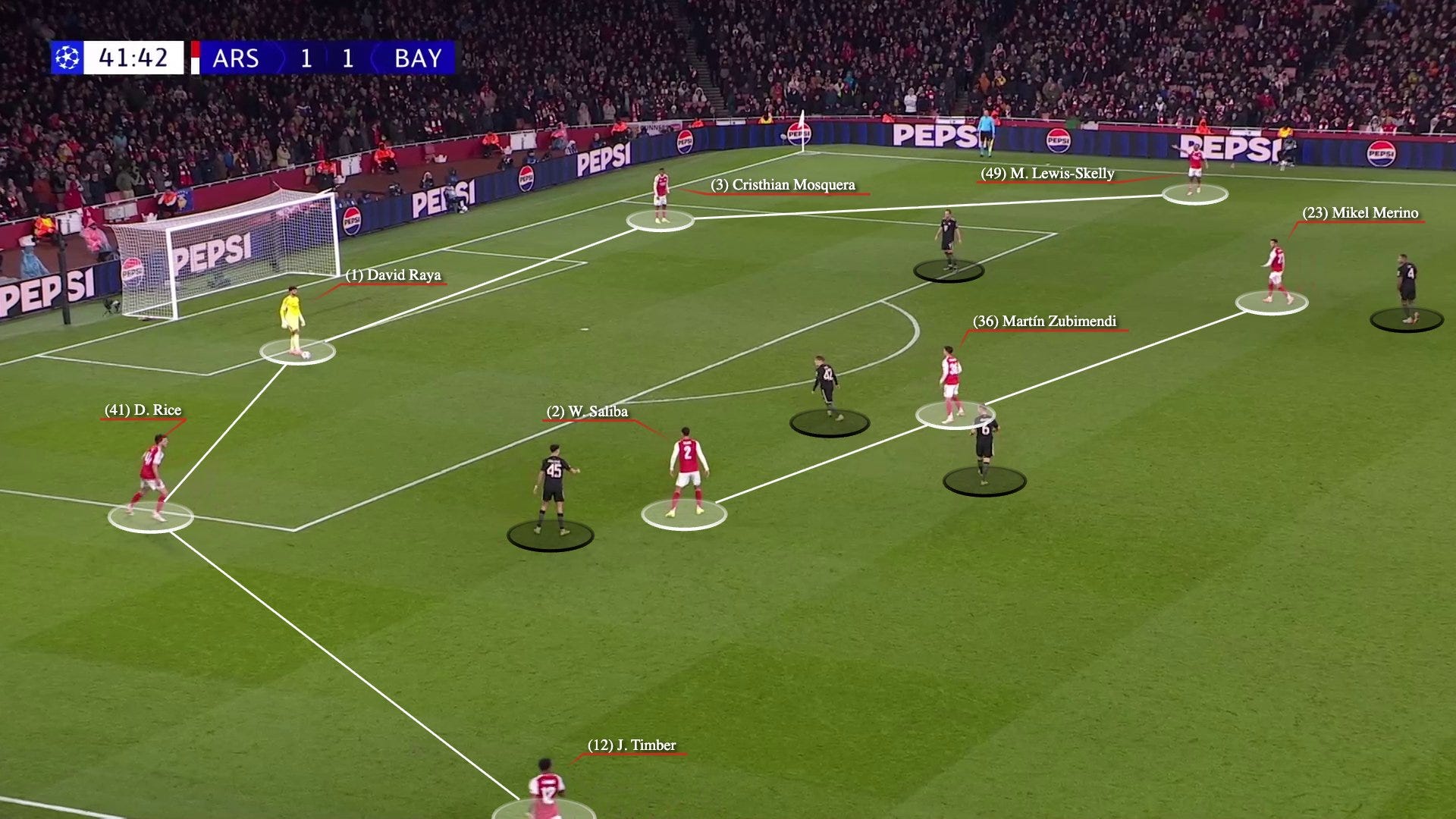
The Arsenal/Bayern group stage game was one of the more flexible matchups you’ll ever see. Here’s Arsenal building up, with Rice as an RCB, Saliba as a #6, and the striker (Merino) as an auxiliary midfielder.
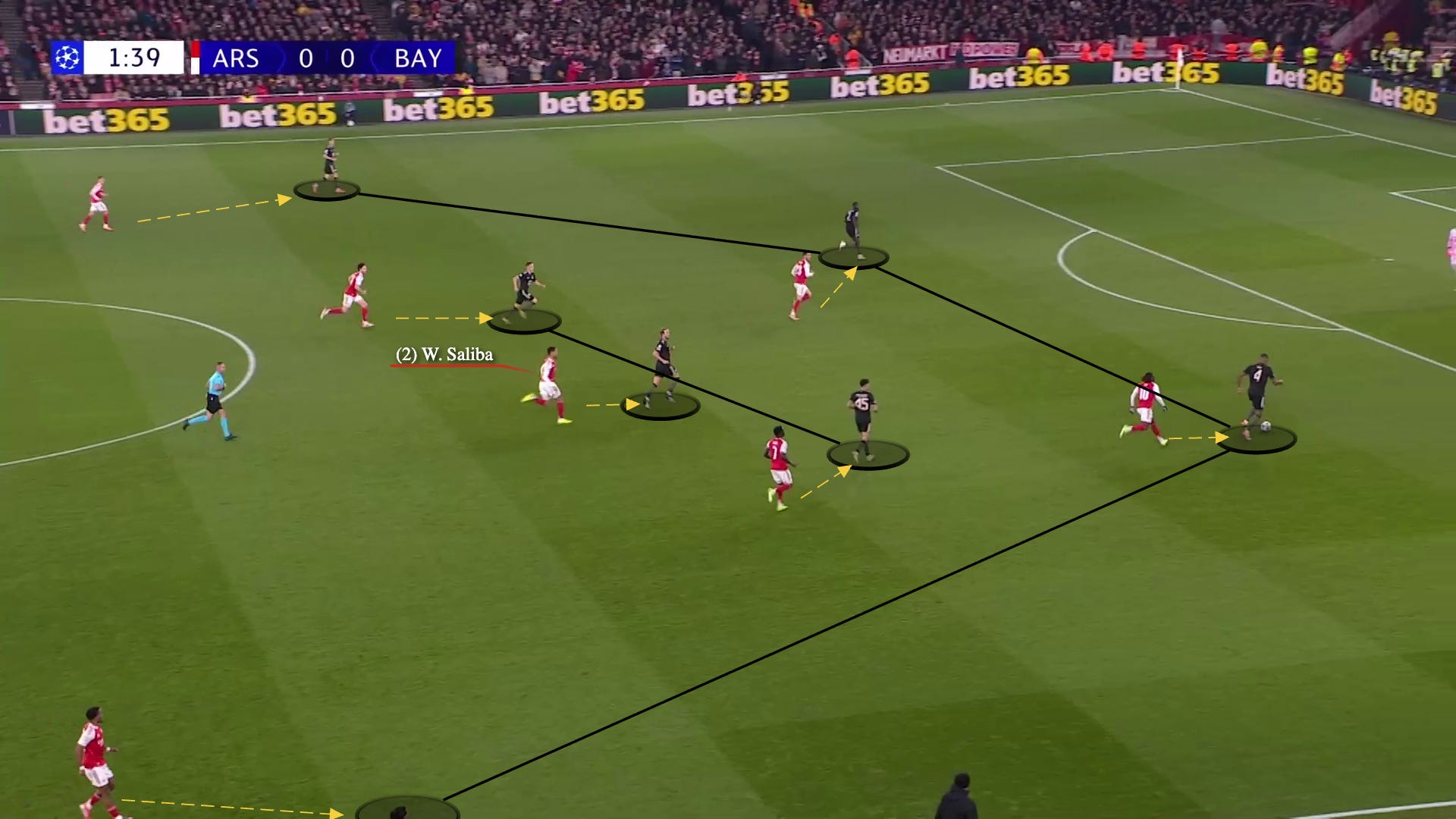
And here’s Saliba following Kane all the way across the pitch.
The complication is that none of this is free. Marcelo Bielsa, the patron saint of man-marking, expressed his frustrations with the natural tradeoffs of these movements.
“When the ball is regained, the team is set up in a defensive formation. Possession is then harder to manage as on the turnover, your players are breaking from a place of having been man-to-man marking. It’s harder to launch out into attacks from whatever formation that is formed as a result of chasing down opponents.”
It requires rare players. Players who are comfortable all over the pitch, in every possible scenario: in-possesssion, out-of-possession, pressing, counterpressing, the works.
Enrique’s evolution on this is especially instructive, especially with regard to the process of building up comfort in these rotations, and the time it takes.
Before his job with PSG, he presided over fairly rigid positional principles as the Spanish head coach. His last game in charge was the round-of-16 knockout against Morocco, in which Spain logged 1,019 passes, culminating in perfectly balanced, pinning pass maps.
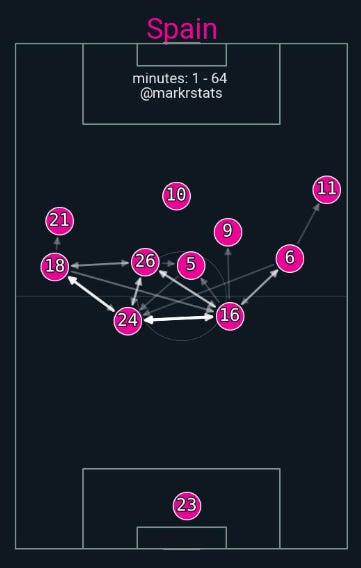
The only problem? In 123 minutes, this approach resulted in 1 shot on target, a total of 0.69 open play xG, heartbreak, and an exit.
With less training, and shotgun marriages all over the pitch, a stricter positional portfolio comes with the territory of international play. The current Spanish squad keeps many of the same principles, but with a key difference: more time together, and better players. Likewise, Enrique’s transformation of PSG into the swashbuckling side we know now took time, and it should be said, downright offensive amounts of capital.
“The team started the season with principles that were already well assimilated, and the coach tried to incorporate even more mobility,” said Vitinha last year. “Today, a #6 can be an #8, an #8 can be a #10, a #10 can be a #6 and with the forwards, you never know if they’re on the left, the right or in the middle. It’s very difficult for opponents.”
Eric Löwendahl called it “Adaptive Positionism,” as Enrique increasingly sought players with the physical and cognitive qualities to succeed in such a system.
When I speak of adaptivity, I am referring to the player’s ability to read where in the opponent’s defensive structure there is an open space to receive the ball relative to the ball-carrier’s position and the position of local opponents. To deviate from a predefined position/area on the pitch and attack a space to create an overload as a third player or to read the game to become the fourth player in a play where a third-man play has already occurred.
None of this sounds foreign to an Arsenal ear. After the Kai Havertz signing, Amy Lawrence wrote about the Arsenal philosophy of targeting “general footballing qualities and human characteristics, [rather] than a specific positional profile.”
In the original Merino scouting report, I wrote about looking beyond positions.
I think it’s helpful to take a more expansive look at squad lists, and look less at “positional cover,” and more at “profile cover.” A player doesn’t need to slot in at the exact same position to effectively cover a starter; their qualities need to be covered, however. For instance, Jorginho and Zinchenko were essentially spelling each other last year … at different positions. If Saka misses time, Arsenal will be light on 1v1 gravity, dribbling, and playmaking — that needs to be offset somewhere, but it doesn’t necessarily have to be at RW. As such, Merino is great Rice cover, even if he never plays in the #6 … He is also, in his own way, Havertz cover. Especially down the line, it got hard to picture lineups without Havertz in them — especially when you’d like to go long or take advantage of set plays. Merino covers that, too.
April was a difficult month. The return from those lows has largely been about a) returns to fitness and b) some crowd-pleasing lineups made up of complementary profiles who are comfortable in zones across the pitch.
Declan Rice has typified this change. While he’s usually had a fairly standard range of responsibilities on the left side of the double-pivot this season, things came to a head: Zubimendi has looked fatigued, some long-ball strategies weren’t working out, and the team needed something new. This pushed Arteta into updated lineups over the last few weeks, essentially settling on a new one. At their heart, these changes have required Rice to adapt his role on a match-by-match basis. They are possible because of him.
Arteta’s comments read like a copy-and-paste of Vitinha’s sentiment earlier.
“What we need are players who can occupy any position on the field. Modern football is going in that direction. When you’re a midfielder, you’re a midfielder — not a six, eight or 10. If we want a total team, we’d better have total players to do that, to be comfortable and dominant in any area of the pitch, to dominate every phase of play. Declan is certainly evolving in that direction.”
👉 Arteta’s gut feeling
It’s easy to say that selections can be overindexed in the mind of a fan. Ultimately, it’s a player’s game, and they have to perform, and it’s not difficult to retcon narratives when results don’t come. But I’ll go the other way: there’s really nothing more important than what players are on the pitch, and how their qualities complement each other. Even more, there are opportunity costs to every decision a manager makes: by starting a runner in a closed game type, for example, you lose the ability to throw him on late against tired legs. Arteta has done a tremendous job this year to navigate the increasing demands of the league and a punishing injury list, all while shepherding a team that never lacks for effort. But there have been spells when lineups didn’t feel quite right, as I covered in my Triangles piece.
With the attack sputtering, Arteta devised a lot of lineup permutations on his iPad. He said he’s leaning on his gut more these days.
“There is something that is related to your intuition. What the game is going to require, the state of the players, the way you can imagine the game and where the players can have the most impact.
“You can get it right or wrong, you never know. But if you do what you feel, at least you have the certainty that you’ve done the preparation, you’ve done the thinking, and when it comes time to deliver, that’s something else.”
The first sign of this was not Fulham, but the first leg of the semi-final, played away at the Metropolitano. That runny, inevitable front-three (Gyökeres, Martinelli, Madueke) started again, but there weren’t many other options, and that kind of lineup can suit an away first leg in the Champions League. Calafiori and Saka were working their way back, but not ready to start, and White was gritting through.
The most interesting tactical change, then, was that Rice and Zubimendi largely switched sides, and something closer to a single-pivot was played. Rice was mostly in the deeper role, with Ødegaard and Zubimendi ahead of him.
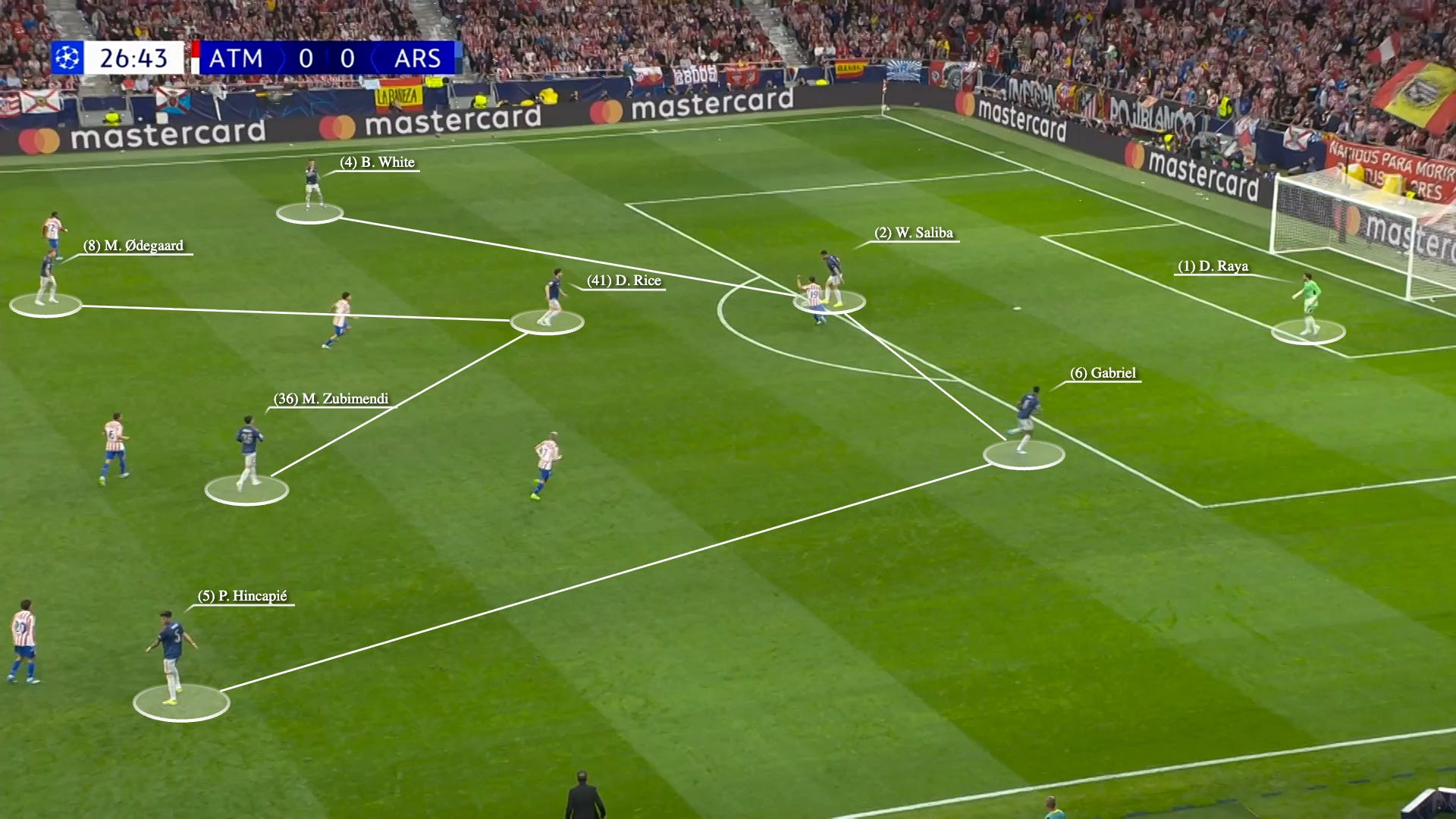
Considering the stakes, the location, and the available personnel, this makes all the sense in the world, and is something that should be considered more next year. Rice is a unicorn as a defensive midfielder deep, and Zubimendi can do some interesting things on the edge of the box. Freed from some of his usual, grittier responsibilities, and with the clarity of mind that comes from having Declan Fucking Rice behind him, Zubimendi had one of his best games of the calendar year by combining in those higher pockets.
Some of this work helped shepherd the Gyökeres penalty:
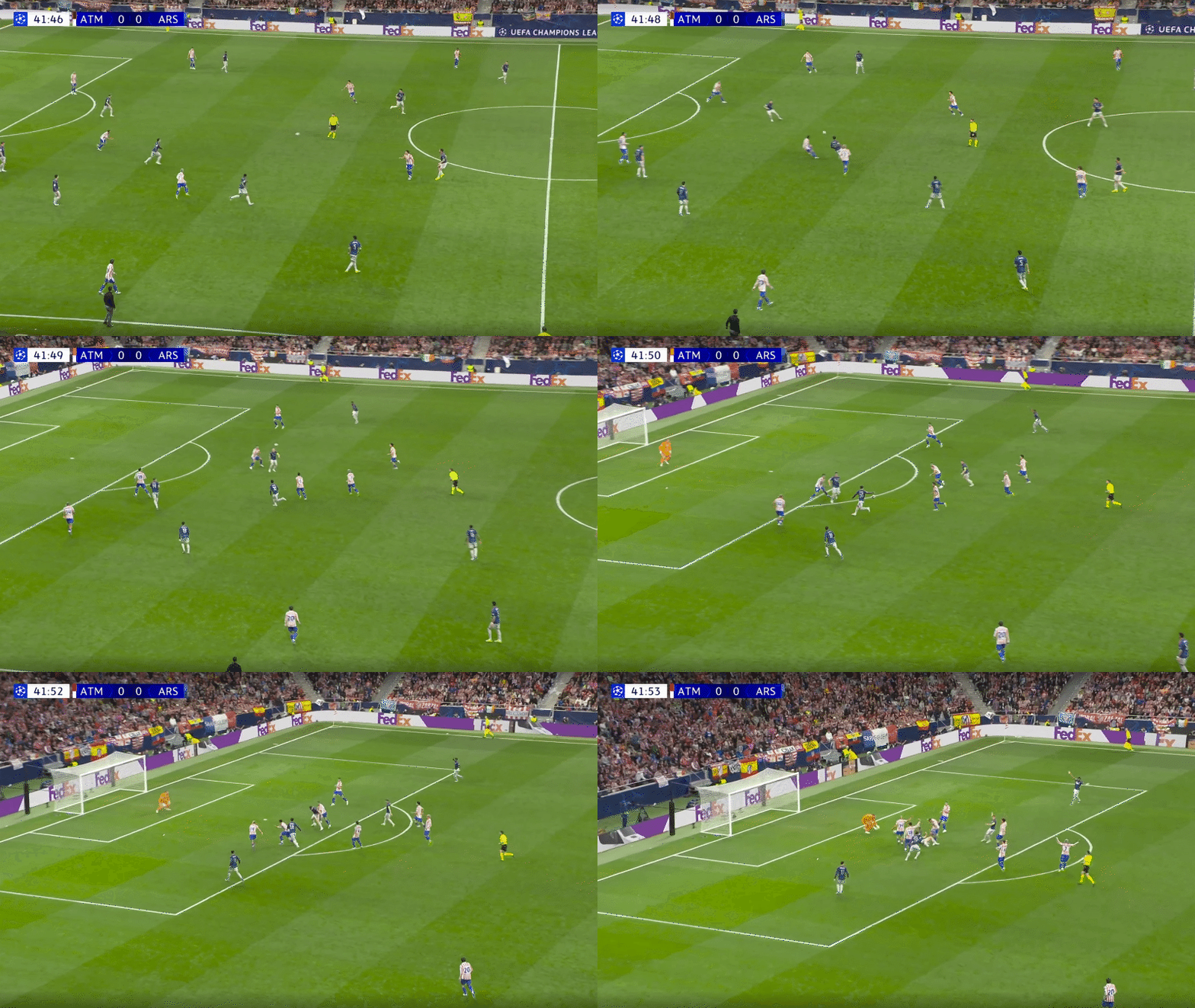
White was fighting his body, but otherwise, it was an assured and mature performance by all.
But ultimately, something needed to change. It had been 8 games since Arsenal had scored multiple goals.
👉 The new dynamic
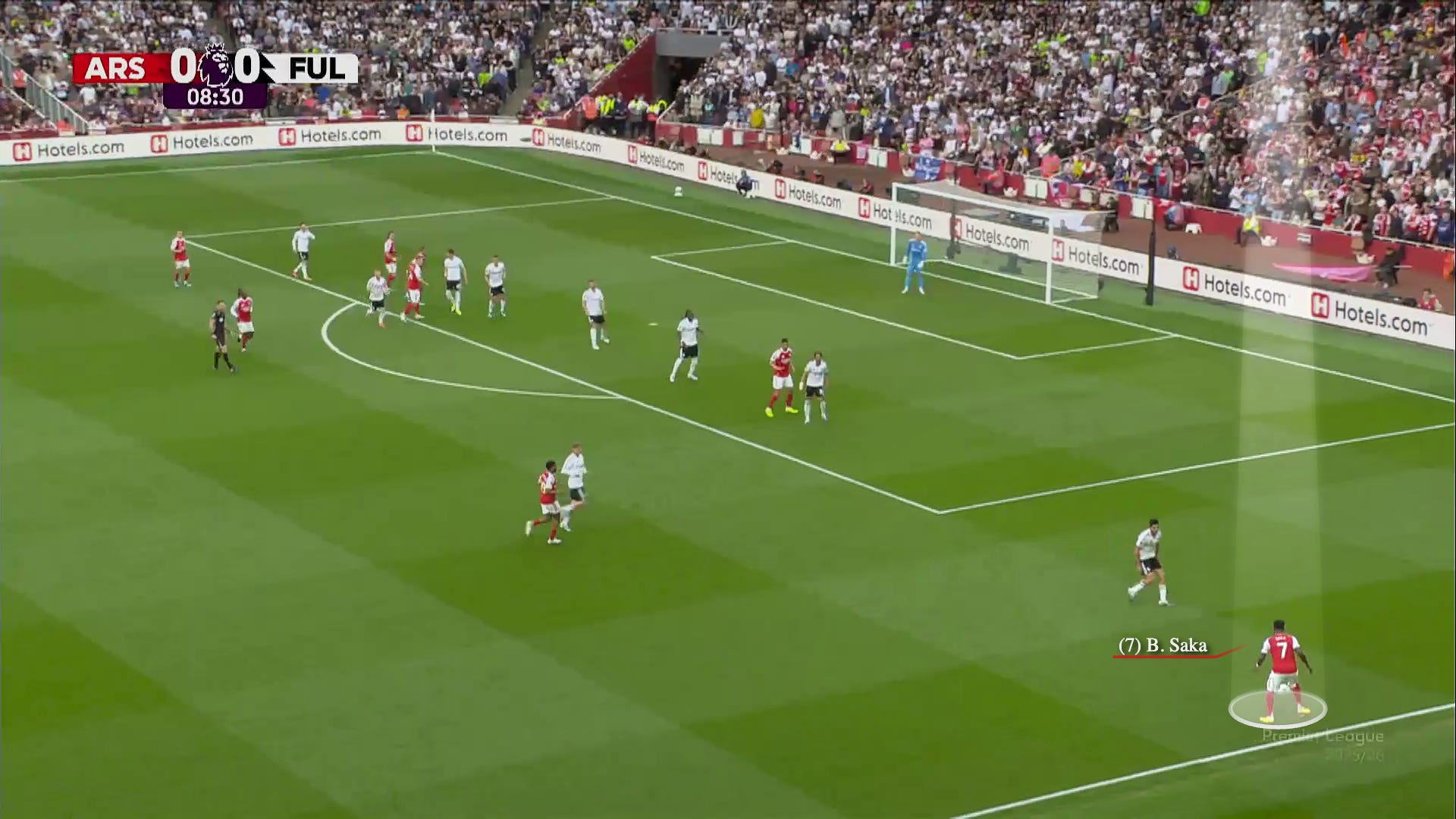
The attacking play can’t be understood without acknowledging the most obvious factor: Bukayo Saka was starting again. Once he started at Fulham, things started to look better. He is perhaps Arsenal’s best player when healthy.
Right from the start, Arsenal would manufacture situations like this after dead balls.
And he sent Jiménez out for some lunch.
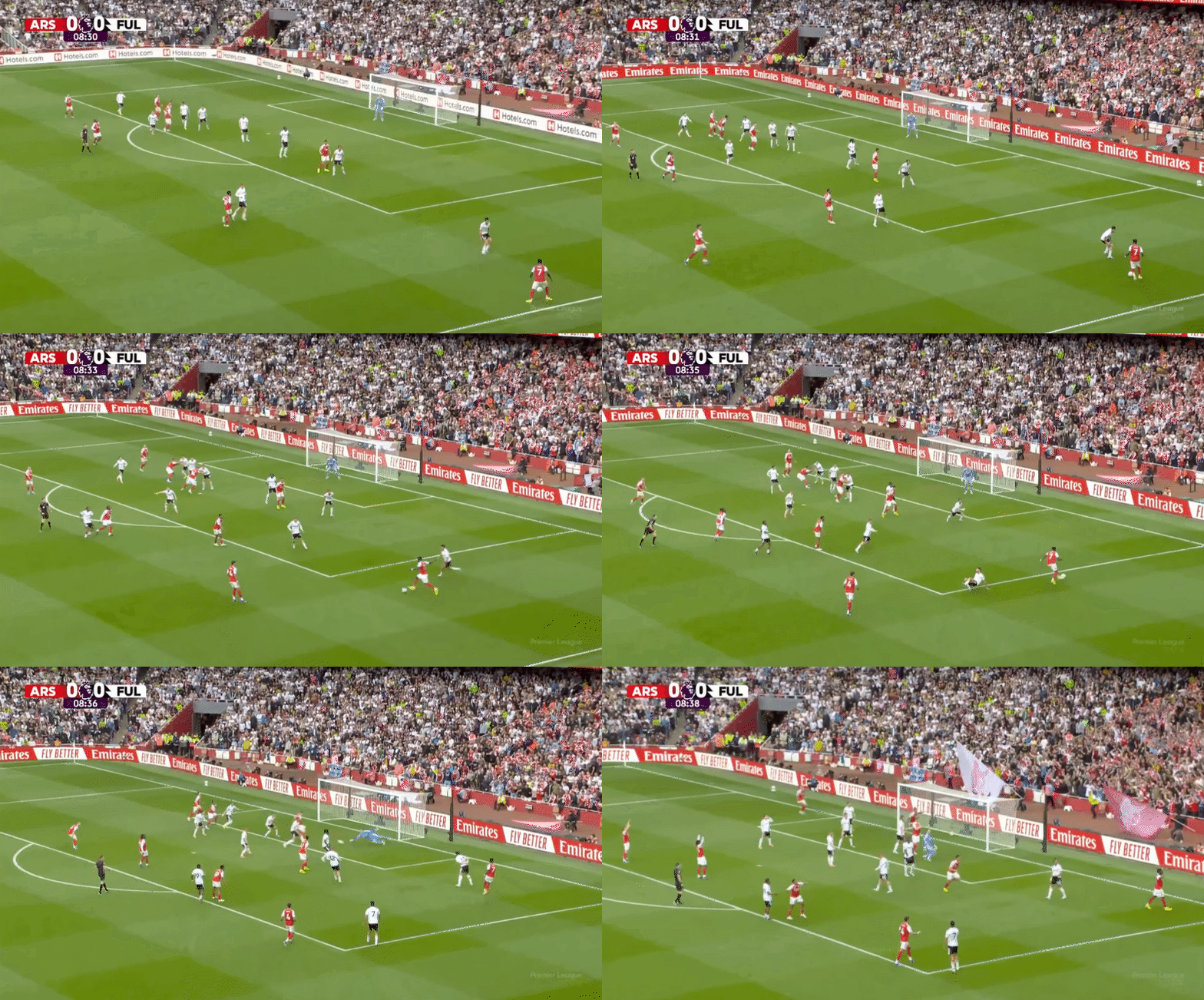
He kept up the pressure with wide combination play.
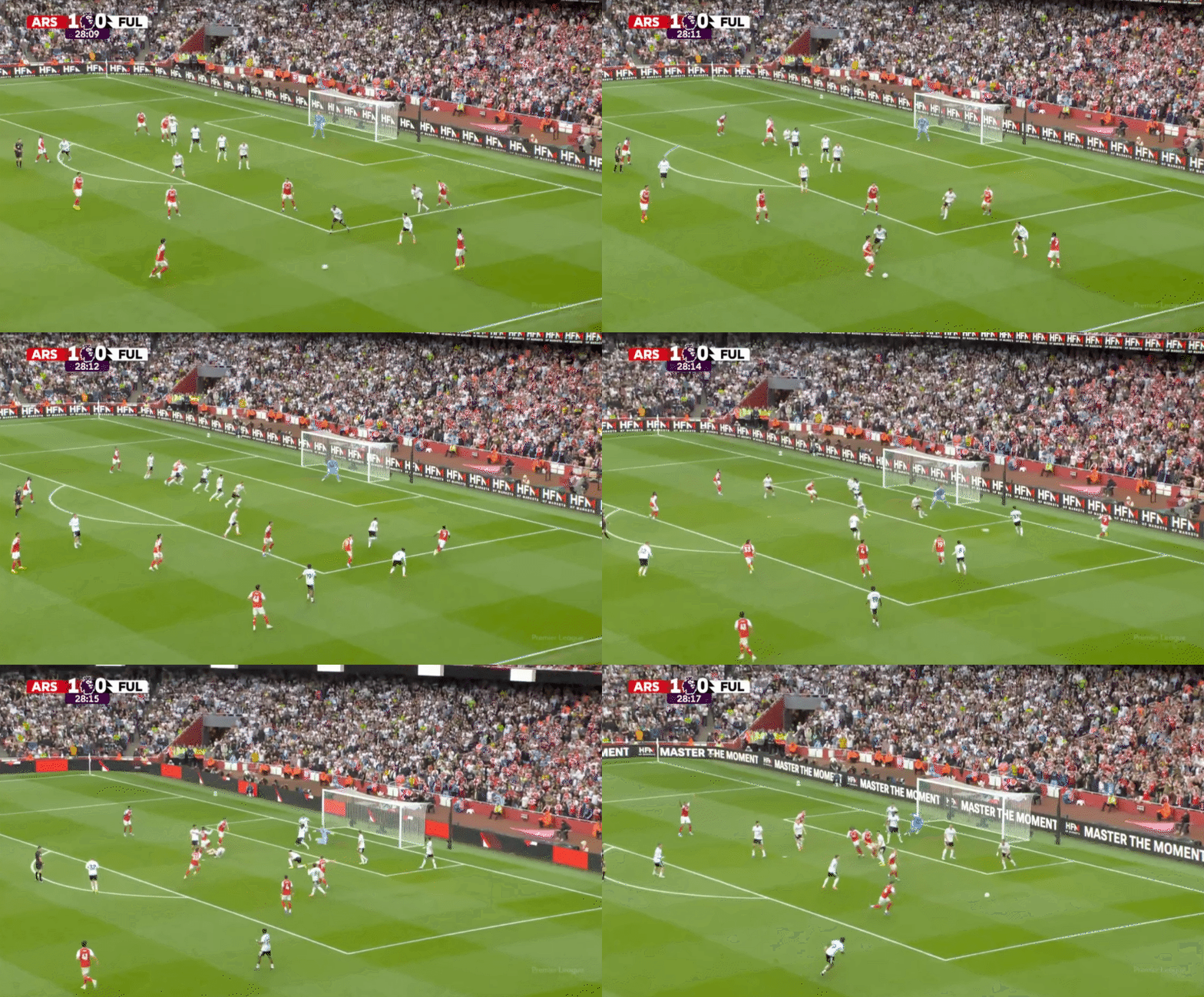
Then he and Gyökeres continued their improved relationship with another goal.
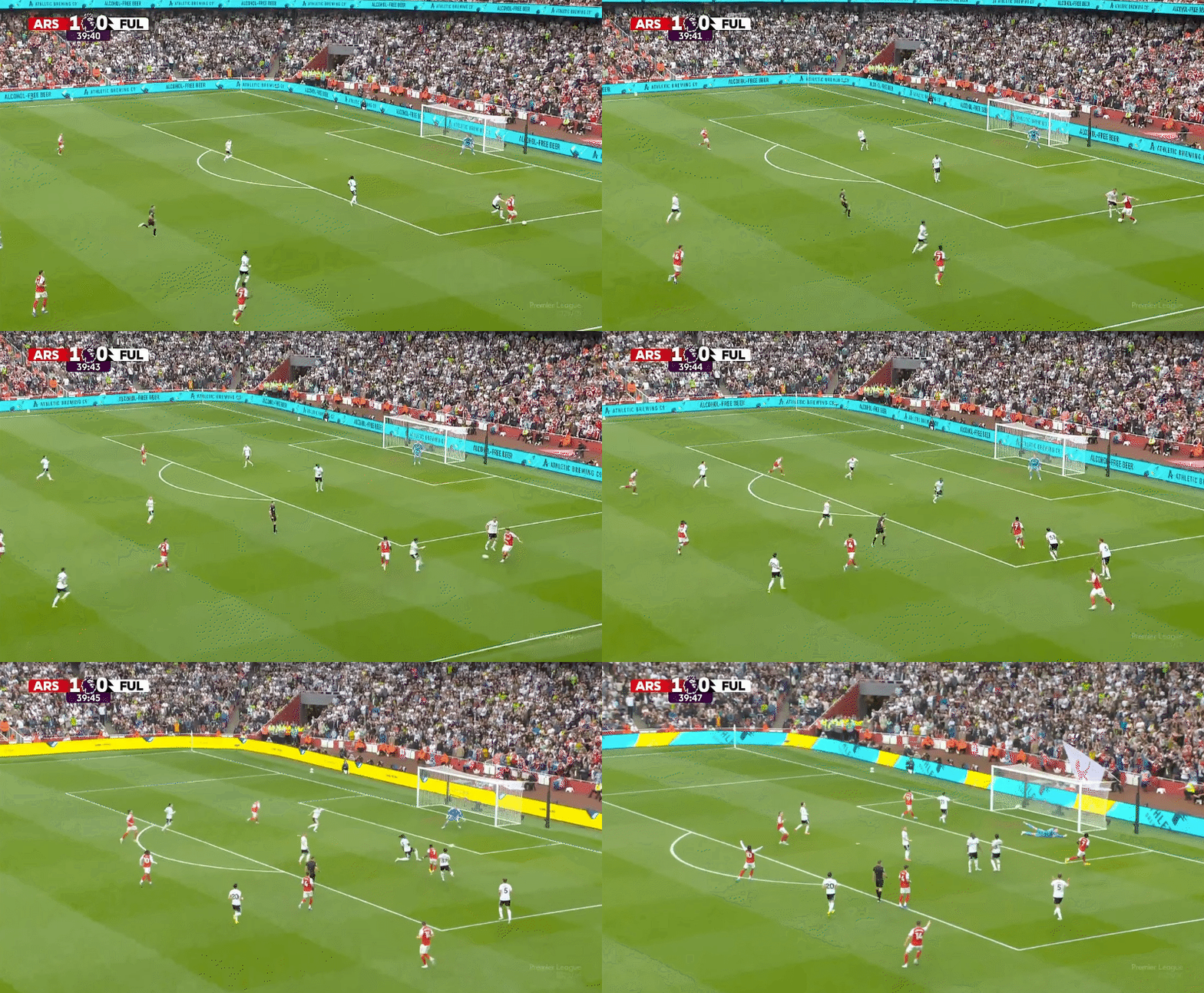
It was 3-0 by half.
In addition to Saka’s return, there have been some welcome improvements to the overall play. There were a few reasons behind this:
Never underestimate individual fitness. Zubimendi was looking tired. This is understandable, as he’d run more than anybody in the league, and has already appeared in 54 matches for Arsenal, logging 4,171 minutes. We’ve seen players like Havertz and White hit a similar fitness wall in the past and soldier through because of a lack of options. It was heroic shit. But while we’re grateful, we also know the cost. It should be seen as nothing but a positive that Zubimendi can rotate now if needed.
Lewis-Skelly gels well with Rice (who can cover space for him) and Calafiori (who can combine and switch spots with him). His role hasn’t been perfectly linear or straightforward during this spell: he’s been deployed in subtly interesting ways.
In this shape, Rice can stay closer to the CB duo. Relatedly, Arsenal haven’t given up an open-play goal since Man City.
Calafiori is vital to Arsenal playing at their vibrant best. Furthermore, the duo of White and Calafiori offer good decisions and assertive, crisp play as total footballing full-backs. We’ll cover all that later.
Trossard is looking closer to his sharpest self.
Thanks in part to lineups that play to his strengths, Gyökeres has improved his overall play. But also, it’s simpler than that: he’s improved as an individual player.
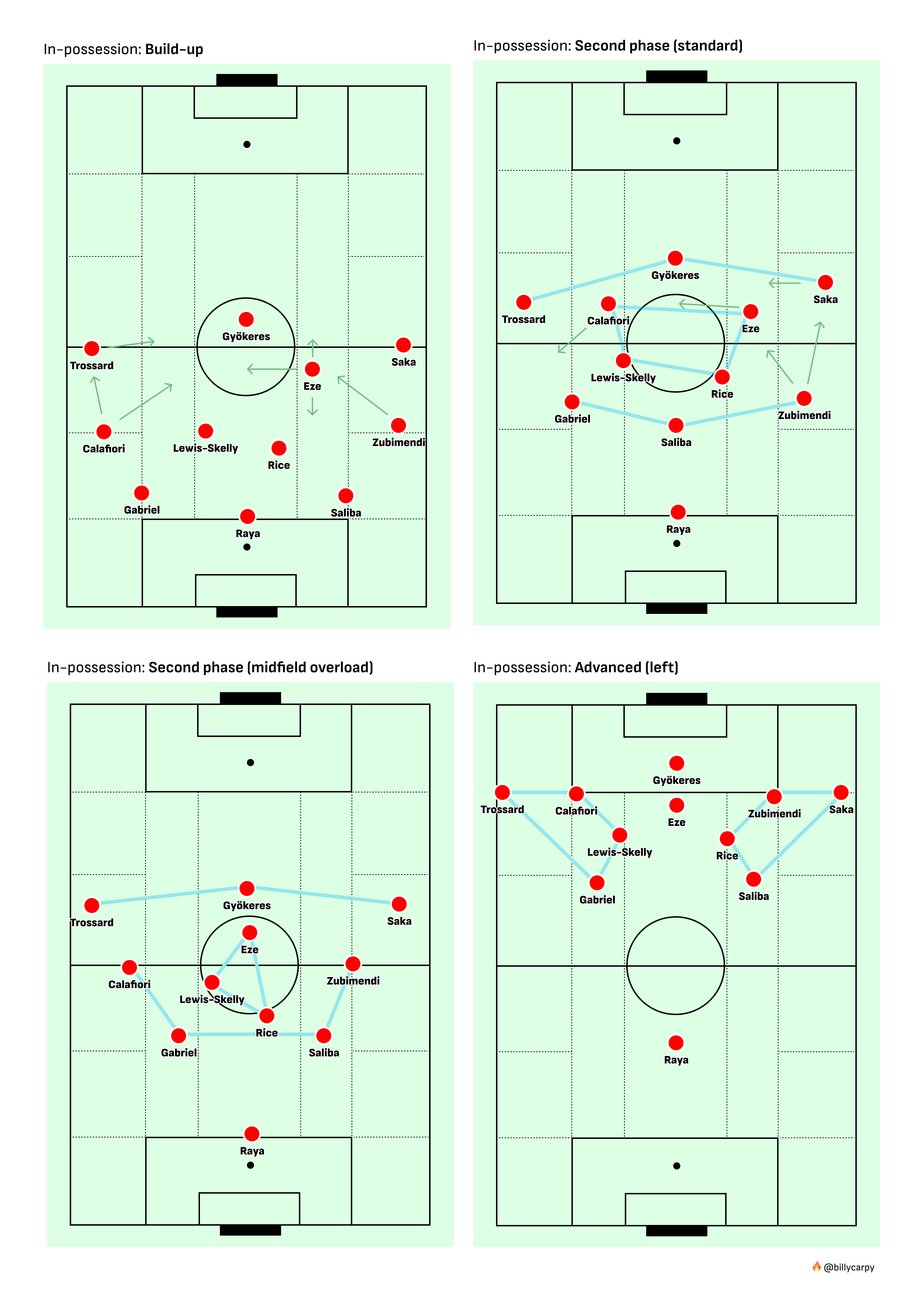
The buildup against Fulham had Rice and Lewis-Skelly as a central pivot, Eze roaming above them, and White and Calafiori offering options.
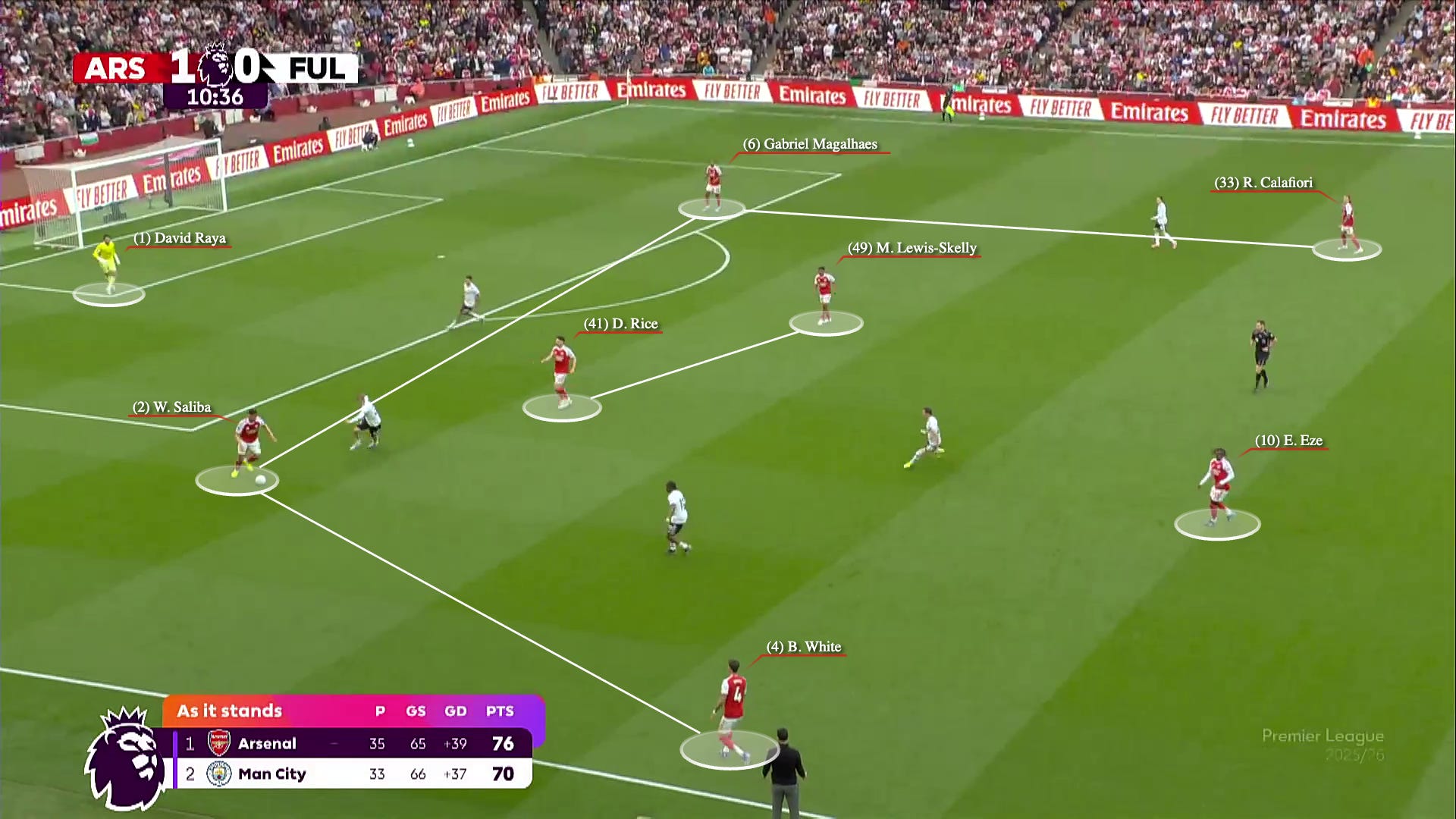
It’s easy to see why this just works. These are players doing what they do best.
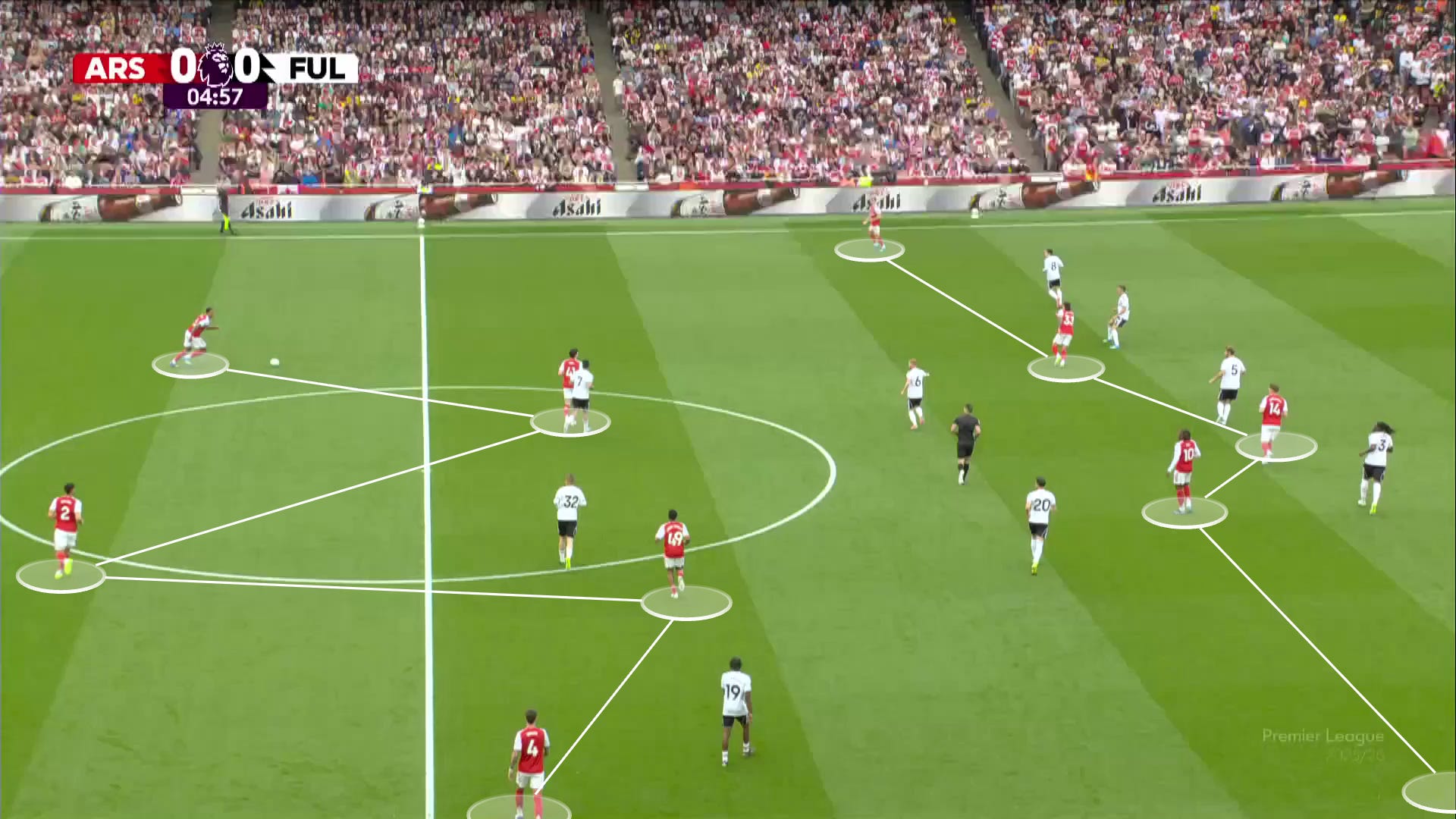
As it progressed, we saw the box midfield. This is where everything feels devastatingly simple: three CBs who are good at CB things, two double-pivot midfielders who are good at double-pivot midfielding, two wingers who are good at wingering, two pocket players who are good at receiving in the half-space, and a striker who likes to strike.
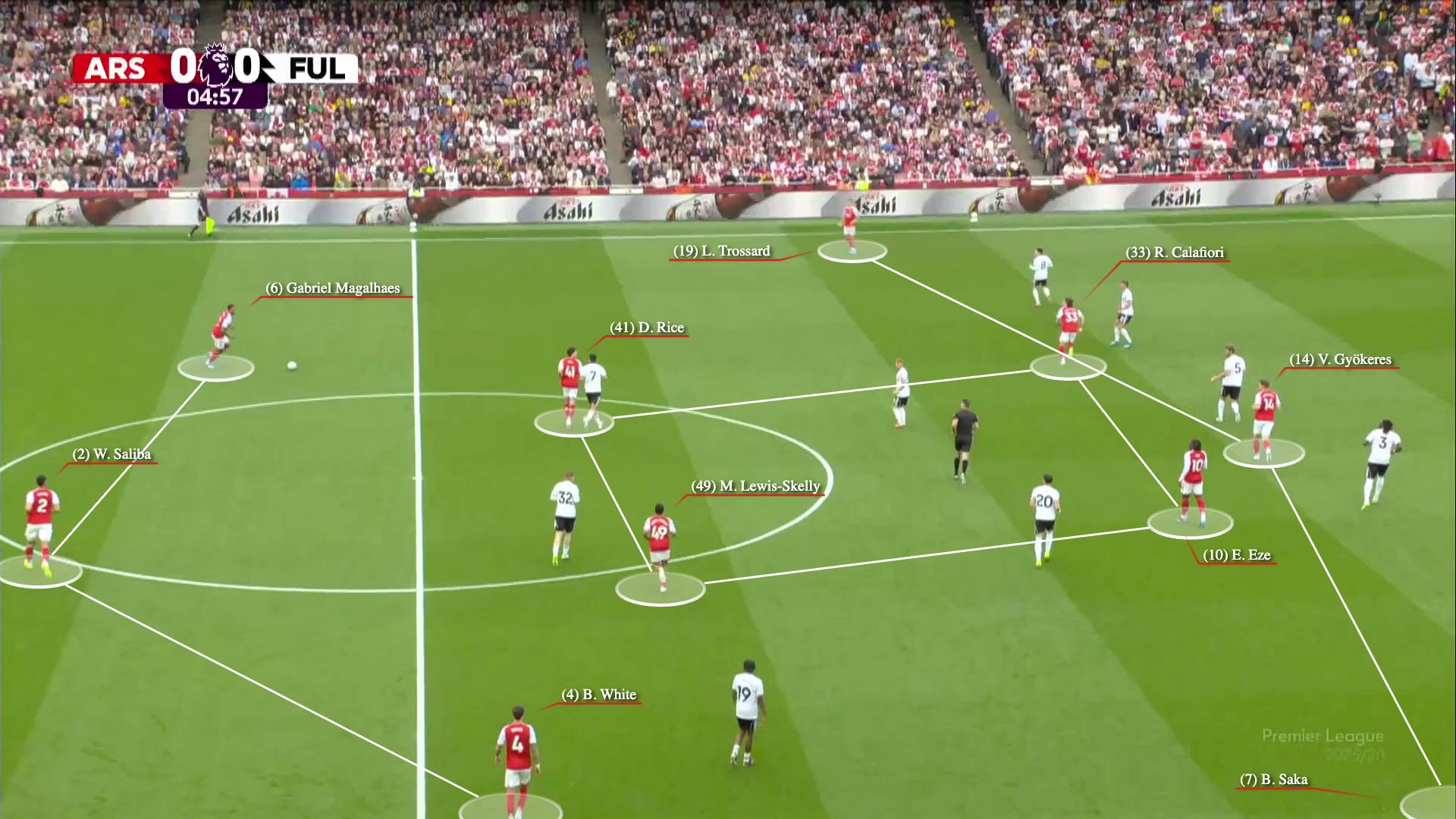
If you draw the lines differently, you can almost make out the old, famous WM shape of Herbert Chapman.
Then, it was time for the second leg of the semifinal, and the previously-mentioned iPad.
“It was probably the hardest line-up that I had to do,” said Arteta. “I don’t know how many lineups I did on my iPad. I deleted them and started again all over. And I really felt that leaving the players out tonight was going to be hurting for some of them. At the end, I went for my gut feeling. I spoke to the ones that were not starting and their reaction was incredible. And you saw when they came in the game at a difficult stage, they were incredible. I think they deserved it [to hear from me], especially the deserve [to hear] how I feel about them.”
He ran it back. According to The Athletic, it was only the second time all season that Arteta has been able to repeat a lineup.
👉 The daisy-chain
But this time, it was a little different. And, contrary to what you may hear on talkSPORT, it was quite risk-tolerant. There were ample rotations, but generally speaking, Lewis-Skelly was often the lone-6 as play moved into the middle third, with Rice pushing forward on the right. This makes a lot of sense in-possession, but on a ball loss, you have to consider the impact of Lewis-Skelly being left all alone, with Rice likely ahead of the play. Arteta knew the risk and accepted it. Rice kept pushing.
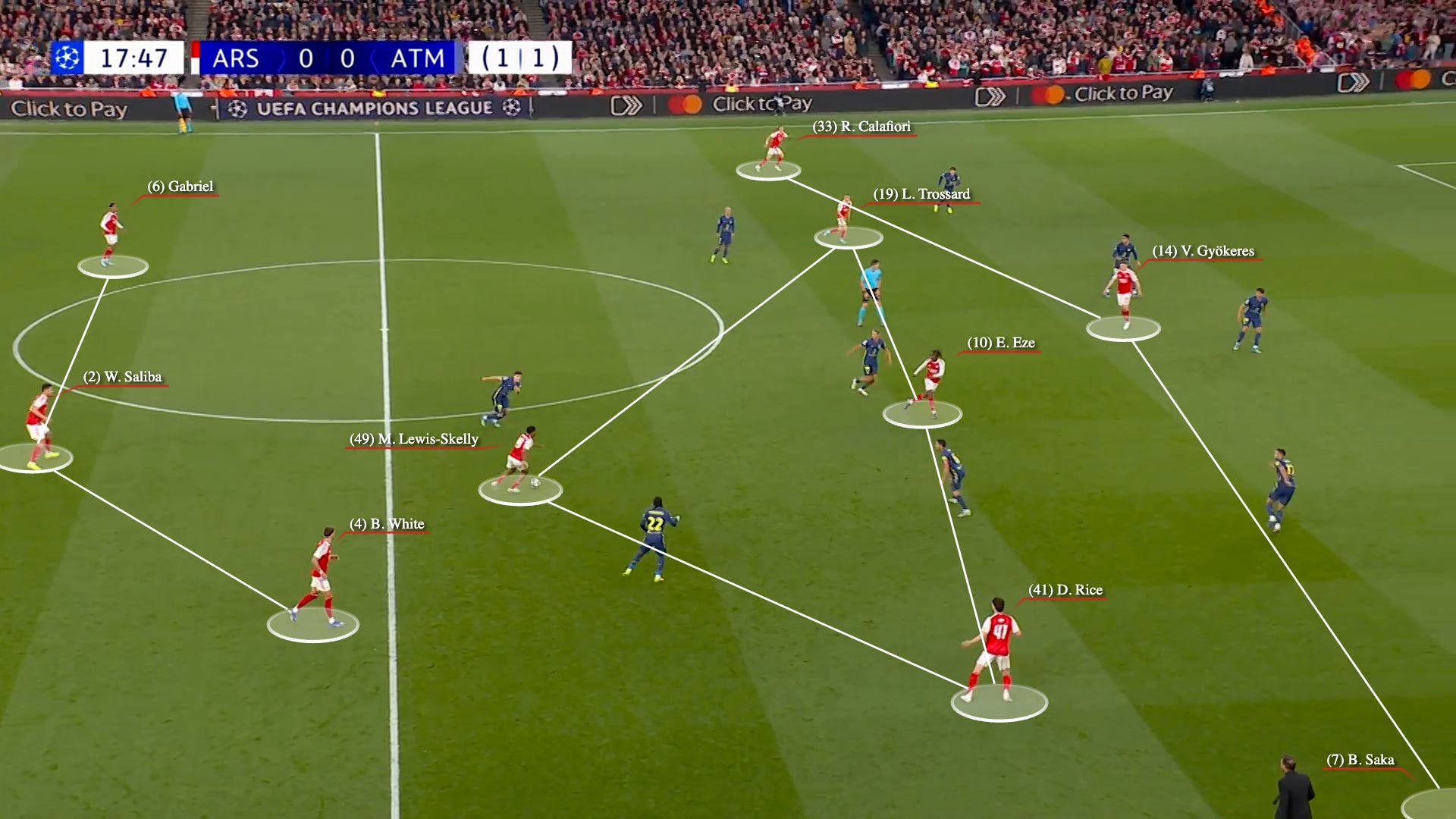
Outside of the out-of-possession “risks,” there are a lot of benefits: Rice gets to run and peel players off Saka, and Eze gets to push more central. Once White pushes forward, seven different players can join the frontline.
In deeper build-up, it was often a truer double-pivot, with the open RCM slot being open for business: this is where we saw Saka float and playmake.
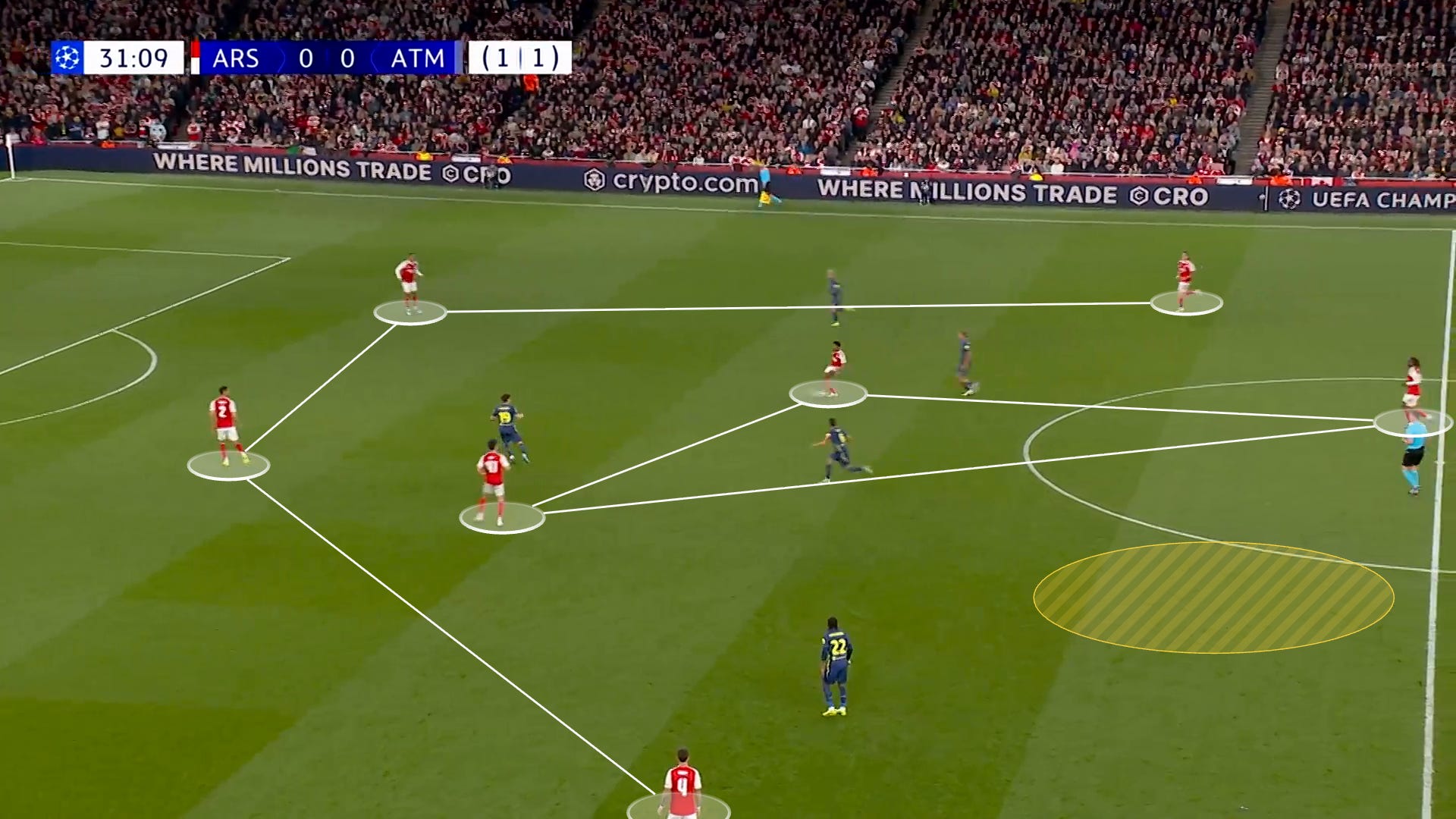
But the real gift of the Rice/Lewis-Skelly partnership is that they’re good at different things, and that difference makes them more dangerous together.
Think of central progression as a daisy-chain: every link needs a player in a threatening position. But instead of calling it “breaking lines,” look at them as gates. Picture a training drill where the ball has to pass through a sequence of checkpoints on its way to the goal, and each gate only opens if someone is positioned to receive, turn, and threaten. Now, see this:
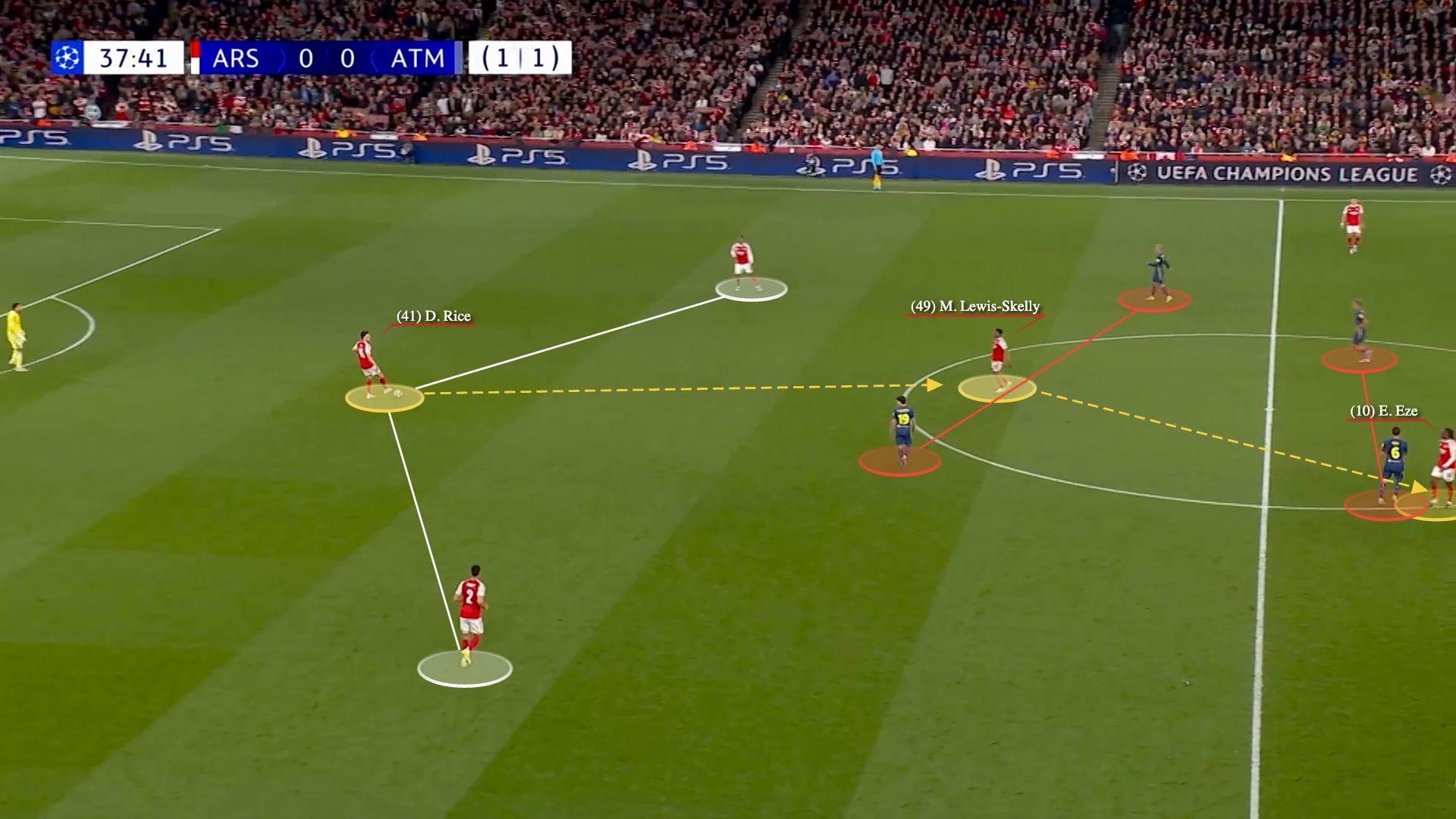
Rice is best when facing play. Lewis-Skelly is superlative at sitting behind the first gate. And Eze is superlative at sitting behind the second gate. Simple as.
You’ll see the daisy-chain effect here. Rice actually plays a switch, but there are multiple coherent arguments for central progression here.
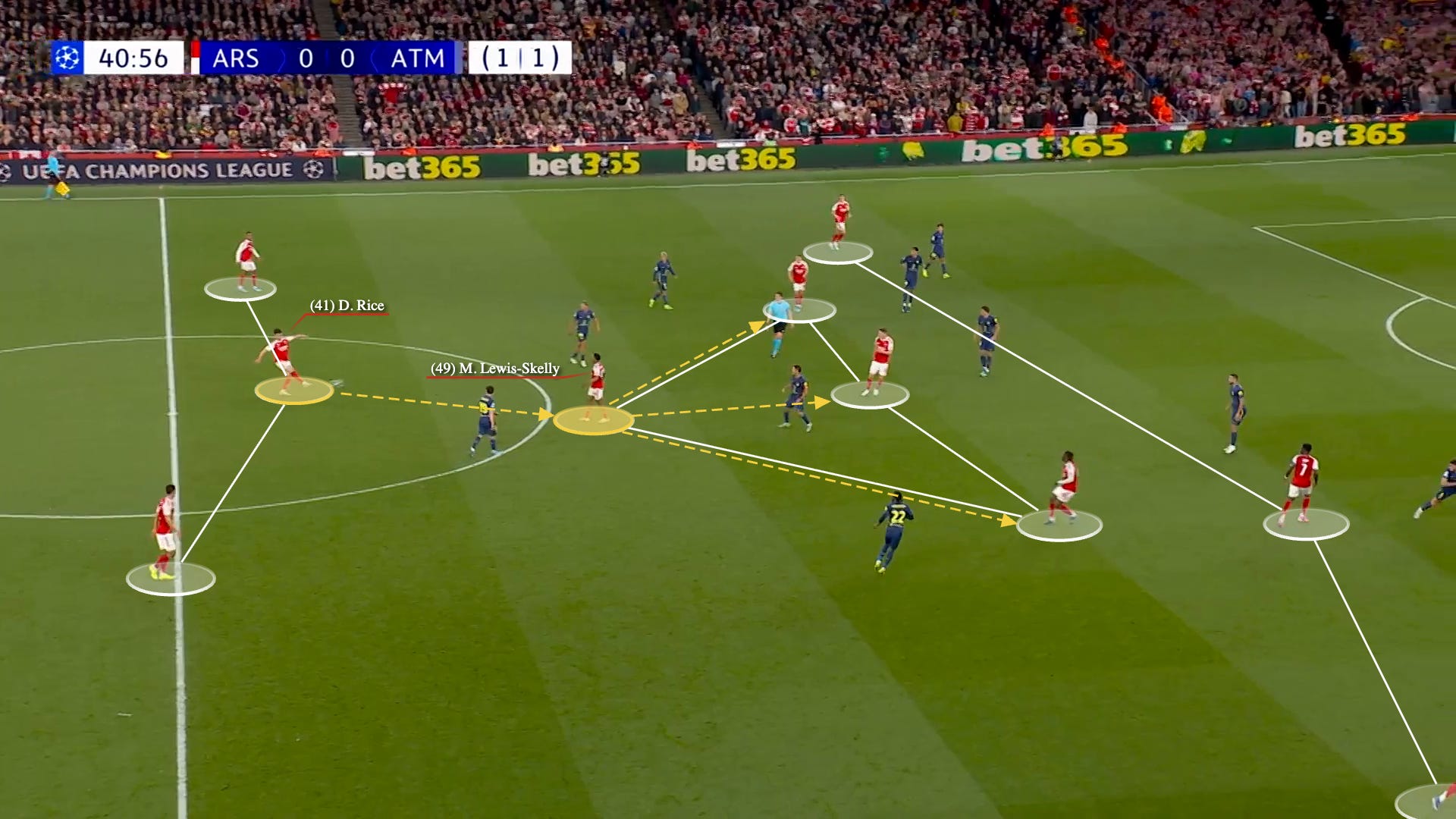
…and again, you can see the gates: Rice outside the shape, Lewis-Skelly tucked behind the first gate, and three players ready behind the second gate.
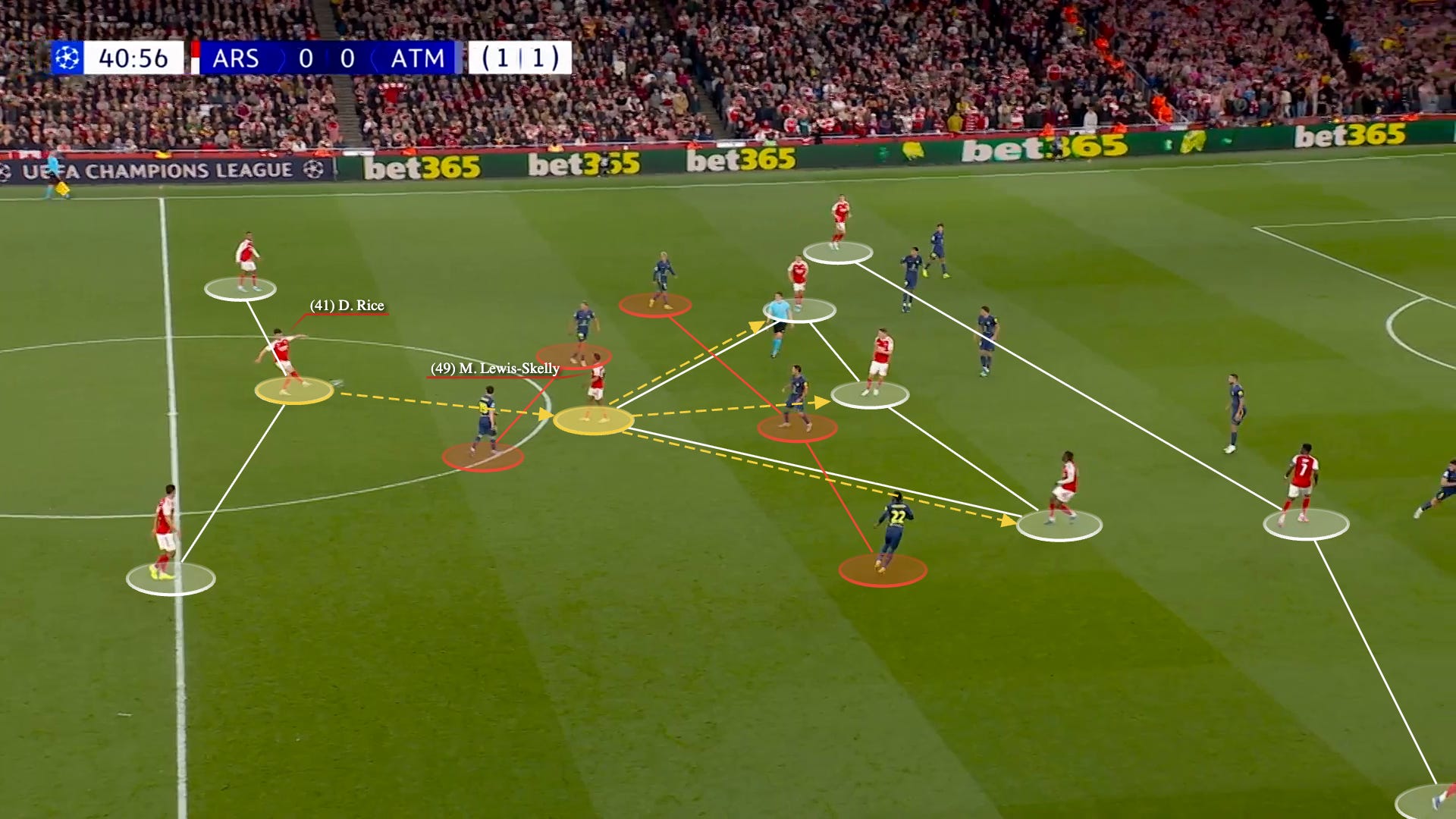
This play, early in the Fulham match, shows the setup humming. Rice drops as a libero, Lewis-Skelly receives behind the first gate, and Gyökeres finds the perpetually free far-side full-back.
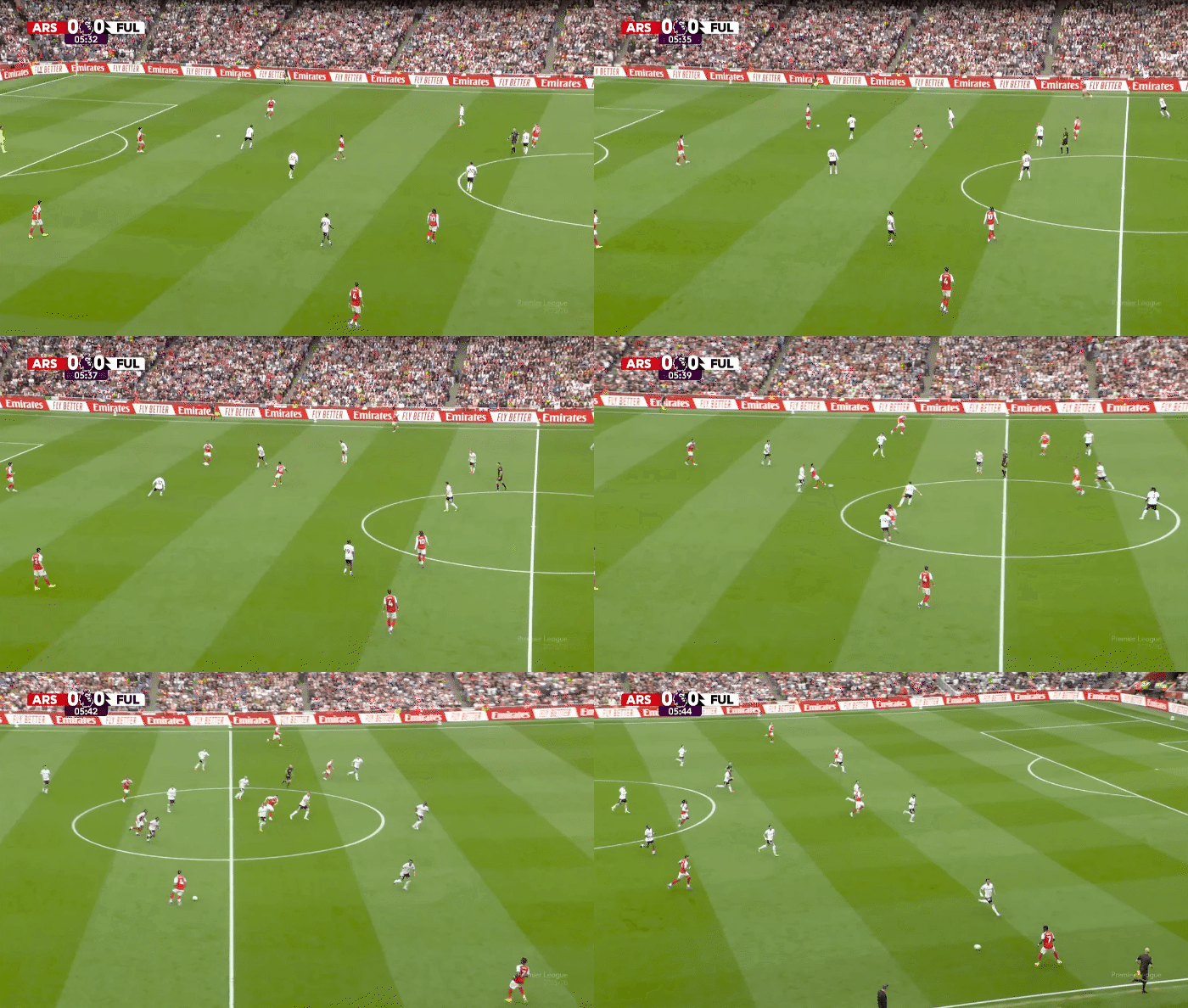
But how different are things, really?
👉 Zubimendi & Lewis-Skelly
In the original Zubimendi scouting report, I covered his unique sensibilities as a Spanish midfielder.
He is constantly moving, scanning, and setting up angles, but as a lone-6, he’s not over-eager to get on the ball or looking to rack up 100 touches. He’s more situational and flexible; he’s talked in interviews about how sometimes he thinks he should get on the ball more, before remembering his responsibilities in his setup.
Because he’s usually outnumbered by pressers, he’s often dragging them away from the 8s, creating lanes, and freeing them up to turn and attack. If the press has gaps or is more mindful of the 8s, he pulls all the strings himself and is happy to drop all the way down and split the centre-backs if needed. If there are numbers high, he pulls the pressers and they go long as he pounces for second balls.
So much of a player’s touch quantity is informed by the system and the player’s responsibilities. But you don’t want to neatly explain everything away, and there is definitely an archetype of a lone-6 that says, usually with ample reason, “just give me the fucking ball. I’ll figure this out.” Zubimendi appears humbler than that.
This has persisted for Arsenal, as Zubimendi occupies every zone on the pitch in buildup.
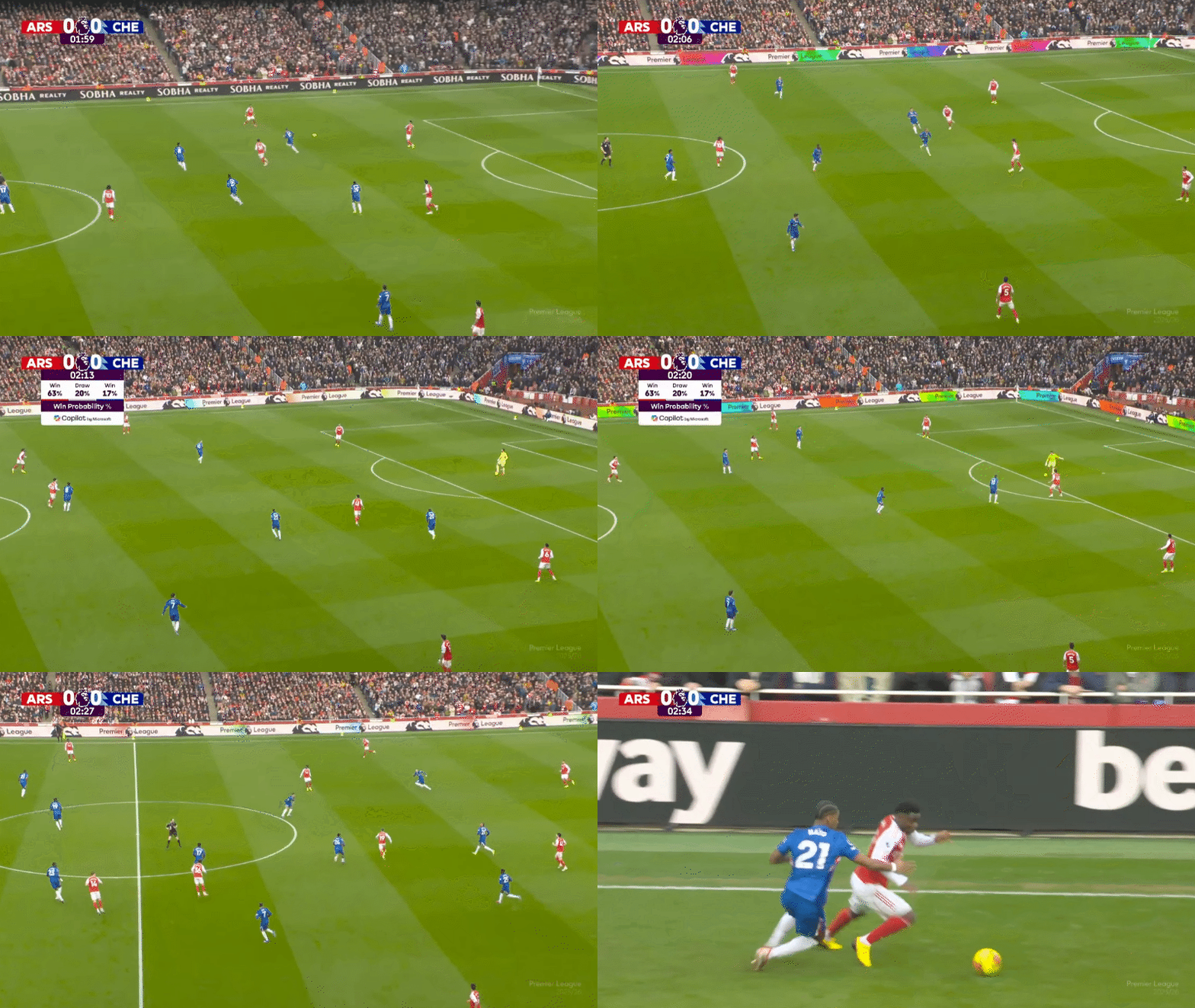
Plus, he has the Saliba trait of defending through anticipation, which makes some of his eventual duels look easier than they should be.
I’m not sure people fully grasp what kind of defensive shift Zubimendi has put in, but according to Gradient Sports, he is the…
#1 ranked midfielder at duels in the league
#1 ranked midfielder at aerial duels in the league
#5 ranked midfielder at 50/50 balls in the league
We’ve covered how Arteta sees the tactical world shifting, and how it has resulted in both a swirling double-pivot and a wider, freer full-back role.
“Before, when you used to do a game plan and you just invert a full-back and bring an extra player in midfield, or a false-nine, opponents are finished, big overload, 4v3 inside, 2v1 inside, time on the ball, so dominant, 70-80% of possession, the other opponent, two counter-attacks, set-pieces, the game is done. Now, teams are adapting.”
It sounds like he believes a fluid midfield double-pivot is the best response to the rise of man-marking, which “un-inverts” the full-back and keeps them wider, which also gives them longer transitional runs. That tilts his equation toward Hincapié.
I’m not 100% sold on that in all situations, and yes, I think Lewis-Skelly’s skillset is well-suited for the floating “double-6” thing that Rice and Zubimendi are doing. It may just take some time to get there.
“Calafiori role” (LB), not LCM, is floating around the pivot, going wide, box-crashing, unlocking new “Rice role” at LCM: deeper, shielding.
“Cala role” (LB) is less suited for MLS; the LCM role now fits him like a glove.
It’s taken some time to get here. While I’ve been impatient to see it more, we can also acknowledge that 17 starts and 33 appearances across competitions for a 19-year-old isn’t exactly nothing, especially considering how many of his ilk get run into the ground by overeager managers. There’s a 2,452-minute difference between Zubimendi and Lewis-Skelly, and the former has shown signs of fatigue, so when you combine that with a development curve behind the scenes, the timing aligned nicely.
Arteta was asked why it took so long.
“Because probably I don’t have a clue and maybe I should have done it earlier, I don’t know. But I have to do things when I believe that the player is ready, the team is ready and the opponent is the right one to play with him in that position. We've done it today, it’s the first time. It was a big risk because I knew what was going to happen, if he wasn't this great, we would have lost the game. How do you play a kid at this age, in this scenario, in a position that he hasn't played all season? I knew that but I had the feeling that it was the right game for him.”
If I had to hazard a guess as to what they’ve been working on, it’d be how Lewis-Skelly defends transitions through the middle. He’s a gambler by nature, and if that style persists in the fastest league in the world, he risks too many pull-downs and awkward fouls, or else being played through. By being a little safer with his angles, he’ll keep the play in front of him. Arteta deemed him ready. Rice helps.
“It’s hugely important for me to set that tone,” said Lewis-Skelly. “When you’re in midfield, there’s a certain rate you have to attain, which is to set the tone, get the engine of the team going. I thought I did a good job of that today.”
So, how has the introduction of his style actually impacted Arsenal’s play in the middle? I pulled the numbers to compare.
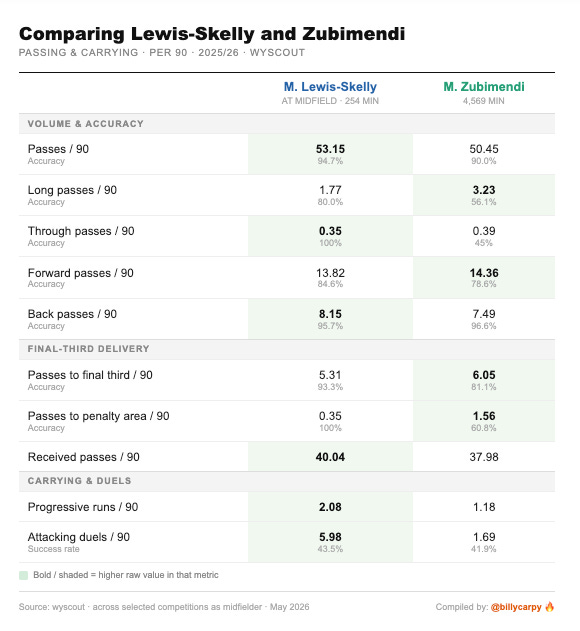
Interesting:
What you’ll see in the passing numbers is that they are remarkably similar. They receive and complete about the same, though Lewis-Skelly is marginally more accurate.
As a narrative violation, Zubimendi passes forward more, and Lewis-Skelly passes backwards more. Now, all forward passes are not created equal, and some of the best passers in the league are those who pass backwards the most (Rodri being a shining example). Still, it’s an interesting context.
Zubimendi is more likely to go long, at a lower success rate. I’d chalk this up to what he does on regains: opportunistic first-touch slaps forward into space.
Zubimendi has been much more active around the box. For all Lewis-Skelly’s rambunctiousness in the middle third, Zubimendi is more likely to offer chaos in the box. Not mentioned here are his 6 goals and 3 assists across comps.
So, it’s all quite similar. But there is one area in which Lewis-Skelly and Zubimendi are dramatically different players: Lewis-Skelly is ~4 times as likely as Zubimendi to engage in an attacking duel.
In a situation like the one below, Zubimendi would probably tap it forward on the first touch.
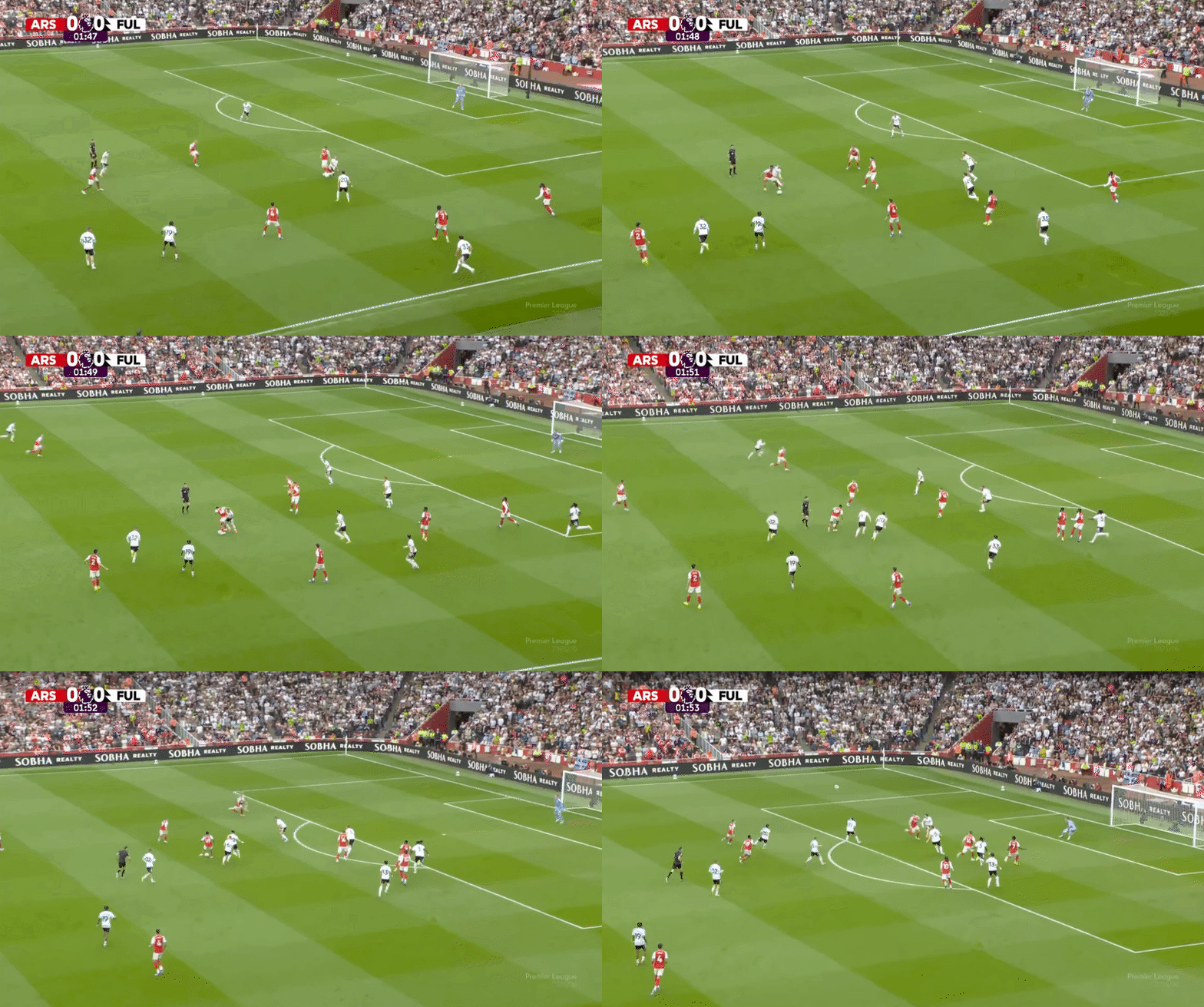
Lewis-Skelly treasures moments where he can pull a Mousa Dembélé and shove them off. When these moves work, they’re especially powerful for Arsenal, because they create a total collapse of the opponent’s shape, which is a situation that is hard to generate otherwise.
We saw one of those moments recently when he set up a Nwaneri goal for the England U21s. You get the sense that teammates almost delight in passing him into difficult situations so they can see him twist out of them.
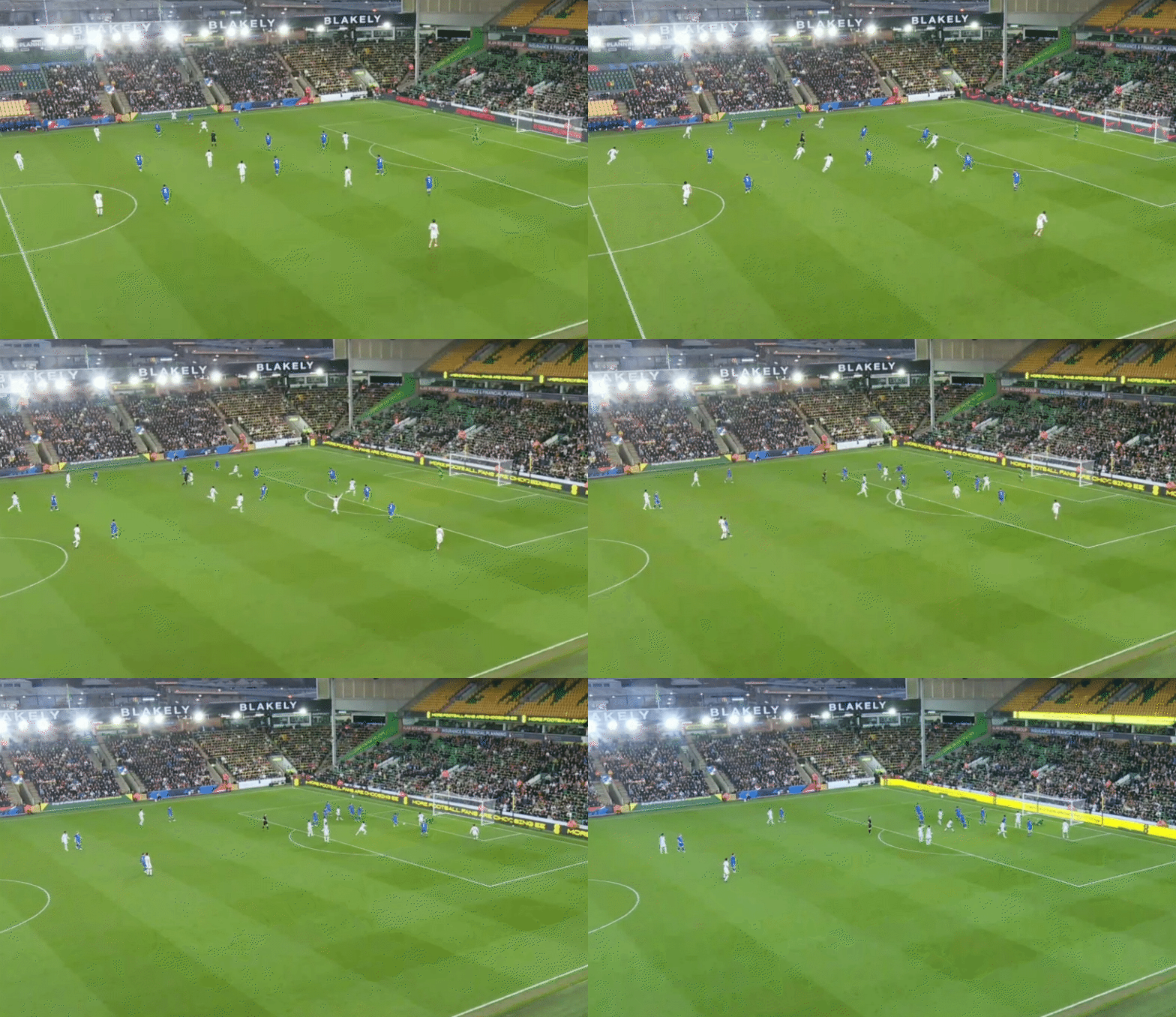
He’s one of the best foul-getters in the game.
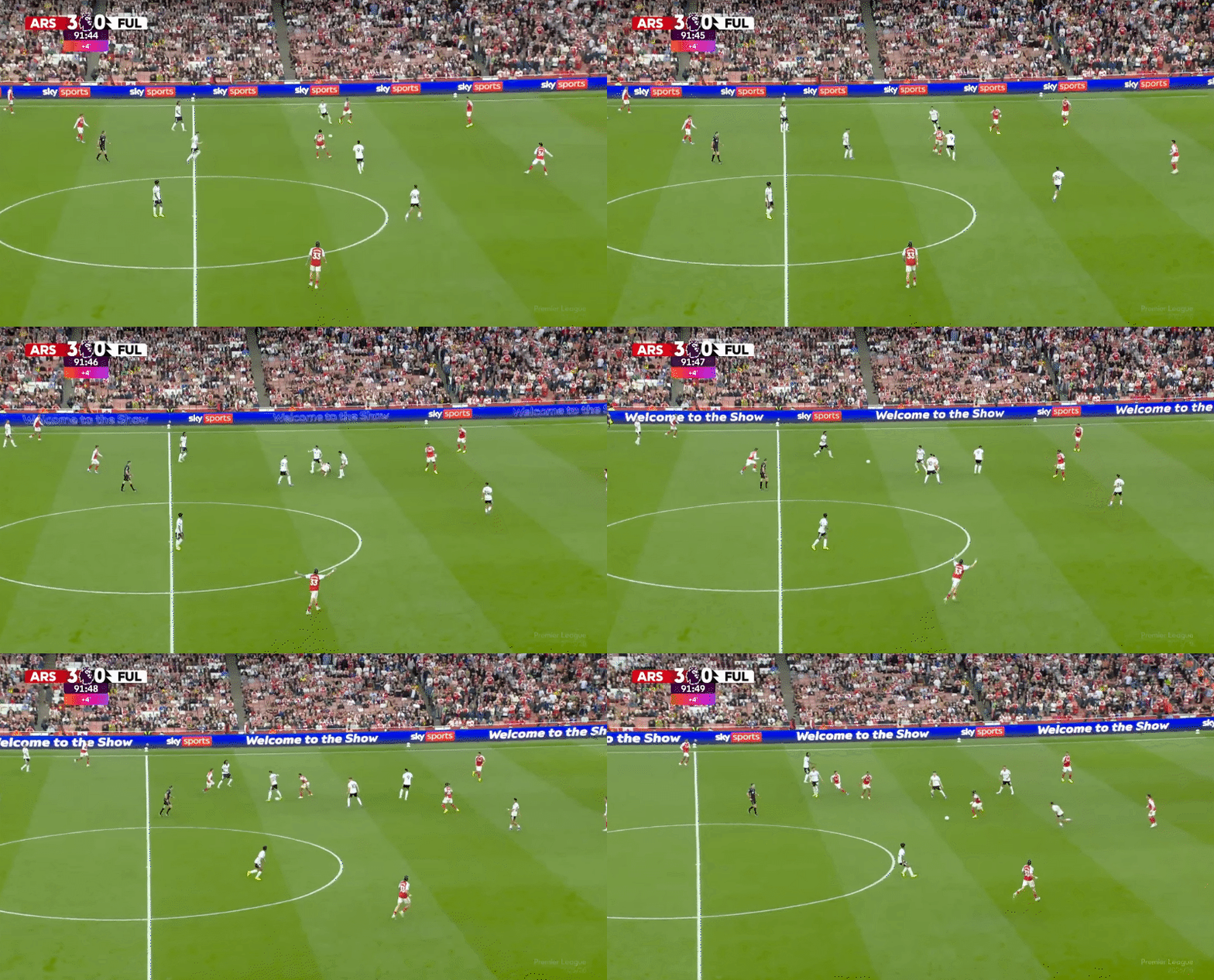
But, it should be said, these duels are riskier in the middle of the pitch, which can make him more partner-dependent as a midfielder. You want Lewis-Skelly to duel and be himself, but you also want somebody who can quickly sweep up a ball like this (which Madueke does here, naturally).
I was pithy on social media and said, ‘“Zubimendi ran more than anyone in the league and now looks a bit tired, so thank God Lewis-Skelly is here to ball out” can be your entire take on the situation, you know.’ Lewis-Skelly has been as impactful as you could have reasonably imagined, as a Chekhov’s gun pulled out in the third act. At a certain point, it felt almost too late in the season to be having this conversation. And yet, here we are.
Zubimendi absolutely still has his place. And with some rest before the Champions League final, I’d still be strongly considering playing him in that left-8 role that he played in the first leg of the semifinal.
👉 The all-important full-back question
Tomiyasu showed us how it’s done.
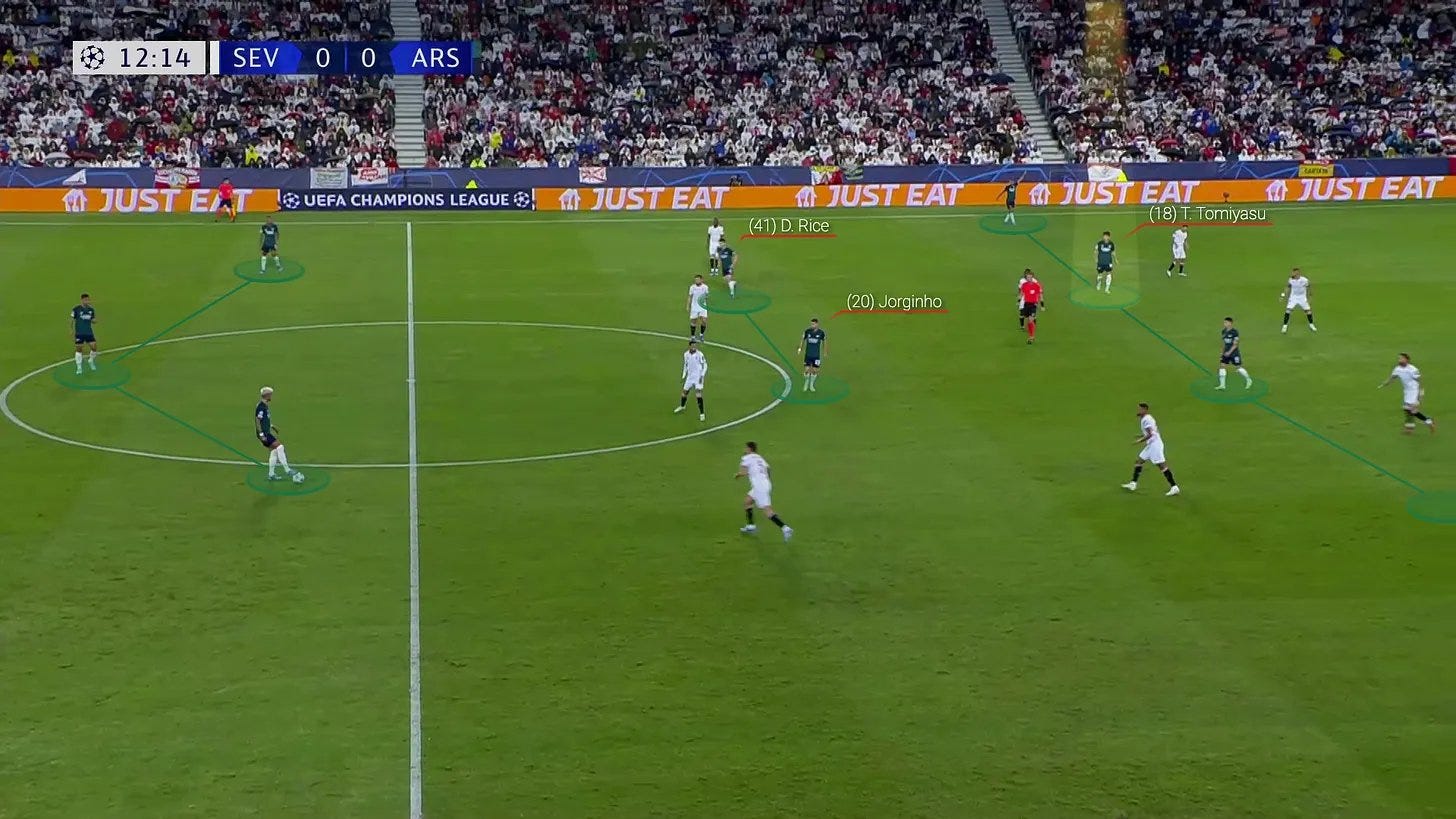
The role of the full-back is all-important these days. One of my feelings is that top coaches have essentially hacked the ideal role as the all-action, perpetually free man. But the physical demands are unsustainable, so you need a superhuman athlete to defy gravity, or ridiculous rotation.
Injuries and all, in five seasons at PSG, Nuno Mendes has played 40.2% of league minutes; he’s started-and-finished fewer league games than Ben White did in one year at Leeds. His playing time magically jumps up to 75.4% of available minutes in the Champions League. And remember the example from Enrique’s dream: “Nuno Mendes as a full-back, Nuno Mendes as a winger, Nuno Mendes as a No 9, Nuno Mendes as a midfielder.”
The FIFA Training Centre recently wrote Innovation: The emerging positioning of the inverted full-back, in which they tracked some of the evolving responsibilities. There are definitely some sample biases here, but you can also see how full-backs are getting more interior.
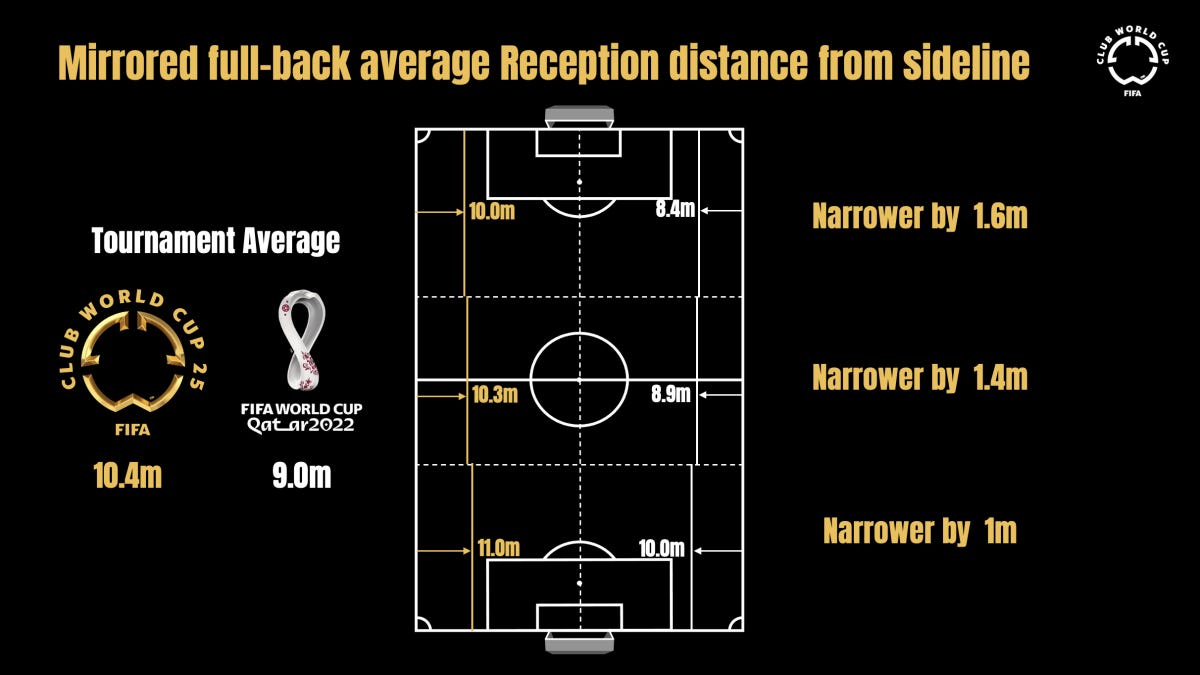
What they found:
Full-backs received the ball 10 meters inside the sideline in the final third, which was 1.6m narrower than at WC2022.
Inverted full-backs had 23.1% higher reception rate in inside and central channels than WC2022.
And we’re seeing typical “inversion,” that idea of Zinchenko folding into the double-pivot, a little less. What is more often the case is that full-backs are floating around as a third man, looking to exploit jumps by the block, and create overloads. On the far side, they are often left unmarked as hybrid pressing schemes try to squeeze one side.
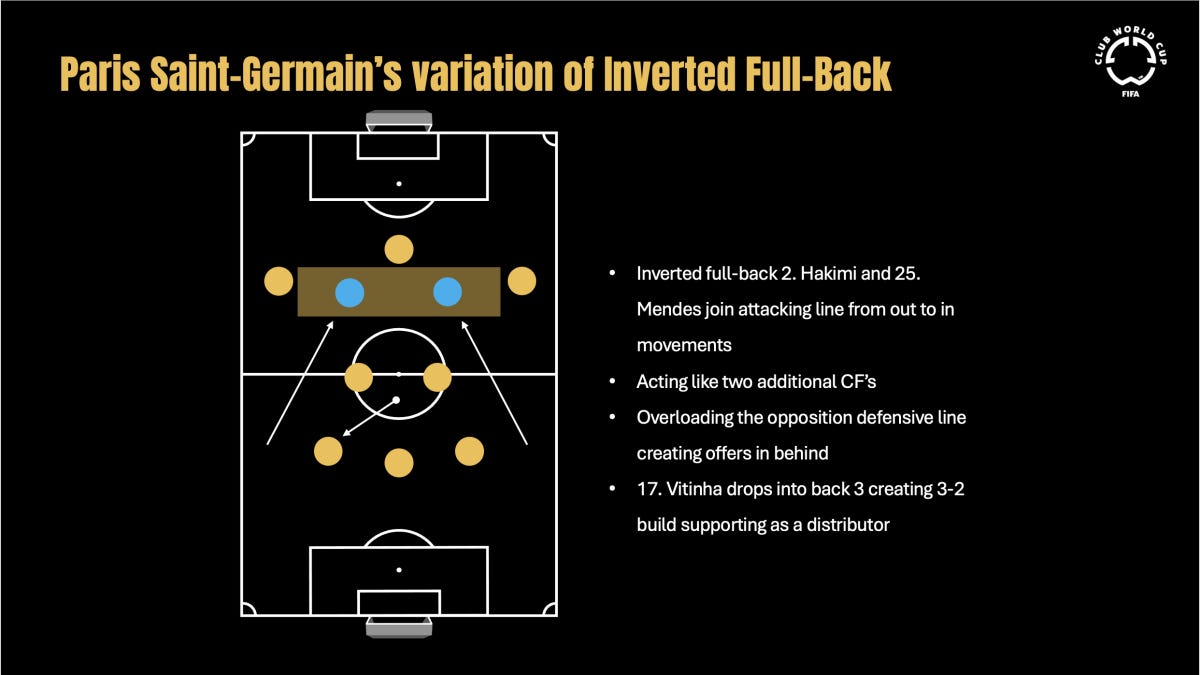
But you can see, just in those arrows, how far the distances are to travel, how many zones they might have to be comfortable in, and what kind of tactical and physical load they are under. As instructive as his stint was, Tomiyasu was not known for his health.
For today, the point is this: in such a shape, some of the most decisive touches are going to come from the full-back. They will find themselves in dangerous territory, with space that teams haven’t planned for. If things are looking at their fluid best, you may have a full-back to thank. If not, same.
Here is a pristine example. With Atletico sending four players forward in a passive pressing front, the free man is over the press to White. This is the kind of ball that would have been nice to have in the League Cup final. But then, play squeezes onto the Arsenal right, so the point of attack changes, and who is the free man after that? The other full-back: Calafiori.
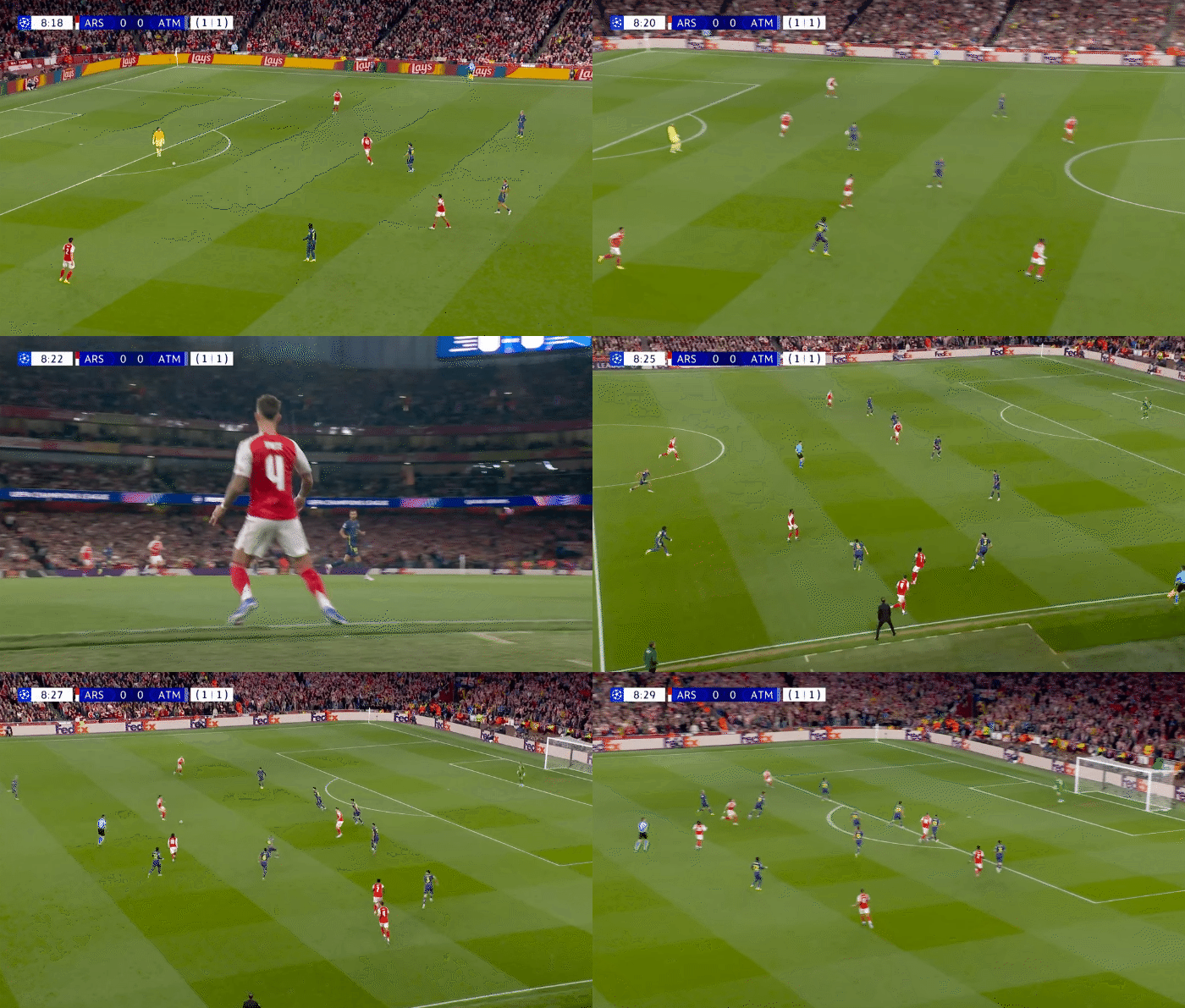
Less of a “total football” skillset from those two, and that shot never comes.
In more straightforward moments, you can still see how easily the full-back can be found unmarked, particularly if an opponent is caught between a zonal and pressing moment.
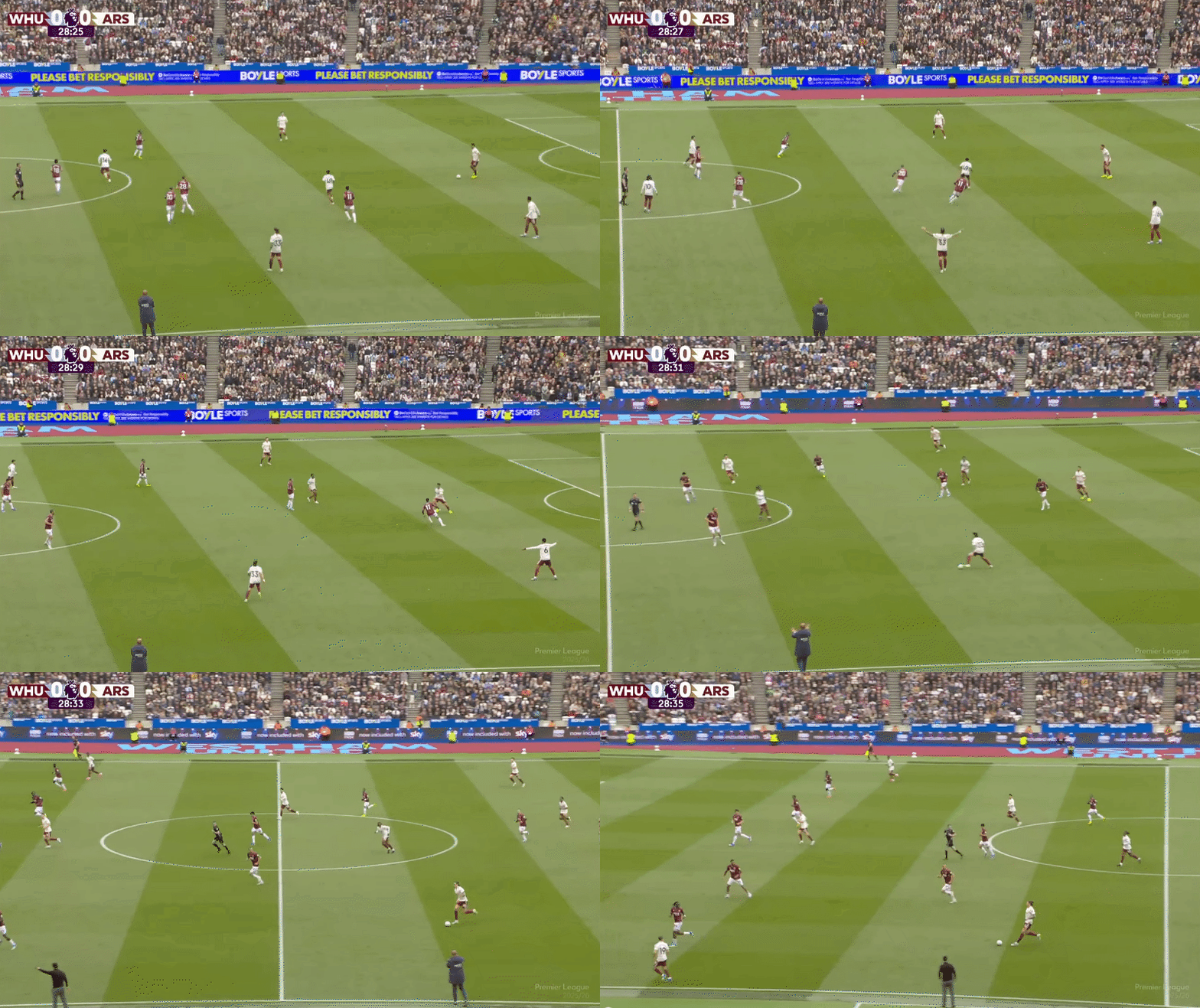
No, this isn’t a replay.
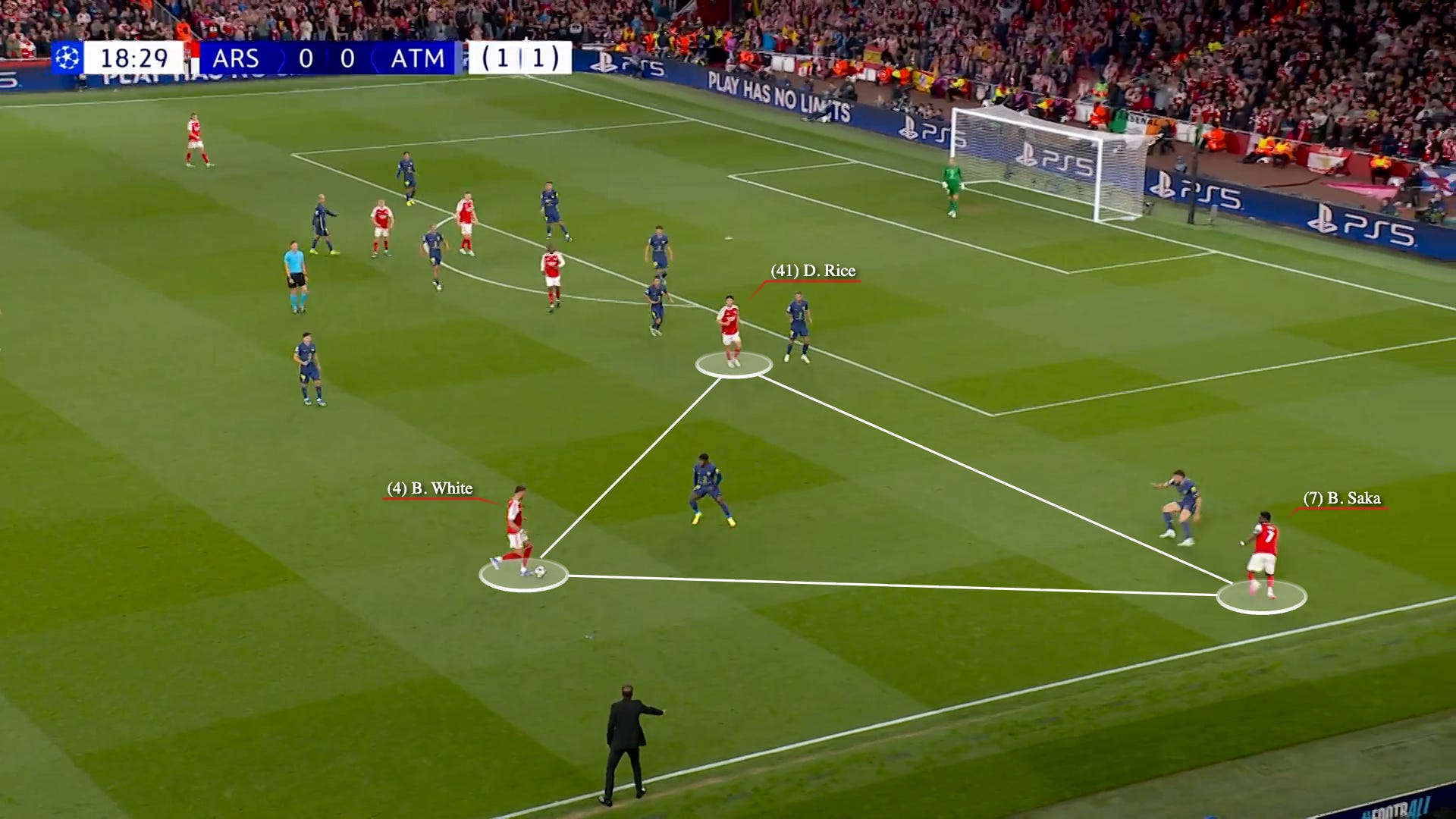
These players also play vital roles in the balance of wide triangles.
As I wrote in, erm, Triangles:
It’s oversimplified, but in any outside trio, I’d like to see a few adjacent profiles:
(Below) An orchestrator: somebody who can dictate play and pick apart the opponent shape with passes.
(Beside) A dribbler: somebody who can drive at opponents and collapse the shape, starting a cascading effect.
(Beyond) A runner: somebody who can interpret space and pull it apart: “decompacting” the shape horizontally, diagonally, or vertically.
Ben White is so valuable and difficult to replace because he is many things in one: he has the controlling instincts of a midfielder, and the tireless runs of a wing-back, all in the body of a former CB. This makes almost anything flow better because of the natural balance he provides to other profiles. Remember, too, that his “late return to form” also coincided with Saka’s return.
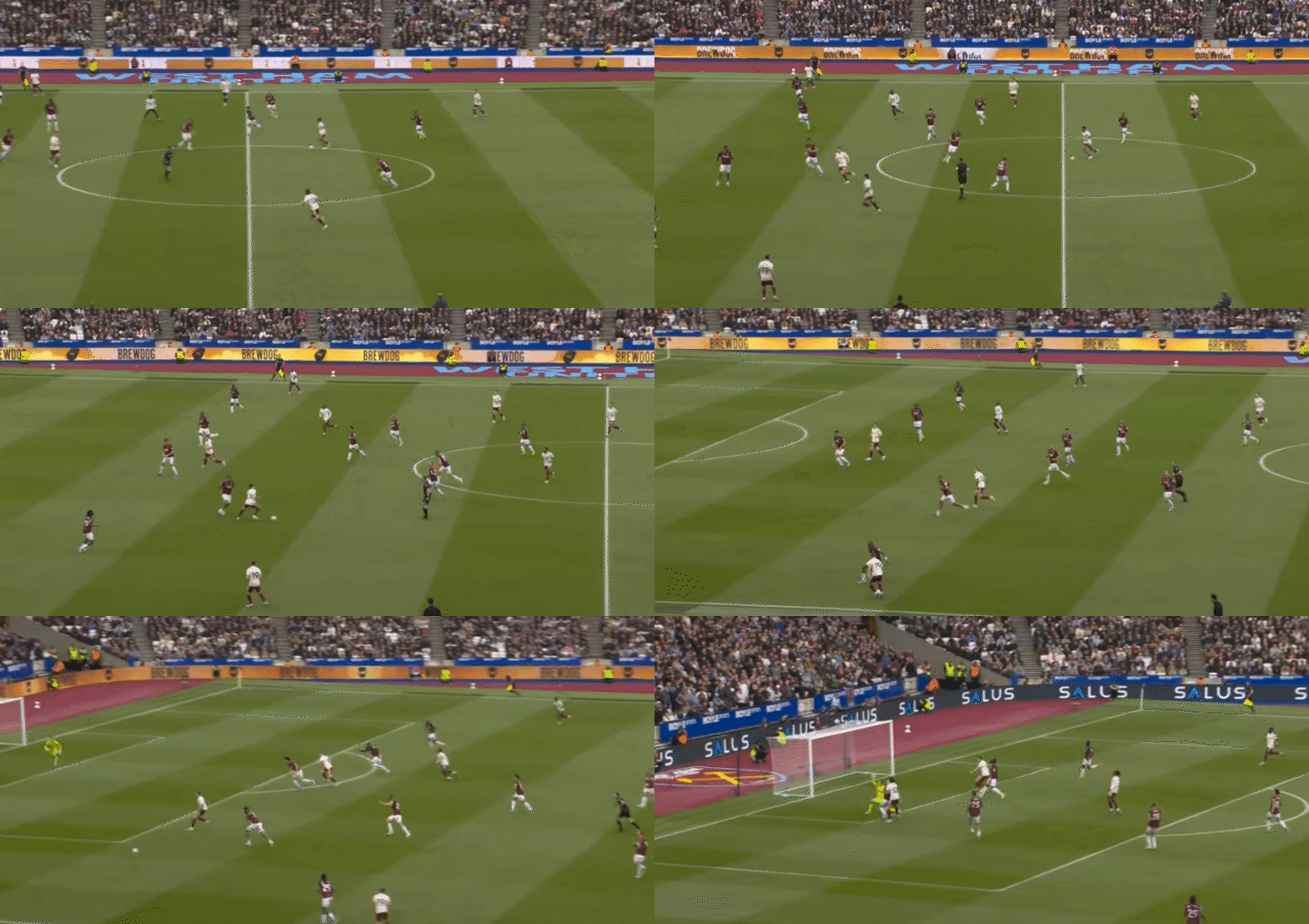
The same is true on the other side. Lewis-Skelly and Calafiori work together in a way that is easy to understand. They can swap positions, they can both play midfield, they can both play left-back, and most importantly of late: Calafiori offers a credible option behind the “gate” for Lewis-Skelly to punch it through to.
We look for triangles with an orchestrator, dribbler, and runner. Like Nico O’Reilly and Nuno Mendes, Calafiori is all that in a single player, which balances out the profiles around him. Physically or temperamentally, these players have more in common with, say, Jude Bellingham than they do with a more prototypical full-back like Kieran Tierney.
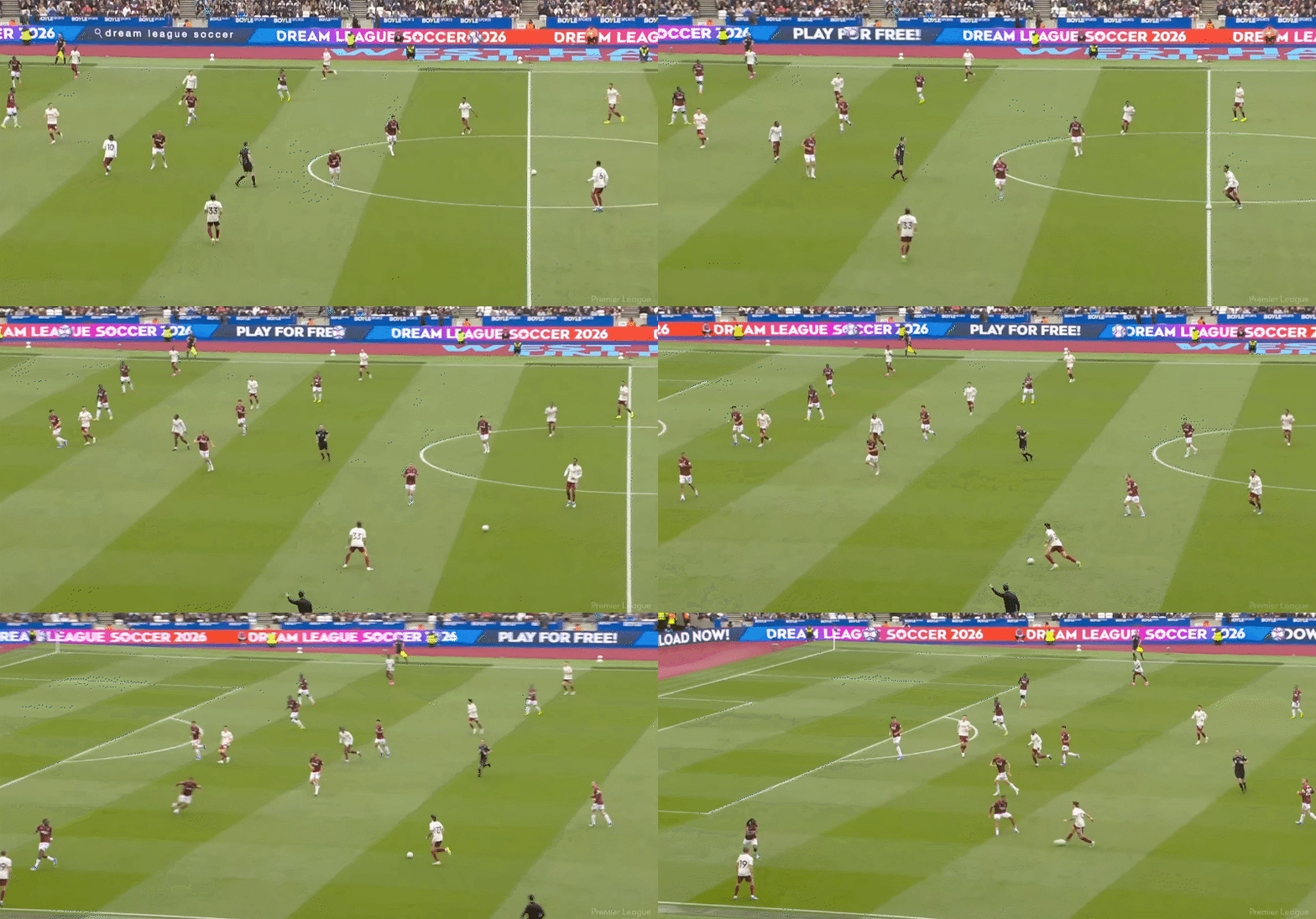
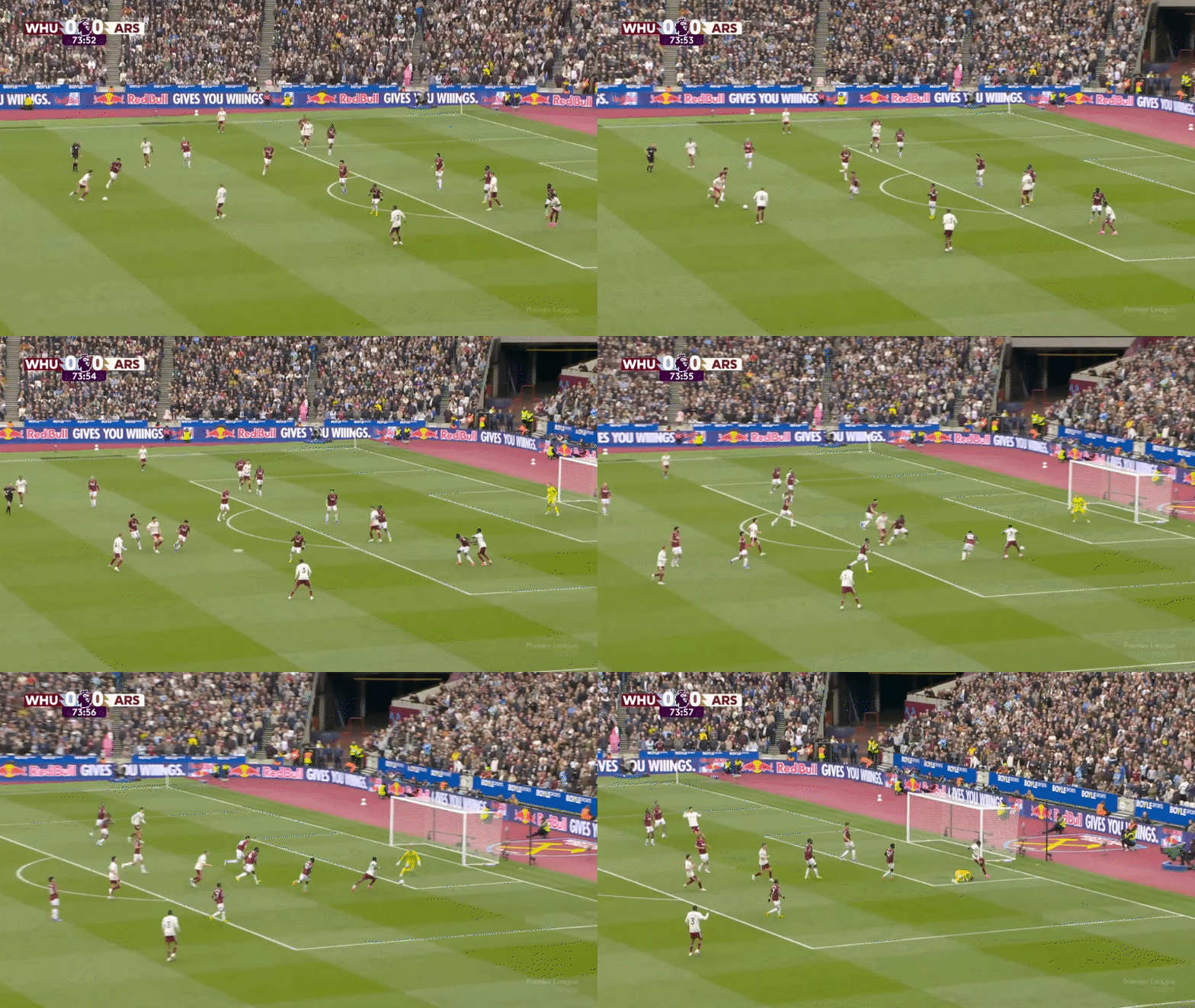
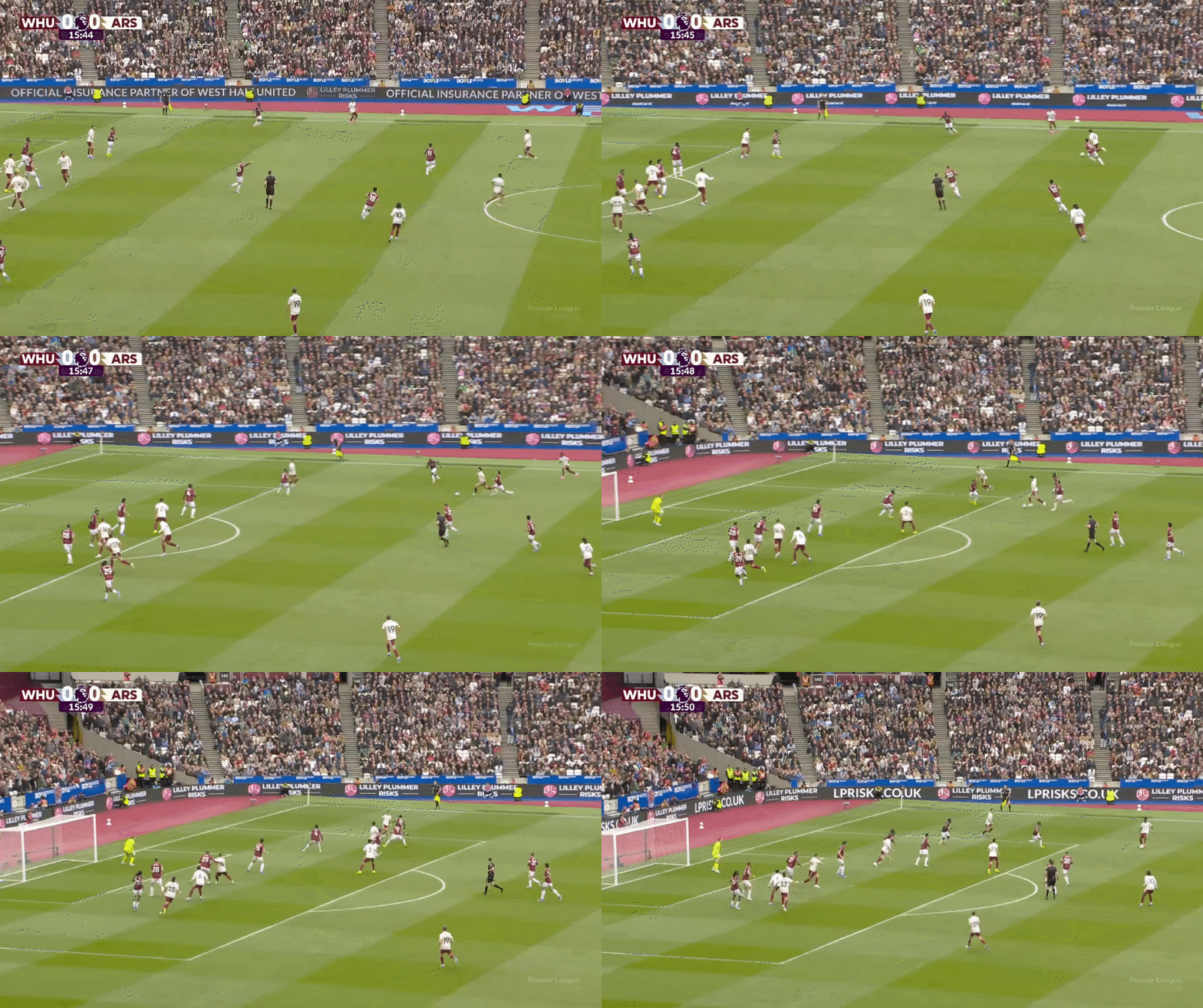
Most of the early passage of play against West Ham looked like this.
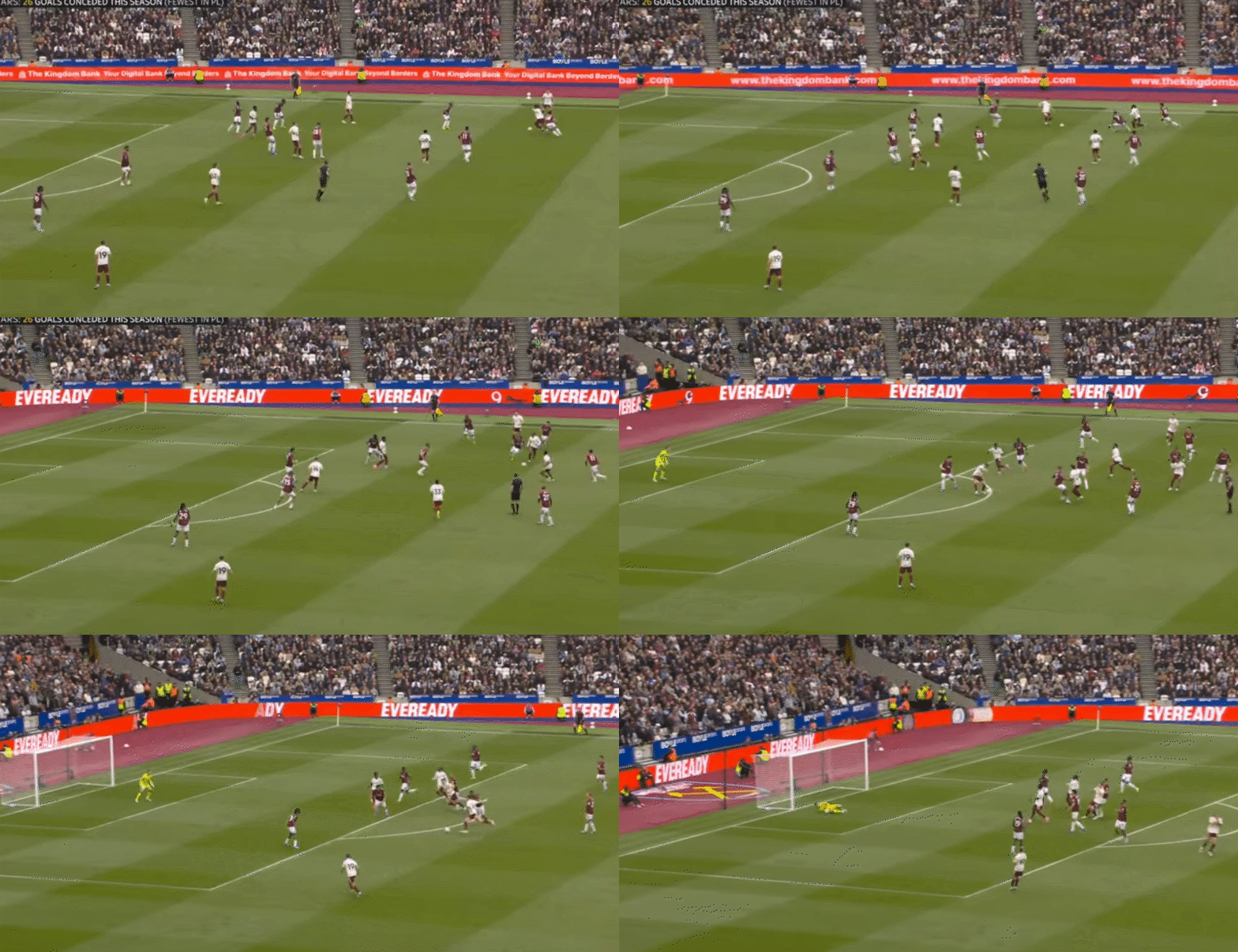
Mosquera arrived at the Metropolitano and immediately made the argument for how dangerous these full-backing touches are.
My points, to close this thing up:
Full-backs are indescribably important right now. Defending 1v1, contributing to build-up, making long recovery sprints, operating all over the pitch, and most critically, arriving at the decisive moment with the ball at their feet. The ask may indeed be unsustainable over 50+ games. Going into next season, I’d like to add a hybrid midfielder capable of covering at right-back, the way Lewis-Skelly currently does on the left.
It is no surprise that Lewis-Skelly is thriving specifically with Calafiori beside him, floating and swapping but always providing an option in front, and with Rice alongside, making the big recovery runs and cleaning up, giving him the confidence to turn and carry. I would personally argue for Calafiori to start every game he is fit. Him for 60’ and Hincapié for 30’ just works.
White’s loss looms large. I cannot adequately describe how grateful I am for everything he has done and sacrificed for this club.
I would be hesitant to pull Rice out of the middle again. Keep the partnership with Lewis-Skelly rolling in the league. The only question is who starts the final, and depending on fitness, I remain open to Rice at right-six and Zubimendi at left-eight, as we saw at the Metropolitano.
Timber’s return is vital for that. In the meantime, the cleanest answer is Mosquera at right-back. He is doing fairly well; his spatial awareness and confidence in manipulating the first line are particularly interesting. But as we’ve established, the full-back is often the one receiving the free-man touch, and their read of that moment is frequently decisive. He is a talented young centre-half. In forward areas, he usually looks like a talented young centre-half. If we are going to use him up there, it might be fun to have him as a target man, or back-post headerer. Use his strengths.
For the two remaining league games, I would be, at very least, interested in starting Zubimendi at right-back. This is not a new idea. It was something I wanted to explore as an option when he was signed. But if his superpowers are tactical intelligence, work-rate, spatial interpretation, quick combo play, and the ability to duel and generate chaos in final actions, I would greatly prefer to keep Calafiori in his best position (with Trossard and Lewis-Skelly to play with), the Lewis-Skelly and Rice partnership intact, and try something new on the right. Zubimendi seems almost agnostic to the zone where he plays, and his two-footedness helps everywhere. The obvious risk is the physical ask and the recovery runs down the line: it is not lost on me that we’ve just been talking about Zubimendi’s physical fatigue, and now I’m considering putting him into a position that can be super demanding. It’s marginal, but my hope is that Saliba and a deeper Rice can cover most of that against Burnley and Crystal Palace; and my real hope is that we have so much of the ball that there isn’t much running in the first place. If it were up to me, I think it’s the route I’d take. If we believe that the position now belongs to total footballers, Zubimendi is certainly one.
👉 Issues at West Ham, and what to learn
The initial lineup against West Ham was to run it back, again. But there were tweaks: Lewis-Skelly was essentially a lone-6, with a diamond formed around him, all designed to overload the back line.
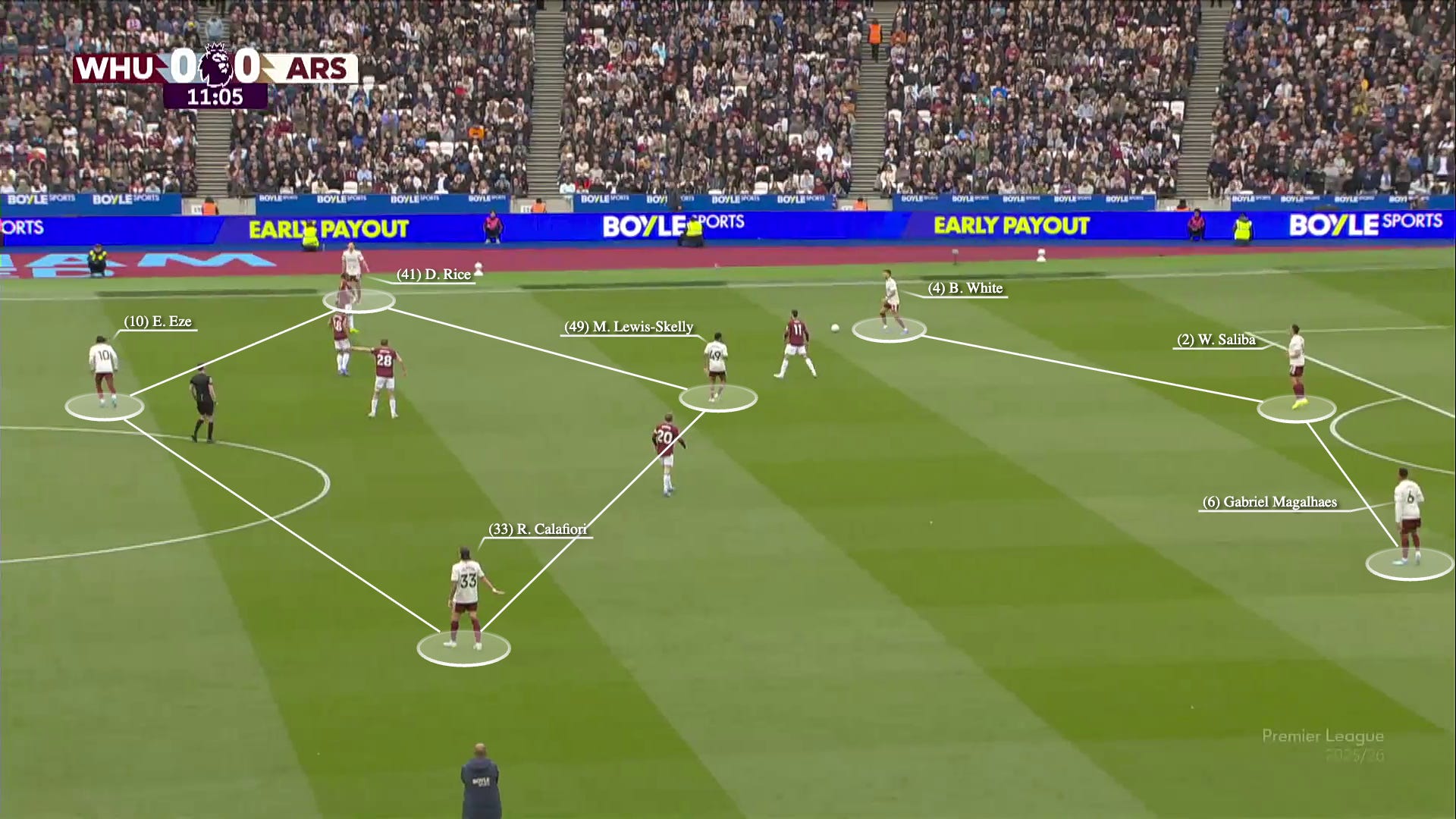
This represents some real commitment from Arteta. It provides between 3 and 6 options for Lewis-Skelly to distribute to, but it also can leave him alone with the CB’s to defend transitions, with Rice sprinting back. Arteta decided it was worth the risk, and the team looked good in the opening period.
This kind of play happened early, and kept happening.
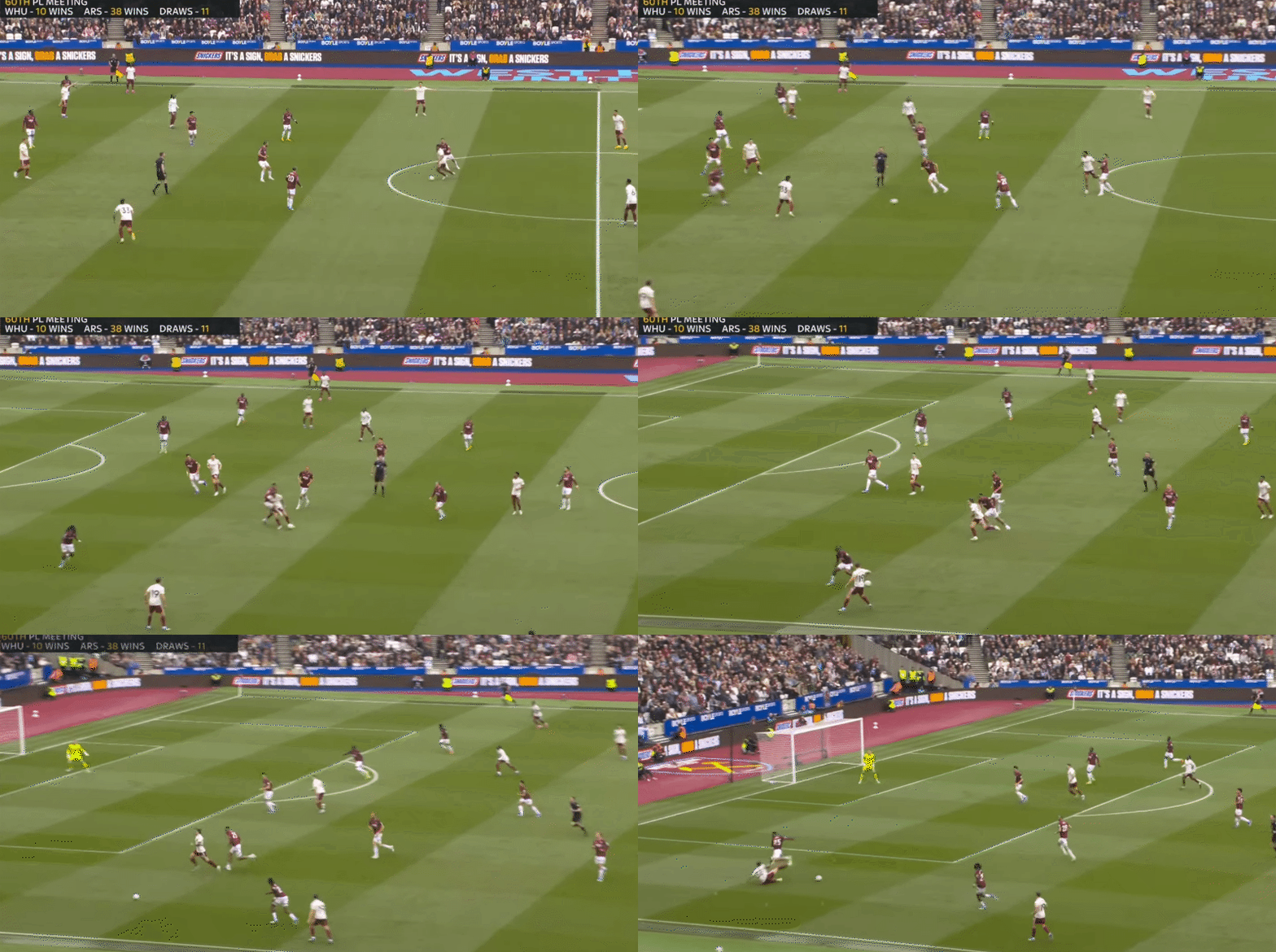
I feel fairly confident that the pressure would have kept squeezing West Ham, and a goal would have come before too long.
Once White went off, though, things lost their thrust. Rice was inserted at RB, and Zubimendi came on to form a double-pivot with Lewis-Skelly. I understood this move better after rewatch: Rice was playing a high-pocket RCM role anyway, so the thinking was just to keep that going with Zubimendi, keep Lewis-Skelly doing what he was doing, and Rice could continue the good work he did at Brighton at RB.
I’d offer two reasons for this not working out:
The vibes were off on the right flank. Rice just never looked comfortable or particularly assertive over there this time. Yes, the vibes were off is analysis, thank you.
Lewis-Skelly and the current version of Zubimendi didn’t complement each other in spatial defending. With Lewis-Skelly deeper, there were distance issues.
From there, Calafiori went off at half, and Lewis-Skelly went to left-back. This was understandable, but it put Lewis-Skelly at a less advantageous role, kept him outside the block, and separated him from Rice.
Here’s a perfect example. Summerville receives the ball, and instead of getting goal-side, Lewis-Skelly gambles for a tackle and leaves Summerville open to carry forward. From the other midfield slot, Zubimendi tries to mop it up, but is a step late. Normal, but this is the kind of run that the £105m alien closes down.
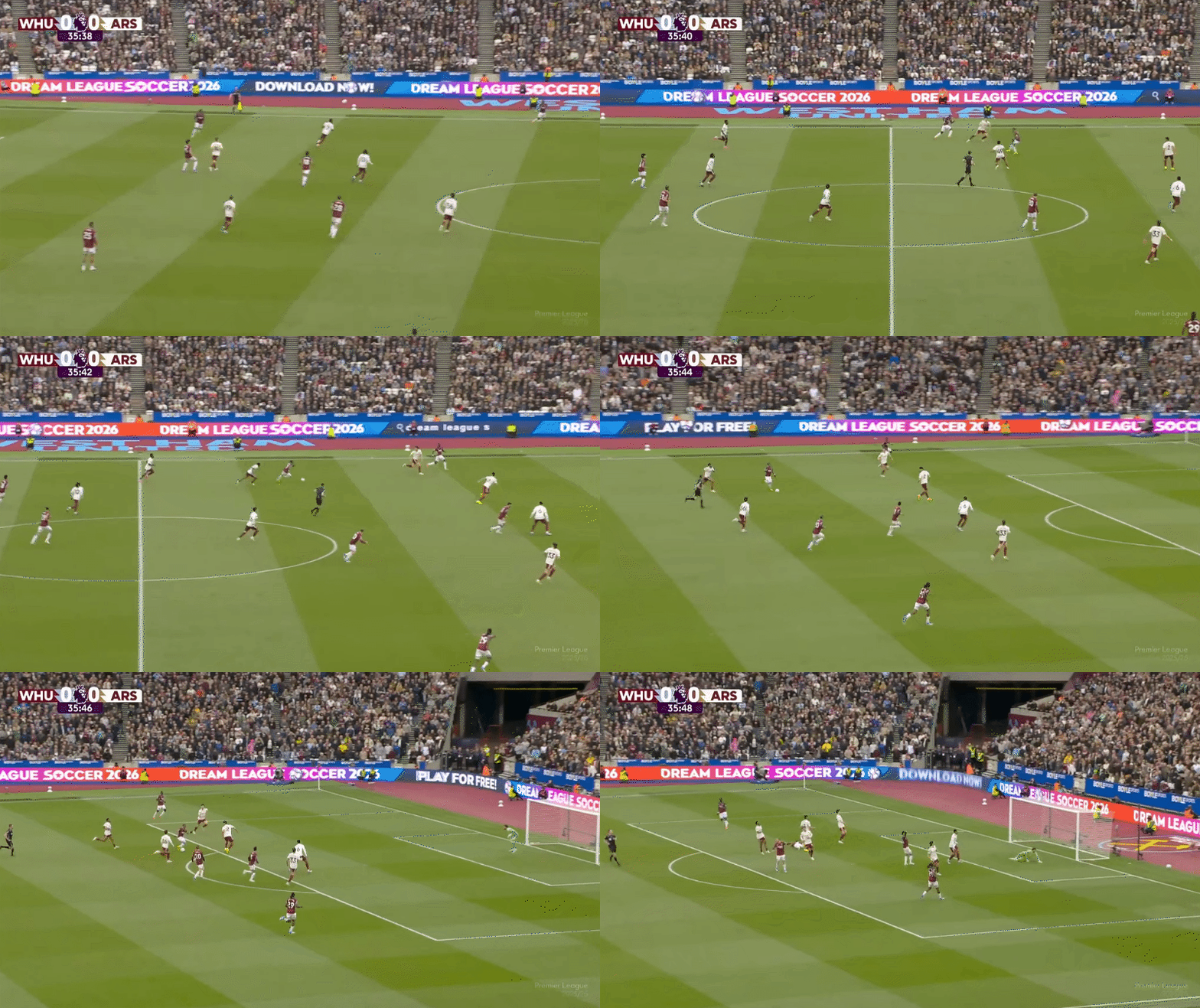
In the second half, we saw a shift to a new setup.
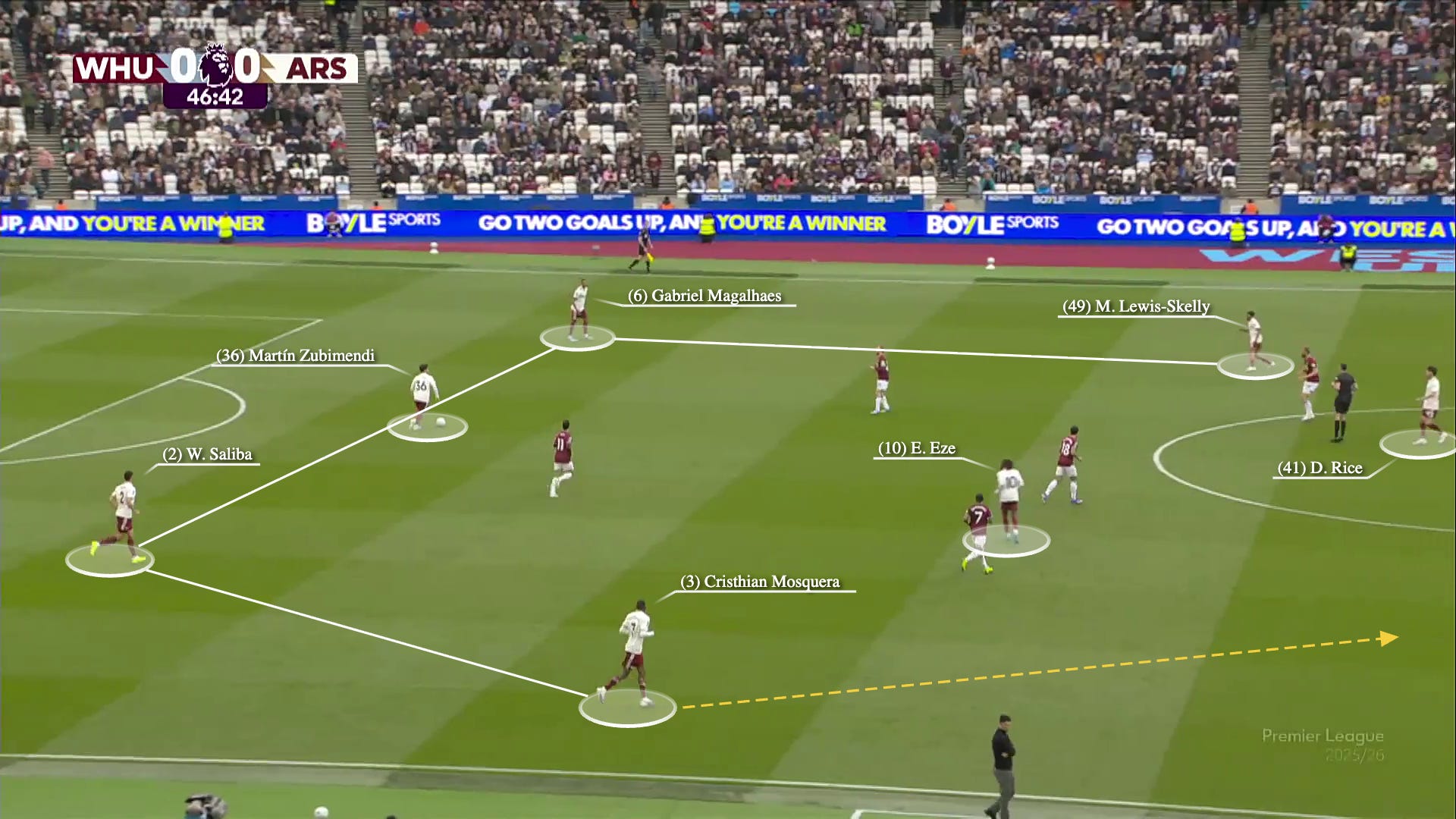
Eze is free to receive. But this is giving Lewis-Skelly those fewer, higher Calafiori touches; it’s giving Rice, Mosquera, and Eze the touches of a floating #10, where only Eze is at his best there. Basically, the receivers in the “first gate” (behind the front-two pressers) and the “second gate” (behind the midfield) aren’t as dangerous as the starters were.
Things changed later, as Arteta sought a lineup that could pin and overwhelm. But much of the game stayed cagey for too long. My lessons were simple: Zubimendi and Lewis-Skelly may work as a duo under peak fitness, but not right now, and especially not with their distances too far apart. And we’d better make damn sure there’s some liveliness in those pockets. Full-backs are highly important for that.
The decision at full-back has been weighing on Arteta.
“Declan Rice, when he’s played as a full-back, against Brighton, was exceptional. But then the other night, it was something else. It depends. The sample is still so little, it will remain so little from here to the end of the season to judge if a player is good enough who can perform in the position, and what is the cost of moving that player from one position to the other, and that’s the balance that we need to find.”
👉 Ødegaard the lockpicker
As the scoreless draw continued, the spaces seemed to close instead of open. Look at the vertical and horizontal spacing for West Ham.
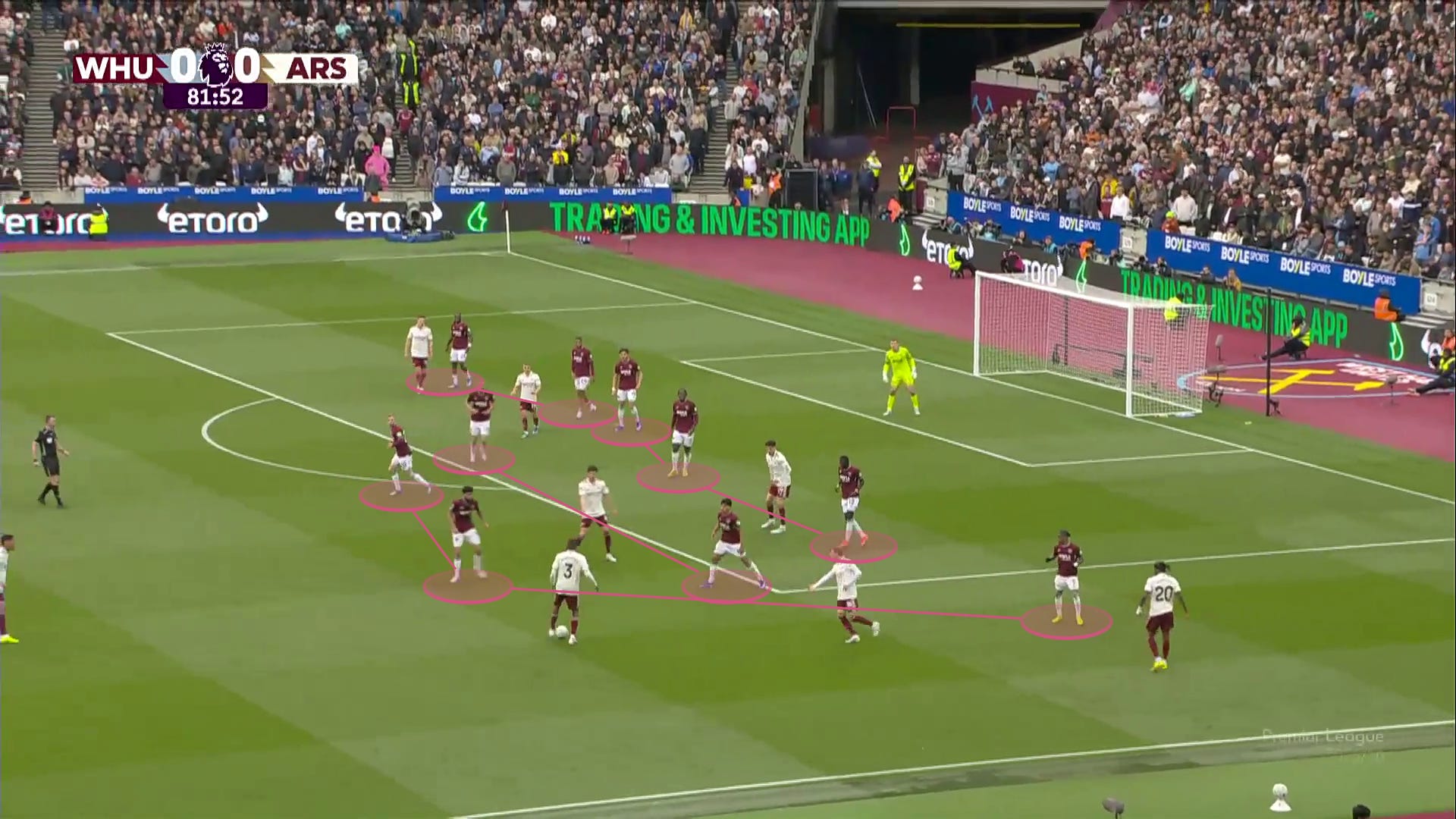
Last time, we talked about the difficulties of some of our lineups to unlock a situation like this.
“When facing a lower block in the Premier League, they are not the ideal candidates for pinning. Pinning requires a mix of retention, patience, and, in the decisive moment, the ability to execute a refined tight-space action: a snap shot, quick dribble, or slipped pass. As a striker, you’d want to dominate in both reaction time and aerial physicality. As a winger, you need to win a crowded 1v1.”
This meant that Arteta wanted personnel to match the moment, and turned to Havertz and Ødegaard. We can see how much prodding the situation required.
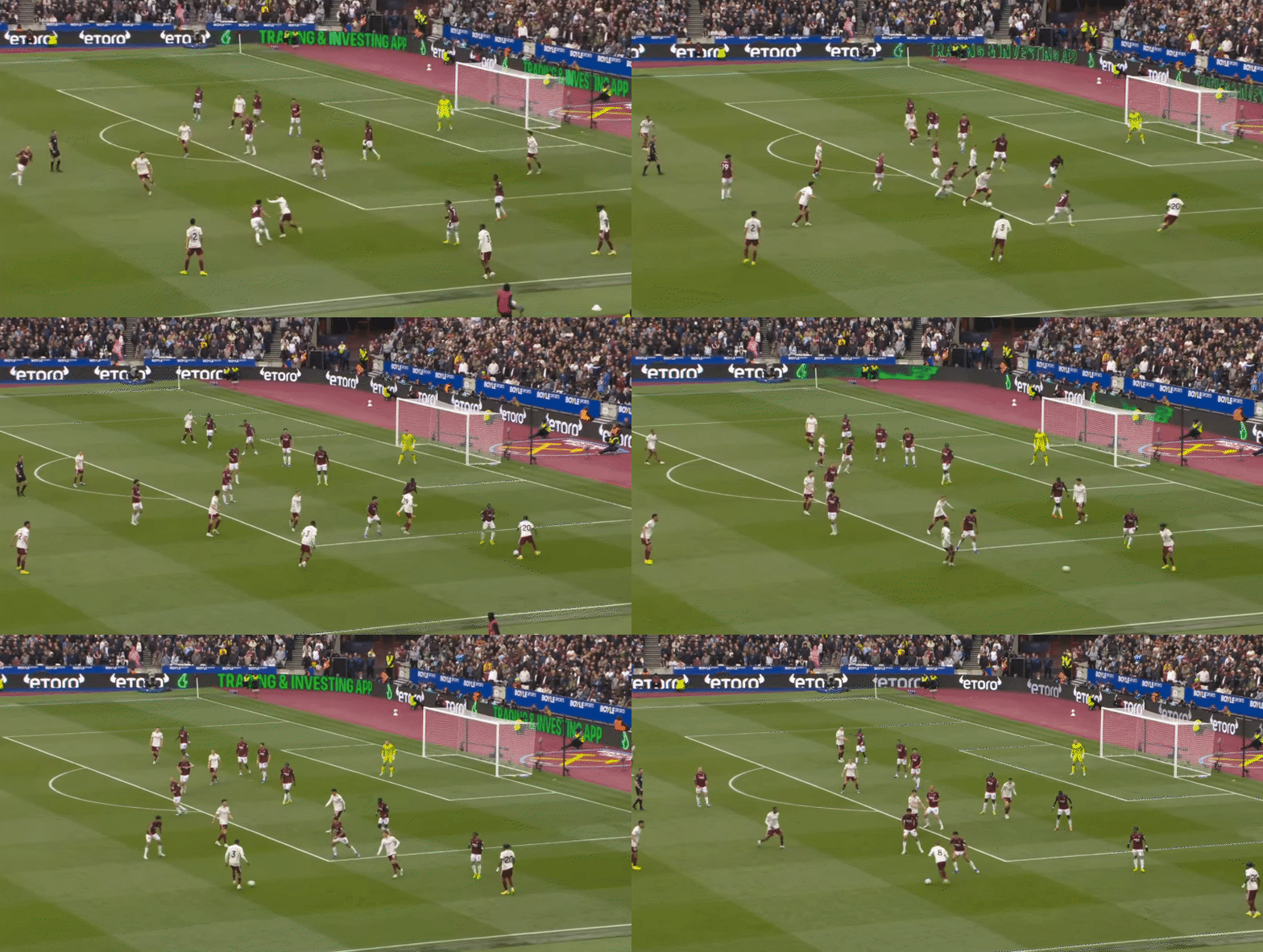
This is where Ødegaard is just special.
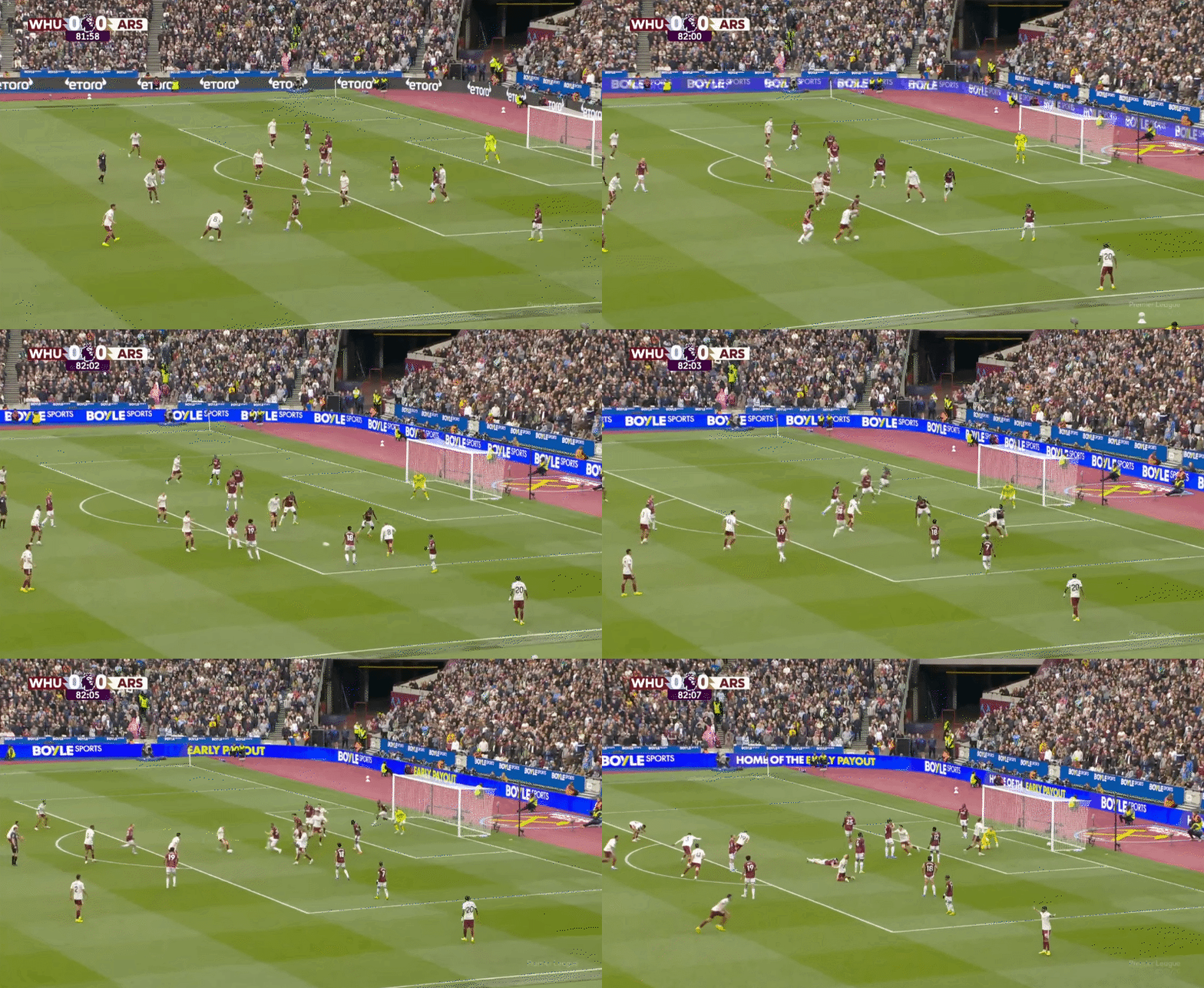
We’ve had years of Ødegaard getting the ball into the box more than anyone in Europe, and many assuming it was because of his role or positioning or whatever. Really, it’s just hard to work the ball into a packed 10-man box, and he’s great at it.
Even in a year such as this, here’s Ødegaard in the Premier League this year, amongst all players, via Opta and Gradient:
#1 in through-balls/90 (1.14)
#1 in passes breaking final line (1.42)
#2 in open play assists/90 after Cherki (0.35)
#4 in open play chances created/90 (2.04)
#9 in xA/90 (0.25)
The recent setup (Calafiori at LB, Trossard at LW, and a Rice, Lewis-Skelly and Eze midfield) has worked well, and I’m in no rush to change it, especially with lingering questions about Ødegaard’s fitness. Ødegaard has also been closing out games well, and if you need to change the dynamic, you can just put him on quite early. That kind of luxury is why you buy an Eze in the first place. But with low blocks a-coming, it’s tempting to start Ødegaard again.
I’ll call out two other aspects of that play, as well.
The first is the entry pass from Rice. I don’t have anything more interesting to say than I think he’s looked good combining on the right. He has more experience on the left, but I seem to prefer his combination play and crossing angles over here.
Another. (Marginally offside, I think)
Weeee.
…and the final point there is Trossard, who has notched an assist to Gyökeres, the rebound that led to Saka’s goal, and the winner at West Ham, right when we needed him most.
He’s so interesting because of his ability to recreate himself every year. He went from 1 goal and 10 assists in his debut campaign to 12 goals and 1 assist the next. This year, he’s been more of a wide facilitator, adding some interesting tempo things out on the touchline, and seems to have a natural understanding with Calafiori and Gyökeres down that left side. He had a down period, but what he’s really been exploiting of late is his ability to slow things down and keep defenders off-balance with his two-footedness. His old teammate at Brighton, Pascal Groß, has made a career out of chopping and crossing, but Trossard has the advantage of being even more genuinely two-footed with his chops, which creates the kind of anxiety in defenders that Son Heung-min used to generate before a shot.
It was nice to see him lurking at the penalty spot before the goal.
👉 Gyökeres
I’ve been asked whether Gyökeres has been improving or whether he has just faced some good matchups. The Atleti performances could feasibly be kept in a compartment, as he can beat them physically. But Joachim Andersen and Calvin Bassey are no slouches.
Looking through the footage, I see two reasons for his recent uptick:
Surrounding him with a cocoon of passers high (Trossard, Eze, Saka) and even low (Calafiori, White) suits him far better than playing him with looser, running types.
Yes, he has just … gotten better at playing football in Arsenal-type game-states.
The clearest example is the timing of his darts in the box. In the past, he’s struggled with reactive movement, waiting for the ball to get hit to make his run, often arriving a step late. The problem, as Gary Lineker tells us, is that you’re then confining yourself to the same information that the defender is working with. Ideally, you have a feel for your wide attackers and can better predict when the ball is coming in and gamble as a result.
For both goals against Fulham, he started his move before the ball was hit.
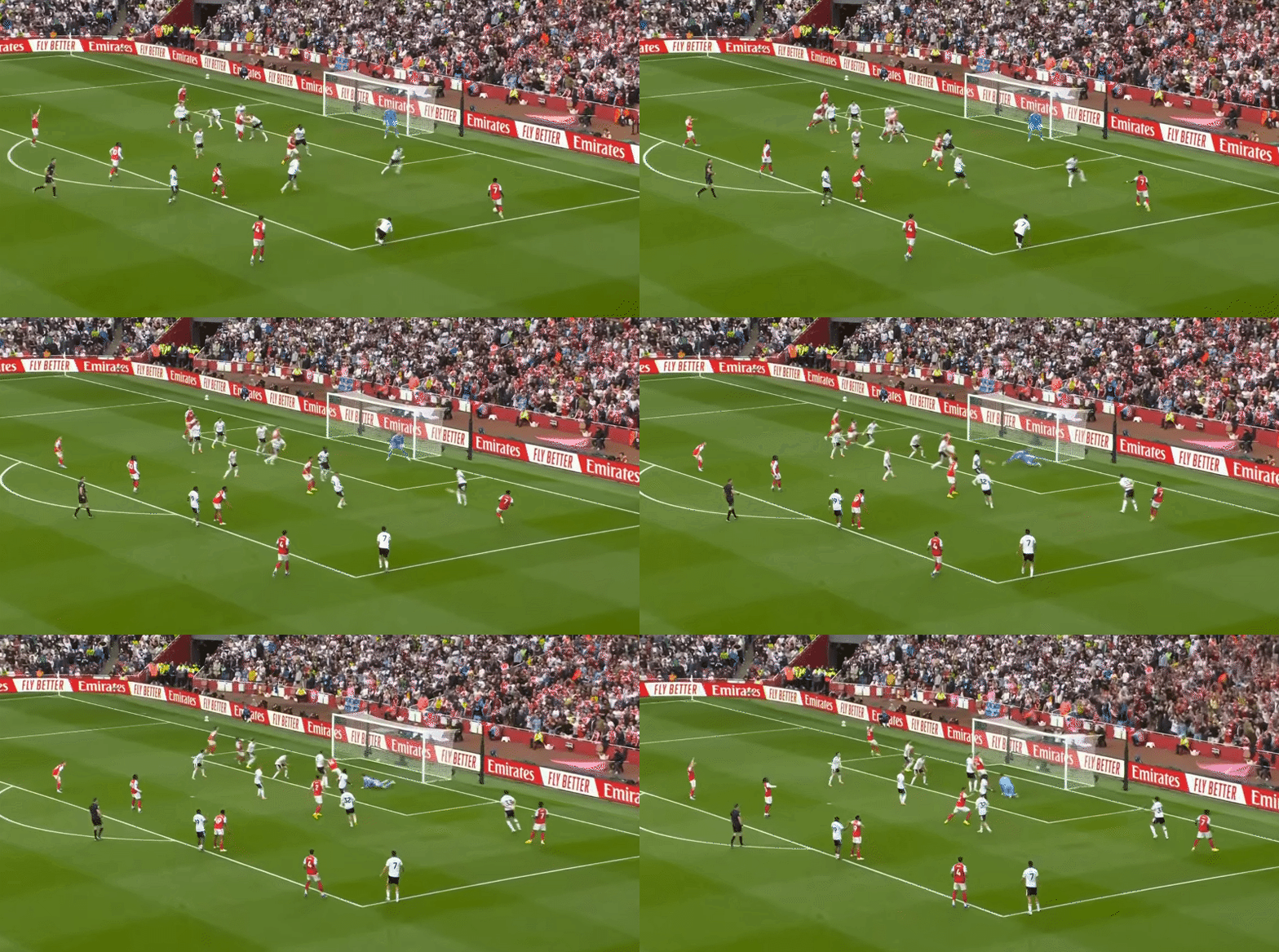
Here, he drove into the space instead of tracking the ball.
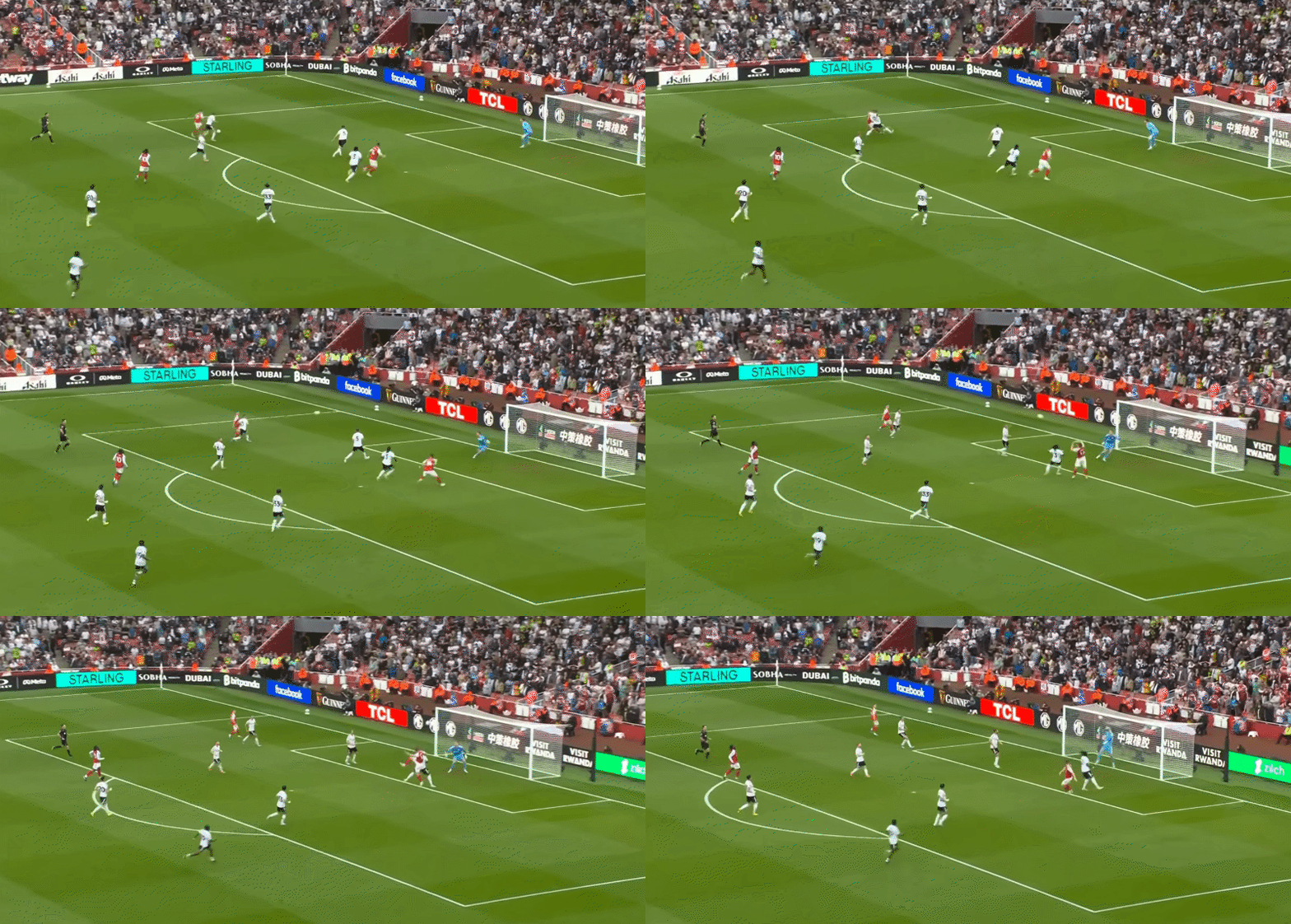
And yes, your eyes don’t deceive you: his dropping to link up play has gotten better. It’s still not enough to be considered a genuine strength, and it’s probably not his touch that is improving, but his level of certainty: if you’re clearer about what you want to do with it, you’ll touch the ball with more confidence.
I’ve been satisfied with my preseason read on Gyökeres. It laid out my reservations, but also:
I also don’t think anyone should discount the possibility that he is a stubborn motherfucker … If he’s fast, elite with his intensity, high-level tenacity and game mentality, and has good ball-striking, it’s hard to be too blasé about that skillset. He’s [also] durable and ready for a Premier League calendar.
Almost every professional footballer is headstrong in their own way. Gyökeres seems to be in the 99.9999th percentile of that.
👉 Declan Rice, he play nice
You asked me for my votes for Arsenal Player of the Season? Wait, you didn’t? Ah, you’re getting it anyway. Along with some grades from Gradient.
Declan Rice (Gradient: #1 rated overall player in the Premier League)
William Saliba (Gradient: #1 player at positioning in the Premier League)
David Raya (Gradient: #1 rated keeper in the Premier League)
On Saliba: I watch a lot of football, and am certainly not free from bias. But I do think Saliba’s the best defender in the world, and is absolutely vital to everything we do. Van Dijk is now a step off, so if you asked me which world defender I’d want to start a team with, I’d pick Saliba every time. He should not be undercelebrated for making everything look so easy.
remember how arsenal weren't challenging for titles and then saliba got in the team they immediately started challenging for titles and then he got injured and they lost the title and then he got fit and they started challenging for everything again
👉 Looking ahead
For Burnley and Crystal Palace, I don’t want to disrupt the chemistry of Trossard and Calafiori, or Calafiori and Lewis-Skelly, or Lewis-Skelly and Rice. Mosquera is the most likely candidate at RB, but I’d prefer a little more on-ball menace. And I assume that Havertz and Ødegaard are still being managed physically.
As such, here’s where I’d lean at the moment.
Zubimendi can offer a lot of the combination and half-space play that White does, and he also has a chaotic, unexpected streak that can create moments against overmatched teams: we’ll need to send numbers forward, creating diamonds instead of triangles.
To me, this feels like a good balance between “keep what’s working” and “injecting something new.” The team retains some great finishers, as well. But as always, so much depends on a clear understanding of physical levels, which is something the team has a better view of.
For my next piece, I’ll work on a full PSG preview and opposition report. Really need Timber for that one. Getting him fifteen minutes against Palace would mean the world, and Lord knows he deserves it.
🔥 Wrapping up
Going through this all has been my form of stress-eating before the three to come. I am confident, yes, but also … all the other things. Perhaps reading it was a form of stress-eating for you, too. It is, after all, a BBQ.
You’ll notice I made it an entire newsletter without mentioning VAR once. That is because my friend and writing confidante, Tom, already covered the narrative of the last week so perfectly. Fuck ‘em.
Last month, I wrote about what it means to grow up and to take on the weight of what you’ve entrusted yourself with. I closed it like this:
While we get nostalgic about childhood and wax poetic about simpler joys in simpler times, those are simple joys. Simple joys are found at the beach, and there’s nothing wrong with them. But the deepest, most resonant joys are hard-won, and they come from a sense of responsibility, to our community, to our family, to our children, and maybe even to strangers on the internet. (Hi, I love you.)
On a grand scale, the same feeling applies, I suspect, for the players. Whatever resonant joy they find, if they find it this season, will come from the deeper place, from the responsibility they have entrusted in themselves, that the club has entrusted in them, and that we’ve all entrusted in them to carry on our behalf for another month or so.
I don’t know what will happen. So much depends on the lineups and the performance levels; from there, happenstance and variance will do their work. But I agree with Tom Hiddleston, and I agree with Amy Lawrence: what a fortunate place to be in, to feel the weight of such expectations. You can’t do something consequential without consequences.
The decision to start Lewis-Skelly in midfield, in a Champions League semi-final no less, was a tactical one, sure, and one that would carry consequences. Arteta meditated on it at the presser: “I knew what was going to happen, if he wasn’t this great, we would have lost the game. How do you play a kid at this age, in this scenario, in a position that he hasn’t played all season? I knew that, but I had the feeling that it was the right game for him.”
As much as it was tactical, it was also an emotional bet. He was betting on the idea that the right jolt at the right time can shift things beyond the midfield. And that was Arteta’s responsibility; Lewis-Skelly’s responsibility, then, was to deliver. You make the call, you play the game, and you live with what happens next.
I keep returning to that Saka quote about the rebound. In those situations, I just try to stay alive. Sometimes it bounces for you, sometimes it doesn’t, but you have to be there. And I was there.
Five and a half years of work to shake markers and get into the right spots. And now, untold anticipation, two league games, and a plane to Budapest, where a tunnel is waiting and the anthem will again blare.
I always look forward the your writing. Sometimes it feels like I'm reading a work of fiction from someone truly brilliant. My example doesn't make sense, but I imagine that if Calafiori was a writer this is how he'd write.
Meanwhile, yes, I agree with many of the things you wrote in this wonderful work.
Gyokeres has been a revelation so far. It appears as though he's simply making little things work better now. Or maybe it's the other reason you gave, reducing his on-ball responsibility by surrounding him with actual ballers has done much for his overall play.
But that and the fact that he looks and feels like a different player with the way he's looking to peel off his markers instead of occupying them all game.
There's also something different about the balls we send his way in recent games. Unfortunately, I'm too emotional to rewatch our games but it feels as though the long balls are aimed at his chest. Maybe it's him positioning himself that way.
Gyokeres has improved a lot and this is good for Arsenal and the fans. A better Gyokeres makes the team more competitive.
With Rice, I have no words. He's such a wonderful player to have around. He feels like salt in a bowl of broth. Unseen but tasted. And when it's missing, everyone at the table knows something is wrong.
The same applies to Saliba and Calafiori.
In my opinion, the intention of creatain players and the general vibes are the biggest differences in recent weeks. Players who want to hurt by doing what they want, Gyokeres willing to hog possession more than usual (from him) and many more instances.
Wonderful work from you, Billy. I look forward earnestly to your next work.
I enjoyed the passage of play breakdowns in this particular article a lot. These parts of your articles always have me scrolling up and down to look again at gifs. Saka’s quote, “I just try to stay alive. Sometimes it bounces for you, sometimes it doesn’t, but you have to be there. And I was there,” is a good one to just carry around in your daily life. Sometimes things go your way and other times they don’t, but as long as you’re alive and keep on living it’s a chance to go again and get the desired result. If you just keep on breathing, you can go again. Let’s make this run in one to remember! Thanks for the words as always, Billy.